The global Non Metallic Minerals Market is poised to register a 8.6% CAGR from $48.3 Billion in 2024 to $79.2 Billion in 2030.
The global Non Metallic Minerals Market Study analyzes and forecasts the market size across 6 regions and 24 countries for diverse segments -By Type (Powder Form, Liquid Form), By Application (Jewellery, Construction, Iron & Ore).
An Introduction to Global Non Metallic Minerals Market in 2024
The future of non-metallic minerals is influenced by several key trends, including increasing demand for raw materials in construction, manufacturing, and renewable energy sectors, advancements in mining technologies and sustainability practices, and growing emphasis on resource conservation, environmental protection, and circular economy principles. Non-metallic minerals encompass a wide range of mineral resources such as sand, gravel, limestone, gypsum, and quartz, which are used in various applications including construction aggregates, industrial minerals, and refractory materials. With the rise of urbanization, infrastructure development, and technological innovation, there's a growing need for non-metallic minerals that offer sustainable sourcing, efficient extraction methods, and minimal environmental impact throughout their lifecycle. Moreover, advancements in mineral processing techniques such as beneficiation, sorting, and recycling are driving the development of efficient and eco-friendly processes for extracting and refining non-metallic minerals from natural deposits and secondary sources such as industrial waste streams and construction debris. Additionally, the integration of non-metallic minerals into innovative product applications such as lightweight aggregates, eco-friendly concrete, and energy-efficient insulation materials is enabling the development of greener and more sustainable solutions that meet the evolving needs of industries and communities for resilient and resource-efficient infrastructure. Collaboration between mineral producers, mining companies, research institutions, and government agencies is essential to drive innovation, ensure responsible mining practices, and address market demands in the non-metallic minerals industry.
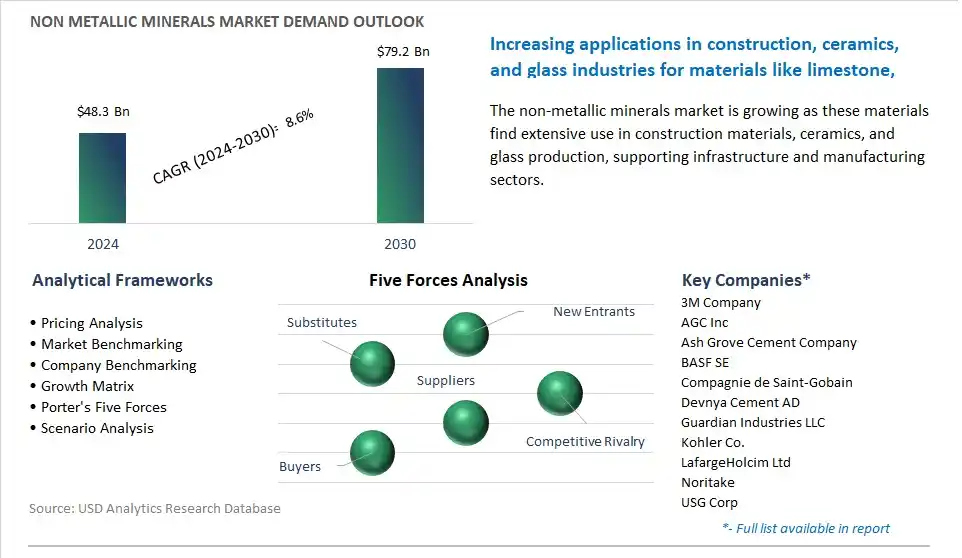
Non Metallic Minerals Market Competitive Landscape
The market report analyses the leading companies in the industry including 3M Company, AGC Inc, Ash Grove Cement Company, BASF SE, Compagnie de Saint-Gobain, Devnya Cement AD, Guardian Industries LLC, Kohler Co., LafargeHolcim Ltd, Noritake, USG Corp, Wienerberger AG, Xella Bulgaria AD.
Non Metallic Minerals Market Dynamics
Non Metallic Minerals Market Trend: Increasing Demand for Industrial Minerals in Infrastructure and Construction
A significant trend in the non-metallic minerals market is the increasing demand for industrial minerals in infrastructure and construction projects. Non-metallic minerals, including limestone, gypsum, and silica sand, are essential raw materials used in the construction of buildings, roads, bridges, and other infrastructure. With urbanization and population growth driving the need for new infrastructure and housing developments, there's a growing demand for non-metallic minerals for concrete, asphalt, and construction aggregates. This trend is fueled by government investments in infrastructure projects, urban development initiatives, and the expansion of transportation networks. As countries prioritize economic growth and sustainable development, the demand for non-metallic minerals in infrastructure and construction applications is expected to continue rising.
Non Metallic Minerals Market Driver: Growth in Manufacturing and Industrial Production
A major driver of the non-metallic minerals market is the growth in manufacturing and industrial production. Non-metallic minerals serve as essential inputs in various industries, including ceramics, glass, cement, and chemical manufacturing. These minerals are used in the production of ceramics for tiles and sanitaryware, glass for windows and packaging, cement for construction, and chemicals for industrial processes. The driver behind this demand is the expansion of manufacturing activities, consumer goods production, and industrial infrastructure development worldwide. As industries continue to expand and modernize, the demand for non-metallic minerals as raw materials for manufacturing processes is expected to increase. Moreover, technological advancements in material science and manufacturing techniques drive the development of new applications and products that require non-metallic minerals as key components.
Non Metallic Minerals Market Opportunity: Exploration of High-Value Specialty Minerals and Applications
An opportunity within the non-metallic minerals market lies in the exploration of high-value specialty minerals and applications. While industrial minerals such as limestone and silica sand are essential for construction and manufacturing, there's potential to identify and develop specialty minerals with unique properties and applications. Specialty minerals such as talc, graphite, and barite have specialized uses in industries such as cosmetics, electronics, and energy production. By investing in geological surveys, mineral exploration, and processing technologies, companies can discover new mineral deposits and extract high-value specialty minerals for niche markets. Moreover, there's an opportunity to innovate with value-added products and applications that leverage the unique properties of specialty minerals, such as flame retardants, lubricants, and conductive materials. By diversifying their product portfolios and targeting niche markets with specialty minerals, companies can unlock new revenue streams and differentiate themselves in the competitive non-metallic minerals market.
Non-Metallic Minerals Market Share Analysis: The Powder Form Segment generated the highest revenue in 2024
The Powder Form segment is the largest in the Non-Metallic Minerals Market, primarily due to its diverse range of applications and versatility. Powdered non-metallic minerals find extensive use across various industries, including construction, ceramics, paints and coatings, agriculture, and pharmaceuticals, among others. In the construction industry, powdered minerals such as limestone, gypsum, and silica are essential components in the production of cement, concrete, and plaster, vital for infrastructure development worldwide. Further, powdered minerals serve as key ingredients in the manufacturing of ceramics, providing strength, durability, and aesthetic appeal to tiles, pottery, and sanitaryware. Additionally, the paints and coatings industry heavily relies on powdered minerals as pigments, fillers, and extenders, enhancing the quality and performance of coatings while imparting color, opacity, and texture. Furthermore, powdered minerals play crucial roles in agriculture as soil amendments, fertilizers, and livestock feed supplements, contributing to improved crop yields and animal health. The widespread utilization of powdered non-metallic minerals across diverse sectors solidifies the Powder Form segment's position as the largest segment in the Non-Metallic Minerals Market, with sustained growth expected as industries continue to innovate and expand their applications.
Non-Metallic Minerals Market Share Analysis: The Construction segment is poised to register the fastest growth rate (CAGR) over the forecast period to 2030
The Construction segment is the fastest-growing segment in the Non-Metallic Minerals Market rapid urbanization and infrastructure development worldwide drive robust demand for non-metallic minerals in the construction sector. Minerals such as limestone, gypsum, and silica are essential ingredients in the production of cement, concrete, and aggregates, fundamental for building roads, bridges, residential, and commercial structures. Additionally, the growing emphasis on sustainable construction practices further accelerates the adoption of non-metallic minerals, as they offer eco-friendly alternatives to traditional building materials. Further, innovations in construction techniques and materials, such as high-performance concrete and lightweight aggregates, increase the versatility and utility of non-metallic minerals in construction applications. Furthermore, government initiatives aimed at improving infrastructure and housing facilities in emerging economies contribute to the segment's rapid growth. As the construction industry continues to expand globally, driven by population growth and urbanization trends, the demand for non-metallic minerals in construction applications is expected to experience sustained acceleration, solidifying the Construction segment as the fastest-growing segment in the Non-Metallic Minerals Market.
Non Metallic Minerals Market Report Segmentation
By Type
Powder Form
Liquid Form
By Application
Jewellery
Construction
Iron & Ore
Regions Included
North America (US, Canada, Mexico)
Europe (Germany, UK, France, Spain, Italy, Russia, Rest of Europe)
Asia Pacific (China, India, Japan, South Korea, Australia, South East Asia, Rest of Asia)
South America (Brazil, Argentina, Rest of South America)
Middle East and Africa (Saudi Arabia, UAE, Rest of Middle East, South Africa, Egypt, Rest of Africa)
Non Metallic Minerals Companies Profiled in the Market Study
3M Company
AGC Inc
Ash Grove Cement Company
BASF SE
Compagnie de Saint-Gobain
Devnya Cement AD
Guardian Industries LLC
Kohler Co.
LafargeHolcim Ltd
Noritake
USG Corp
Wienerberger AG
Xella Bulgaria AD
*- List Not Exhaustive
TABLE OF CONTENTS
1 Introduction to 2024 Non Metallic Minerals Market
1.1 Market Overview
1.2 Quick Facts
1.3 Scope/Objective of the Study
1.4 Market Definition
1.5 Countries and Regions Covered
1.6 Units, Currency, and Conversions
1.7 Industry Value Chain
2 Research Methodology
2.1 Market Size Estimation
2.2 Sources and Research Methodology
2.3 Data Triangulation
2.4 Assumptions and Limitations
3 Executive Summary
3.1 Global Non Metallic Minerals Market Size Outlook, $ Million, 2021 to 2030
3.2 Non Metallic Minerals Market Outlook by Type, $ Million, 2021 to 2030
3.3 Non Metallic Minerals Market Outlook by Product, $ Million, 2021 to 2030
3.4 Non Metallic Minerals Market Outlook by Application, $ Million, 2021 to 2030
3.5 Non Metallic Minerals Market Outlook by Key Countries, $ Million, 2021 to 2030
4 Market Dynamics
4.1 Key Driving Forces of Non Metallic Minerals Industry
4.2 Key Market Trends in Non Metallic Minerals Industry
4.3 Potential Opportunities in Non Metallic Minerals Industry
4.4 Key Challenges in Non Metallic Minerals Industry
5 Market Factor Analysis
5.1 Value Chain Analysis
5.2 Competitive Landscape
5.2.1 Global Non Metallic Minerals Market Share by Company (%), 2023
5.2.2 Product Offerings by Company
5.3 Porter’s Five Forces Analysis
5.4 Pricing Analysis and Outlook
6 Growth Outlook Across Scenarios
6.1 Growth Analysis-Case Scenario Definitions
6.2 Low Growth Scenario Forecasts
6.3 Reference Growth Scenario Forecasts
6.4 High Growth Scenario Forecasts
7 Global Non Metallic Minerals Market Outlook by Segments
7.1 Non Metallic Minerals Market Outlook by Segments, $ Million, 2021- 2030
By Type
Powder Form
Liquid Form
By Application
Jewellery
Construction
Iron & Ore
8 North America Non Metallic Minerals Market Analysis and Outlook To 2030
8.1 Introduction to North America Non Metallic Minerals Markets in 2024
8.2 North America Non Metallic Minerals Market Size Outlook by Country, 2021-2030
8.2.1 United States
8.2.2 Canada
8.2.3 Mexico
8.3 North America Non Metallic Minerals Market size Outlook by Segments, 2021-2030
By Type
Powder Form
Liquid Form
By Application
Jewellery
Construction
Iron & Ore
9 Europe Non Metallic Minerals Market Analysis and Outlook To 2030
9.1 Introduction to Europe Non Metallic Minerals Markets in 2024
9.2 Europe Non Metallic Minerals Market Size Outlook by Country, 2021-2030
9.2.1 Germany
9.2.2 France
9.2.3 Spain
9.2.4 United Kingdom
9.2.4 Italy
9.2.5 Russia
9.2.6 Norway
9.2.7 Rest of Europe
9.3 Europe Non Metallic Minerals Market Size Outlook by Segments, 2021-2030
By Type
Powder Form
Liquid Form
By Application
Jewellery
Construction
Iron & Ore
10 Asia Pacific Non Metallic Minerals Market Analysis and Outlook To 2030
10.1 Introduction to Asia Pacific Non Metallic Minerals Markets in 2024
10.2 Asia Pacific Non Metallic Minerals Market Size Outlook by Country, 2021-2030
10.2.1 China
10.2.2 India
10.2.3 Japan
10.2.4 South Korea
10.2.5 Indonesia
10.2.6 Malaysia
10.2.7 Australia
10.2.8 Rest of Asia Pacific
10.3 Asia Pacific Non Metallic Minerals Market size Outlook by Segments, 2021-2030
By Type
Powder Form
Liquid Form
By Application
Jewellery
Construction
Iron & Ore
11 South America Non Metallic Minerals Market Analysis and Outlook To 2030
11.1 Introduction to South America Non Metallic Minerals Markets in 2024
11.2 South America Non Metallic Minerals Market Size Outlook by Country, 2021-2030
11.2.1 Brazil
11.2.2 Argentina
11.2.3 Rest of South America
11.3 South America Non Metallic Minerals Market size Outlook by Segments, 2021-2030
By Type
Powder Form
Liquid Form
By Application
Jewellery
Construction
Iron & Ore
12 Middle East and Africa Non Metallic Minerals Market Analysis and Outlook To 2030
12.1 Introduction to Middle East and Africa Non Metallic Minerals Markets in 2024
12.2 Middle East and Africa Non Metallic Minerals Market Size Outlook by Country, 2021-2030
12.2.1 Saudi Arabia
12.2.2 UAE
12.2.3 Oman
12.2.4 Rest of Middle East
12.2.5 Egypt
12.2.6 Nigeria
12.2.7 South Africa
12.2.8 Rest of Africa
12.3 Middle East and Africa Non Metallic Minerals Market size Outlook by Segments, 2021-2030
By Type
Powder Form
Liquid Form
By Application
Jewellery
Construction
Iron & Ore
13 Company Profiles
13.1 Company Snapshot
13.2 SWOT Profiles
13.3 Products and Services
13.4 Recent Developments
13.5 Financial Profile
3M Company
AGC Inc
Ash Grove Cement Company
BASF SE
Compagnie de Saint-Gobain
Devnya Cement AD
Guardian Industries LLC
Kohler Co.
LafargeHolcim Ltd
Noritake
USG Corp
Wienerberger AG
Xella Bulgaria AD
14 Appendix
14.1 Customization Offerings
14.2 Subscription Services
14.3 Related Reports
14.4 Publisher Expertise
By Type
Powder Form
Liquid Form
By Application
Jewellery
Construction
Iron & Ore
Countries Analyzed
North America (US, Canada, Mexico)
Europe (Germany, UK, France, Spain, Italy, Russia, Rest of Europe)
Asia Pacific (China, India, Japan, South Korea, Australia, South East Asia, Rest of Asia)
South America (Brazil, Argentina, Rest of South America)
Middle East and Africa (Saudi Arabia, UAE, Rest of Middle East, South Africa, Egypt, Rest of Africa)
