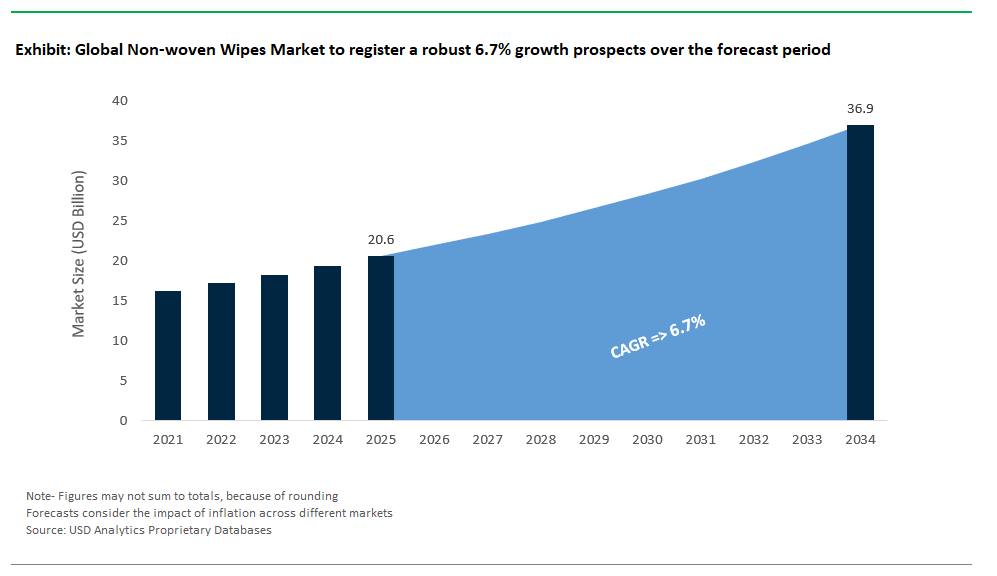
Recording a market revenue of $20.6 billion in 2025 and expected to rise to $35.73 billion by 2034, at a CAGR of 6.7%, the non-woven wipes market serves as a solid cornerstone for hygiene and convenience in today’s world, providing diverse applications across personal care, health and wellness, hygiene, industrial and home use. These core products, which are produced using spunbond fabrics, as well other non-traditional processes such as thermal, chemical, and mechanical bonding, are an absorbent material of outstanding strength and disposability. With scope being from wet wipes with skin care agents, to rugged dry wipes for industrial purposes, they encompass a wide variety of applications which are developed by the confluence if advancement of material science and the use of modern nonwoven processing technologies.
The market’s course is strongly influenced by a worldwide surge in hygiene awareness, a trend that has been heightened by recent public health crises casting a spotlight on infection control and sanitation. Higher demand: The rising use of single-use, disposables wipes for on-the-go applications and higher disposable incomes in emerging economies have contributed to continuous demand gain. Crucially, the non-woven wipes market is now being transformed again by a second generation of sustainable innovations: bio-based, bio-degradable, and flushable wipes that are increasingly being supported by regulators and green-minded consumers. Certainly not surprising is the constant push from manufacturers to strike the right balance between function, cost and sustainability as nonwovens wipes have grown into an essential product across personal care, healthcare, foodservice and household cleaning markets.
Non-Woven Wipes Market Analysis: Recent Innovations and Strategic Developments Propel Industry Evolution
In 2024 and 2025, the non-woven wipes market has significantly evolved with disruptive innovations, launches of sustainable products and capacity expansions setting new competitive dynamics. In May 2025, Aquapak grabbed the headlines by announcing the release of a marine-safe, water-soluble polymer, Hydropol, for flushable, microplastic-free wipes that would tackle the growing alarm about the environmental impact and the increased regulatory scrutiny on disposable hygiene products. Manufacturers are also taking advantage of the “waterless hygiene” trend, launching wipes that feature natural extracts, antibacterial properties and dermatologist-tested impulse for the personal care and household industries to fulfill increased consumer need for achieving the sanitation, on the go.
Sustainability is also on everyone’s minds, with companies like Favourite Fab leading the pack in promoting biodegradable non-woven fabrics suitable for everything from compostable packaging to reusable shopping bags. PlaniPlant and rapidly disintegrating substrates are climate investments across industry facilitating more sustainable innovations and better disposable wipes environmental footprints. Meanwhile, major non-woven producers have been incorporating more sophisticated cellulose, rayon, cotton and bamboo content to improve softness, absorbency and biodegradability, mainly with regard to the premium tier.
Both household-oriented and industrial products are being made to handle a plethora of innovative applications, many being developed along doctor blade and as well for the printing of nonwovens which are engineered to act as sailcloth-lake cloth in water purification systems. On the household front, companies such as the Soonercleaning have led the charge with professional-grade spunlace nonwovens developed for oil-absorbing kitchen wipes, pet-specific wet wipes, and lint-free glass cleaners. Key growth factors continue to be healthcare and industrial markets, which require disinfectant wipes with high absorbency, chemical compatibility and resistance to shedding in the performance of infection control, and surface cleaning. Flushability remains a concern with a number of manufacturers similarly aiming to satisfy the regulatory push to focus on “flushability” by continuing to produce wipes certified as having the ability to disintegrate quickly in waste water systems, while the baby wipes sector continues to be awash with new launches focused on natural, hypoallergenic and plastic free substrates.
Trends and Opportunities: Sustainability, Biodegradability, and Professional Hygiene Applications Shape the Non-Woven Wipes Market
Accelerating Shift Towards Sustainable and Biodegradable Wipes
The worldwide non-woven wipes market is in the midst of a radical transition, with sustainability and environmental regulations driving the country of choice and new product development. One of the biggest drivers has been the global backlash against plastic pollution in general and the release microplastics the traditional wipes have been causing for years, resulting in government intervention, bans and industry standards such as the EU Single-Use Plastics Directive. Consumers are getting conscious, with more than 66% on the lookout for making environmentally friendly choices, increasing the demand for the products which are labelled biodegradable, compostable or made of renewable fibres.
Towards this, industry giants are introducing products made with naturally derived plant fibres, bamboo and cotton and manufacturing water dispersible and certified ‘Fine to Flush’ wipes. Companies like Aquapak are also pioneering flushable, dissolvable polymers that leave no microplastic residue, and others are trying oil-based or instantaneously dissolvable wipes that have zero environmental footprint. The trend is driving record investment in R&D for sustainable fiber sourcing, hydroentangling processes and collaboration on innovation between raw material suppliers and converters.
Expanding Applications in Professional and Specialized Hygiene
Non-woven wipes are becoming more critical outside the consumer space, with significant penetration in healthcare, industrial and foodservice applications. The increased focus on infection prevention that has been spurred on by COVID-19 has solidified the value of disinfectant wipes within hospitals, clinics and long term care settings. These wipes, which are necessary not only to clean patient skin but to disinfect your equipment as well as keep your surfaces sterile. Foodservice establishments also need high-efficacy wipes for surface disinfection to protect food safety and meet regulatory requirements.
Industrial wipes are making strides as they be more effective in cleaning oils, greases, and delicate parts than rags, which can significantly improve productivity in nearly every sector from automotive assembly to electronics assembly. Within health care, surface decontamination protocols are now uniform nationally, requiring pre-impregnated non-woven wipes to reduce the risk of cross-contamination. This vital demand has resulted in a steady stream of innovation in terms of chemical compatibility, absorbency and mechanical strength, consolidating non-woven wipes place as the preferred weapon in mission-critical applications across the globe.
Competitive Landscape: Major Innovators and Specialized Leaders Define the Global Non-Woven Wipes Market
The global non-woven wipes market is shaped by the interplay of established consumer brands, innovative material suppliers, and specialized nonwovens manufacturers, each driving new standards for hygiene, convenience, and sustainability.
Kimberly-Clark Worldwide, Inc.: Leading Personal Hygiene Innovation
Kimberly-Clark remains a global giant in personal care, offering iconic non-woven wipe brands like Huggies®, Kleenex®, and Cottonelle®. The company is a pioneer in plastic-free and biodegradable baby wipes, investing in advanced material science to enhance softness and absorbency. With an expanding presence in emerging economies and strategic local partnerships, Kimberly-Clark maintains its dominance through continuous product innovation, a focus on sustainable solutions, and strong brand loyalty.
The Procter & Gamble Company: Diversified Solutions for Hygiene and Cleaning
Procter & Gamble commands a strong non-woven wipes portfolio, leveraging brands like Pampers® and Bounty®. The company is advancing skin-friendly baby wipes with natural, dermatologically tested ingredients, while also investing in next-generation fiber technologies for superior cleaning performance. P&G’s extensive global network, robust R&D, and emphasis on sustainability position it as a leader in the rapidly evolving wipes market.
Nice-Pak Products, Inc.: Pioneering Flushable and Functional Wet Wipes
Nice-Pak stands out for its vertically integrated manufacturing and focus on flushable, pre-moistened wet wipes that meet stringent international standards. The company’s Nice ‘N Clean moist toilet wipes, designed to break apart quickly, highlight its commitment to responsible disposability. With a comprehensive product line serving baby, household, and healthcare segments, Nice-Pak is recognized for innovation, safety, and convenience.
Reckitt Benckiser Group plc: Science-Driven Hygiene and Infection Control
Reckitt Benckiser is renowned for its disinfectant wipes through brands like Lysol® and Dettol®. The company continually innovates with advanced antimicrobial formulations, ensuring high efficacy against pathogens for both household and institutional use. Reckitt’s science-driven approach and strong global reach reinforce its leadership in hygiene, health, and ready-to-use disinfectant wipes.
Glatfelter Corporation: Engineered Nonwoven Substrates for Performance and Sustainability
Glatfelter is a leading global supplier of engineered nonwoven materials, providing specialty spunlace, airlaid, and wetlaid substrates to the world’s top wipe converters. While not a direct wipe producer, Glatfelter’s investments in plant-based and biodegradable fibers, as well as advanced substrate technologies, are pivotal in shaping next-generation wipes. Their expertise in fiber science and customization enables the development of wipes with superior softness, absorbency, and environmental responsibility.
Non-Woven Wipes Market Share Analysis: Key Segment Insights for 2025
Spunlace Technology Leads with Versatility; Spunbond and Meltblown Solutions Expand
Spunlace (hydroentangled) technology: This is the most widely used technology in the market making up 38% of the market in 2025, as it is the technology of choice for soft, strong and highly absorbent wipes, most commonly found in personal care applications like baby wipes, facial wipes and sensitive skincare products. Spunbond technology accounts for 22% of the market, is valued for its lightweight strength, and is the top technology in medical disposables, cleaning wipes and protective apparel. The mass appeal of meltblown as a choice for filtration and medical-grade wipes – in the wake of tightened hygiene protocols in a post-pandemic world - is clear. Airlaid is strong in high-bulk, absorbent household and industrial wipes, with needle-punched nonwovens key for dense and abrasion resistant wipes which are used for industrial and automotive cleaning. Other technologies such as wet-laid, thermal bonded and chemical bonded currently provide niche and specialty application substrates, and are still subject to R&D regarding more economical and sustainable alternatives.
Personal Care and Household Cleaning Drive End-Use Growth
Household Care manufacturers, the drive for increased use of high-quality and competitively priced specialty surfactants are driven by global trends towards convenience, greener, and sustainable household products. Personal care wipes dominate the applications, which held the market share of 45% and is primarily led by growing hygiene consciousness, convenience trends and increasing demand for baby wipes, facial wipes and feminine intimate wipes. Household cleaning wipes have grown dramatically post-pandemic, up 25 percent driven largely by disinfectant and multi-surface cleaning. Healthcare wipes are still enjoying the ripple effects of infection control standards in healthcare/clinical environments, and industrial wipes are propping up the stringent clean up and control requirements in manufacturing and maintenance. Foodservice wipes for on-site sanitization in food service facilities, and automotive wipes for specialized applications in service station and vehicle maintenance are included. The continued drive for greater levels of cleanliness and safety is also driving innovation in wipes for electronics, aerospace and other advanced applications.
China: The Manufacturing Epicenter for Non-Woven Wipes
China leads the world in the non-woven wipes industry with extensive production capacity and a huge local consumer base. The nation's investment in: high end nonwoven lines (they are building spunlace and meltblown lines) is ongoing and is aimed at satisfying both the country's domestic demand as well as international export needs. Infant and childwipes, personal care wipes, household cleaning wipes and industrial and medical wipes remain key growth areas, and the healthcare sector is growing as infrastructure and public health needs drive demand.
Chinese manufacturers regard cost-efficient products as that which must have a peaking performance and more and more to involving sustainability, in response to the changing environmental regulations. Automation, and a focus on efficiency of the materials, is increasingly on the agenda as local and international companies vie for market share. China's focus on developing higher value, responsible wipes makes it now the global leader, in both volume size and product innovation.
United States: Leading in Product Innovation and Regulatory Compliance
The United States is renowned for high-performance and specialized non-woven wipes, with industry giants like Kimberly-Clark, Nice-Pak, and Procter & Gamble investing in advanced hydroentangled and airlaid processes. Product innovation is a top priority, demonstrated by new launches such as PFAS-free compounds for safer, more sustainable wipes, especially in healthcare and household applications. The country’s regulatory landscape emphasizing chemical safety, flushability, and sustainability drives the development of wipes with improved safety profiles and environmental responsibility.
Continuous investment in manufacturing infrastructure, coupled with significant R&D in antimicrobial and disinfectant technologies, enables the U.S. to supply a wide range of personal care, cleaning, healthcare, and industrial wipes. Major players also focus on premiumization, convenience, and skin compatibility, ensuring the U.S. maintains its reputation for leadership in both quality and innovation.
Germany: Sustainable Nonwoven Leadership and Premium Applications
Germany stands out for technological excellence in nonwovens machinery and chemical innovation, leading the charge in biodegradable and compostable wipe materials. The country’s manufacturers are at the forefront of developing high-quality, eco-friendly wipes for healthcare, industrial cleaning, and specialized consumer applications. German firms work closely with EU policymakers to meet stringent regulations on chemical safety, plastic reduction, and waste management.
R&D is a central pillar of the German market, with investments in new substrates, flushable wipes, and high-performance products for hospitals, clinics, and industrial clients. These initiatives support a premium, environmentally compliant wipes market that aligns with European values on sustainability and performance, helping Germany maintain its position as a top exporter and technology leader.
India: Fast-Growing Consumer and Producer of Non-Woven Wipes
India’s non-woven wipes market is experiencing exponential growth, driven by rapid urbanization, rising hygiene awareness, and an expanding healthcare sector. Investments in modern nonwoven production lines and material technologies enable domestic companies to serve booming demand for baby wipes, facial wipes, and household cleaning products. The healthcare sector, in particular, is a focal point, as hospitals and clinics seek reliable, medical-grade non-woven wipes.
Government initiatives such as “Make in India” and public health campaigns are spurring both local production and consumption of hygiene products. As regulatory standards and consumer expectations evolve, there is a growing focus on quality, environmental impact, and modern formulations. India is fast becoming a major growth hub in Asia, attracting both local and international players seeking to tap into its large and dynamic market.
Japan: Precision-Engineered Wipes for Sensitive and High-Tech Markets
Japan’s non-woven wipes sector is renowned for high-quality manufacturing and a strong focus on specialized applications ranging from premium cosmetic and baby wipes to advanced industrial cleaning products. The country’s emphasis on softness, skin compatibility, and innovative formulations ensures leading-edge performance for discerning consumers. Japanese manufacturers are investing heavily in R&D, developing novel fiber structures and additive technologies that deliver unique tactile and functional properties.
Strict safety and quality regulations guide product development, while the market’s preference for premium and dermatologically tested wipes drives innovation in both materials and packaging. Japan’s reputation for excellence in high-performance and gentle wipes makes it a top destination for sensitive, value-added, and technologically advanced non-woven solutions.
United Kingdom: Sustainability-Driven Innovation and Environmental Standards
The UK is a European leader in sustainable, biodegradable, and plastic-free wipes, with both government and industry investing in R&D to comply with “Fine to Flush” and other environmental regulations. Companies focus on developing rapidly disintegrating and wastewater-compatible wipes, helping to combat fatbergs and microplastic pollution. The UK market sees strong demand for moist toilet wipes, baby wipes, and disinfectant cleaning wipes.
Regulatory frameworks and active government campaigns push manufacturers toward greener, more responsible materials, while consumer preferences continue to shift toward eco-friendly, plastic-free, and flushable solutions. The UK’s pioneering role in environmental responsibility and innovation is influencing market standards across Europe.
Brazil: Urbanization and Expanding Demand for Hygiene Products
Brazil’s growing middle class and urbanization trends are increasing demand for personal care and household cleaning wipes. The local market is experiencing significant growth in baby wipes, surface disinfectants, and industrial cleaning products. Investment in local nonwoven and converting capacity is allowing manufacturers to meet domestic demand with modern, cost-effective solutions.
Government efforts to expand access to modern hygiene products and consumer education around sanitation are key growth drivers. Brazilian manufacturers are gradually incorporating more sustainable practices, reflecting rising awareness of environmental impacts, while also focusing on affordability and product accessibility to cater to a wide range of consumers.
France: Premium, Eco-Friendly, and Dermatologically Tested Wipes
France’s non-woven wipes market is defined by high demand for premium cosmetic, baby, and facial cleansing wipes often developed with natural, eco-friendly ingredients. French manufacturers and brands are leaders in dermatological safety and environmental compliance, responding to EU frameworks that shape formulation and disposal practices. The strong tradition of skincare and personal care innovation drives continuous improvement in wipe performance, feel, and safety.
Technological advancements focus on developing wipes that balance efficacy, skin compatibility, and environmental sustainability. France’s market is at the forefront of premiumization, offering specialized, value-added wipes that align with European preferences for quality, health, and environmental stewardship.
Non-woven Wipes Market Report Scope
Non-woven Wipes Market
Parameter
Details
Market Size (2025)
$20.6 Billion
Market Size (2034)
$35.73 Billion
Market Growth Rate
6.7%
Segments
By Product Type (Dry Wipes, Wet Wipes (BaBy Wipes, Facial Wipes, Industrial Wipes, Household Wipes, Disinfectant Wipes, Moist Toilet Wipes, Feminine Hygiene Wipes, Medical Wipes, Others))
By Material (Polypropylene (PP), Polyester (PET), Cotton, Wood Pulp, Rayon/Viscose, Bamboo, Blends, Biodegradable Polymers)
By Technology (Spunlace/Hydroentangled, Meltblown, Spunbond, Needle-punched, Airlaid, Thermal Bonded, Chemical Bonded, Wet-laid)
By Application (Personal Care (BaBy Care, Facial & Cosmetic, Adult Incontinence, Feminine Hygiene, Bathing Wipes, Hand & Body Wipes), Household Cleaning (Surface Wipes, Floor Wipes, Glass Wipes, Kitchen Wipes, Bathroom Wipes), Industrial Cleaning (General Industrial Wipes, Critical Cleaning Wipes, Automotive Wipes, Aerospace Wipes), Healthcare (Medical Wipes for Patient Care, Disinfectant Wipes for Surfaces, Surgical Wipes), Foodservice, Automotive (Interior, Exterior), Other Applications
Study Period
2019- 2024 and 2025-2034
Units
Revenue (USD)
Qualitative Analysis
Porter’s Five Forces, SWOT Profile, Market Share, Scenario Forecasts, Market Ecosystem, Company Ranking, Market Dynamics, Industry Benchmarking
Companies
Kimberly-Clark Worldwide, Inc., The Procter & Gamble Company, Nice-Pak Products, Inc., Reckitt Benckiser Group plc, S. C. Johnson & Son, Inc., The Clorox Company, Glatfelter Corporation, Suominen Corporation, Berry Global Group, Inc., Essity Aktiebolag (publ), Johnson & Johnson, Unicharm Corporation, Contec, Inc., Freudenberg Group, Asahi Kasei Corporation
Countries
US, Canada, Mexico, Germany, France, Spain, Italy, UK, Russia, China, India, Japan, South Korea, Australia, South East Asia, Brazil, Argentina, Middle East, Africa
Healthcare (Medical Wipes for Patient Care, Disinfectant Wipes for Surfaces, Surgical Wipes)
Foodservice
Automotive (Interior, Exterior)
Other Applications
Countries Analyzed
North America (US, Canada, Mexico)
Europe (Germany, UK, France, Spain, Italy, Russia, Rest of Europe)
Asia Pacific (China, India, Japan, South Korea, Australia, South East Asia, Rest of Asia)
South America (Brazil, Argentina, Rest of South America)
Middle East and Africa (Saudi Arabia, UAE, Rest of Middle East, South Africa, Egypt, Rest of Africa)
Top Companies in Non-woven Wipes Market
Kimberly-Clark Worldwide, Inc.
The Procter & Gamble Company
Nice-Pak Products, Inc.
Reckitt Benckiser Group plc
S. C. Johnson & Son, Inc.
The Clorox Company
Glatfelter Corporation
Suominen Corporation
Berry Global Group, Inc.
Essity Aktiebolag (publ)
Johnson & Johnson
Unicharm Corporation
Contec, Inc.
Freudenberg Group
Asahi Kasei Corporation
* List Not Exhaustive
Research Coverage
This report from USDAnalytics dynamically investigates the global Non-Woven Wipes Market, presenting in-depth analysis reviews, industry breakthroughs, and key trends shaping technology, applications, and end-use sectors. It highlights product and material innovations, environmental and regulatory impacts, and the role of top manufacturers in driving the future of wipes worldwide. The report rigorously covers segmentation by product type, material, technology, and application, providing critical data from historic years (2021–2024) and actionable forecasts (2025–2034). Insights into competitive strategies and sustainable product development make this report an essential resource for manufacturers, converters, and industry stakeholders.
The non-woven wipes market is projected to soar from $20.6 billion in 2025 to $35.73 billion by 2034, with a CAGR of 6.7%. Growth is propelled by rising hygiene awareness, demand for convenience, and rapid innovation in materials and product functionality. Heightened focus on infection control and expanding uses in personal care, healthcare, and industrial applications further accelerate market expansion.
Sustainability is transforming the market, with brands launching bio-based, biodegradable, and flushable wipes to address environmental and regulatory concerns. Investments in plant-based fibers and rapidly disintegrating substrates are helping to reduce plastic pollution and support circular economy initiatives. Eco-friendly innovation has become central to product development and market differentiation.
Personal care wipes lead with 45% of market share, followed by household, healthcare, and industrial wipes. Spunlace (hydroentangled) technology holds the largest share for its versatility and softness, while spunbond and meltblown solutions are expanding in medical, cleaning, and filtration applications. Growing demand in foodservice, automotive, and electronics is driving further product diversification.
Key players include Kimberly-Clark, Procter & Gamble, Nice-Pak Products, Reckitt Benckiser, and Glatfelter, each leading in specialized segments such as baby wipes, disinfectant wipes, and engineered substrates. These companies drive market leadership through advanced material science, sustainability efforts, and a strong focus on safety and performance. Strategic innovation, regulatory compliance, and global reach underpin their competitive advantage.
China dominates as the largest producer and consumer, driven by vast manufacturing capacity and rising domestic demand. The United States excels in product innovation and regulatory standards, while Germany and Japan lead in premium, sustainable, and technologically advanced wipes. India, the UK, Brazil, and France are also experiencing rapid growth, driven by urbanization, consumer awareness, and sustainability initiatives.
More Equipment, Services and End-use Products Reports

.png)