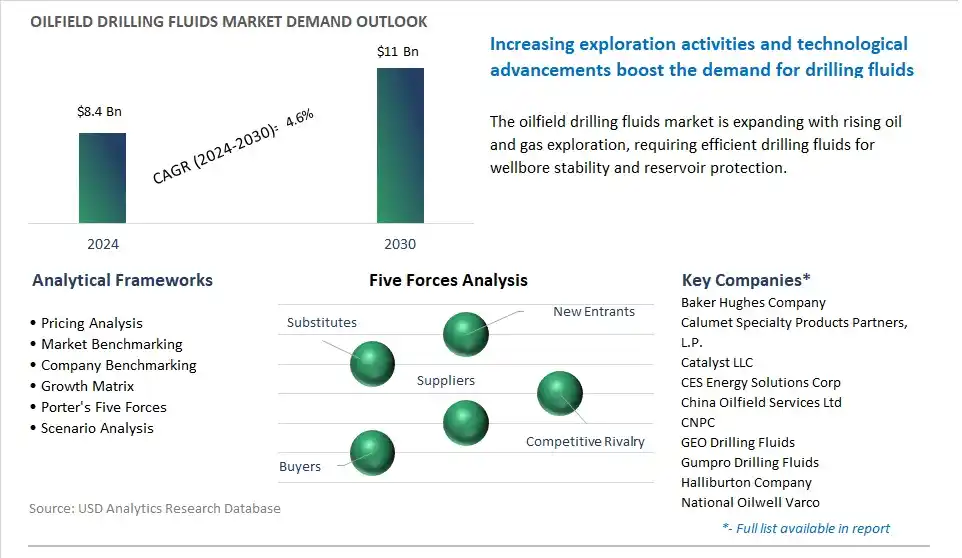
The global Oilfield Drilling Fluids Market is poised to register a 4.6% CAGR from $8.4 Billion in 2024 to $11 Billion in 2030.
The global Oilfield Drilling Fluids Market Study analyzes and forecasts the market size across 6 regions and 24 countries for diverse segments -By Type (Water-based Fluids, Oil-based Fluids, Synthetic-based Fluids, Others), By Application (Onshore, Offshore).
An Introduction to Global Oilfield Drilling Fluids Market in 2024
The future of oilfield drilling fluids is influenced by several key trends, including increasing demand for advanced drilling fluid technologies in exploration and production activities, advancements in fluid formulation and rheology control, and growing emphasis on drilling efficiency, reservoir protection, and environmental compliance in the oil and gas industry. Oilfield drilling fluids, also known as drilling muds, are complex fluid systems used to lubricate drill bits, remove cuttings, and maintain wellbore stability during drilling operations in oil and gas wells. With the rise of deepwater drilling, directional drilling, and unconventional reservoirs, there's a growing need for drilling fluids that offer superior performance in challenging downhole conditions such as high pressure, high temperature, and complex geology while minimizing environmental impact and operational risks. Moreover, advancements in drilling fluid chemistry, such as nano-additives, biodegradable polymers, and environmentally friendly additives, are driving the development of next-generation drilling fluid formulations with enhanced stability, fluid loss control, and wellbore integrity for improved drilling efficiency and reservoir productivity. Additionally, the integration of drilling fluid management technologies such as automated monitoring systems, real-time data analysis, and waste treatment solutions is enabling the optimization of drilling operations, cost reduction, and regulatory compliance in the oilfield industry. Collaboration between drilling fluid suppliers, oilfield service companies, research institutions, and regulatory agencies is essential to drive innovation, ensure fluid performance, and address market demands in the oilfield drilling fluids industry.
Oilfield Drilling Fluids Market Competitive Landscape
The market report analyses the leading companies in the industry including Baker Hughes Company, Calumet Specialty Products Partners, L.P., Catalyst LLC, CES Energy Solutions Corp, China Oilfield Services Ltd, CNPC, GEO Drilling Fluids, Gumpro Drilling Fluids, Halliburton Company, National Oilwell Varco, Newpark Resources Inc, QMax Solutions Inc, Schlumberger Ltd, Scomi Group, TETRA Technologies, The Lubrizol Corp.
Oilfield Drilling Fluids Market Dynamics
Oilfield Drilling Fluids Market Trend: Adoption of Environmentally Friendly and Sustainable Drilling Fluids
A significant trend in the oilfield drilling fluids market is the increasing adoption of environmentally friendly and sustainable drilling fluids. With growing concerns over environmental impact and regulatory pressures to reduce pollution from oil and gas operations, there's a rising demand for drilling fluids that minimize environmental footprint and promote sustainability. Environmentally friendly drilling fluids, also known as green or eco-friendly fluids, are formulated with biodegradable additives, low-toxicity chemicals, and renewable materials to reduce harm to ecosystems and groundwater. This trend is driven by industry initiatives to improve environmental stewardship, meet regulatory requirements, and enhance corporate sustainability practices. As oil and gas companies prioritize environmental responsibility in their operations, the demand for environmentally friendly drilling fluids is expected to continue growing.
Oilfield Drilling Fluids Market Driver: Increasing Exploration and Production Activities
A major driver of the oilfield drilling fluids market is the increasing exploration and production activities in the oil and gas industry. With global energy demand on the rise and conventional reserves becoming increasingly depleted, there's a growing need for exploration and production activities to access unconventional oil and gas resources such as shale formations, deepwater reservoirs, and heavy oil deposits. Drilling fluids play a crucial role in drilling operations by lubricating drill bits, carrying rock cuttings to the surface, and maintaining wellbore stability. The driver behind this demand is the expansion of drilling activities in both established and emerging oil and gas regions, driven by technological advancements, favorable market conditions, and geopolitical factors. As oilfield operators seek to maximize production and recoverable reserves, the demand for drilling fluids to support exploration and production activities is expected to remain strong.
Oilfield Drilling Fluids Market Opportunity: Development of Advanced Specialty Fluids and Additives
An opportunity within the oilfield drilling fluids market lies in the development of advanced specialty fluids and additives. With the increasing complexity of drilling operations and challenges posed by harsh drilling environments, there's a need for specialized drilling fluids that can address specific drilling challenges and improve operational efficiency. Opportunities exist for the development of high-performance fluids and additives that offer enhanced lubricity, thermal stability, shale inhibition, and filtration control in challenging drilling conditions such as high-pressure, high-temperature (HPHT) wells, extended reach drilling, and unconventional reservoirs. By investing in research and development, collaboration with technology partners, and customization of drilling fluid formulations, companies can capitalize on opportunities to provide value-added solutions that meet the evolving needs of oilfield operators. Additionally, there's an opportunity to integrate digital technologies such as real-time monitoring and data analytics into drilling fluid systems to optimize performance, reduce costs, and improve decision-making in drilling operations. Investing in innovation and technology-driven solutions offers an opportunity to differentiate and capture market share in the competitive oilfield drilling fluids market.
Oilfield Drilling Fluids Market Share Analysis: The Water-based Fluids Segment generated the highest revenue in 2024
The Water-based Fluids segment is the largest in the Oilfield Drilling Fluids Market, primarily due to its widespread adoption and numerous advantages over other types of drilling fluids. Water-based fluids are favored in the oilfield industry due to their cost-effectiveness, environmental friendliness, and versatility. These fluids are composed of water as the continuous phase, with additives such as clays, polymers, and emulsifiers to enhance their performance in various drilling applications. Water-based fluids offer excellent wellbore stability, lubrication, and cooling properties, making them suitable for drilling through different formations and geological conditions. Further, water-based fluids are non-toxic and biodegradable, minimizing environmental impact and regulatory concerns associated with drilling operations. Additionally, advancements in drilling fluid technologies have improved the rheological properties and filtration control of water-based fluids, further enhancing their suitability for challenging drilling environments. Furthermore, the abundance and accessibility of water as a base fluid contribute to the widespread use and dominance of water-based fluids in the Oilfield Drilling Fluids Market. As the oil and gas industry continues to prioritize safety, efficiency, and environmental sustainability, the demand for water-based fluids is expected to remain robust, solidifying their position as the largest segment in the market.
Oilfield Drilling Fluids Market Share Analysis: The Offshore segment is poised to register the fastest growth rate (CAGR) over the forecast period to 2030
The Offshore segment is the fastest-growing segment in the Oilfield Drilling Fluids Market Offshore drilling operations present unique challenges compared to onshore drilling, including harsher environmental conditions, deeper water depths, and greater logistical complexities. As offshore drilling activities continue to expand globally to access untapped reserves, there is a growing demand for advanced drilling fluids tailored to offshore environments. Offshore drilling often encounters challenging formations, high-pressure/high-temperature (HP/HT) conditions, and sensitive ecosystems, necessitating specialized drilling fluid formulations to ensure wellbore stability, reservoir protection, and environmental compliance. Further, offshore drilling projects require longer drilling times, deeper well depths, and higher drilling costs compared to onshore operations, driving the need for efficient and reliable drilling fluid solutions to maximize operational efficiency and mitigate risks. Additionally, advancements in drilling fluid technologies, such as low-toxicity additives, biodegradable formulations, and enhanced fluid properties, further support the growth of the Offshore segment by addressing environmental and regulatory concerns associated with offshore drilling activities. Furthermore, the increasing investments in offshore exploration and production projects, particularly in deepwater and ultra-deepwater regions, fuel the demand for specialized drilling fluids tailored to offshore applications, driving the rapid growth of the Offshore segment in the Oilfield Drilling Fluids Market. As offshore drilling activities continue to expand to meet global energy demands, the demand for advanced drilling fluid solutions optimized for offshore operations is expected to experience sustained acceleration, positioning the Offshore segment as a key driver of growth in the market.
Oilfield Drilling Fluids Market Report Segmentation
By Type
Water-based Fluids
Oil-based Fluids
Synthetic-based Fluids
Others
By Application
Onshore
Offshore
Regions Included
North America (US, Canada, Mexico)
Europe (Germany, UK, France, Spain, Italy, Russia, Rest of Europe)
Asia Pacific (China, India, Japan, South Korea, Australia, South East Asia, Rest of Asia)
South America (Brazil, Argentina, Rest of South America)
Middle East and Africa (Saudi Arabia, UAE, Rest of Middle East, South Africa, Egypt, Rest of Africa)
Oilfield Drilling Fluids Companies Profiled in the Market Study
Baker Hughes Company
Calumet Specialty Products Partners, L.P.
Catalyst LLC
CES Energy Solutions Corp
China Oilfield Services Ltd
CNPC
GEO Drilling Fluids
Gumpro Drilling Fluids
Halliburton Company
National Oilwell Varco
Newpark Resources Inc
QMax Solutions Inc
Schlumberger Ltd
Scomi Group
TETRA Technologies
The Lubrizol Corp
*- List Not Exhaustive
TABLE OF CONTENTS
1 Introduction to 2024 Oilfield Drilling Fluids Market
1.1 Market Overview
1.2 Quick Facts
1.3 Scope/Objective of the Study
1.4 Market Definition
1.5 Countries and Regions Covered
1.6 Units, Currency, and Conversions
1.7 Industry Value Chain
2 Research Methodology
2.1 Market Size Estimation
2.2 Sources and Research Methodology
2.3 Data Triangulation
2.4 Assumptions and Limitations
3 Executive Summary
3.1 Global Oilfield Drilling Fluids Market Size Outlook, $ Million, 2021 to 2030
3.2 Oilfield Drilling Fluids Market Outlook by Type, $ Million, 2021 to 2030
3.3 Oilfield Drilling Fluids Market Outlook by Product, $ Million, 2021 to 2030
3.4 Oilfield Drilling Fluids Market Outlook by Application, $ Million, 2021 to 2030
3.5 Oilfield Drilling Fluids Market Outlook by Key Countries, $ Million, 2021 to 2030
4 Market Dynamics
4.1 Key Driving Forces of Oilfield Drilling Fluids Industry
4.2 Key Market Trends in Oilfield Drilling Fluids Industry
4.3 Potential Opportunities in Oilfield Drilling Fluids Industry
4.4 Key Challenges in Oilfield Drilling Fluids Industry
5 Market Factor Analysis
5.1 Value Chain Analysis
5.2 Competitive Landscape
5.2.1 Global Oilfield Drilling Fluids Market Share by Company (%), 2023
5.2.2 Product Offerings by Company
5.3 Porter’s Five Forces Analysis
5.4 Pricing Analysis and Outlook
6 Growth Outlook Across Scenarios
6.1 Growth Analysis-Case Scenario Definitions
6.2 Low Growth Scenario Forecasts
6.3 Reference Growth Scenario Forecasts
6.4 High Growth Scenario Forecasts
7 Global Oilfield Drilling Fluids Market Outlook by Segments
7.1 Oilfield Drilling Fluids Market Outlook by Segments, $ Million, 2021- 2030
By Type
Water-based Fluids
Oil-based Fluids
Synthetic-based Fluids
Others
By Application
Onshore
Offshore
8 North America Oilfield Drilling Fluids Market Analysis and Outlook To 2030
8.1 Introduction to North America Oilfield Drilling Fluids Markets in 2024
8.2 North America Oilfield Drilling Fluids Market Size Outlook by Country, 2021-2030
8.2.1 United States
8.2.2 Canada
8.2.3 Mexico
8.3 North America Oilfield Drilling Fluids Market size Outlook by Segments, 2021-2030
By Type
Water-based Fluids
Oil-based Fluids
Synthetic-based Fluids
Others
By Application
Onshore
Offshore
9 Europe Oilfield Drilling Fluids Market Analysis and Outlook To 2030
9.1 Introduction to Europe Oilfield Drilling Fluids Markets in 2024
9.2 Europe Oilfield Drilling Fluids Market Size Outlook by Country, 2021-2030
9.2.1 Germany
9.2.2 France
9.2.3 Spain
9.2.4 United Kingdom
9.2.4 Italy
9.2.5 Russia
9.2.6 Norway
9.2.7 Rest of Europe
9.3 Europe Oilfield Drilling Fluids Market Size Outlook by Segments, 2021-2030
By Type
Water-based Fluids
Oil-based Fluids
Synthetic-based Fluids
Others
By Application
Onshore
Offshore
10 Asia Pacific Oilfield Drilling Fluids Market Analysis and Outlook To 2030
10.1 Introduction to Asia Pacific Oilfield Drilling Fluids Markets in 2024
10.2 Asia Pacific Oilfield Drilling Fluids Market Size Outlook by Country, 2021-2030
10.2.1 China
10.2.2 India
10.2.3 Japan
10.2.4 South Korea
10.2.5 Indonesia
10.2.6 Malaysia
10.2.7 Australia
10.2.8 Rest of Asia Pacific
10.3 Asia Pacific Oilfield Drilling Fluids Market size Outlook by Segments, 2021-2030
By Type
Water-based Fluids
Oil-based Fluids
Synthetic-based Fluids
Others
By Application
Onshore
Offshore
11 South America Oilfield Drilling Fluids Market Analysis and Outlook To 2030
11.1 Introduction to South America Oilfield Drilling Fluids Markets in 2024
11.2 South America Oilfield Drilling Fluids Market Size Outlook by Country, 2021-2030
11.2.1 Brazil
11.2.2 Argentina
11.2.3 Rest of South America
11.3 South America Oilfield Drilling Fluids Market size Outlook by Segments, 2021-2030
By Type
Water-based Fluids
Oil-based Fluids
Synthetic-based Fluids
Others
By Application
Onshore
Offshore
12 Middle East and Africa Oilfield Drilling Fluids Market Analysis and Outlook To 2030
12.1 Introduction to Middle East and Africa Oilfield Drilling Fluids Markets in 2024
12.2 Middle East and Africa Oilfield Drilling Fluids Market Size Outlook by Country, 2021-2030
12.2.1 Saudi Arabia
12.2.2 UAE
12.2.3 Oman
12.2.4 Rest of Middle East
12.2.5 Egypt
12.2.6 Nigeria
12.2.7 South Africa
12.2.8 Rest of Africa
12.3 Middle East and Africa Oilfield Drilling Fluids Market size Outlook by Segments, 2021-2030
By Type
Water-based Fluids
Oil-based Fluids
Synthetic-based Fluids
Others
By Application
Onshore
Offshore
13 Company Profiles
13.1 Company Snapshot
13.2 SWOT Profiles
13.3 Products and Services
13.4 Recent Developments
13.5 Financial Profile
Baker Hughes Company
Calumet Specialty Products Partners, L.P.
Catalyst LLC
CES Energy Solutions Corp
China Oilfield Services Ltd
CNPC
GEO Drilling Fluids
Gumpro Drilling Fluids
Halliburton Company
National Oilwell Varco
Newpark Resources Inc
QMax Solutions Inc
Schlumberger Ltd
Scomi Group
TETRA Technologies
The Lubrizol Corp
14 Appendix
14.1 Customization Offerings
14.2 Subscription Services
14.3 Related Reports
14.4 Publisher Expertise
By Type
Water-based Fluids
Oil-based Fluids
Synthetic-based Fluids
Others
By Application
Onshore
Offshore
Countries Analyzed
North America (US, Canada, Mexico)
Europe (Germany, UK, France, Spain, Italy, Russia, Rest of Europe)
Asia Pacific (China, India, Japan, South Korea, Australia, South East Asia, Rest of Asia)
South America (Brazil, Argentina, Rest of South America)
Middle East and Africa (Saudi Arabia, UAE, Rest of Middle East, South Africa, Egypt, Rest of Africa)
