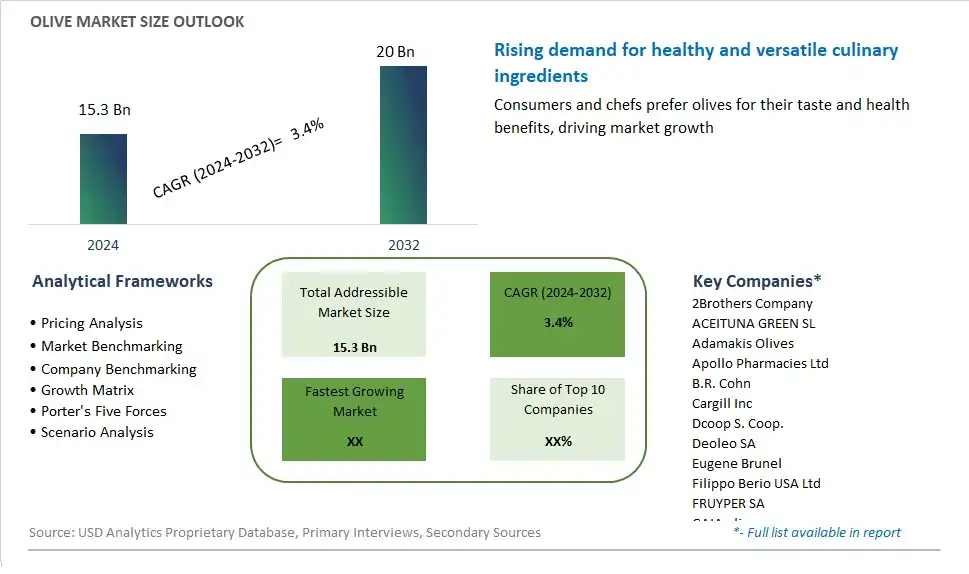
Global Olive Market Size is valued at $15.3 Billion in 2024 and is forecast to register a growth rate (CAGR) of 3.4% to reach $20 Billion by 2032.
The global Olive Market Comprehensive Study analyzes and forecasts the market size across 6 regions and 24 countries for diverse segments -By Application (Food and beverage, Pharmaceuticals, Others), By Distribution Channel (Offline, Online)
An Introduction to Olive Market
In 2024, the olive market continues to thrive as consumers embrace the Mediterranean diet and its associated health benefits, driving demand for olives and olive products worldwide. Olives are a versatile fruit harvested from the olive tree (Olea europaea), prized for their rich flavor, nutritional value, and culinary versatility. From table olives and olive oil to olive tapenade, spreads, and marinades, olives are used in a wide range of dishes, including salads, pasta, pizza, and mezze platters. With their distinctive taste, texture, and aroma, olives add depth and complexity to recipes while providing essential nutrients such as healthy fats, antioxidants, and vitamins. Moreover, olive oil, extracted from olives, is renowned for its potential health benefits, including cardiovascular health, anti-inflammatory properties, and skin nourishment, making it a staple in Mediterranean cuisine and natural skincare products. As consumer interest in healthy eating, gourmet cooking, and sustainable agriculture grows, expect to see continued innovation in the olive market, including new olive varieties, sustainable farming practices, and value-added olive products that cater to diverse tastes, preferences, and lifestyles, reflecting the enduring popularity and cultural significance of this ancient fruit.
Olive Competitive Landscape
The market report analyses the leading companies in the industry including 2Brothers Company, ACEITUNA GREEN SL, Adamakis Olives, Apollo Pharmacies Ltd, B.R. Cohn, Cargill Inc, Dcoop S. Coop., Deoleo SA, Eugene Brunel, Filippo Berio USA Ltd, FRUYPER SA, GAIA olives, Gallo, Grup Pons, MINERVA S.A, OLIVA OLIVA INTERNET SL, Olive line international SL, SCAMILLA OLIVES, and Others.
Olive Market Dynamics
Olive Market Trend: Increasing Adoption of Mediterranean Diet
A significant trend in the olive market is the increasing adoption of the Mediterranean diet worldwide. Olive products, including olive oil, table olives, and olive-based condiments, are integral components of the Mediterranean diet, which is renowned for its health benefits and association with longevity. As consumers become more health-conscious and seek out nutritious and flavorful dietary options, there's a growing interest in Mediterranean cuisine and the incorporation of olive products into daily meals. This trend is driven by the recognition of the Mediterranean diet as a heart-healthy eating pattern, supported by scientific research linking olive consumption to reduced risk of cardiovascular diseases, inflammation, and certain chronic conditions. Additionally, the promotion of Mediterranean cuisine by culinary influencers, health experts, and government agencies further fuels consumer interest in olive products as essential ingredients for a balanced and wholesome diet.
Market Driver: Health Benefits and Nutritional Value of Olives
A key driver for the olive market is the perceived health benefits and nutritional value of olives, which drive consumer demand for olive products as functional foods. Olives are rich in monounsaturated fats, antioxidants, vitamins, and minerals, making them a nutritious addition to the diet with potential health-promoting properties. This driver is reinforced by increasing consumer awareness of the role of dietary fats in overall health, as well as the importance of antioxidants in protecting against oxidative stress and chronic diseases. Moreover, olives are valued for their anti-inflammatory, immune-boosting, and digestive health benefits, contributing to their popularity as a staple ingredient in Mediterranean cuisine and a versatile ingredient in various culinary applications. As consumers seek out natural and minimally processed foods that offer both flavor and nutritional benefits, there's a growing demand for olive products as a healthy and flavorful alternative to conventional cooking oils and snacks.
Market Opportunity: Diversification of Olive Product Offerings and Varieties
An opportunity for the olive market lies in the diversification of product offerings and varieties to meet evolving consumer preferences and expand market reach. Companies can capitalize on this opportunity by introducing innovative olive-based products, such as flavored olive oils, infused olives, olive-based spreads, tapenades, and olive snacks, to cater to diverse taste preferences and culinary trends. Moreover, there's potential to highlight the unique characteristics and flavors of different olive varieties, including Kalamata, Manzanilla, Arbequina, and Hojiblanca, to appeal to discerning consumers interested in gourmet and artisanal food experiences. Additionally, there's an opportunity to explore niche market segments such as organic, premium, and single-origin olives, targeting consumers seeking high-quality, sustainably sourced products with authentic flavor profiles. By diversifying product offerings and varieties, companies can enhance their competitive edge, capture new market segments, and drive growth in the olive market.
Olive Market Share Analysis: Food and Beverage held the dominant market share in 2024
In the Olive Market segmented by application, the food and beverage sector is the largest segment, driven by several pivotal factors. Olives have been integral to culinary traditions worldwide for centuries, serving as a staple ingredient in various cuisines and food preparations. Their versatility allows for their use in a wide range of dishes, including salads, appetizers, pasta, and pizza, contributing to their widespread consumption in the food industry. Additionally, olives and olive-derived products such as olive oil are renowned for their health benefits, including being rich in monounsaturated fats and antioxidants, which further enhances their appeal among health-conscious consumers. Further, the growing popularity of Mediterranean and plant-based diets, coupled with the increasing demand for natural and authentic ingredients, has fueled the steady growth of the food and beverage segment in the olive market. As consumer preferences continue to emphasize wholesome and nutritious food choices, the dominance of the food and beverage sector is expected to persist, driving further expansion and innovation in the olive market.
Olive Market Share Analysis: Online Distribution market is poised to register the fastest growth rae over the forecast period to 2032
In the Olive Market segmented by distribution channel, the online segment is the fastest-growing, propelled by several key factors. The exponential growth of e-commerce platforms and the increasing preference for online shopping have revolutionized the way consumers purchase olive products. Online channels offer unparalleled convenience, allowing consumers to browse a wide selection of olives and olive-based products, compare prices, and make purchases from the comfort of their homes. Further, the COVID-19 pandemic has accelerated the shift towards online shopping as consumers prioritize safety and social distancing measures. Additionally, the accessibility of online channels eliminates geographical barriers, enabling consumers to access a diverse range of olive products from around the world. Furthermore, the digitalization of marketing and promotional efforts by olive producers and retailers, coupled with the seamless integration of online payment gateways and doorstep delivery services, further enhances the appeal of purchasing olives online. As consumer behavior continues to favor the convenience and flexibility offered by online shopping, the online distribution segment is poised to maintain its rapid growth trajectory, reshaping the future landscape of the olive market.
Olive Market Segmentation
By Application
Food and beverage
Pharmaceuticals
Others
By Distribution Channel
Offline
Online
Countries Analyzed
North America (US, Canada, Mexico)
Europe (Germany, UK, France, Spain, Italy, Russia, Rest of Europe)
Asia Pacific (China, India, Japan, South Korea, Australia, South East Asia, Rest of Asia)
South America (Brazil, Argentina, Rest of South America)
Middle East and Africa (Saudi Arabia, UAE, Rest of Middle East, South Africa, Egypt, Rest of Africa)
Olive Companies Profiled in the Study
2Brothers Company
ACEITUNA GREEN SL
Adamakis Olives
Apollo Pharmacies Ltd
B.R. Cohn
Cargill Inc
Dcoop S. Coop.
Deoleo SA
Eugene Brunel
Filippo Berio USA Ltd
FRUYPER SA
GAIA olives
Gallo
Grup Pons
MINERVA S.A
OLIVA OLIVA INTERNET SL
Olive line international SL
SCAMILLA OLIVES
*- List Not Exhaustive
Chapter 1. TABLE OF CONTENTS
Chapter 2. Introduction to Olive Market
2.1. Market Overview
2.2. Key Statistics and Report Highlights
2.3. Scope of the Comprehensive Study
2.3.1. Market Definition
2.3.2 Countries and Regions Covered
2.3.3 Research Objective
2.3.4 Units, Currency, and Conversions
2.3.5 Industry Value Chain
2.4. Key Market Segments
2.5. Key Companies
2.6. Study Period
Chapter 3. Strategic Analysis Review
3.1. Olive Pricing Analysis and Forecast
3.2. Porter’s Five Forces
3.3. Market Ecosystem
3.4. SWOT Analysis
3.5. Regulatory Scenario
3.3. Effects of Inflation, Russia-Ukraine War, moderating economic growth, and other macroeconomic factors
Chapter 4. Competitive Landscape
4.1. Market Share Analysis
4.1.1. Global Olive Market Share by Company, 2023
4.1.2. Product Offerings of Leading Olive Companies
4.2. Market Entropy
4.2.1. New Product Launches in the Industry
4.2.2. Mergers, Acquisitions, Joint ventures, and Partnerships
4.3. Key Strategies and Best Practices
Chapter 5. Global Market Projections: Best, Reference, and Low Case Scenarios
5.1. Growth Analysis- Case Scenario Definitions
5.2. Low Growth Case Scenario Forecasts
5.3. Reference Growth Case Scenario Forecasts
5.4. High Growth Case Scenario Forecasts
Chapter 6. Market Dynamics
6.1. Olive Market Drivers
6.2. Olive Market Challenges
6.6. Olive Market Opportunities
6.4. Olive Market Trends
Chapter 7. Global Olive Market Outlook Trends
7.1. Global Olive Revenue (USD Million) and CAGR (%) by Type (2021-2032)
7.2. Global Olive Revenue (USD Million) and CAGR (%) by Application (2021-2032)
7.3. Global Olive Revenue (USD Million) and CAGR (%) by Product (2021-2032)
By Application
Food and beverage
Pharmaceuticals
Others
By Distribution Channel
Offline
Online
Chapter 8. Global Olive Regional Analysis and Outlook
8.1. Global Olive Revenue (USD Million) By Regions (2021- 2032)
8.2. North America Olive Revenue (USD Million) by Country (2021-2032)
8.2.1. United States Olive Regional Analysis and Outlook
8.2.2. Canada Olive Regional Analysis and Outlook
8.2.3. Mexico Olive Regional Analysis and Outlook
8.3. Europe Olive Revenue (USD Million), by Country (2021-2032)
8.3.1. Germany Olive Regional Analysis and Outlook
8.3.2. France Olive Regional Analysis and Outlook
8.3.3. United Kingdom Olive Regional Analysis and Outlook
8.3.4. Spain Olive Regional Analysis and Outlook
8.3.5. Italy Olive Regional Analysis and Outlook
8.3.6. Russia Olive Regional Analysis and Outlook
8.3.7. Rest of Europe Olive Regional Analysis and Outlook
8.4. Asia Pacific Olive Revenue (USD Million) by Country (2021-2032)
8.4.1. China Olive Regional Analysis and Outlook
8.4.2. Japan Olive Regional Analysis and Outlook
8.4.3. India Olive Regional Analysis and Outlook
8.4.4. South Korea Olive Regional Analysis and Outlook
8.4.5. Australia Olive Regional Analysis and Outlook
8.4.6. South East Asia Olive Regional Analysis and Outlook
8.4.7. Rest of Asia Pacific Olive Regional Analysis and Outlook
8.5. South America Olive Revenue (USD Million), by Country (2021-2032)
8.5.1. Brazil Olive Regional Analysis and Outlook
8.5.2. Argentina Olive Regional Analysis and Outlook
8.5.3. Rest of South America Olive Regional Analysis and Outlook
8.6. Middle East and Africa Olive Revenue (USD Million) by Country (2021-2032)
8.6.1. Middle East Olive Regional Analysis and Outlook
8.6.2. Africa Olive Regional Analysis and Outlook
Chapter 9. North America Olive Analysis and Outlook
9.1. North America Olive Revenue (USD Million) by Segments (2021-2032)
9.1.1. North America Olive Revenue (USD Million) by Type (2021-2032)
9.1.2. North America Olive Revenue (USD Million) by Application (2021-2032)
9.1.3. North America Olive Revenue (USD Million) by Product (2021-2032)
By Application
Food and beverage
Pharmaceuticals
Others
By Distribution Channel
Offline
Online
Chapter 10. Europe Olive Analysis and Outlook
10.1. Europe Olive Revenue (USD Million), by Segments (USD Million) (2021-2032)
10.1.1. Europe Olive Revenue (USD Million) by Type (2021-2032)
10.1.2. Europe Olive Revenue (USD Million) by Application (2021-2032)
10.1.3. Europe Olive Revenue (USD Million) by Product (2021-2032)
By Application
Food and beverage
Pharmaceuticals
Others
By Distribution Channel
Offline
Online
Chapter 11. Asia Pacific Olive Analysis and Outlook
11.1. Asia Pacific Olive Revenue (USD Million), and Revenue (USD Million) by Segments (2021-2032)
11.1.1. Asia Pacific Olive Revenue (USD Million) by Type (2021-2032)
11.1.2. Asia Pacific Olive Revenue (USD Million) by Application (2021-2032)
11.1.3. Asia Pacific Olive Revenue (USD Million) by Product (2021-2032)
By Application
Food and beverage
Pharmaceuticals
Others
By Distribution Channel
Offline
Online
Chapter 12. South America Olive Analysis and Outlook
12.1. South America Olive Revenue (USD Million), by Segments (2021-2032)
12.1.1. South America Olive Revenue (USD Million) by Type (2021-2032)
12.1.2. South America Olive Revenue (USD Million) by Application (2021-2032)
12.1.3. South America Olive Revenue (USD Million) by Product (2021-2032)
By Application
Food and beverage
Pharmaceuticals
Others
By Distribution Channel
Offline
Online
Chapter 13. Middle East and Africa Olive Analysis and Outlook
13.1. Middle East and Africa Olive Revenue (USD Million), by Segments (2021-2032)
13.1.1. Middle East and Africa Olive Revenue (USD Million) by Type (2021-2032)
13.1.2. Middle East and Africa Olive Revenue (USD Million) by Application (2021-2032)
13.1.3. Middle East and Africa Olive Revenue (USD Million) by Product (2021-2032)
By Application
Food and beverage
Pharmaceuticals
Others
By Distribution Channel
Offline
Online
Chapter 14. Olive Company Profiles
14.1 Business Overview
14.2 Product Profiles
14.3 SWOT Profiles
14.5 Recent Developments
14.6 Financial Profile
List of Companies
2Brothers Company
ACEITUNA GREEN SL
Adamakis Olives
Apollo Pharmacies Ltd
B.R. Cohn
Cargill Inc
Dcoop S. Coop.
Deoleo SA
Eugene Brunel
Filippo Berio USA Ltd
FRUYPER SA
GAIA olives
Gallo
Grup Pons
MINERVA S.A
OLIVA OLIVA INTERNET SL
Olive line international SL
SCAMILLA OLIVES
15. Methodology and Data Sources
15.1 Customization Offerings
15.2 Subscription Services
15.3 Related Reports
15.4 Publisher Expertise
LIST OF TABLES
Table 1 Market Segmentation Analysis
Table 2 Global Olive Market Share of Leading Companies, 2023
Table 3 Product Offerings of Leading Companies
Table 4 Low Growth Scenario Forecasts
Table 5 Reference Case Growth Scenario
Table 6 High Growth Case Scenario
Table 7 Global Olive Revenue (USD Million) And CAGR (%) By Type (2021-2032)
Table 8 Global Olive Revenue (USD Million) And CAGR (%) By Application (2021-2032)
Table 9 Global Olive Revenue (USD Million) And CAGR (%) By Product (2021-2032)
Table 10 Global Olive Market Revenue (USD Million) By Regions (2021-2032)
Table 11 Global Olive Market Share (%) By Regions (2021-2032)
Table 12 North America Olive Revenue (USD Million) By Country (2021-2032)
Table 13 Europe Olive Revenue (USD Million) By Country (2021-2032)
Table 14 Asia Pacific Olive Revenue (USD Million) By Country (2021-2032)
Table 15 South America Olive Revenue (USD Million) By Country (2021-2032)
Table 16 Middle East and Africa Olive Revenue (USD Million) By Region (2021-2032)
Table 17 North America Olive Revenue (USD Million) By Type (2021-2032)
Table 18 North America Olive Revenue (USD Million) By Application (2021-2032)
Table 19 North America Olive Revenue (USD Million) By Product (2021-2032)
Table 20 Europe Olive Revenue (USD Million) By Type (2021-2032)
Table 21 Europe Olive Revenue (USD Million) By Application (2021-2032)
Table 22 Europe Olive Revenue (USD Million) By Product (2021-2032)
Table 23 Asia Pacific Olive Revenue (USD Million) By Type (2021-2032)
Table 24 Asia Pacific Olive Revenue (USD Million) By Application (2021-2032)
Table 25 Asia Pacific Olive Revenue (USD Million) By Product (2021-2032)
Table 26 South America Olive Revenue (USD Million) By Type (2021-2032)
Table 27 South America Olive Revenue (USD Million) By Application (2021-2032)
Table 28 South America Olive Revenue (USD Million) By Product (2021-2032)
Table 29 Middle East and Africa Olive Revenue (USD Million) By Type (2021-2032)
Table 30 Middle East and Africa Olive Revenue (USD Million) By Application (2021-2032)
Table 31 Middle East and Africa Olive Revenue (USD Million) By Product (2021-2032)
LIST OF FIGURES
Figure 1. Market Scope
Figure 2. Pricing Forecasts Per Unit, 2023- 2032
Figure 3. Porter’s Five Forces
Figure 4. Global Olive Market Revenue (USD Million) By Regions (2021-2032)
Figure 5. Global Olive Market Share (%) By Regions (2023)
Figure 6. North America Olive Revenue (USD Million) By Country (2021-2032)
Figure 7. United States Olive Revenue (USD Million) By Country (2021-2032)
Figure 8. Canada Olive Revenue (USD Million) By Country (2021-2032)
Figure 9. Mexico Olive Revenue (USD Million) By Country (2021-2032)
Figure 10. Europe Olive Revenue (USD Million) By Country (2021-2032)
Figure 11. Germany Olive Revenue (USD Million) By Country (2021-2032)
Figure 12. France Olive Revenue (USD Million) By Country (2021-2032)
Figure 13. United Kingdom Olive Revenue (USD Million) By Country (2021-2032)
Figure 14. Spain Olive Revenue (USD Million) By Country (2021-2032)
Figure 15. Italy Olive Revenue (USD Million) By Country (2021-2032)
Figure 16. Russia Olive Revenue (USD Million) By Country (2021-2032)
Figure 17. Rest of Europe Olive Revenue (USD Million) By Country (2021-2032)
Figure 11. Asia Pacific Olive Revenue (USD Million) By Country (2021-2032)
Figure 12. China Olive Revenue (USD Million) By Country (2021-2032)
Figure 13. Japan Olive Revenue (USD Million) By Country (2021-2032)
Figure 14. India Olive Revenue (USD Million) By Country (2021-2032)
Figure 15. South Korea Olive Revenue (USD Million) By Country (2021-2032)
Figure 16. Australia Olive Revenue (USD Million) By Country (2021-2032)
Figure 17. South East Asia Olive Revenue (USD Million) By Country (2021-2032)
Figure 18. South America Olive Revenue (USD Million) By Country (2021-2032)
Figure 19. Brazil Olive Revenue (USD Million) By Country (2021-2032)
Figure 20. Argentina Olive Revenue (USD Million) By Country (2021-2032)
Figure 21. Rest of Asia Pacific Olive Revenue (USD Million) By Country (2021-2032)
Figure 22. Middle East and Africa Olive Revenue (USD Million) By Region (2021-2032)
Figure 23. Saudi Arabia Olive Revenue (USD Million) By Region (2021-2032)
Figure 24. The UAE Olive Revenue (USD Million) By Region (2021-2032)
Figure 25. Rest of Middle East Olive Revenue (USD Million) By Region (2021-2032)
Figure 26. South Africa Olive Revenue (USD Million) By Region (2021-2032)
Figure 27. Africa Olive Revenue (USD Million) By Region (2021-2032)
Figure 28. North America Olive Revenue (USD Million) By Type (2021-2032)
Figure 29. North America Olive Revenue (USD Million) By Application (2021-2032)
Figure 30. North America Olive Revenue (USD Million) By Product (2021-2032)
Figure 31. Europe Olive Revenue (USD Million) By Type (2021-2032)
Figure 32. Europe Olive Revenue (USD Million) By Application (2021-2032)
Figure 33. Europe Olive Revenue (USD Million) By Product (2021-2032)
Figure 34. Asia Pacific Olive Revenue (USD Million) By Type (2021-2032)
Figure 35. Asia Pacific Olive Revenue (USD Million) By Application (2021-2032)
Figure 36. Asia Pacific Olive Revenue (USD Million) By Product (2021-2032)
Figure 37. South America Olive Revenue (USD Million) By Type (2021-2032)
Figure 38. South America Olive Revenue (USD Million) By Application (2021-2032)
Figure 39. South America Olive Revenue (USD Million) By Product (2021-2032)
Figure 40. Middle East and Africa Olive Revenue (USD Million) By Type (2021-2032)
Figure 41. Middle East and Africa Olive Revenue (USD Million) By Application (2021-2032)
Figure 42. Middle East and Africa Olive Revenue (USD Million) By Product (2021-2032)
By Application
Food and beverage
Pharmaceuticals
Others
By Distribution Channel
Offline
Online
Countries Analyzed
North America (US, Canada, Mexico)
Europe (Germany, UK, France, Spain, Italy, Russia, Rest of Europe)
Asia Pacific (China, India, Japan, South Korea, Australia, South East Asia, Rest of Asia)
South America (Brazil, Argentina, Rest of South America)
Middle East and Africa (Saudi Arabia, UAE, Rest of Middle East, South Africa, Egypt, Rest of Africa)
