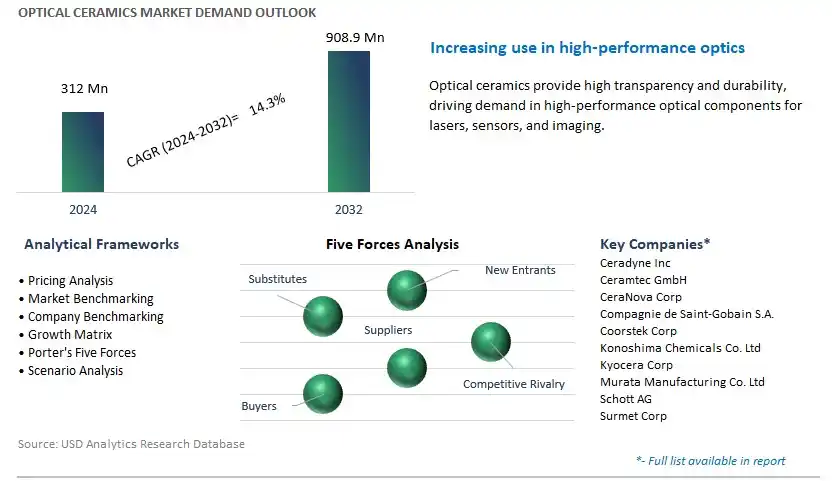
Global Optical Ceramics Market Size is valued at $312 Million in 2024 and is forecast to register a growth rate (CAGR) of 14.3% to reach $908.9 Million by 2032.
The global Optical Ceramics Market Study analyzes and forecasts the market size across 6 regions and 24 countries for diverse segments -By Material (Sapphire, Aluminum Oxynitride, Spinel, Yttrium Aluminum Garnet, Others), By End-User (Optics & optoelectronics, Aerospace, Security, Energy, Others).
An Introduction to Optical Ceramics Market in 2024
Optical ceramics are advanced materials engineered for optical applications such as lasers, sensors, lenses, and windows, where they offer superior optical properties, thermal stability, and mechanical strength compared to traditional optical materials. In 2024, the market for optical ceramics experiences steady growth as industries such as aerospace, defense, healthcare, and telecommunications demand high-performance optical components for critical applications. Optical ceramics are typically based on compounds such as alumina (Al2O3), zirconia (ZrO2), silicon carbide (SiC), and sapphire (Al2O3), which exhibit excellent transparency, hardness, and thermal conductivity. These ceramics are used in harsh environments where conventional optical glasses or polymers may degrade or fail, such as high-power laser systems, infrared imaging devices, and optical sensors for aerospace and defense applications. The demand for optical ceramics is driven by factors such as the increasing demand for precision optical systems in medical diagnostics and surgical procedures, the growth of lidar and autonomous vehicle technologies, and the expanding use of optical communication networks for high-speed data transmission. Market trends include the development of advanced ceramic processing techniques for improved optical quality and dimensional accuracy, the integration of nanotechnology for enhanced functionality and miniaturization, and the customization of ceramic compositions and formulations for specific optical requirements and end-user applications.
Optical Ceramics Market Competitive Landscape
The market report analyses the leading companies in the industry including Ceradyne Inc, Ceramtec GmbH, CeraNova Corp, Compagnie de Saint-Gobain S.A., Coorstek Corp, Konoshima Chemicals Co. Ltd, Kyocera Corp, Murata Manufacturing Co. Ltd, Schott AG, Surmet Corp, and others.
Optical Ceramics Market Dynamics
Market Trend: Increasing Demand for Optical Ceramics in High-Tech Applications
A prominent market trend in optical ceramics is the increasing demand for these advanced materials in high-tech applications across industries such as aerospace, defense, telecommunications, and medical devices. Optical ceramics, known for their exceptional optical properties, thermal stability, and durability, are used in a wide range of optical components and systems, including lenses, windows, laser optics, sensors, and semiconductors. With the rapid advancement of technology and the growing need for precision optics in cutting-edge applications such as space exploration, satellite communications, and medical imaging, there is a rising demand for optical ceramics that offer superior performance, reliability, and functionality. This trend towards high-tech applications drives the adoption of optical ceramics as critical components in advanced optical systems and devices, shaping the growth trajectory of the optical ceramics market.
Market Driver: Technological Advancements and Innovation in Optical Components
A key driver for the optical ceramics market is technological advancements and innovation in optical components and systems. As industries continue to push the boundaries of performance and functionality in optical devices, there is a growing demand for materials that can withstand extreme conditions, provide precise optical properties, and enable miniaturization and integration of optical systems. Optical ceramics, with their unique combination of optical clarity, thermal resistance, and mechanical strength, are increasingly favored over traditional optical materials such as glass and plastics for demanding applications where precision, reliability, and performance are paramount. The drive for technological innovation and product differentiation in the optics industry fuels the demand for optical ceramics as enabling materials for next-generation optical devices and systems.
Market Opportunity: Expansion into Emerging Markets and Applications
A significant market opportunity for optical ceramics lies in the expansion into emerging markets and applications beyond traditional aerospace and defense sectors. With advancements in manufacturing techniques and cost reduction efforts, there is a potential to explore and penetrate new markets such as consumer electronics, automotive LiDAR systems, virtual reality (VR) devices, and 3D sensing technologies. Optical ceramics offer advantages such as high transparency, thermal stability, and resistance to harsh environments, making them suitable for a wide range of emerging applications where optical performance and reliability are critical. By leveraging the opportunity presented by expanding into new markets and applications, suppliers of optical ceramics can diversify their customer base, capture new growth opportunities, and establish themselves as key players in the evolving landscape of high-tech optics.
Optical Ceramics Market Share Analysis: Sapphire segment generated the highest revenue in 2024
Sapphire is the largest segment in the optical ceramics market, primarily due to its exceptional properties and widespread applications. Known for its superior hardness, high thermal conductivity, and excellent optical transparency in a wide range of wavelengths, sapphire is a preferred material for various high-performance optical applications. Its durability and resistance to scratching and chemical etching make it ideal for use in demanding environments such as military, aerospace, and industrial settings. Additionally, sapphire's ability to withstand extreme temperatures without degradation further enhances its appeal for use in high-temperature optical systems and sensors. The growing demand for advanced optical components in sectors such as defense, electronics, and healthcare is driving the rapid growth of the sapphire segment. This expansion is supported by continuous advancements in manufacturing technologies, which are improving the cost-efficiency and scalability of sapphire production, thereby making it more accessible for a broader range of applications.
Optical Ceramics Market Share Analysis: Optics & Optoelectronics is poised to register the fastest CAGR over the forecast period
The fastest-growing segment in the optical ceramics market is the Optics & Optoelectronics sector. This rapid growth is driven by the increasing demand for high-performance optical components in consumer electronics, telecommunications, and advanced imaging systems. The proliferation of smartphones, tablets, and other portable electronic devices requires high-quality camera lenses and sensors, which in turn fuels the demand for optical ceramics due to their superior transparency and durability. Additionally, the advent of 5G technology and the growing adoption of fiber optic communications necessitate advanced optoelectronic components that can withstand high data transmission speeds and environmental stresses. Innovations in optoelectronic applications, such as LiDAR systems for autonomous vehicles and advanced medical imaging technologies, further bolster the market's expansion. The continuous improvement in optical ceramic materials, such as better light transmission properties and enhanced manufacturing techniques, makes them increasingly attractive for these high-tech applications. Consequently, the Optics & Optoelectronics segment is experiencing significant growth, driven by both technological advancements and the rising demand for sophisticated optical solutions across various industries.
Optical Ceramics Market
By Material
Sapphire
Aluminum Oxynitride
Spinel
Yttrium Aluminum Garnet
Others
By End-User
Optics & optoelectronics
Aerospace
Security
Energy
Others
Countries Analyzed
North America (US, Canada, Mexico)
Europe (Germany, UK, France, Spain, Italy, Russia, Rest of Europe)
Asia Pacific (China, India, Japan, South Korea, Australia, South East Asia, Rest of Asia)
South America (Brazil, Argentina, Rest of South America)
Middle East and Africa (Saudi Arabia, UAE, Rest of Middle East, South Africa, Egypt, Rest of Africa)
Optical Ceramics Companies Profiled in the Study
Ceradyne Inc
Ceramtec GmbH
CeraNova Corp
Compagnie de Saint-Gobain S.A.
Coorstek Corp
Konoshima Chemicals Co. Ltd
Kyocera Corp
Murata Manufacturing Co. Ltd
Schott AG
Surmet Corp
*- List Not Exhaustive
TABLE OF CONTENTS
1 Introduction to 2024 Optical Ceramics Market
1.1 Market Overview
1.2 Quick Facts
1.3 Scope/Objective of the Study
1.4 Market Definition
1.5 Countries and Regions Covered
1.6 Units, Currency, and Conversions
1.7 Industry Value Chain
2 Research Methodology
2.1 Market Size Estimation
2.2 Sources and Research Methodology
2.3 Data Triangulation
2.4 Assumptions and Limitations
3 Executive Summary
3.1 Global Optical Ceramics Market Size Outlook, $ Million, 2021 to 2032
3.2 Optical Ceramics Market Outlook by Type, $ Million, 2021 to 2032
3.3 Optical Ceramics Market Outlook by Product, $ Million, 2021 to 2032
3.4 Optical Ceramics Market Outlook by Application, $ Million, 2021 to 2032
3.5 Optical Ceramics Market Outlook by Key Countries, $ Million, 2021 to 2032
4 Market Dynamics
4.1 Key Driving Forces of Optical Ceramics Industry
4.2 Key Market Trends in Optical Ceramics Industry
4.3 Potential Opportunities in Optical Ceramics Industry
4.4 Key Challenges in Optical Ceramics Industry
5 Market Factor Analysis
5.1 Value Chain Analysis
5.2 Competitive Landscape
5.2.1 Global Optical Ceramics Market Share by Company (%), 2023
5.2.2 Product Offerings by Company
5.3 Porter’s Five Forces Analysis
5.4 Pricing Analysis and Outlook
6 Growth Outlook Across Scenarios
6.1 Growth Analysis-Case Scenario Definitions
6.2 Low Growth Scenario Forecasts
6.3 Reference Growth Scenario Forecasts
6.4 High Growth Scenario Forecasts
7 Global Optical Ceramics Market Outlook by Segments
7.1 Optical Ceramics Market Outlook by Segments, $ Million, 2021- 2032
By Material
Sapphire
Aluminum Oxynitride
Spinel
Yttrium Aluminum Garnet
Others
By End-User
Optics & optoelectronics
Aerospace
Security
Energy
Others
8 North America Optical Ceramics Market Analysis and Outlook To 2032
8.1 Introduction to North America Optical Ceramics Markets in 2024
8.2 North America Optical Ceramics Market Size Outlook by Country, 2021-2032
8.2.1 United States
8.2.2 Canada
8.2.3 Mexico
8.3 North America Optical Ceramics Market size Outlook by Segments, 2021-2032
By Material
Sapphire
Aluminum Oxynitride
Spinel
Yttrium Aluminum Garnet
Others
By End-User
Optics & optoelectronics
Aerospace
Security
Energy
Others
9 Europe Optical Ceramics Market Analysis and Outlook To 2032
9.1 Introduction to Europe Optical Ceramics Markets in 2024
9.2 Europe Optical Ceramics Market Size Outlook by Country, 2021-2032
9.2.1 Germany
9.2.2 France
9.2.3 Spain
9.2.4 United Kingdom
9.2.4 Italy
9.2.5 Russia
9.2.6 Norway
9.2.7 Rest of Europe
9.3 Europe Optical Ceramics Market Size Outlook by Segments, 2021-2032
By Material
Sapphire
Aluminum Oxynitride
Spinel
Yttrium Aluminum Garnet
Others
By End-User
Optics & optoelectronics
Aerospace
Security
Energy
Others
10 Asia Pacific Optical Ceramics Market Analysis and Outlook To 2032
10.1 Introduction to Asia Pacific Optical Ceramics Markets in 2024
10.2 Asia Pacific Optical Ceramics Market Size Outlook by Country, 2021-2032
10.2.1 China
10.2.2 India
10.2.3 Japan
10.2.4 South Korea
10.2.5 Indonesia
10.2.6 Malaysia
10.2.7 Australia
10.2.8 Rest of Asia Pacific
10.3 Asia Pacific Optical Ceramics Market size Outlook by Segments, 2021-2032
By Material
Sapphire
Aluminum Oxynitride
Spinel
Yttrium Aluminum Garnet
Others
By End-User
Optics & optoelectronics
Aerospace
Security
Energy
Others
11 South America Optical Ceramics Market Analysis and Outlook To 2032
11.1 Introduction to South America Optical Ceramics Markets in 2024
11.2 South America Optical Ceramics Market Size Outlook by Country, 2021-2032
11.2.1 Brazil
11.2.2 Argentina
11.2.3 Rest of South America
11.3 South America Optical Ceramics Market size Outlook by Segments, 2021-2032
By Material
Sapphire
Aluminum Oxynitride
Spinel
Yttrium Aluminum Garnet
Others
By End-User
Optics & optoelectronics
Aerospace
Security
Energy
Others
12 Middle East and Africa Optical Ceramics Market Analysis and Outlook To 2032
12.1 Introduction to Middle East and Africa Optical Ceramics Markets in 2024
12.2 Middle East and Africa Optical Ceramics Market Size Outlook by Country, 2021-2032
12.2.1 Saudi Arabia
12.2.2 UAE
12.2.3 Oman
12.2.4 Rest of Middle East
12.2.5 Egypt
12.2.6 Nigeria
12.2.7 South Africa
12.2.8 Rest of Africa
12.3 Middle East and Africa Optical Ceramics Market size Outlook by Segments, 2021-2032
By Material
Sapphire
Aluminum Oxynitride
Spinel
Yttrium Aluminum Garnet
Others
By End-User
Optics & optoelectronics
Aerospace
Security
Energy
Others
13 Company Profiles
13.1 Company Snapshot
13.2 SWOT Profiles
13.3 Products and Services
13.4 Recent Developments
13.5 Financial Profile
Ceradyne Inc
Ceramtec GmbH
CeraNova Corp
Compagnie de Saint-Gobain S.A.
Coorstek Corp
Konoshima Chemicals Co. Ltd
Kyocera Corp
Murata Manufacturing Co. Ltd
Schott AG
Surmet Corp
14 Appendix
14.1 Customization Offerings
14.2 Subscription Services
14.3 Related Reports
14.4 Publisher Expertise
By Material
Sapphire
Aluminum Oxynitride
Spinel
Yttrium Aluminum Garnet
Others
By End-User
Optics & optoelectronics
Aerospace
Security
Energy
Others
Countries Analyzed
North America (US, Canada, Mexico)
Europe (Germany, UK, France, Spain, Italy, Russia, Rest of Europe)
Asia Pacific (China, India, Japan, South Korea, Australia, South East Asia, Rest of Asia)
South America (Brazil, Argentina, Rest of South America)
Middle East and Africa (Saudi Arabia, UAE, Rest of Middle East, South Africa, Egypt, Rest of Africa)
