Packaging Nets Market Poised to Reach $2.1 Billion by 2034 with 4.8% CAGR Driven by Sustainable and Breathable Solutions
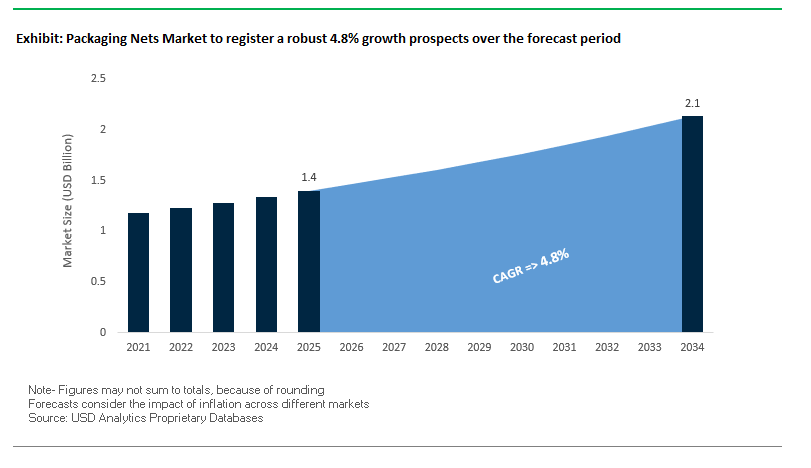
The Global Packaging Nets Market is projected to grow from $1.4 billion in 2025 to $2.1 billion by 2034, at a CAGR of 4.8%, reflecting the growing importance of breathable, flexible, and eco-friendly packaging solutions. Packaging nets play a vital role in preserving freshness, enhancing product visibility, and providing cost-effective containment, particularly in agriculture, fresh produce, and consumer goods. The industry is increasingly defined by sustainability, innovation, and versatility, with a focus on reducing plastic usage and improving product presentation.
Key Insights for Industry Professionals:
Breathable Packaging for Fresh Produce: Nets allow air circulation, extending shelf life, reducing spoilage, and minimizing food waste for products like onions, citrus, and potatoes.
Shift Toward Sustainable Materials: Biodegradable, compostable, and recyclable nets made from corn starch, paper fibers, and other eco-friendly materials are replacing conventional plastics.
Enhanced Retail Appeal: Finer mesh designs, color variety, and resealable closures increase product visibility and consumer attraction in retail displays.
Versatility Across Industries: Beyond food, nets are used in toys, household goods, firewood, and shellfish packaging, highlighting their adaptability and durability.
Innovation in Functionality: Companies are integrating advanced perforations, flexible shapes, and automated packaging solutions to improve efficiency and consumer experience.
The market is well-positioned for growth as manufacturers focus on sustainable, high-performance packaging nets that balance durability, visibility, and environmental responsibility.
Strategic Investments and Sustainability Initiatives Driving Packaging Nets Market Expansion
The Packaging Nets Industry has seen significant strategic moves emphasizing sustainability, advanced manufacturing, and market consolidation. In August 2025, Amcor upgraded its UK recycling facility, enhancing recycling capabilities for diverse packaging materials. In July 2025, Crown Holdings’ net-zero targets for 2050 were validated by SBTi, reinforcing its commitment to reducing greenhouse gas emissions across the supply chain.
In June 2025, Pregis published its 2024 Sustainability Report, highlighting progress in circular product innovation and emissions accountability, while GaeaStar expanded to over 200 locations, responding to rising demand for premium, plastic-free solutions. May 2025 saw Pregis expanding its curbside-recyclable paper packaging portfolio with White EasyPack GeoTerra for protective and sustainable applications.
Other notable developments include Ring Container Technologies’ April 2025 Sustainability Report, demonstrating ESG commitment, and Dynamic Dies’ March 2025 facility expansion in Indianapolis, enhancing manufacturing capacity for packaging dies. Earthfirst® Films launched compostable laminations in November 2024, signaling growing adoption of bio-materials.
Trends and Opportunities Shaping the Packaging Nets Market
Regulatory Phase-Out of Conventional Plastics Driving Adoption of Bio-Based Nets
The packaging nets market is undergoing a significant transition as regulatory pressure accelerates the phase-out of conventional plastics. The EU Single-Use Plastics Directive (SUPD), combined with national-level legislation, is creating a decisive shift away from hard-to-recycle plastic nets toward bio-based and compostable alternatives. Countries such as Spain and France have already implemented bans on plastic packaging for fresh produce, directly reducing demand for traditional polyethylene nets and forcing retailers to adopt cellulose and compostable solutions.
This regulatory shift is fueling commercialization of sustainable products like VPZ Verpackungszentrum’s Packnatur® Cellulose Tube Netting, made from beechwood cellulose and certified home-compostable. The use of such alternatives is being reinforced by evolving global standards, including EN 13432 (EU) and ASTM D6400 (U.S.), which provide brands with certification frameworks that reassure consumers and prevent greenwashing. As a result, compostable and bio-based nets are no longer niche but rapidly becoming mainstream, particularly in fresh produce supply chains where consumer scrutiny and government oversight are highest.
Shift Towards Precision-Engineered, Lightweighted Nets for Resource Reduction
Another defining trend in the packaging nets industry is the shift to lightweighted, precision-engineered designs that reduce raw material use and optimize logistics efficiency. Lightweighting helps companies cut transportation emissions and costs by enabling more units per pallet and truck, a crucial driver in today’s carbon-conscious and cost-sensitive supply chains.
Advancements in extrusion and weaving technologies are enabling manufacturers to develop nets with superior tensile strength and knot stability, ensuring product protection even with reduced material usage. Studies highlight that optimized polymer structures can make nets lighter, stronger, and more tear-resistant, reducing both environmental footprint and operational expenses. This shift reflects a dual market demand: eco-efficient materials that maintain durability, making lightweight nets an essential component of future-proofed packaging strategies.
Development of High-Performance Home-Compostable Netting from Novel Polymers
A major growth opportunity lies in the commercialization of advanced home-compostable nets that can degrade in backyard composting environments, not just in industrial facilities. Current R&D is focused on PLA/PHA biopolymer blends, which improve toughness, impact strength, and low-temperature degradability compared to pure PLA. Academic findings show that such blends can overcome brittleness, making them suitable for high-performance supply chain applications.
Industry players are scaling up production, with NUREL’s INZEA biopolymers offering a renewable and compostable substitute for polyethylene nets. At the same time, mechanical enhancements are ensuring these nets meet the strength and elongation requirements for transporting produce without damage. By combining waste-to-value feedstocks, such as agricultural residues, with advanced polymer science, this segment has the potential to replace conventional plastic nets at scale while addressing end-of-life challenges that are top of mind for regulators and consumers.
Integration of RFID and Smart Traceability Tags into Net Structures
The integration of RFID, NFC, and digital traceability features into packaging nets represents a transformative opportunity for the industry. By embedding smart tags into netting materials, brands can enable farm-to-retail visibility, optimize inventory management, and reduce food waste through more accurate shelf-life monitoring. Pilot projects have shown that RFID-enabled produce supply chains can cut waste by up to 20%, proving both sustainability and financial benefits.
Beyond efficiency, smart nets enhance brand protection and consumer trust. Counterfeit prevention is particularly relevant for premium and organic produce, with blockchain-enabled traceability allowing end-users to verify authenticity with a quick scan. On the retail side, RFID-enabled nets streamline inventory counts and bulk checkout processes, reducing labor costs and improving customer convenience.
Leading Packaging Nets Companies Driving Innovation, Sustainability, and Market Growth
The Packaging Nets Market is driven by key global players leveraging materials expertise, sustainable innovation, and automation to provide high-quality, versatile packaging solutions across agricultural, consumer, and industrial segments.
Grup Giró: Pioneering End-to-End Sustainable Netting Solutions for Fresh Produce
Grup Giró is a leader in mesh packaging for fruits and vegetables, offering vertically integrated solutions from net production to automated packaging machinery. The company focuses on plastic-free and biodegradable nets, with innovations such as laser perforations and resealable closures enhancing both functionality and retail appeal. Its portfolio includes extruded and knitted nets, bags, and GirBagger/GiróPack machines, supporting efficiency and sustainability across the supply chain.
Intermas Nets S.A.: Expanding Recycled and Specialized Nets for Global Packaging Applications
Intermas Nets specializes in extruded plastic nets for packaging, agriculture, and construction. With strong R&D capabilities, the company develops customized, high-performance nets, increasingly using recycled materials. Its offerings include tubular and flat nets suitable for fruits, vegetables, and protective consumer packaging. Intermas focuses on innovation and sustainability, contributing to a circular economy while meeting global customer demands.
SWM International: Engineering High-Performance Nets for Industrial, Medical, and Food Applications
SWM International excels in materials science, producing engineered nets for food packaging, industrial, and medical applications. The company invests in manufacturing efficiency and global expansion, offering extruded nets with superior durability and strength. SWM emphasizes innovation and continuous process improvement, addressing evolving market needs for reliable and high-performance packaging nets.
KM Packaging Services Ltd.: Leading the Transition to Compostable and Eco-Friendly Net Packaging
KM Packaging provides flexible, compostable, and bio-plastic nets, including the C-NET industrially compostable range. The company integrates sustainability and regulatory guidance, helping customers comply with Extended Producer Responsibility (EPR) regulations. Its portfolio includes films, pouches, and nets, supporting industries from food to consumer goods. KM Packaging’s strategy focuses on eco-friendly innovation and high-quality performance.
Packaging Nets Market Share Insights, 2025-2034
Extruded Nets Dominate Market Share by Product Type in the Packaging Nets Industry
Extruded nets represent an overwhelming 85% share of the packaging nets market, cementing their dominance due to cost-effectiveness, durability, and versatility in large-scale applications. Produced primarily from polyethylene (PE) and polypropylene (PP), these nets are engineered in a wide variety of mesh sizes, strengths, and colors, enabling them to serve diverse packaging needs. Their lightweight yet robust structure makes them the default choice for fresh produce packaging, particularly onions, citrus fruits, potatoes, and melons, where breathability is critical to extending shelf-life. The extrusion process ensures high-volume, continuous production at low cost, making extruded nets the economic standard in the industry. By contrast, knitted nets maintain a smaller, niche role, favored for specialty applications that require softness, stretchability, and abrasion resistance—such as delicate fruits, horticultural items, or non-food products. However, the segment’s future trajectory is heavily influenced by sustainability imperatives, with a surge in development of bio-based and compostable alternatives like PLA-based extruded nets aimed at replacing conventional plastics.
Food Industry Overwhelmingly Leads Market Share by Application in Packaging Nets
The food industry accounts for 92% of demand in the packaging nets market, underscoring the sector’s reliance on netting to preserve freshness and reduce post-harvest losses. These nets are indispensable in packaging fruits, vegetables, and specialty food products, where the open mesh structure allows continuous air circulation to manage respiration and minimize moisture buildup. This is particularly critical for perishables such as onions, citrus, and mushrooms, where improper packaging can result in rapid spoilage. The segment’s dominance is further amplified by supermarket and retailer requirements for lightweight, visually transparent, and low-cost packaging that ensures visibility of product quality at the point of sale. While non-food applications—including industrial goods, toys, construction materials, and horticulture—exist, they remain small in scale compared to food. The sustainability challenge is reshaping this landscape, as regulators and retailers push to reduce single-use plastics, accelerating investment in compostable, biodegradable, and fiber-based net alternatives. Nevertheless, the food industry’s enormous scale and stringent shelf-life requirements guarantee its sustained leadership in global packaging nets demand.
United States Packaging Nets Market Driven by EPR Laws, Federal R&D Programs, and Automation
The United States packaging nets market is being reshaped by state-level Extended Producer Responsibility (EPR) laws, which incentivize the use of recyclable and reusable materials. These regulations, while primarily targeting plastic packaging, are influencing the adoption of eco-friendly nets for fruits, vegetables, and consumer packaged goods (CPG). The National Advanced Packaging Manufacturing Program (NAPMP), under the CHIPS for America Act, is also channeling up to $1.6 billion into R&D for advanced packaging technologies, fueling demand for high-tech and precision packaging solutions.
Corporate strategies are aligning with sustainability and automation. Investments in automation-ready secondary packaging lines are rising as companies address labor shortages and seek higher efficiency. At the same time, AI-driven systems and robotics are enhancing consistency, predictive maintenance, and quality control across packaging operations. Demand is concentrated in e-commerce and fresh produce packaging, where nets play a crucial role in product protection, visibility, and freshness.
Germany Packaging Nets Market Accelerated by PPWR Compliance and Bioplastics Innovation
The German packaging nets market operates within the strict regulatory framework of the EU Packaging and Packaging Waste Regulation (PPWR), in force since February 2025. This law mandates ambitious recycling and reuse targets, including minimum recycled content thresholds by 2030 and 2040, while restricting specific single-use plastics. Together with the German Packaging Act (VerpackG), expanded in 2022, these measures are driving innovation in bioplastics, recycled fibers, and sustainable nets.
Germany’s reputation for advanced packaging technologies is reflected in its leadership in circular economy solutions. The adoption of AI-powered sorting systems and transparent labeling rules introduced in 2025 ensures higher recycling efficiency and clearer consumer communication. Demand is strongest in food and beverage packaging, particularly fresh produce like fruits and vegetables, where nets must combine strength, lightweight design, and recyclability. The emphasis on sustainable materials and traceable labeling is expected to set new benchmarks for packaging nets in Europe.
China Packaging Nets Market Expanded by Dual-Carbon Targets and Massive E-Commerce Volumes
The packaging nets market in China is advancing under the government’s dual-carbon goals, targeting carbon peaking by 2030 and neutrality by 2060. Regulations for the express delivery sector, implemented in June 2025, mandate eco-friendly and reusable packaging materials, which include lightweight and recyclable nets for logistics and retail.
Regulatory compliance is further reinforced by the GB 7718-2025 national food labeling standard, effective March 2027, which introduces mandatory allergen labeling, stricter packaging claims, and new digital labeling options via QR codes. To meet these requirements, manufacturers are investing heavily in automation, AI-driven production, and smart traceability systems. With 175 billion parcel deliveries recorded in 2024, demand for durable and automation-ready nets is growing rapidly, particularly in fresh produce, consumer goods, and e-commerce packaging applications.
India Packaging Nets Market Supported by Make in India and EPR-Driven Circular Economy
India’s packaging nets market is being fueled by government programs such as Make in India and the Production Linked Incentive (PLI) scheme, which encourage domestic manufacturing. The introduction of Extended Producer Responsibility (EPR) rules, requiring 30% recycled content in rigid plastics by April 2025, is also driving the use of recyclable and reusable net materials in packaging.
The market is witnessing strong growth in automation, robotics, and AI-enabled packaging lines, which help manufacturers improve efficiency and minimize human error. Corporate initiatives such as the Huhtamaki Foundation’s “CloseTheLoop” recycling program highlight India’s efforts to build circular economy infrastructure. The strongest demand comes from the food and beverage sector, including on-the-go products, snacks, and beverages. Additionally, the surge in online retail adoption has made packaging nets critical for product protection, durability, and sustainable delivery solutions.
Japan Packaging Nets Market Driven by Positive List System and Bio-PP Sustainability Targets
The Japanese packaging nets market is being reshaped by the positive list system for food-contact materials, introduced in June 2025. This regulation restricts unapproved synthetic substances, requiring the development of compliant and safe packaging nets for produce and food applications. Simultaneously, e-labeling supported by QR codes is becoming widespread, improving consumer transparency and supply chain traceability.
Japan is also advancing its sustainability agenda, with a national goal to cut greenhouse gas emissions by 46% by 2030 and achieve net zero by 2050. The government’s plan to introduce 2 million tonnes per year of bio-PP products by 2030 is directly influencing the packaging nets industry. Companies like Stora Enso are partnering with Japanese firms to create paper-based barrier solutions that complement net-based packaging formats. Demand is especially strong in ready-to-drink teas, coffees, snacks, and fresh produce, where lightweight, durable, and aesthetically pleasing nets support both design quality and environmental compliance.
Packaging Nets Market Report Scope
Packaging Nets Market
Parameter
Details
Market Size (2025)
$1.4 Billion
Market Size (2034)
$2.1 Billion
Market Growth Rate
4.8%
Segments
By Material Type (Synthetic, Natural), By Product Type (Extruded Nets, Knitted Nets), By Application (Food Industry, Non-Food Industries)
Study Period
2019- 2024 and 2025-2034
Units
Revenue (USD)
Qualitative Analysis
Porter’s Five Forces, SWOT Profile, Market Share, Scenario Forecasts, Market Ecosystem, Company Ranking, Market Dynamics, Industry Benchmarking
Companies
Avery Dennison Corporation, Amcor plc, Berry Global Inc., DS Smith Plc, Intermas Nets S.A., Giro Group, SWM International, EXPO-NET Danmark A/S, RKW Group, Trelleborg AB, RKW Group, Signode India Ltd., Econetting Enterprises Pvt. Ltd., Novolex, Jindal Poly Films Limited
Countries
US, Canada, Mexico, Germany, France, Spain, Italy, UK, Russia, China, India, Japan, South Korea, Australia, South East Asia, Brazil, Argentina, Middle East, Africa
Packaging Nets Market Segmentation
By Material Type
Synthetic
Natural
By Product Type
Extruded Nets
Knitted Nets
By Application
Food Industry
Non-Food Industries
Countries Analyzed
North America (US, Canada, Mexico)
Europe (Germany, UK, France, Spain, Italy, Russia, Rest of Europe)
Asia Pacific (China, India, Japan, South Korea, Australia, South East Asia, Rest of Asia)
South America (Brazil, Argentina, Rest of South America)
Middle East and Africa (Saudi Arabia, UAE, Rest of Middle East, South Africa, Egypt, Rest of Africa)
Top Companies in Packaging Nets Market
Avery Dennison Corporation
Amcor plc
Berry Global Inc.
DS Smith Plc
Intermas Nets S.A.
Giro Group
SWM International
EXPO-NET Danmark A/S
RKW Group
Trelleborg AB
RKW Group
Signode India Ltd.
Econetting Enterprises Pvt. Ltd.
Novolex
Jindal Poly Films Limited
* List Not Exhaustive
Methodology
USDAnalytics employs a rigorous, multi-faceted research methodology to provide a comprehensive analysis of the Global Packaging Nets Market. Our approach combines primary research, including interviews with manufacturers, distributors, end-users, and industry experts across food, agriculture, e-commerce, and industrial applications, with secondary research from corporate reports, regulatory publications, sustainability frameworks, and trade journals. Quantitative models are applied to forecast market growth from 2025 to 2034, examining material types (synthetic vs. natural), product types (extruded and knitted nets), and applications (food vs. non-food). We also analyze innovations in sustainable materials, bio-based polymers, home-compostable nets, lightweighting, and smart packaging solutions, including RFID and NFC integration for traceability. Regional insights cover key markets such as the U.S., Germany, China, India, and Japan, highlighting compliance with regulations like EPR, SUPD, PPWR, GB 7718-2025, and positive list rules for food-contact substances. Competitive landscape evaluation includes strategic investments, mergers, acquisitions, R&D initiatives, and sustainability programs of leading players such as Grup Giró, Intermas Nets, SWM International, KM Packaging, and Amcor. By combining market dynamics, regulatory drivers, and technological advancements, USDAnalytics provides actionable intelligence for industry professionals seeking sustainable, efficient, and high-performance packaging net solutions.
Deliverables:
Comprehensive Market Research Report (PDF and Excel) with detailed tables, charts, and interactive visualizations.
Country-Specific Forecasts & Analysis.
Segment-Wise Revenue Forecasts (2025–2034).
Competitive Analysis, Benchmarking, and SWOT Profiles.
Recent Developments & Innovation Tracker.
Executive Summary & Analyst Commentary.
Post-Purchase Analyst Support for Client-Specific Questions and Custom Data Requirements.
Table of Contents: Packaging Nets Market
1. Executive Summary
1.1. Market Highlights
1.2. Key Findings
1.3. Global Market Snapshot
2. Packaging Nets Market Landscape & Outlook (2025–2034)
2.1. Introduction to Packaging Nets Market
2.2. Market Valuation and Growth Projections (2025–2034)
2.3. Evolution of Sustainable and Breathable Packaging Solutions
2.4. Regulatory Landscape and Its Impact on Packaging Materials
2.5. Technological Advancements and Automation Trends
3. Innovations Reshaping the Packaging Nets Market
3.1. Trend: Regulatory Phase-Out of Conventional Plastics Driving Adoption of Bio-Based Nets
3.2. Trend: Shift Towards Precision-Engineered, Lightweighted Nets for Resource Reduction
3.3. Opportunity: Development of High-Performance Home-Compostable Netting from Novel Polymers
3.4. Opportunity: Integration of RFID and Smart Traceability Tags into Net Structures
4. Competitive Landscape and Strategic Initiatives
4.1. Mergers, Acquisitions and Strategic Alliances
4.2. R&D and Material Innovation
4.3. Sustainability and Circular Economy Strategies
4.4. Market Expansion and Regional Focus
5. Market Share and Segmentation Insights: Packaging Nets Market
5.1. By Material Type
5.1.1. Synthetic
5.1.2. Natural
5.2. By Product Type
5.2.1. Extruded Nets
5.2.2. Knitted Nets
5.3. By Application
5.3.1. Food Industry
5.3.2. Non-Food Industries
6. Country Analysis and Outlook of Packaging Nets Market
6.1. United States
6.2. Canada
6.3. Mexico
6.4. Germany
6.5. France
6.6. Spain
6.7. Italy
6.8. United Kingdom
6.9. Russia
6.10. China
6.11. India
6.12. Japan
6.13. South Korea
6.14. Australia
6.15. South East Asia
6.16. Brazil
6.17. Argentina
6.18. Middle East
6.19. Africa
7. Packaging Nets Market Size Outlook by Region (2025–2034)
7.1. North America Packaging Nets Market Size Outlook to 2034
7.1.1. By Material Type
7.1.2. By Product Type
7.1.3. By Application
7.2. Europe Packaging Nets Market Size Outlook to 2034
7.2.1. By Material Type
7.2.2. By Product Type
7.2.3. By Application
7.3. Asia Pacific Packaging Nets Market Size Outlook to 2034
7.3.1. By Material Type
7.3.2. By Product Type
7.3.3. By Application
7.4. South America Packaging Nets Market Size Outlook to 2034
7.4.1. By Material Type
7.4.2. By Product Type
7.4.3. By Application
7.5. Middle East and Africa Packaging Nets Market Size Outlook to 2034
7.5.1. By Material Type
7.5.2. By Product Type
7.5.3. By Application
8. Company Profiles: Leading Players in the Packaging Nets Market
8.1. Avery Dennison Corporation
8.2. Amcor plc
8.3. Berry Global Inc.
8.4. DS Smith Plc
8.5. Intermas Nets S.A.
8.6. Giro Group
8.7. SWM International
8.8. EXPO-NET Danmark A/S
8.9. RKW Group
8.10. Trelleborg AB
8.11. Signode India Ltd.
8.12. Econetting Enterprises Pvt. Ltd.
8.13. Novolex
8.14. Jindal Poly Films Limited
8.15. KM Packaging Services Ltd.
9. Methodology
9.1. Research Scope
9.2. Market Research Approach
9.3. Market Sizing and Forecasting Model
9.4. Research Coverage
9.5. Data Horizon
9.6. Deliverables
10. Appendix
10.1. Acronyms and Abbreviations
10.2. List of Tables
10.3. List of Figures
Packaging Nets Market Segmentation
By Material Type
Synthetic
Natural
By Product Type
Extruded Nets
Knitted Nets
By Application
Food Industry
Non-Food Industries
Countries Analyzed
North America (US, Canada, Mexico)
Europe (Germany, UK, France, Spain, Italy, Russia, Rest of Europe)
Asia Pacific (China, India, Japan, South Korea, Australia, South East Asia, Rest of Asia)
South America (Brazil, Argentina, Rest of South America)
Middle East and Africa (Saudi Arabia, UAE, Rest of Middle East, South Africa, Egypt, Rest of Africa)
The Global Packaging Nets Market is expected to expand from $1.4 billion in 2025 to $2.1 billion by 2034, growing at a CAGR of 4.8%. Growth is primarily driven by sustainable materials, breathable net designs for fresh produce, and adoption across food, e-commerce, and industrial applications.
Regulatory pressures such as the EU Single-Use Plastics Directive and national EPR laws are accelerating the shift from conventional plastics to biodegradable, compostable, and recyclable nets. Bio-based nets made from PLA, PHA blends, and cellulose are now mainstream, reducing environmental impact while maintaining durability and performance.
Extruded nets account for approximately 85% of the market due to cost-efficiency, robustness, and versatility for high-volume applications like fruits, vegetables, and industrial goods. Knitted nets are niche, serving delicate produce or specialized applications that require stretchability and softness.
RFID, NFC, and digital watermarking embedded into packaging nets enable farm-to-retail traceability, reduce food waste, and improve inventory management. These smart nets enhance brand protection, consumer trust, and regulatory compliance, offering both operational and sustainability benefits.
The food industry dominates with 92% of global demand, especially for fresh produce like onions, citrus, and potatoes. Non-food applications such as construction, toys, and household goods are growing slowly, while e-commerce and logistics increasingly require lightweight, durable, and eco-friendly netting solutions.