
The global Paraformaldehyde Market Study analyzes and forecasts the market size across 6 regions and 24 countries for diverse segments -By Application (Resins, Agrochemicals, Medical, Others).
The key trend shaping the future of the paraformaldehyde industry is the increasing demand for formaldehyde-based resins and intermediates in various applications such as adhesives, coatings, plastics, and pharmaceuticals. Paraformaldehyde, a white crystalline solid, is a polymer of formaldehyde and serves as a versatile precursor in the synthesis of formaldehyde-based polymers such as phenol-formaldehyde resins, urea-formaldehyde resins, and melamine-formaldehyde resins. With growing requirements for performance, durability, and environmental sustainability, there is a rising interest in paraformaldehyde as a key raw material in the manufacture of formaldehyde-based products with specific properties and functionalities. Manufacturers are investing in advanced synthesis technologies, purification processes, and formulation methods to produce high-purity paraformaldehyde products that meet stringent quality standards and regulatory requirements in different industries. Additionally, the adoption of paraformaldehyde in pharmaceutical synthesis, tissue fixation, and disinfection applications is driving innovation in product development and customization, enabling manufacturers to address diverse market needs and emerging application areas. Furthermore, the trend towards green chemistry and sustainable manufacturing practices is driving research and development efforts in alternative feedstocks and eco-friendly production processes for formaldehyde-based chemicals, providing opportunities for growth and innovation in the specialty chemicals sector. As industries continue to prioritize performance, safety, and sustainability in their products and processes, the demand for high-quality and versatile paraformaldehyde is expected to grow, driving market expansion and technological advancement in the chemical industry.
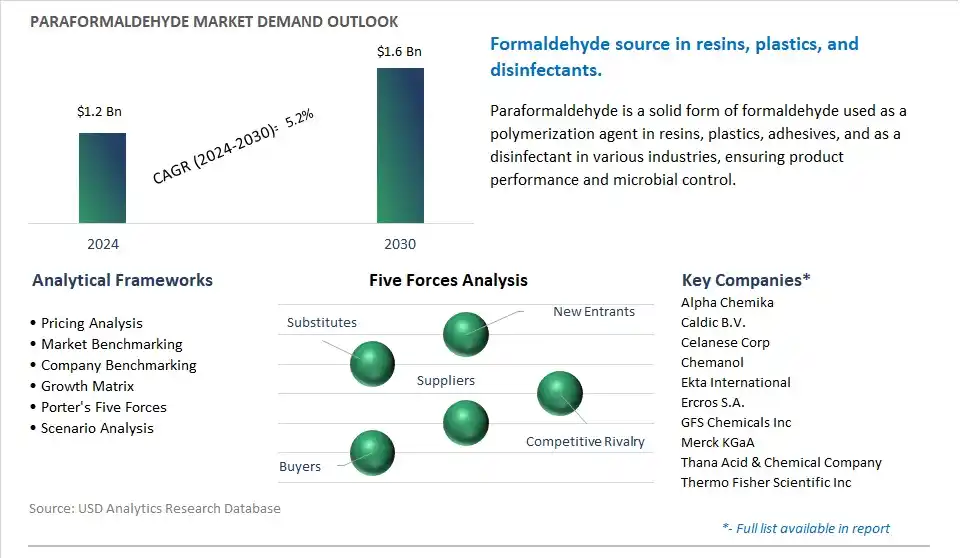
The market report analyses the leading companies in the industry including Alpha Chemika, Caldic B.V., Celanese Corp, Chemanol, Ekta International, Ercros S.A., GFS Chemicals Inc, Merck KGaA, Thana Acid & Chemical Company, Thermo Fisher Scientific Inc.
A prominent trend in the paraformaldehyde market is the growing demand for resin manufacturing. Paraformaldehyde is a key raw material used in the production of various resins, including urea-formaldehyde, phenol-formaldehyde, and melamine-formaldehyde resins. These resins are widely utilized in industries such as construction, automotive, electronics, and furniture manufacturing for applications such as adhesives, coatings, laminates, and molded parts. The increasing construction activities, infrastructure development, and automotive production globally are driving the demand for resins, thus fueling the demand for paraformaldehyde as a primary feedstock.
A significant driver propelling the paraformaldehyde market is the expansion of end-use industries such as construction, automotive, and electronics. These industries are experiencing significant growth due to urbanization, population growth, and increasing disposable income levels in emerging economies. Paraformaldehyde plays a crucial role in the production of resins used in various applications within these industries, such as particleboard manufacturing in construction, composite materials in automotive, and printed circuit boards in electronics. The expanding industrial activities and infrastructure development projects worldwide are driving the demand for paraformaldehyde as an essential chemical intermediate.
An opportunity for the paraformaldehyde market lies in the adoption of environmentally friendly production methods. While paraformaldehyde is traditionally manufactured through the polymerization of formaldehyde gas, there is growing interest in developing alternative production routes that are more sustainable and environmentally friendly. These methods include the use of renewable feedstocks, catalytic processes, and advanced technologies for formaldehyde synthesis. By investing in research and development of greener production techniques, manufacturers can not only reduce their environmental footprint but also meet the increasing regulatory requirements and consumer preferences for eco-friendly products. Additionally, offering bio-based or sustainably produced paraformaldehyde can provide a competitive edge in the market and open up new opportunities for growth and market expansion.
The largest segment in the Paraformaldehyde Market is Resins. The market growth is driven by the extensive use of paraformaldehyde as a key raw material in the production of various resins. Paraformaldehyde is a highly reactive compound that readily polymerizes to form formaldehyde-based resins, including urea-formaldehyde (UF) resins, phenol-formaldehyde (PF) resins, and melamine-formaldehyde (MF) resins. These resins find widespread applications in industries such as construction, automotive, furniture manufacturing, and electronics. UF resins are commonly used in wood adhesives, plywood, particleboard, and medium-density fiberboard (MDF), where they provide strong bonding, water resistance, and dimensional stability. PF resins are utilized in the production of laminates, coatings, and molded products due to their excellent heat resistance and mechanical properties. MF resins are preferred for decorative laminates, dinnerware, and molded articles due to their scratch resistance and durability. The versatility and performance of formaldehyde-based resins make them indispensable materials in various manufacturing processes, consolidating the dominance of the Resins segment in the Paraformaldehyde Market.
By Application
Resins
Agrochemicals
Medical
Others
Regions Included
North America (US, Canada, Mexico)
Europe (Germany, UK, France, Spain, Italy, Russia, Rest of Europe)
Asia Pacific (China, India, Japan, South Korea, Australia, South East Asia, Rest of Asia)
South America (Brazil, Argentina, Rest of South America)
Middle East and Africa (Saudi Arabia, UAE, Rest of Middle East, South Africa, Egypt, Rest of Africa)
Alpha Chemika
Caldic B.V.
Celanese Corp
Chemanol
Ekta International
Ercros S.A.
GFS Chemicals Inc
Merck KGaA
Thana Acid & Chemical Company
Thermo Fisher Scientific Inc
*- List Not Exhaustive
TABLE OF CONTENTS
1 Introduction to 2024 Paraformaldehyde Market
1.1 Market Overview
1.2 Quick Facts
1.3 Scope/Objective of the Study
1.4 Market Definition
1.5 Countries and Regions Covered
1.6 Units, Currency, and Conversions
1.7 Industry Value Chain
2 Research Methodology
2.1 Market Size Estimation
2.2 Sources and Research Methodology
2.3 Data Triangulation
2.4 Assumptions and Limitations
3 Executive Summary
3.1 Global Paraformaldehyde Market Size Outlook, $ Million, 2021 to 2030
3.2 Paraformaldehyde Market Outlook by Type, $ Million, 2021 to 2030
3.3 Paraformaldehyde Market Outlook by Product, $ Million, 2021 to 2030
3.4 Paraformaldehyde Market Outlook by Application, $ Million, 2021 to 2030
3.5 Paraformaldehyde Market Outlook by Key Countries, $ Million, 2021 to 2030
4 Market Dynamics
4.1 Key Driving Forces of Paraformaldehyde Industry
4.2 Key Market Trends in Paraformaldehyde Industry
4.3 Potential Opportunities in Paraformaldehyde Industry
4.4 Key Challenges in Paraformaldehyde Industry
5 Market Factor Analysis
5.1 Value Chain Analysis
5.2 Competitive Landscape
5.2.1 Global Paraformaldehyde Market Share by Company (%), 2023
5.2.2 Product Offerings by Company
5.3 Porter’s Five Forces Analysis
5.4 Pricing Analysis and Outlook
6 Growth Outlook Across Scenarios
6.1 Growth Analysis-Case Scenario Definitions
6.2 Low Growth Scenario Forecasts
6.3 Reference Growth Scenario Forecasts
6.4 High Growth Scenario Forecasts
7 Global Paraformaldehyde Market Outlook by Segments
7.1 Paraformaldehyde Market Outlook by Segments, $ Million, 2021- 2030
By Application
Resins
Agrochemicals
Medical
Others
8 North America Paraformaldehyde Market Analysis and Outlook To 2030
8.1 Introduction to North America Paraformaldehyde Markets in 2024
8.2 North America Paraformaldehyde Market Size Outlook by Country, 2021-2030
8.2.1 United States
8.2.2 Canada
8.2.3 Mexico
8.3 North America Paraformaldehyde Market size Outlook by Segments, 2021-2030
By Application
Resins
Agrochemicals
Medical
Others
9 Europe Paraformaldehyde Market Analysis and Outlook To 2030
9.1 Introduction to Europe Paraformaldehyde Markets in 2024
9.2 Europe Paraformaldehyde Market Size Outlook by Country, 2021-2030
9.2.1 Germany
9.2.2 France
9.2.3 Spain
9.2.4 United Kingdom
9.2.4 Italy
9.2.5 Russia
9.2.6 Norway
9.2.7 Rest of Europe
9.3 Europe Paraformaldehyde Market Size Outlook by Segments, 2021-2030
By Application
Resins
Agrochemicals
Medical
Others
10 Asia Pacific Paraformaldehyde Market Analysis and Outlook To 2030
10.1 Introduction to Asia Pacific Paraformaldehyde Markets in 2024
10.2 Asia Pacific Paraformaldehyde Market Size Outlook by Country, 2021-2030
10.2.1 China
10.2.2 India
10.2.3 Japan
10.2.4 South Korea
10.2.5 Indonesia
10.2.6 Malaysia
10.2.7 Australia
10.2.8 Rest of Asia Pacific
10.3 Asia Pacific Paraformaldehyde Market size Outlook by Segments, 2021-2030
By Application
Resins
Agrochemicals
Medical
Others
11 South America Paraformaldehyde Market Analysis and Outlook To 2030
11.1 Introduction to South America Paraformaldehyde Markets in 2024
11.2 South America Paraformaldehyde Market Size Outlook by Country, 2021-2030
11.2.1 Brazil
11.2.2 Argentina
11.2.3 Rest of South America
11.3 South America Paraformaldehyde Market size Outlook by Segments, 2021-2030
By Application
Resins
Agrochemicals
Medical
Others
12 Middle East and Africa Paraformaldehyde Market Analysis and Outlook To 2030
12.1 Introduction to Middle East and Africa Paraformaldehyde Markets in 2024
12.2 Middle East and Africa Paraformaldehyde Market Size Outlook by Country, 2021-2030
12.2.1 Saudi Arabia
12.2.2 UAE
12.2.3 Oman
12.2.4 Rest of Middle East
12.2.5 Egypt
12.2.6 Nigeria
12.2.7 South Africa
12.2.8 Rest of Africa
12.3 Middle East and Africa Paraformaldehyde Market size Outlook by Segments, 2021-2030
By Application
Resins
Agrochemicals
Medical
Others
13 Company Profiles
13.1 Company Snapshot
13.2 SWOT Profiles
13.3 Products and Services
13.4 Recent Developments
13.5 Financial Profile
Alpha Chemika
Caldic B.V.
Celanese Corp
Chemanol
Ekta International
Ercros S.A.
GFS Chemicals Inc
Merck KGaA
Thana Acid & Chemical Company
Thermo Fisher Scientific Inc
14 Appendix
14.1 Customization Offerings
14.2 Subscription Services
14.3 Related Reports
14.4 Publisher Expertise
By Application
Resins
Agrochemicals
Medical
Others
Countries Analyzed
North America (US, Canada, Mexico)
Europe (Germany, UK, France, Spain, Italy, Russia, Rest of Europe)
Asia Pacific (China, India, Japan, South Korea, Australia, South East Asia, Rest of Asia)
South America (Brazil, Argentina, Rest of South America)
Middle East and Africa (Saudi Arabia, UAE, Rest of Middle East, South Africa, Egypt, Rest of Africa)
Global Paraformaldehyde is forecast to reach $1.6 Billion in 2030 from $1.2 Billion in 2024, registering a CAGR of 5.2%
Emerging Markets across Asia Pacific, Europe, and Americas present robust growth prospects.
Alpha Chemika, Caldic B.V., Celanese Corp, Chemanol, Ekta International, Ercros S.A., GFS Chemicals Inc, Merck KGaA, Thana Acid & Chemical Company, Thermo Fisher Scientific Inc
Base Year- 2023; Estimated Year- 2024; Historic Period- 2018-2023; Forecast period- 2024 to 2030; Currency: Revenue (USD); Volume