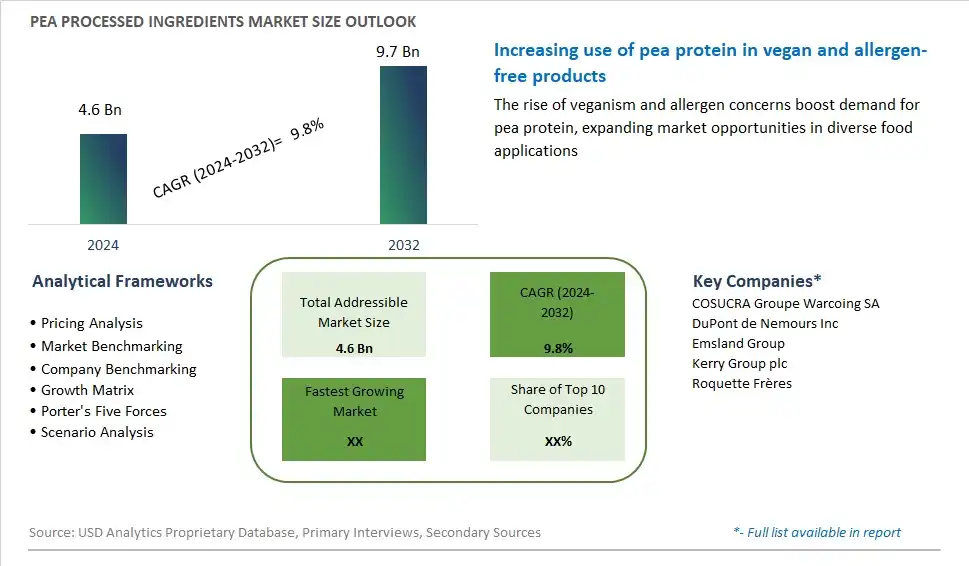
Global Pea Processed Ingredients Market Size is valued at $4.6 Billion in 2024 and is forecast to register a growth rate (CAGR) of 9.8% to reach $9.7 Billion by 2032.
The global Pea Processed Ingredients Market Comprehensive Study analyzes and forecasts the market size across 6 regions and 24 countries for diverse segments -By Type (Protein, Starch, Flour, Fiber), By Application (Food, Beverage, Others), By Source (Yellow split peas, Chickpeas, Lentils)
An Introduction to Pea Processed Ingredients Market
Pea processed ingredients refer to food ingredients derived from peas, including pea protein, pea starch, and pea fiber, used in various food and beverage applications as plant-based alternatives to traditional ingredients in 2024. Pea protein is rich in essential amino acids, particularly lysine, and is utilized in sports nutrition products, meat alternatives, and dairy alternatives, where it provides protein fortification and functional properties such as emulsification and foaming. Pea starch is a gluten-free starch used as a thickener, stabilizer, and texturizer in soups, sauces, bakery products, and snacks, offering clean label and non-GMO alternatives to modified starches and hydrocolloids. Pea fiber is a soluble and insoluble dietary fiber used to improve texture, moisture retention, and fiber content in baked goods, cereals, and extruded snacks, promoting digestive health and satiety. With advancements in ingredient processing, functional properties, and consumer acceptance, the market for pea processed ingredients is growing, driven by innovations in pea fractionation, extraction technology, and product formulation that deliver sustainable, nutritious, and versatile ingredients to meet diverse application needs and consumer preferences.
Pea Processed Ingredients Competitive Landscape
The market report analyses the leading companies in the industry including COSUCRA Groupe Warcoing SA, DuPont de Nemours Inc, Emsland Group, Kerry Group plc, Roquette Frères, and Others.
Pea Processed Ingredients Market Dynamics
Pea Processed Ingredients Market Trend: Growing Demand for Plant-Based Alternatives
One prominent market trend in pea processed ingredients is the growing demand for plant-based alternatives, driven by increasing consumer awareness of health, sustainability, and ethical considerations. As people seek to reduce their consumption of animal products and adopt plant-based diets for health and environmental reasons, there's a rising interest in plant-based ingredients such as pea protein, pea starch, and pea fiber. This trend is further fueled by the growing popularity of vegetarianism, veganism, and flexitarianism, as well as the desire for clean label products made from natural, minimally processed ingredients. Pea processed ingredients offer a sustainable, allergen-free, and nutritious alternative to animal-derived ingredients, appealing to health-conscious consumers looking for plant-based options in their diets.
Market Driver: Demand for Clean Label and Sustainable Ingredients
A key driver propelling the market for pea processed ingredients is the demand for clean label and sustainable ingredients in food and beverage formulations. Consumers are increasingly scrutinizing product labels and avoiding synthetic additives, artificial flavors, and genetically modified organisms (GMOs) in favor of clean label products made from wholesome, minimally processed ingredients. Pea processed ingredients align with this clean label trend as they are derived from peas grown using sustainable farming practices and undergo minimal processing to retain their nutritional integrity and natural properties. This driver is supported by regulatory initiatives promoting sustainable agriculture, organic farming practices, and transparency in food production, as well as endorsements from health and wellness influencers and celebrities. As food manufacturers respond to consumer demand for clean label products, the market for pea processed ingredients continues to expand, driven by their compatibility with clean label formulations and their nutritional benefits as plant-based ingredients.
Market Opportunity: Expansion into Functional Food and Beverage Applications
An opportunity within the pea processed ingredients market lies in expansion into functional food and beverage applications to capitalize on the growing demand for fortified and value-added products. While pea processed ingredients are commonly used as plant-based alternatives in meat analogs, dairy alternatives, and protein supplements, there's potential to broaden their applications in functional food and beverage categories such as snacks, bakery products, beverages, and ready-to-eat meals. By incorporating pea processed ingredients into a variety of food and beverage formulations, manufacturers can enhance the nutritional profile, texture, and sensory attributes of their products while appealing to health-conscious consumers seeking plant-based options with added health benefits. Additionally, pea processed ingredients can be fortified with vitamins, minerals, antioxidants, and functional ingredients to create targeted functional foods addressing specific health concerns such as muscle recovery, weight management, and digestive health. By leveraging the versatility and nutritional benefits of pea processed ingredients, companies can innovate and differentiate their offerings in the competitive functional food and beverage market, driving market penetration and growth opportunities.
Pea Processed Ingredients Market Share Analysis: Protein held the dominant market share in 2024
In the pea processed ingredients market, the Protein segment is the largest, driven by several pivotal factors. Pea protein is renowned for its exceptional nutritional profile, high protein content, and versatility in various food and beverage applications. As consumers increasingly seek plant-based alternatives to animal-derived proteins, pea protein stands out as a preferred choice due to its allergen-free nature, sustainability, and digestibility. Further, pea protein's neutral flavor profile and functional properties make it suitable for a wide range of product formulations, including plant-based meat alternatives, dairy alternatives, snacks, and beverages. Additionally, the growing demand for clean label and natural ingredients further propels the adoption of pea protein in food and beverage manufacturing. Furthermore, advancements in processing technologies and ingredient innovation drive the development of pea protein isolates and concentrates with enhanced functionality and sensory attributes, reinforcing the Protein segment's dominance in the pea processed ingredients market.
Pea Processed Ingredients Market Share Analysis: Meat & Meat Substitutes market is poised to register the fastest growth rae over the forecast period to 2032
In the pea processed ingredients market, the Meat & Meat Substitutes segment is the fastest-growing, propelled by several pivotal factors. With the rising demand for plant-based alternatives to traditional meat products, pea processed ingredients play a crucial role in the development of meat substitutes and plant-based protein products. Pea proteins offer an ideal solution for meat analogues due to their texture, mouthfeel, and ability to mimic the taste and appearance of meat. Further, as consumers increasingly prioritize health, sustainability, and ethical considerations, plant-based meat substitutes made with pea processed ingredients resonate with their values and dietary preferences. Additionally, the versatility of pea processed ingredients allows for the creation of a wide range of meat substitutes, including burgers, sausages, nuggets, and deli slices, catering to diverse consumer tastes and culinary preferences. Furthermore, the Meat & Meat Substitutes segment benefits from ongoing innovations in ingredient formulation, product development, and marketing strategies aimed at enhancing the sensory experience and nutritional profile of plant-based meat alternatives. As the demand for plant-based protein continues to surge, driven by health-conscious consumers and environmental concerns, the Meat & Meat Substitutes segment is poised to maintain its rapid growth trajectory, driving innovation and reshaping the pea processed ingredients market landscape.
Pea Processed Ingredients Market Share Analysis: Yellow Split Peas held the dominant market share in 2024
In the pea processed ingredients market, the Yellow Split Peas segment is the largest, driven by several critical factors. Yellow split peas are widely cultivated and processed globally, offering a rich source of protein, fiber, and essential nutrients. Their widespread availability and relatively low cost compared to other pea varieties make them a preferred choice for ingredient manufacturers and food processors. Further, yellow split peas possess excellent functional properties, including gelling, thickening, and emulsifying abilities, making them versatile ingredients in various food and beverage applications. Additionally, the neutral flavor profile of yellow split peas allows for easy incorporation into a wide range of product formulations without compromising taste or sensory characteristics. Furthermore, the growing demand for plant-based proteins and clean label ingredients further boosts the adoption of yellow split peas in food and beverage manufacturing. As consumer preferences continue to shift towards healthier and more sustainable food choices, the Yellow Split Peas segment maintains its dominance, driving growth and innovation in the pea processed ingredients market.
Pea Processed Ingredients Market Segmentation
By Type
Protein
Starch
Flour
Fiber
By Application
Food
-Meat & Meat Substitutes
-Performance Nutrition
-Functional Foods
-Snacks
-Bakery
-Confectionery
-Others
Beverage
Others
By Source
Yellow split peas
Chickpeas
Lentils
Countries Analyzed
North America (US, Canada, Mexico)
Europe (Germany, UK, France, Spain, Italy, Russia, Rest of Europe)
Asia Pacific (China, India, Japan, South Korea, Australia, South East Asia, Rest of Asia)
South America (Brazil, Argentina, Rest of South America)
Middle East and Africa (Saudi Arabia, UAE, Rest of Middle East, South Africa, Egypt, Rest of Africa)
Pea Processed Ingredients Companies Profiled in the Study
COSUCRA Groupe Warcoing SA
DuPont de Nemours Inc
Emsland Group
Kerry Group plc
Roquette Frères
*- List Not Exhaustive
Chapter 1. TABLE OF CONTENTS
Chapter 2. Introduction to Pea Processed Ingredients Market
2.1. Market Overview
2.2. Key Statistics and Report Highlights
2.3. Scope of the Comprehensive Study
2.3.1. Market Definition
2.3.2 Countries and Regions Covered
2.3.3 Research Objective
2.3.4 Units, Currency, and Conversions
2.3.5 Industry Value Chain
2.4. Key Market Segments
2.5. Key Companies
2.6. Study Period
Chapter 3. Strategic Analysis Review
3.1. Pea Processed Ingredients Pricing Analysis and Forecast
3.2. Porter’s Five Forces
3.3. Market Ecosystem
3.4. SWOT Analysis
3.5. Regulatory Scenario
3.3. Effects of Inflation, Russia-Ukraine War, moderating economic growth, and other macroeconomic factors
Chapter 4. Competitive Landscape
4.1. Market Share Analysis
4.1.1. Global Pea Processed Ingredients Market Share by Company, 2023
4.1.2. Product Offerings of Leading Pea Processed Ingredients Companies
4.2. Market Entropy
4.2.1. New Product Launches in the Industry
4.2.2. Mergers, Acquisitions, Joint ventures, and Partnerships
4.3. Key Strategies and Best Practices
Chapter 5. Global Market Projections: Best, Reference, and Low Case Scenarios
5.1. Growth Analysis- Case Scenario Definitions
5.2. Low Growth Case Scenario Forecasts
5.3. Reference Growth Case Scenario Forecasts
5.4. High Growth Case Scenario Forecasts
Chapter 6. Market Dynamics
6.1. Pea Processed Ingredients Market Drivers
6.2. Pea Processed Ingredients Market Challenges
6.6. Pea Processed Ingredients Market Opportunities
6.4. Pea Processed Ingredients Market Trends
Chapter 7. Global Pea Processed Ingredients Market Outlook Trends
7.1. Global Pea Processed Ingredients Revenue (USD Million) and CAGR (%) by Type (2021-2032)
7.2. Global Pea Processed Ingredients Revenue (USD Million) and CAGR (%) by Application (2021-2032)
7.3. Global Pea Processed Ingredients Revenue (USD Million) and CAGR (%) by Product (2021-2032)
By Type
Protein
Starch
Flour
Fiber
By Application
Food
-Meat & Meat Substitutes
-Performance Nutrition
-Functional Foods
-Snacks
-Bakery
-Confectionery
-Others
Beverage
Others
By Source
Yellow split peas
Chickpeas
Lentils
Chapter 8. Global Pea Processed Ingredients Regional Analysis and Outlook
8.1. Global Pea Processed Ingredients Revenue (USD Million) By Regions (2021- 2032)
8.2. North America Pea Processed Ingredients Revenue (USD Million) by Country (2021-2032)
8.2.1. United States Pea Processed Ingredients Regional Analysis and Outlook
8.2.2. Canada Pea Processed Ingredients Regional Analysis and Outlook
8.2.3. Mexico Pea Processed Ingredients Regional Analysis and Outlook
8.3. Europe Pea Processed Ingredients Revenue (USD Million), by Country (2021-2032)
8.3.1. Germany Pea Processed Ingredients Regional Analysis and Outlook
8.3.2. France Pea Processed Ingredients Regional Analysis and Outlook
8.3.3. United Kingdom Pea Processed Ingredients Regional Analysis and Outlook
8.3.4. Spain Pea Processed Ingredients Regional Analysis and Outlook
8.3.5. Italy Pea Processed Ingredients Regional Analysis and Outlook
8.3.6. Russia Pea Processed Ingredients Regional Analysis and Outlook
8.3.7. Rest of Europe Pea Processed Ingredients Regional Analysis and Outlook
8.4. Asia Pacific Pea Processed Ingredients Revenue (USD Million) by Country (2021-2032)
8.4.1. China Pea Processed Ingredients Regional Analysis and Outlook
8.4.2. Japan Pea Processed Ingredients Regional Analysis and Outlook
8.4.3. India Pea Processed Ingredients Regional Analysis and Outlook
8.4.4. South Korea Pea Processed Ingredients Regional Analysis and Outlook
8.4.5. Australia Pea Processed Ingredients Regional Analysis and Outlook
8.4.6. South East Asia Pea Processed Ingredients Regional Analysis and Outlook
8.4.7. Rest of Asia Pacific Pea Processed Ingredients Regional Analysis and Outlook
8.5. South America Pea Processed Ingredients Revenue (USD Million), by Country (2021-2032)
8.5.1. Brazil Pea Processed Ingredients Regional Analysis and Outlook
8.5.2. Argentina Pea Processed Ingredients Regional Analysis and Outlook
8.5.3. Rest of South America Pea Processed Ingredients Regional Analysis and Outlook
8.6. Middle East and Africa Pea Processed Ingredients Revenue (USD Million) by Country (2021-2032)
8.6.1. Middle East Pea Processed Ingredients Regional Analysis and Outlook
8.6.2. Africa Pea Processed Ingredients Regional Analysis and Outlook
Chapter 9. North America Pea Processed Ingredients Analysis and Outlook
9.1. North America Pea Processed Ingredients Revenue (USD Million) by Segments (2021-2032)
9.1.1. North America Pea Processed Ingredients Revenue (USD Million) by Type (2021-2032)
9.1.2. North America Pea Processed Ingredients Revenue (USD Million) by Application (2021-2032)
9.1.3. North America Pea Processed Ingredients Revenue (USD Million) by Product (2021-2032)
By Type
Protein
Starch
Flour
Fiber
By Application
Food
-Meat & Meat Substitutes
-Performance Nutrition
-Functional Foods
-Snacks
-Bakery
-Confectionery
-Others
Beverage
Others
By Source
Yellow split peas
Chickpeas
Lentils
Chapter 10. Europe Pea Processed Ingredients Analysis and Outlook
10.1. Europe Pea Processed Ingredients Revenue (USD Million), by Segments (USD Million) (2021-2032)
10.1.1. Europe Pea Processed Ingredients Revenue (USD Million) by Type (2021-2032)
10.1.2. Europe Pea Processed Ingredients Revenue (USD Million) by Application (2021-2032)
10.1.3. Europe Pea Processed Ingredients Revenue (USD Million) by Product (2021-2032)
By Type
Protein
Starch
Flour
Fiber
By Application
Food
-Meat & Meat Substitutes
-Performance Nutrition
-Functional Foods
-Snacks
-Bakery
-Confectionery
-Others
Beverage
Others
By Source
Yellow split peas
Chickpeas
Lentils
Chapter 11. Asia Pacific Pea Processed Ingredients Analysis and Outlook
11.1. Asia Pacific Pea Processed Ingredients Revenue (USD Million), and Revenue (USD Million) by Segments (2021-2032)
11.1.1. Asia Pacific Pea Processed Ingredients Revenue (USD Million) by Type (2021-2032)
11.1.2. Asia Pacific Pea Processed Ingredients Revenue (USD Million) by Application (2021-2032)
11.1.3. Asia Pacific Pea Processed Ingredients Revenue (USD Million) by Product (2021-2032)
By Type
Protein
Starch
Flour
Fiber
By Application
Food
-Meat & Meat Substitutes
-Performance Nutrition
-Functional Foods
-Snacks
-Bakery
-Confectionery
-Others
Beverage
Others
By Source
Yellow split peas
Chickpeas
Lentils
Chapter 12. South America Pea Processed Ingredients Analysis and Outlook
12.1. South America Pea Processed Ingredients Revenue (USD Million), by Segments (2021-2032)
12.1.1. South America Pea Processed Ingredients Revenue (USD Million) by Type (2021-2032)
12.1.2. South America Pea Processed Ingredients Revenue (USD Million) by Application (2021-2032)
12.1.3. South America Pea Processed Ingredients Revenue (USD Million) by Product (2021-2032)
By Type
Protein
Starch
Flour
Fiber
By Application
Food
-Meat & Meat Substitutes
-Performance Nutrition
-Functional Foods
-Snacks
-Bakery
-Confectionery
-Others
Beverage
Others
By Source
Yellow split peas
Chickpeas
Lentils
Chapter 13. Middle East and Africa Pea Processed Ingredients Analysis and Outlook
13.1. Middle East and Africa Pea Processed Ingredients Revenue (USD Million), by Segments (2021-2032)
13.1.1. Middle East and Africa Pea Processed Ingredients Revenue (USD Million) by Type (2021-2032)
13.1.2. Middle East and Africa Pea Processed Ingredients Revenue (USD Million) by Application (2021-2032)
13.1.3. Middle East and Africa Pea Processed Ingredients Revenue (USD Million) by Product (2021-2032)
By Type
Protein
Starch
Flour
Fiber
By Application
Food
-Meat & Meat Substitutes
-Performance Nutrition
-Functional Foods
-Snacks
-Bakery
-Confectionery
-Others
Beverage
Others
By Source
Yellow split peas
Chickpeas
Lentils
Chapter 14. Pea Processed Ingredients Company Profiles
14.1 Business Overview
14.2 Product Profiles
14.3 SWOT Profiles
14.5 Recent Developments
14.6 Financial Profile
List of Companies
COSUCRA Groupe Warcoing SA
DuPont de Nemours Inc
Emsland Group
Kerry Group plc
Roquette Frères
15. Methodology and Data Sources
15.1 Customization Offerings
15.2 Subscription Services
15.3 Related Reports
15.4 Publisher Expertise
LIST OF TABLES
Table 1 Market Segmentation Analysis
Table 2 Global Pea Processed Ingredients Market Share of Leading Companies, 2023
Table 3 Product Offerings of Leading Companies
Table 4 Low Growth Scenario Forecasts
Table 5 Reference Case Growth Scenario
Table 6 High Growth Case Scenario
Table 7 Global Pea Processed Ingredients Revenue (USD Million) And CAGR (%) By Type (2021-2032)
Table 8 Global Pea Processed Ingredients Revenue (USD Million) And CAGR (%) By Application (2021-2032)
Table 9 Global Pea Processed Ingredients Revenue (USD Million) And CAGR (%) By Product (2021-2032)
Table 10 Global Pea Processed Ingredients Market Revenue (USD Million) By Regions (2021-2032)
Table 11 Global Pea Processed Ingredients Market Share (%) By Regions (2021-2032)
Table 12 North America Pea Processed Ingredients Revenue (USD Million) By Country (2021-2032)
Table 13 Europe Pea Processed Ingredients Revenue (USD Million) By Country (2021-2032)
Table 14 Asia Pacific Pea Processed Ingredients Revenue (USD Million) By Country (2021-2032)
Table 15 South America Pea Processed Ingredients Revenue (USD Million) By Country (2021-2032)
Table 16 Middle East and Africa Pea Processed Ingredients Revenue (USD Million) By Region (2021-2032)
Table 17 North America Pea Processed Ingredients Revenue (USD Million) By Type (2021-2032)
Table 18 North America Pea Processed Ingredients Revenue (USD Million) By Application (2021-2032)
Table 19 North America Pea Processed Ingredients Revenue (USD Million) By Product (2021-2032)
Table 20 Europe Pea Processed Ingredients Revenue (USD Million) By Type (2021-2032)
Table 21 Europe Pea Processed Ingredients Revenue (USD Million) By Application (2021-2032)
Table 22 Europe Pea Processed Ingredients Revenue (USD Million) By Product (2021-2032)
Table 23 Asia Pacific Pea Processed Ingredients Revenue (USD Million) By Type (2021-2032)
Table 24 Asia Pacific Pea Processed Ingredients Revenue (USD Million) By Application (2021-2032)
Table 25 Asia Pacific Pea Processed Ingredients Revenue (USD Million) By Product (2021-2032)
Table 26 South America Pea Processed Ingredients Revenue (USD Million) By Type (2021-2032)
Table 27 South America Pea Processed Ingredients Revenue (USD Million) By Application (2021-2032)
Table 28 South America Pea Processed Ingredients Revenue (USD Million) By Product (2021-2032)
Table 29 Middle East and Africa Pea Processed Ingredients Revenue (USD Million) By Type (2021-2032)
Table 30 Middle East and Africa Pea Processed Ingredients Revenue (USD Million) By Application (2021-2032)
Table 31 Middle East and Africa Pea Processed Ingredients Revenue (USD Million) By Product (2021-2032)
LIST OF FIGURES
Figure 1. Market Scope
Figure 2. Pricing Forecasts Per Unit, 2023- 2032
Figure 3. Porter’s Five Forces
Figure 4. Global Pea Processed Ingredients Market Revenue (USD Million) By Regions (2021-2032)
Figure 5. Global Pea Processed Ingredients Market Share (%) By Regions (2023)
Figure 6. North America Pea Processed Ingredients Revenue (USD Million) By Country (2021-2032)
Figure 7. United States Pea Processed Ingredients Revenue (USD Million) By Country (2021-2032)
Figure 8. Canada Pea Processed Ingredients Revenue (USD Million) By Country (2021-2032)
Figure 9. Mexico Pea Processed Ingredients Revenue (USD Million) By Country (2021-2032)
Figure 10. Europe Pea Processed Ingredients Revenue (USD Million) By Country (2021-2032)
Figure 11. Germany Pea Processed Ingredients Revenue (USD Million) By Country (2021-2032)
Figure 12. France Pea Processed Ingredients Revenue (USD Million) By Country (2021-2032)
Figure 13. United Kingdom Pea Processed Ingredients Revenue (USD Million) By Country (2021-2032)
Figure 14. Spain Pea Processed Ingredients Revenue (USD Million) By Country (2021-2032)
Figure 15. Italy Pea Processed Ingredients Revenue (USD Million) By Country (2021-2032)
Figure 16. Russia Pea Processed Ingredients Revenue (USD Million) By Country (2021-2032)
Figure 17. Rest of Europe Pea Processed Ingredients Revenue (USD Million) By Country (2021-2032)
Figure 11. Asia Pacific Pea Processed Ingredients Revenue (USD Million) By Country (2021-2032)
Figure 12. China Pea Processed Ingredients Revenue (USD Million) By Country (2021-2032)
Figure 13. Japan Pea Processed Ingredients Revenue (USD Million) By Country (2021-2032)
Figure 14. India Pea Processed Ingredients Revenue (USD Million) By Country (2021-2032)
Figure 15. South Korea Pea Processed Ingredients Revenue (USD Million) By Country (2021-2032)
Figure 16. Australia Pea Processed Ingredients Revenue (USD Million) By Country (2021-2032)
Figure 17. South East Asia Pea Processed Ingredients Revenue (USD Million) By Country (2021-2032)
Figure 18. South America Pea Processed Ingredients Revenue (USD Million) By Country (2021-2032)
Figure 19. Brazil Pea Processed Ingredients Revenue (USD Million) By Country (2021-2032)
Figure 20. Argentina Pea Processed Ingredients Revenue (USD Million) By Country (2021-2032)
Figure 21. Rest of Asia Pacific Pea Processed Ingredients Revenue (USD Million) By Country (2021-2032)
Figure 22. Middle East and Africa Pea Processed Ingredients Revenue (USD Million) By Region (2021-2032)
Figure 23. Saudi Arabia Pea Processed Ingredients Revenue (USD Million) By Region (2021-2032)
Figure 24. The UAE Pea Processed Ingredients Revenue (USD Million) By Region (2021-2032)
Figure 25. Rest of Middle East Pea Processed Ingredients Revenue (USD Million) By Region (2021-2032)
Figure 26. South Africa Pea Processed Ingredients Revenue (USD Million) By Region (2021-2032)
Figure 27. Africa Pea Processed Ingredients Revenue (USD Million) By Region (2021-2032)
Figure 28. North America Pea Processed Ingredients Revenue (USD Million) By Type (2021-2032)
Figure 29. North America Pea Processed Ingredients Revenue (USD Million) By Application (2021-2032)
Figure 30. North America Pea Processed Ingredients Revenue (USD Million) By Product (2021-2032)
Figure 31. Europe Pea Processed Ingredients Revenue (USD Million) By Type (2021-2032)
Figure 32. Europe Pea Processed Ingredients Revenue (USD Million) By Application (2021-2032)
Figure 33. Europe Pea Processed Ingredients Revenue (USD Million) By Product (2021-2032)
Figure 34. Asia Pacific Pea Processed Ingredients Revenue (USD Million) By Type (2021-2032)
Figure 35. Asia Pacific Pea Processed Ingredients Revenue (USD Million) By Application (2021-2032)
Figure 36. Asia Pacific Pea Processed Ingredients Revenue (USD Million) By Product (2021-2032)
Figure 37. South America Pea Processed Ingredients Revenue (USD Million) By Type (2021-2032)
Figure 38. South America Pea Processed Ingredients Revenue (USD Million) By Application (2021-2032)
Figure 39. South America Pea Processed Ingredients Revenue (USD Million) By Product (2021-2032)
Figure 40. Middle East and Africa Pea Processed Ingredients Revenue (USD Million) By Type (2021-2032)
Figure 41. Middle East and Africa Pea Processed Ingredients Revenue (USD Million) By Application (2021-2032)
Figure 42. Middle East and Africa Pea Processed Ingredients Revenue (USD Million) By Product (2021-2032)
By Type
Protein
Starch
Flour
Fiber
By Application
Food
-Meat & Meat Substitutes
-Performance Nutrition
-Functional Foods
-Snacks
-Bakery
-Confectionery
-Others
Beverage
Others
By Source
Yellow split peas
Chickpeas
Lentils
Countries Analyzed
North America (US, Canada, Mexico)
Europe (Germany, UK, France, Spain, Italy, Russia, Rest of Europe)
Asia Pacific (China, India, Japan, South Korea, Australia, South East Asia, Rest of Asia)
South America (Brazil, Argentina, Rest of South America)
Middle East and Africa (Saudi Arabia, UAE, Rest of Middle East, South Africa, Egypt, Rest of Africa)
