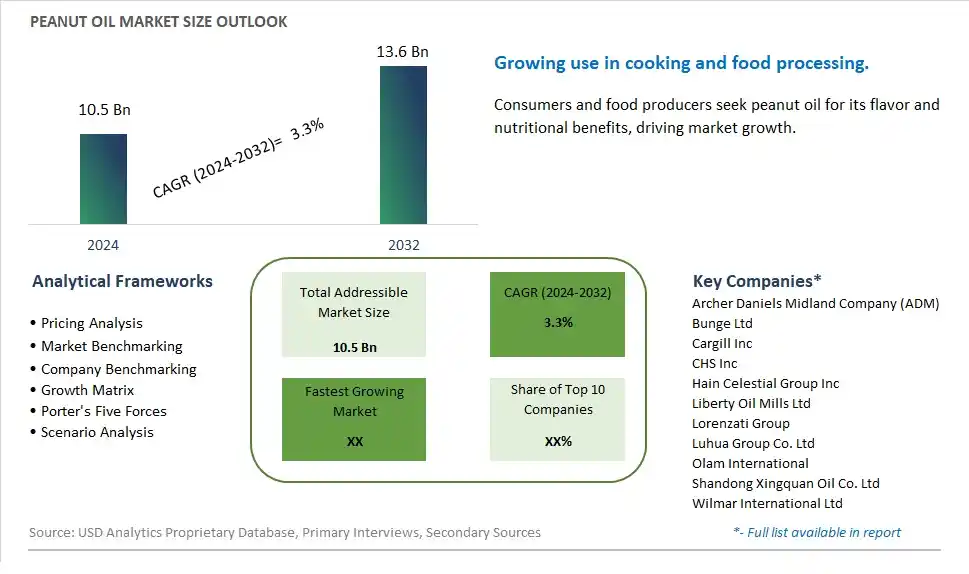
Global Peanut Oil Market Size is valued at $10.5 Billion in 2024 and is forecast to register a growth rate (CAGR) of 3.3% to reach $13.6 Billion by 2032.
The global Peanut Oil Market Comprehensive Study analyzes and forecasts the market size across 6 regions and 24 countries for diverse segments -By Type (Refined, Unrefined), By Application (Cosmetics, Food, Pharmaceuticals, Others), By Distribution Channel (Supermarkets/ Hypermarkets, Independent Retail Stores, Online, Others)
An Introduction to Peanut Oil Market
In 2024, the peanut oil market is experiencing steady growth driven by its versatile culinary applications, nutritional benefits, and growing consumer interest in plant-based oils. Peanut oil, extracted from peanuts, is celebrated for its high smoke point, neutral flavor, and heart-healthy monounsaturated fats. Widely used in cooking, frying, baking, and salad dressings, peanut oil is favored by chefs and home cooks alike for its ability to enhance the taste and texture of dishes while imparting a distinctive nutty aroma. Moreover, the rising awareness of the health benefits associated with peanut oil, such as its cholesterol-lowering properties, antioxidant content, and vitamin E, is driving its adoption among health-conscious consumers. Additionally, the food processing industry is incorporating peanut oil into a wide range of products, including snacks, sauces, and ready-to-eat meals, further fueling market growth. As consumers seek healthier and flavorful cooking oils, the peanut oil market is poised for continued expansion, with opportunities for product innovation, diversification, and market penetration.
Peanut Oil Competitive Landscape
The market report analyses the leading companies in the industry including Archer Daniels Midland Company (ADM), Bunge Ltd, Cargill Inc, CHS Inc, Hain Celestial Group Inc, Liberty Oil Mills Ltd, Lorenzati Group, Luhua Group Co. Ltd, Olam International, Shandong Xingquan Oil Co. Ltd, Wilmar International Ltd, and Others.
Peanut Oil Market Dynamics
Peanut Oil Market Trend: Growing Preference for Healthier Cooking Oils
One prominent trend in the peanut oil market is the growing preference for healthier cooking oils. As consumers become more health-conscious and seek out alternatives to traditional cooking oils like vegetable or corn oil, there is an increasing interest in peanut oil due to its perceived health benefits. Peanut oil is high in monounsaturated fats, low in saturated fats, and contains vitamin E, making it a healthier option for cooking purposes. This trend is driving the demand for peanut oil as consumers prioritize healthier dietary choices and look for cooking oils that offer nutritional advantages.
Market Driver: Expansion of the Food Industry and Culinary Trends
A key driver in the peanut oil market is the expansion of the food industry and culinary trends. As the food industry continues to innovate and diversify, there is a growing demand for specialty ingredients like peanut oil to meet the evolving needs and preferences of consumers. Peanut oil is valued by chefs and food manufacturers for its neutral flavor, high smoke point, and versatility in various culinary applications, including frying, sautéing, baking, and salad dressings. This driver fuels market growth as the foodservice sector, home cooks, and food manufacturers incorporate peanut oil into a wide range of recipes and food products to enhance flavor, texture, and cooking performance.
Market Opportunity: Positioning as a Premium and Gourmet Ingredient
An emerging opportunity in the peanut oil market is the positioning of peanut oil as a premium and gourmet ingredient. While peanut oil is commonly used in everyday cooking, there's potential to elevate its image and appeal to discerning consumers by emphasizing its premium quality, purity, and origin. Manufacturers can explore opportunities to source high-quality peanuts, implement stringent production processes, and offer cold-pressed or unrefined peanut oil varieties that retain more of the natural flavor and nutrients. Additionally, there's an opportunity to target the gourmet food market by marketing peanut oil as a gourmet cooking oil suitable for upscale dining establishments, specialty food stores, and culinary enthusiasts seeking premium ingredients for their recipes. By leveraging its culinary versatility and premium attributes, peanut oil brands can differentiate themselves in the market and capture new growth opportunities.
Peanut Oil Market Share Analysis: Refined Peanut Oil held the dominant market share in 2024
In the Peanut Oil Market segmented by type, Refined Peanut Oil is the largest segment. This dominance can be attributed to several factors. Firstly, refined peanut oil undergoes a thorough refining process that removes impurities, odors, and flavors, resulting in a neutral taste and higher smoke point compared to unrefined varieties. This makes refined peanut oil versatile for various cooking methods such as frying, sautéing, and baking. Additionally, refined peanut oil has a longer shelf life and better stability, making it preferred by consumers and food manufacturers alike for its durability and extended storage capabilities. Further, the widespread availability of refined peanut oil in supermarkets, grocery stores, and food service establishments further contributes to its popularity and dominance in the Peanut Oil Market. As consumers continue to prioritize quality, versatility, and shelf life in cooking oils, the demand for refined peanut oil is expected to remain strong, solidifying its position as the largest segment in the market.
Peanut Oil Market Share Analysis: Cosmetics market is poised to register the fastest growth rae over the forecast period to 2032
Among the segmented applications in the Peanut Oil Market, Cosmetics emerge as the fastest-growing segment. This growth is propelled by several factors. Firstly, peanut oil is rich in vitamins, minerals, and antioxidants, making it a beneficial ingredient for skincare and haircare products. Its moisturizing and nourishing properties make it suitable for use in creams, lotions, serums, and hair treatments, where it helps to hydrate, soften, and protect the skin and hair. Additionally, the natural emollient properties of peanut oil make it an effective carrier oil for essential oils and other active ingredients in cosmetic formulations. Further, the increasing consumer preference for natural and organic beauty products drives the demand for peanut oil as a natural alternative to synthetic additives and preservatives. As cosmetic companies continue to innovate and develop new skincare and haircare products, the demand for peanut oil in the cosmetics industry is expected to grow rapidly, solidifying its position as the fastest-growing segment in the Peanut Oil Market.
Peanut Oil Market Share Analysis: Supermarkets/Hypermarkets held the dominant market share in 2024
In the Peanut Oil Market segmented by distribution channel, Supermarkets/Hypermarkets emerge as the largest segment. This dominance can be attributed to several factors. Firstly, supermarkets and hypermarkets offer a wide range of peanut oil brands and varieties under one roof, providing consumers with convenience and choice. These retail outlets have extensive shelf space and prominent display areas, allowing peanut oil products to be easily accessible and visible to shoppers. Additionally, supermarkets and hypermarkets often run promotions, discounts, and bulk-buying deals, attracting consumers seeking value for their purchases. Further, the established presence of supermarkets and hypermarkets in urban and suburban areas, along with their reputation for quality and reliability, further contributes to their popularity as preferred shopping destinations for peanut oil. As consumers continue to prioritize convenience and one-stop shopping experiences, the demand for peanut oil in supermarkets and hypermarkets is expected to remain strong, solidifying their position as the largest segment in the Peanut Oil Market.
Peanut Oil Market Segmentation
By Type
Refined
Unrefined
By Application
Cosmetics
Food
Pharmaceuticals
Others
By Distribution Channel
Supermarkets/ Hypermarkets
Independent Retail Stores
Online
Others
Countries Analyzed
North America (US, Canada, Mexico)
Europe (Germany, UK, France, Spain, Italy, Russia, Rest of Europe)
Asia Pacific (China, India, Japan, South Korea, Australia, South East Asia, Rest of Asia)
South America (Brazil, Argentina, Rest of South America)
Middle East and Africa (Saudi Arabia, UAE, Rest of Middle East, South Africa, Egypt, Rest of Africa)
Peanut Oil Companies Profiled in the Study
Archer Daniels Midland Company (ADM)
Bunge Ltd
Cargill Inc
CHS Inc
Hain Celestial Group Inc
Liberty Oil Mills Ltd
Lorenzati Group
Luhua Group Co. Ltd
Olam International
Shandong Xingquan Oil Co. Ltd
Wilmar International Ltd
*- List Not Exhaustive
Chapter 1. TABLE OF CONTENTS
Chapter 2. Introduction to Peanut Oil Market
2.1. Market Overview
2.2. Key Statistics and Report Highlights
2.3. Scope of the Comprehensive Study
2.3.1. Market Definition
2.3.2 Countries and Regions Covered
2.3.3 Research Objective
2.3.4 Units, Currency, and Conversions
2.3.5 Industry Value Chain
2.4. Key Market Segments
2.5. Key Companies
2.6. Study Period
Chapter 3. Strategic Analysis Review
3.1. Peanut Oil Pricing Analysis and Forecast
3.2. Porter’s Five Forces
3.3. Market Ecosystem
3.4. SWOT Analysis
3.5. Regulatory Scenario
3.3. Effects of Inflation, Russia-Ukraine War, moderating economic growth, and other macroeconomic factors
Chapter 4. Competitive Landscape
4.1. Market Share Analysis
4.1.1. Global Peanut Oil Market Share by Company, 2023
4.1.2. Product Offerings of Leading Peanut Oil Companies
4.2. Market Entropy
4.2.1. New Product Launches in the Industry
4.2.2. Mergers, Acquisitions, Joint ventures, and Partnerships
4.3. Key Strategies and Best Practices
Chapter 5. Global Market Projections: Best, Reference, and Low Case Scenarios
5.1. Growth Analysis- Case Scenario Definitions
5.2. Low Growth Case Scenario Forecasts
5.3. Reference Growth Case Scenario Forecasts
5.4. High Growth Case Scenario Forecasts
Chapter 6. Market Dynamics
6.1. Peanut Oil Market Drivers
6.2. Peanut Oil Market Challenges
6.6. Peanut Oil Market Opportunities
6.4. Peanut Oil Market Trends
Chapter 7. Global Peanut Oil Market Outlook Trends
7.1. Global Peanut Oil Revenue (USD Million) and CAGR (%) by Type (2021-2032)
7.2. Global Peanut Oil Revenue (USD Million) and CAGR (%) by Application (2021-2032)
7.3. Global Peanut Oil Revenue (USD Million) and CAGR (%) by Product (2021-2032)
By Type
Refined
Unrefined
By Application
Cosmetics
Food
Pharmaceuticals
Others
By Distribution Channel
Supermarkets/ Hypermarkets
Independent Retail Stores
Online
Others
Chapter 8. Global Peanut Oil Regional Analysis and Outlook
8.1. Global Peanut Oil Revenue (USD Million) By Regions (2021- 2032)
8.2. North America Peanut Oil Revenue (USD Million) by Country (2021-2032)
8.2.1. United States Peanut Oil Regional Analysis and Outlook
8.2.2. Canada Peanut Oil Regional Analysis and Outlook
8.2.3. Mexico Peanut Oil Regional Analysis and Outlook
8.3. Europe Peanut Oil Revenue (USD Million), by Country (2021-2032)
8.3.1. Germany Peanut Oil Regional Analysis and Outlook
8.3.2. France Peanut Oil Regional Analysis and Outlook
8.3.3. United Kingdom Peanut Oil Regional Analysis and Outlook
8.3.4. Spain Peanut Oil Regional Analysis and Outlook
8.3.5. Italy Peanut Oil Regional Analysis and Outlook
8.3.6. Russia Peanut Oil Regional Analysis and Outlook
8.3.7. Rest of Europe Peanut Oil Regional Analysis and Outlook
8.4. Asia Pacific Peanut Oil Revenue (USD Million) by Country (2021-2032)
8.4.1. China Peanut Oil Regional Analysis and Outlook
8.4.2. Japan Peanut Oil Regional Analysis and Outlook
8.4.3. India Peanut Oil Regional Analysis and Outlook
8.4.4. South Korea Peanut Oil Regional Analysis and Outlook
8.4.5. Australia Peanut Oil Regional Analysis and Outlook
8.4.6. South East Asia Peanut Oil Regional Analysis and Outlook
8.4.7. Rest of Asia Pacific Peanut Oil Regional Analysis and Outlook
8.5. South America Peanut Oil Revenue (USD Million), by Country (2021-2032)
8.5.1. Brazil Peanut Oil Regional Analysis and Outlook
8.5.2. Argentina Peanut Oil Regional Analysis and Outlook
8.5.3. Rest of South America Peanut Oil Regional Analysis and Outlook
8.6. Middle East and Africa Peanut Oil Revenue (USD Million) by Country (2021-2032)
8.6.1. Middle East Peanut Oil Regional Analysis and Outlook
8.6.2. Africa Peanut Oil Regional Analysis and Outlook
Chapter 9. North America Peanut Oil Analysis and Outlook
9.1. North America Peanut Oil Revenue (USD Million) by Segments (2021-2032)
9.1.1. North America Peanut Oil Revenue (USD Million) by Type (2021-2032)
9.1.2. North America Peanut Oil Revenue (USD Million) by Application (2021-2032)
9.1.3. North America Peanut Oil Revenue (USD Million) by Product (2021-2032)
By Type
Refined
Unrefined
By Application
Cosmetics
Food
Pharmaceuticals
Others
By Distribution Channel
Supermarkets/ Hypermarkets
Independent Retail Stores
Online
Others
Chapter 10. Europe Peanut Oil Analysis and Outlook
10.1. Europe Peanut Oil Revenue (USD Million), by Segments (USD Million) (2021-2032)
10.1.1. Europe Peanut Oil Revenue (USD Million) by Type (2021-2032)
10.1.2. Europe Peanut Oil Revenue (USD Million) by Application (2021-2032)
10.1.3. Europe Peanut Oil Revenue (USD Million) by Product (2021-2032)
By Type
Refined
Unrefined
By Application
Cosmetics
Food
Pharmaceuticals
Others
By Distribution Channel
Supermarkets/ Hypermarkets
Independent Retail Stores
Online
Others
Chapter 11. Asia Pacific Peanut Oil Analysis and Outlook
11.1. Asia Pacific Peanut Oil Revenue (USD Million), and Revenue (USD Million) by Segments (2021-2032)
11.1.1. Asia Pacific Peanut Oil Revenue (USD Million) by Type (2021-2032)
11.1.2. Asia Pacific Peanut Oil Revenue (USD Million) by Application (2021-2032)
11.1.3. Asia Pacific Peanut Oil Revenue (USD Million) by Product (2021-2032)
By Type
Refined
Unrefined
By Application
Cosmetics
Food
Pharmaceuticals
Others
By Distribution Channel
Supermarkets/ Hypermarkets
Independent Retail Stores
Online
Others
Chapter 12. South America Peanut Oil Analysis and Outlook
12.1. South America Peanut Oil Revenue (USD Million), by Segments (2021-2032)
12.1.1. South America Peanut Oil Revenue (USD Million) by Type (2021-2032)
12.1.2. South America Peanut Oil Revenue (USD Million) by Application (2021-2032)
12.1.3. South America Peanut Oil Revenue (USD Million) by Product (2021-2032)
By Type
Refined
Unrefined
By Application
Cosmetics
Food
Pharmaceuticals
Others
By Distribution Channel
Supermarkets/ Hypermarkets
Independent Retail Stores
Online
Others
Chapter 13. Middle East and Africa Peanut Oil Analysis and Outlook
13.1. Middle East and Africa Peanut Oil Revenue (USD Million), by Segments (2021-2032)
13.1.1. Middle East and Africa Peanut Oil Revenue (USD Million) by Type (2021-2032)
13.1.2. Middle East and Africa Peanut Oil Revenue (USD Million) by Application (2021-2032)
13.1.3. Middle East and Africa Peanut Oil Revenue (USD Million) by Product (2021-2032)
By Type
Refined
Unrefined
By Application
Cosmetics
Food
Pharmaceuticals
Others
By Distribution Channel
Supermarkets/ Hypermarkets
Independent Retail Stores
Online
Others
Chapter 14. Peanut Oil Company Profiles
14.1 Business Overview
14.2 Product Profiles
14.3 SWOT Profiles
14.5 Recent Developments
14.6 Financial Profile
List of Companies
Archer Daniels Midland Company (ADM)
Bunge Ltd
Cargill Inc
CHS Inc
Hain Celestial Group Inc
Liberty Oil Mills Ltd
Lorenzati Group
Luhua Group Co. Ltd
Olam International
Shandong Xingquan Oil Co. Ltd
Wilmar International Ltd
15. Methodology and Data Sources
15.1 Customization Offerings
15.2 Subscription Services
15.3 Related Reports
15.4 Publisher Expertise
LIST OF TABLES
Table 1 Market Segmentation Analysis
Table 2 Global Peanut Oil Market Share of Leading Companies, 2023
Table 3 Product Offerings of Leading Companies
Table 4 Low Growth Scenario Forecasts
Table 5 Reference Case Growth Scenario
Table 6 High Growth Case Scenario
Table 7 Global Peanut Oil Revenue (USD Million) And CAGR (%) By Type (2021-2032)
Table 8 Global Peanut Oil Revenue (USD Million) And CAGR (%) By Application (2021-2032)
Table 9 Global Peanut Oil Revenue (USD Million) And CAGR (%) By Product (2021-2032)
Table 10 Global Peanut Oil Market Revenue (USD Million) By Regions (2021-2032)
Table 11 Global Peanut Oil Market Share (%) By Regions (2021-2032)
Table 12 North America Peanut Oil Revenue (USD Million) By Country (2021-2032)
Table 13 Europe Peanut Oil Revenue (USD Million) By Country (2021-2032)
Table 14 Asia Pacific Peanut Oil Revenue (USD Million) By Country (2021-2032)
Table 15 South America Peanut Oil Revenue (USD Million) By Country (2021-2032)
Table 16 Middle East and Africa Peanut Oil Revenue (USD Million) By Region (2021-2032)
Table 17 North America Peanut Oil Revenue (USD Million) By Type (2021-2032)
Table 18 North America Peanut Oil Revenue (USD Million) By Application (2021-2032)
Table 19 North America Peanut Oil Revenue (USD Million) By Product (2021-2032)
Table 20 Europe Peanut Oil Revenue (USD Million) By Type (2021-2032)
Table 21 Europe Peanut Oil Revenue (USD Million) By Application (2021-2032)
Table 22 Europe Peanut Oil Revenue (USD Million) By Product (2021-2032)
Table 23 Asia Pacific Peanut Oil Revenue (USD Million) By Type (2021-2032)
Table 24 Asia Pacific Peanut Oil Revenue (USD Million) By Application (2021-2032)
Table 25 Asia Pacific Peanut Oil Revenue (USD Million) By Product (2021-2032)
Table 26 South America Peanut Oil Revenue (USD Million) By Type (2021-2032)
Table 27 South America Peanut Oil Revenue (USD Million) By Application (2021-2032)
Table 28 South America Peanut Oil Revenue (USD Million) By Product (2021-2032)
Table 29 Middle East and Africa Peanut Oil Revenue (USD Million) By Type (2021-2032)
Table 30 Middle East and Africa Peanut Oil Revenue (USD Million) By Application (2021-2032)
Table 31 Middle East and Africa Peanut Oil Revenue (USD Million) By Product (2021-2032)
LIST OF FIGURES
Figure 1. Market Scope
Figure 2. Pricing Forecasts Per Unit, 2023- 2032
Figure 3. Porter’s Five Forces
Figure 4. Global Peanut Oil Market Revenue (USD Million) By Regions (2021-2032)
Figure 5. Global Peanut Oil Market Share (%) By Regions (2023)
Figure 6. North America Peanut Oil Revenue (USD Million) By Country (2021-2032)
Figure 7. United States Peanut Oil Revenue (USD Million) By Country (2021-2032)
Figure 8. Canada Peanut Oil Revenue (USD Million) By Country (2021-2032)
Figure 9. Mexico Peanut Oil Revenue (USD Million) By Country (2021-2032)
Figure 10. Europe Peanut Oil Revenue (USD Million) By Country (2021-2032)
Figure 11. Germany Peanut Oil Revenue (USD Million) By Country (2021-2032)
Figure 12. France Peanut Oil Revenue (USD Million) By Country (2021-2032)
Figure 13. United Kingdom Peanut Oil Revenue (USD Million) By Country (2021-2032)
Figure 14. Spain Peanut Oil Revenue (USD Million) By Country (2021-2032)
Figure 15. Italy Peanut Oil Revenue (USD Million) By Country (2021-2032)
Figure 16. Russia Peanut Oil Revenue (USD Million) By Country (2021-2032)
Figure 17. Rest of Europe Peanut Oil Revenue (USD Million) By Country (2021-2032)
Figure 11. Asia Pacific Peanut Oil Revenue (USD Million) By Country (2021-2032)
Figure 12. China Peanut Oil Revenue (USD Million) By Country (2021-2032)
Figure 13. Japan Peanut Oil Revenue (USD Million) By Country (2021-2032)
Figure 14. India Peanut Oil Revenue (USD Million) By Country (2021-2032)
Figure 15. South Korea Peanut Oil Revenue (USD Million) By Country (2021-2032)
Figure 16. Australia Peanut Oil Revenue (USD Million) By Country (2021-2032)
Figure 17. South East Asia Peanut Oil Revenue (USD Million) By Country (2021-2032)
Figure 18. South America Peanut Oil Revenue (USD Million) By Country (2021-2032)
Figure 19. Brazil Peanut Oil Revenue (USD Million) By Country (2021-2032)
Figure 20. Argentina Peanut Oil Revenue (USD Million) By Country (2021-2032)
Figure 21. Rest of Asia Pacific Peanut Oil Revenue (USD Million) By Country (2021-2032)
Figure 22. Middle East and Africa Peanut Oil Revenue (USD Million) By Region (2021-2032)
Figure 23. Saudi Arabia Peanut Oil Revenue (USD Million) By Region (2021-2032)
Figure 24. The UAE Peanut Oil Revenue (USD Million) By Region (2021-2032)
Figure 25. Rest of Middle East Peanut Oil Revenue (USD Million) By Region (2021-2032)
Figure 26. South Africa Peanut Oil Revenue (USD Million) By Region (2021-2032)
Figure 27. Africa Peanut Oil Revenue (USD Million) By Region (2021-2032)
Figure 28. North America Peanut Oil Revenue (USD Million) By Type (2021-2032)
Figure 29. North America Peanut Oil Revenue (USD Million) By Application (2021-2032)
Figure 30. North America Peanut Oil Revenue (USD Million) By Product (2021-2032)
Figure 31. Europe Peanut Oil Revenue (USD Million) By Type (2021-2032)
Figure 32. Europe Peanut Oil Revenue (USD Million) By Application (2021-2032)
Figure 33. Europe Peanut Oil Revenue (USD Million) By Product (2021-2032)
Figure 34. Asia Pacific Peanut Oil Revenue (USD Million) By Type (2021-2032)
Figure 35. Asia Pacific Peanut Oil Revenue (USD Million) By Application (2021-2032)
Figure 36. Asia Pacific Peanut Oil Revenue (USD Million) By Product (2021-2032)
Figure 37. South America Peanut Oil Revenue (USD Million) By Type (2021-2032)
Figure 38. South America Peanut Oil Revenue (USD Million) By Application (2021-2032)
Figure 39. South America Peanut Oil Revenue (USD Million) By Product (2021-2032)
Figure 40. Middle East and Africa Peanut Oil Revenue (USD Million) By Type (2021-2032)
Figure 41. Middle East and Africa Peanut Oil Revenue (USD Million) By Application (2021-2032)
Figure 42. Middle East and Africa Peanut Oil Revenue (USD Million) By Product (2021-2032)
By Type
Refined
Unrefined
By Application
Cosmetics
Food
Pharmaceuticals
Others
By Distribution Channel
Supermarkets/ Hypermarkets
Independent Retail Stores
Online
Others
Countries Analyzed
North America (US, Canada, Mexico)
Europe (Germany, UK, France, Spain, Italy, Russia, Rest of Europe)
Asia Pacific (China, India, Japan, South Korea, Australia, South East Asia, Rest of Asia)
South America (Brazil, Argentina, Rest of South America)
Middle East and Africa (Saudi Arabia, UAE, Rest of Middle East, South Africa, Egypt, Rest of Africa)
