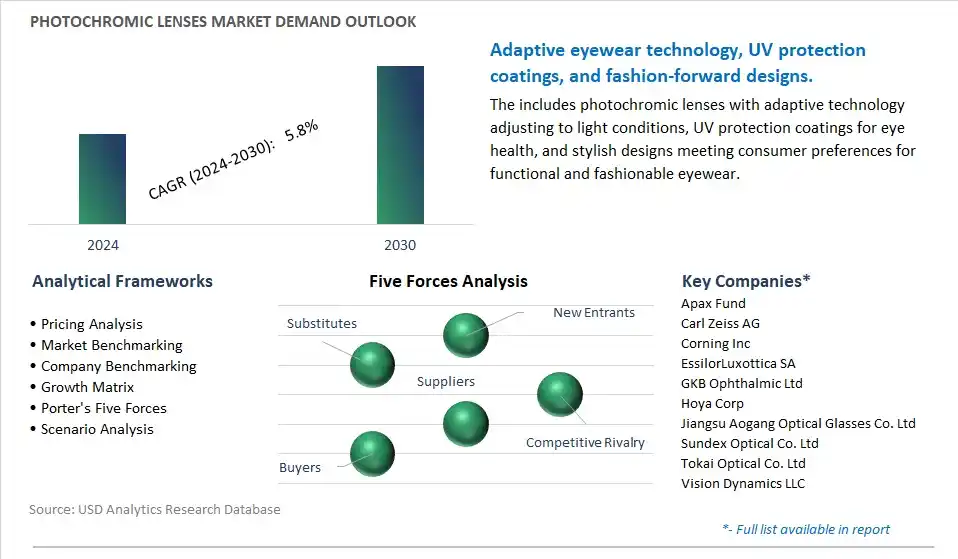
Photochromic Lenses Market is estimated to increase at a Compounded Annual Growth Rate of 5.8% CAGR over the forecast period from 2024 to 2030
The Photochromic Lenses Market study analyzes and forecasts the market size across 6 regions and 24 countries for diverse segments- By Material (Glass, Polycarbonate, Plastic), By Technology (UV and Visible Light, Imbibing and Trans-bonding, In Mass, Others), By Application (Corrective, Preventive), By Sales Channel (Specialty Clinics, Online, Others).
An Introduction to Photochromic Lenses Market in 2024
In 2024, the market for photochromic lenses continues to expand, driven by the growing demand for eyewear that offers both vision correction and light-sensitive tinting capabilities. Photochromic lenses, also known as transition lenses, are optical lenses that darken in response to UV light exposure and return to their clear state when indoors or at night. These lenses provide wearers with the convenience of automatic light adaptation, reducing glare and enhancing visual comfort in changing light conditions. The market for photochromic lenses encompasses a wide range of lens materials, designs, and prescription options, catering to the diverse needs and preferences of eyeglass wearers. Technological advancements in photochromic lens technology focus on improving light-reactive properties, color consistency, and activation speed, ensuring rapid and uniform tinting transitions across the entire lens surface. Additionally, the integration of advanced UV-blocking and blue light-filtering coatings enhances eye protection and visual performance, reducing the risk of UV-related eye damage and digital eye strain. With the increasing awareness of the importance of eye health and the growing demand for multifunctional eyewear solutions, the market for photochromic lenses is poised for continued growth and innovation, offering consumers superior visual comfort, convenience, and protection against environmental stressors.
Market Trend: Increasing Demand for Eye Protection and Comfort
A prominent trend in the Photochromic Lenses market is the increasing demand for eye protection and comfort. With growing awareness of the harmful effects of ultraviolet (UV) radiation on eye health and the importance of protecting eyes from glare and blue light exposure, there is a rising preference for photochromic lenses that offer enhanced UV protection, glare reduction, and blue light filtering capabilities. Photochromic lenses automatically darken in response to UV exposure, providing convenient and effective protection against harmful rays outdoors, while also offering clear vision indoors. Additionally, advancements in lens technology have led to the development of photochromic lenses with faster activation and fadeback times, improved clarity, and broader coverage of the visible light spectrum, meeting the evolving needs and preferences of consumers for comfortable and versatile eyewear solutions.
Market Driver: Growing Aging Population and Prevalence of Eye Conditions
A primary driver fueling the growth of the Photochromic Lenses market is the growing aging population and the increasing prevalence of age-related eye conditions such as cataracts and macular degeneration. As the global population ages, there is a rising incidence of age-related eye disorders that require vision correction and protection from UV radiation. Photochromic lenses offer a convenient and practical solution for individuals with age-related vision problems, providing both vision correction and UV protection in a single lens. Additionally, the growing prevalence of digital device use and prolonged screen time has led to an increased awareness of the importance of blue light protection to reduce eye strain and discomfort, further driving the demand for photochromic lenses with blue light filtering capabilities. The demographic shift towards an older population and the increasing incidence of age-related eye conditions contribute to the continued growth of the Photochromic Lenses market.
Market Opportunity: Expansion into Fashion and Lifestyle Eyewear
An emerging opportunity in the Photochromic Lenses market lies in the expansion into fashion and lifestyle eyewear segments. While photochromic lenses have traditionally been associated with outdoor and sports eyewear, there is potential for their adoption in fashion and lifestyle eyewear categories to address the growing demand for stylish and versatile eyewear options. By collaborating with fashion designers and eyewear brands, manufacturers can incorporate photochromic lens technology into fashionable frames and styles that appeal to fashion-conscious consumers seeking both aesthetic appeal and functional benefits. Additionally, there is an opportunity to develop specialized photochromic lenses tailored to specific lifestyle needs, such as driving, reading, and computer use, offering customized solutions for different daily activities and environments. By tapping into the fashion and lifestyle eyewear market, manufacturers can broaden their customer base, differentiate their product offerings, and capitalize on new opportunities for growth and innovation in the Photochromic Lenses market.
Photochromic Lenses Market Share Analysis: Polycarbonate Photochromic Lenses for Corrective Application
Among the various materials, technologies, applications, and sales channels in the photochromic lenses market, polycarbonate photochromic lenses for corrective application are experiencing rapid growth. Polycarbonate lenses offer several advantages, including impact resistance, lightweight, and UV protection, making them ideal for corrective eyewear applications. When combined with photochromic technology, which allows the lenses to darken when exposed to UV light and fade back to clear indoors, polycarbonate photochromic lenses provide wearers with added convenience and protection from harmful UV rays. Corrective eyewear is in high demand among individuals with refractive errors such as myopia, hyperopia, and astigmatism, as well as presbyopia, which commonly affects individuals over the age of 40. As awareness of the importance of eye health and vision correction grows, and as the global population ages, there is an increasing need for advanced corrective eyewear solutions that offer both vision correction and UV protection. Specialty clinics and online retailers play a crucial role in providing consumers with access to a wide range of eyewear options, including polycarbonate photochromic lenses, tailored to their individual needs and preferences. Moreover, advancements in lens manufacturing technology and materials drive innovation in the photochromic lenses market, further fueling the demand for polycarbonate photochromic lenses for corrective application. As consumers prioritize convenience, comfort, and eye protection, the market for polycarbonate photochromic lenses for corrective application is expected to witness significant growth in the photochromic lenses market.
Photochromic Lenses Competitive Analysis
The market research study provides in-depth insights into leading companies including the SWOT analyses, product profile, financial details, and recent developments acrossApax Fund, Carl Zeiss AG, Corning Inc, EssilorLuxottica SA, GKB Ophthalmic Ltd, Hoya Corp, Jiangsu Aogang Optical Glasses Co. Ltd, Sundex Optical Co. Ltd, Tokai Optical Co. Ltd, Vision Dynamics LLC
Photochromic Lenses Market Segmentation
By Material
Glass
Polycarbonate
Plastic
By Technology
UV and Visible Light
Imbibing and Trans-bonding
In Mass
Others
By Application
Corrective
Preventive
By Sales Channel
Specialty Clinics
Online
Others
Geographical Analysis
North America (United States, Canada, Mexico)
Europe (Germany, France, United Kingdom, Spain, Italy, Rest of Europe)
Asia Pacific (China, India, Japan, South Korea, Rest of Asia Pacific)
South America (Brazil, Argentina, Rest of South America)
Middle East and Africa (Saudi Arabia, UAE, Rest of Middle East, South Africa, Egypt, Rest of Africa)
Photochromic Lenses Market Companies
Apax Fund
Carl Zeiss AG
Corning Inc
EssilorLuxottica SA
GKB Ophthalmic Ltd
Hoya Corp
Jiangsu Aogang Optical Glasses Co. Ltd
Sundex Optical Co. Ltd
Tokai Optical Co. Ltd
Vision Dynamics LLC
Reasons to Buy the Photochromic Lenses Market Study
• Deepen your industry insights and navigate uncertainties for strategy formulation, CAPEX, and Operational decisions
• Gain access to detailed insights on the Photochromic Lenses Market, encompassing current market size, growth trends, and forecasts till 2030.
• Access detailed competitor analysis, enabling competitive advantage through a thorough understanding of market players, strategies, and potential differentiation opportunities
• Stay ahead of the curve with insights on technological advancements, innovations, and upcoming trends
• Identify lucrative investment avenues and expansion opportunities within the Photochromic Lenses Market industry, guided by robust, data-backed analysis.
• Understand regional and global markets through country-wise analysis, regional market potential, regulatory nuances, and dynamics
• Execute strategies with confidence and speed through information, analytics, and insights on the industry value chain
• Corporate leaders, strategists, financial experts, shareholders, asset managers, and governmental representatives can make long-term planning scenarios and build an integrated and timely understanding of market dynamics
• Benefit from tailored solutions and expert consultation based on report insights, providing personalized strategies aligned with specific business needs.
TABLE OF CONTENTS
1 Introduction to 2024 Photochromic Lenses Market
1.1 Market Overview
1.2 Quick Facts
1.3 Scope/Objective of the Study
1.4 Market Definition
1.5 Countries and Regions Covered
1.6 Units, Currency, and Conversions
1.7 Industry Value Chain
2 Research Methodology
2.1 Market Size Estimation
2.2 Sources and Research Methodology
2.3 Data Triangulation
2.4 Assumptions and Limitations
3 Executive Summary
3.1 Global Photochromic Lenses Market Size Outlook, $ Million, 2021 to 2030
3.2 Photochromic Lenses Market Outlook by Type, $ Million, 2021 to 2030
3.3 Photochromic Lenses Market Outlook by Product, $ Million, 2021 to 2030
3.4 Photochromic Lenses Market Outlook by Application, $ Million, 2021 to 2030
3.5 Photochromic Lenses Market Outlook by Key Countries, $ Million, 2021 to 2030
4 Market Dynamics
4.1 Key Driving Forces of Photochromic Lenses Industry
4.2 Key Market Trends in Photochromic Lenses Industry
4.3 Potential Opportunities in Photochromic Lenses Industry
4.4 Key Challenges in Photochromic Lenses Industry
5 Market Factor Analysis
5.1 Value Chain Analysis
5.2 Competitive Landscape
5.2.1 Global Photochromic Lenses Market Share by Company (%), 2023
5.2.2 Product Offerings by Company
5.3 Porter’s Five Forces Analysis
5.4 Pricing Analysis and Outlook
6 Growth Outlook Across Scenarios
6.1 Growth Analysis-Case Scenario Definitions
6.2 Low Growth Scenario Forecasts
6.3 Reference Growth Scenario Forecasts
6.4 High Growth Scenario Forecasts
7 Global Photochromic Lenses Market Outlook by Segments
7.1 Photochromic Lenses Market Outlook by Segments, $ Million, 2021- 2030
By Material
Glass
Polycarbonate
Plastic
By Technology
UV and Visible Light
Imbibing and Trans-bonding
In Mass
Others
By Application
Corrective
Preventive
By Sales Channel
Specialty Clinics
Online
Others
8 North America Photochromic Lenses Market Analysis and Outlook To 2030
8.1 Introduction to North America Photochromic Lenses Markets in 2024
8.2 North America Photochromic Lenses Market Size Outlook by Country, 2021-2030
8.2.1 United States
8.2.2 Canada
8.2.3 Mexico
8.3 North America Photochromic Lenses Market size Outlook by Segments, 2021-2030
By Material
Glass
Polycarbonate
Plastic
By Technology
UV and Visible Light
Imbibing and Trans-bonding
In Mass
Others
By Application
Corrective
Preventive
By Sales Channel
Specialty Clinics
Online
Others
9 Europe Photochromic Lenses Market Analysis and Outlook To 2030
9.1 Introduction to Europe Photochromic Lenses Markets in 2024
9.2 Europe Photochromic Lenses Market Size Outlook by Country, 2021-2030
9.2.1 Germany
9.2.2 France
9.2.3 Spain
9.2.4 United Kingdom
9.2.4 Italy
9.2.5 Russia
9.2.6 Norway
9.2.7 Rest of Europe
9.3 Europe Photochromic Lenses Market Size Outlook by Segments, 2021-2030
By Material
Glass
Polycarbonate
Plastic
By Technology
UV and Visible Light
Imbibing and Trans-bonding
In Mass
Others
By Application
Corrective
Preventive
By Sales Channel
Specialty Clinics
Online
Others
10 Asia Pacific Photochromic Lenses Market Analysis and Outlook To 2030
10.1 Introduction to Asia Pacific Photochromic Lenses Markets in 2024
10.2 Asia Pacific Photochromic Lenses Market Size Outlook by Country, 2021-2030
10.2.1 China
10.2.2 India
10.2.3 Japan
10.2.4 South Korea
10.2.5 Indonesia
10.2.6 Malaysia
10.2.7 Australia
10.2.8 Rest of Asia Pacific
10.3 Asia Pacific Photochromic Lenses Market size Outlook by Segments, 2021-2030
By Material
Glass
Polycarbonate
Plastic
By Technology
UV and Visible Light
Imbibing and Trans-bonding
In Mass
Others
By Application
Corrective
Preventive
By Sales Channel
Specialty Clinics
Online
Others
11 South America Photochromic Lenses Market Analysis and Outlook To 2030
11.1 Introduction to South America Photochromic Lenses Markets in 2024
11.2 South America Photochromic Lenses Market Size Outlook by Country, 2021-2030
11.2.1 Brazil
11.2.2 Argentina
11.2.3 Rest of South America
11.3 South America Photochromic Lenses Market size Outlook by Segments, 2021-2030
By Material
Glass
Polycarbonate
Plastic
By Technology
UV and Visible Light
Imbibing and Trans-bonding
In Mass
Others
By Application
Corrective
Preventive
By Sales Channel
Specialty Clinics
Online
Others
12 Middle East and Africa Photochromic Lenses Market Analysis and Outlook To 2030
12.1 Introduction to Middle East and Africa Photochromic Lenses Markets in 2024
12.2 Middle East and Africa Photochromic Lenses Market Size Outlook by Country, 2021-2030
12.2.1 Saudi Arabia
12.2.2 UAE
12.2.3 Oman
12.2.4 Rest of Middle East
12.2.5 Egypt
12.2.6 Nigeria
12.2.7 South Africa
12.2.8 Rest of Africa
12.3 Middle East and Africa Photochromic Lenses Market size Outlook by Segments, 2021-2030
By Material
Glass
Polycarbonate
Plastic
By Technology
UV and Visible Light
Imbibing and Trans-bonding
In Mass
Others
By Application
Corrective
Preventive
By Sales Channel
Specialty Clinics
Online
Others
13 Company Profiles
13.1 Company Snapshot
13.2 SWOT Profiles
13.3 Products and Services
13.4 Recent Developments
13.5 Financial Profile
List of Companies
Apax Fund
Carl Zeiss AG
Corning Inc
EssilorLuxottica SA
GKB Ophthalmic Ltd
Hoya Corp
Jiangsu Aogang Optical Glasses Co. Ltd
Sundex Optical Co. Ltd
Tokai Optical Co. Ltd
Vision Dynamics LLC
14 Appendix
14.1 Customization Offerings
14.2 Subscription Services
14.3 Related Reports
14.4 Publisher Expertise
By Material
Glass
Polycarbonate
Plastic
By Technology
UV and Visible Light
Imbibing and Trans-bonding
In Mass
Others
By Application
Corrective
Preventive
By Sales Channel
Specialty Clinics
Online
Others
Countries Analyzed
North America (United States, Canada, Mexico)
Europe (Germany, France, United Kingdom, Spain, Italy, Rest of Europe)
Asia Pacific (China, India, Japan, South Korea, Rest of Asia Pacific)
South America (Brazil, Argentina, Rest of South America)
Middle East and Africa (Saudi Arabia, UAE, Rest of Middle East, South Africa, Egypt, Rest of Africa)
