
The global Photoresist Chemicals Market Study analyzes and forecasts the market size across 6 regions and 24 countries for diverse segments -By Type (Positive photoresist, Negative photoresist ), By Application (Microelectronics, Sand carving, Fabrication of printed circuit boards, Semiconductor, Others).
The key trend shaping the future of the photoresist chemicals industry is the continuous advancement of semiconductor manufacturing processes and the demand for higher-resolution, more precise lithography materials to support the production of advanced integrated circuits (ICs), microprocessors, and memory chips. Photoresist chemicals are light-sensitive materials used in photolithography processes to transfer circuit patterns onto semiconductor wafers during IC fabrication. With the ongoing miniaturization of semiconductor devices and the transition to smaller technology nodes such as 7nm, 5nm, and beyond, there is a growing need for photoresist materials that offer submicron resolution, low line edge roughness (LER), and excellent pattern fidelity. Manufacturers are investing in the development of next-generation photoresist formulations, including chemically amplified resists (CARs), metal-containing resists, and EUV-compatible materials, to meet the stringent requirements of advanced lithography techniques such as extreme ultraviolet (EUV) lithography. Additionally, there is a trend towards the use of advanced patterning techniques such as multiple patterning, self-aligned double patterning (SADP), and self-aligned quadruple patterning (SAQP) to achieve smaller feature sizes and tighter pitch requirements in semiconductor manufacturing. Furthermore, with the increasing complexity of semiconductor device architectures, including FinFETs, gate-all-around (GAA) transistors, and 3D packaging technologies, there is a growing demand for photoresist materials that offer superior etch resistance, thermal stability, and compatibility with advanced process integration schemes. As the semiconductor industry continues to push the limits of technology and innovation, the demand for high-performance photoresist chemicals is expected to grow, driving market expansion and technological advancement in semiconductor manufacturing.
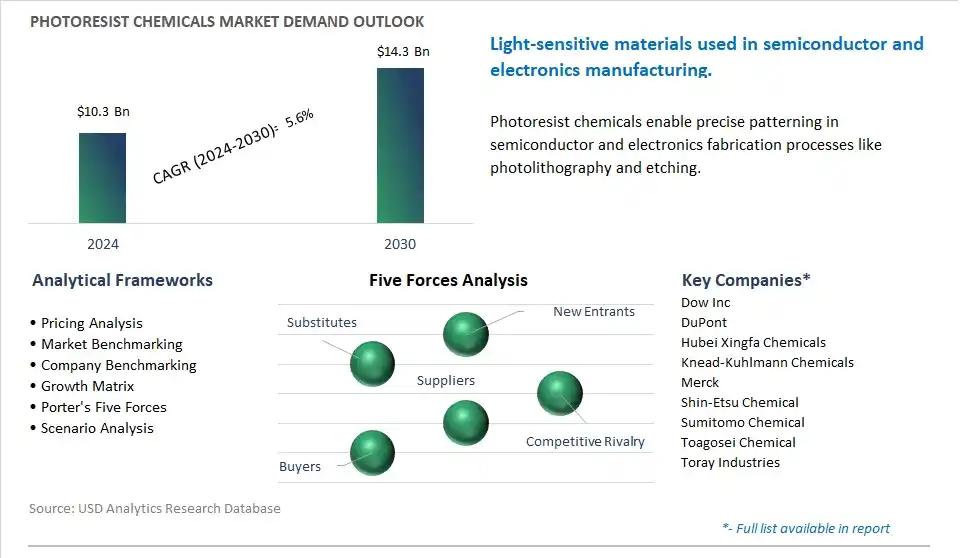
The market report analyses the leading companies in the industry including Dow Inc, DuPont, Hubei Xingfa Chemicals, Knead-Kuhlmann Chemicals, Merck, Shin-Etsu Chemical, Sumitomo Chemical, Toagosei Chemical, Toray Industries.
One prominent trend in the photoresist chemicals market is the increasing demand for advanced semiconductor devices. As the semiconductor industry continues to evolve rapidly, driven by trends such as artificial intelligence, 5G connectivity, and Internet of Things (IoT), there is a growing need for high-performance photoresist chemicals used in photolithography processes. These chemicals play a crucial role in defining intricate patterns on semiconductor wafers, enabling the production of smaller, faster, and more energy-efficient electronic components, which are essential for next-generation devices.
A significant driver propelling the photoresist chemicals market is the continuous technological advancements in semiconductor manufacturing processes. As semiconductor manufacturers strive to enhance chip performance, reduce power consumption, and increase production yields, there is a growing demand for photoresist chemicals with improved resolution, sensitivity, and etch resistance. Innovations in photoresist formulations, such as chemically amplified resists (CARs) and extreme ultraviolet (EUV) photoresists, are driving the adoption of advanced lithography techniques, driving market growth in the semiconductor industry.
An opportunity for the photoresist chemicals market lies in the expansion of virtual reality (VR) and augmented reality (AR) applications. As VR and AR technologies gain momentum across various sectors, including gaming, entertainment, healthcare, education, and automotive, there is an increasing demand for high-resolution displays, sensors, and imaging systems. Photoresist chemicals are essential in the fabrication of advanced microdisplay panels, image sensors, and optical components used in VR and AR devices. Manufacturers focusing on developing photoresist chemicals optimized for microfabrication processes can capitalize on the growing demand for immersive digital experiences, creating opportunities for growth and innovation in the semiconductor market.
The largest segment in the Photoresist Chemicals Market is the Positive photoresist segment. Positive photoresists are widely used in semiconductor manufacturing processes, particularly in the production of integrated circuits (ICs) and microelectronic devices. These photoresists are formulated to become soluble or undergo chemical changes when exposed to light, resulting in the formation of a positive image of the desired pattern on a substrate. Positive photoresists offer potential advantages, including high sensitivity, excellent resolution, and good adhesion to substrates, making them suitable for patterning fine features and achieving high levels of device integration. Additionally, positive photoresists exhibit good etch resistance and process stability, enabling precise and reproducible pattern transfer during subsequent processing steps, such as etching and deposition. Further, positive photoresist materials are compatible with a wide range of lithography techniques, including optical, electron beam, and X-ray lithography, providing flexibility and versatility in semiconductor fabrication processes. Furthermore, positive photoresists are preferred for applications requiring complex multilayer patterning and advanced process integration, such as in the production of memory devices, logic circuits, and microelectromechanical systems (MEMS). Over the forecast period, the superior performance, versatility, and widespread adoption of positive photoresists in semiconductor manufacturing processes position them as the largest segment in the Photoresist Chemicals Market.
The fastest-growing segment in the Photoresist Chemicals Market is the Semiconductor application segment. Diverse factors contribute to the rapid growth of photoresist chemicals in semiconductor applications. The semiconductor industry is experiencing significant technological advancements and increasing demand for advanced semiconductor devices with higher performance, greater functionality, and smaller form factors. Photoresist chemicals play a critical role in semiconductor manufacturing processes, particularly in photolithography, where they are used to transfer intricate patterns onto silicon wafers during the fabrication of integrated circuits (ICs) and other semiconductor devices. As semiconductor nodes continue to shrink and device geometries become increasingly complex, the demand for high-performance photoresists capable of achieving finer feature sizes, tighter critical dimensions, and improved pattern fidelity grows. Additionally, the shift towards advanced lithography techniques, such as extreme ultraviolet (EUV) lithography and multi-patterning, requires specialized photoresist formulations optimized for specific wavelength ranges, process conditions, and device requirements. Further, the expansion of semiconductor markets, including automotive, consumer electronics, telecommunications, and industrial applications, drives the demand for semiconductor-grade photoresists across diverse product segments and end-user industries. Furthermore, investments in research and development (R&D) to develop next-generation photoresist materials, process optimization, and manufacturing technologies contribute to the continuous improvement and innovation in semiconductor photoresist chemistries, enabling manufacturers to meet the evolving demands of the semiconductor industry. Over the forecast period, the combination of technological advancements, market demand, and industry growth prospects positions the Semiconductor application segment as the fastest-growing segment in the Photoresist Chemicals Market.
By Type
Positive photoresist
Negative photoresist
By Application
Microelectronics
Sand carving
Fabrication of printed circuit boards
Semiconductor
Others
Regions Included
North America (US, Canada, Mexico)
Europe (Germany, UK, France, Spain, Italy, Russia, Rest of Europe)
Asia Pacific (China, India, Japan, South Korea, Australia, South East Asia, Rest of Asia)
South America (Brazil, Argentina, Rest of South America)
Middle East and Africa (Saudi Arabia, UAE, Rest of Middle East, South Africa, Egypt, Rest of Africa)
Dow Inc
DuPont
Hubei Xingfa Chemicals
Knead-Kuhlmann Chemicals
Merck
Shin-Etsu Chemical
Sumitomo Chemical
Toagosei Chemical
Toray Industries
*- List Not Exhaustive
TABLE OF CONTENTS
1 Introduction to 2024 Photoresist Chemicals Market
1.1 Market Overview
1.2 Quick Facts
1.3 Scope/Objective of the Study
1.4 Market Definition
1.5 Countries and Regions Covered
1.6 Units, Currency, and Conversions
1.7 Industry Value Chain
2 Research Methodology
2.1 Market Size Estimation
2.2 Sources and Research Methodology
2.3 Data Triangulation
2.4 Assumptions and Limitations
3 Executive Summary
3.1 Global Photoresist Chemicals Market Size Outlook, $ Million, 2021 to 2030
3.2 Photoresist Chemicals Market Outlook by Type, $ Million, 2021 to 2030
3.3 Photoresist Chemicals Market Outlook by Product, $ Million, 2021 to 2030
3.4 Photoresist Chemicals Market Outlook by Application, $ Million, 2021 to 2030
3.5 Photoresist Chemicals Market Outlook by Key Countries, $ Million, 2021 to 2030
4 Market Dynamics
4.1 Key Driving Forces of Photoresist Chemicals Industry
4.2 Key Market Trends in Photoresist Chemicals Industry
4.3 Potential Opportunities in Photoresist Chemicals Industry
4.4 Key Challenges in Photoresist Chemicals Industry
5 Market Factor Analysis
5.1 Value Chain Analysis
5.2 Competitive Landscape
5.2.1 Global Photoresist Chemicals Market Share by Company (%), 2023
5.2.2 Product Offerings by Company
5.3 Porter’s Five Forces Analysis
5.4 Pricing Analysis and Outlook
6 Growth Outlook Across Scenarios
6.1 Growth Analysis-Case Scenario Definitions
6.2 Low Growth Scenario Forecasts
6.3 Reference Growth Scenario Forecasts
6.4 High Growth Scenario Forecasts
7 Global Photoresist Chemicals Market Outlook by Segments
7.1 Photoresist Chemicals Market Outlook by Segments, $ Million, 2021- 2030
By Type
Positive photoresist
Negative photoresist
By Application
Microelectronics
Sand carving
Fabrication of printed circuit boards
Semiconductor
Others
8 North America Photoresist Chemicals Market Analysis and Outlook To 2030
8.1 Introduction to North America Photoresist Chemicals Markets in 2024
8.2 North America Photoresist Chemicals Market Size Outlook by Country, 2021-2030
8.2.1 United States
8.2.2 Canada
8.2.3 Mexico
8.3 North America Photoresist Chemicals Market size Outlook by Segments, 2021-2030
By Type
Positive photoresist
Negative photoresist
By Application
Microelectronics
Sand carving
Fabrication of printed circuit boards
Semiconductor
Others
9 Europe Photoresist Chemicals Market Analysis and Outlook To 2030
9.1 Introduction to Europe Photoresist Chemicals Markets in 2024
9.2 Europe Photoresist Chemicals Market Size Outlook by Country, 2021-2030
9.2.1 Germany
9.2.2 France
9.2.3 Spain
9.2.4 United Kingdom
9.2.4 Italy
9.2.5 Russia
9.2.6 Norway
9.2.7 Rest of Europe
9.3 Europe Photoresist Chemicals Market Size Outlook by Segments, 2021-2030
By Type
Positive photoresist
Negative photoresist
By Application
Microelectronics
Sand carving
Fabrication of printed circuit boards
Semiconductor
Others
10 Asia Pacific Photoresist Chemicals Market Analysis and Outlook To 2030
10.1 Introduction to Asia Pacific Photoresist Chemicals Markets in 2024
10.2 Asia Pacific Photoresist Chemicals Market Size Outlook by Country, 2021-2030
10.2.1 China
10.2.2 India
10.2.3 Japan
10.2.4 South Korea
10.2.5 Indonesia
10.2.6 Malaysia
10.2.7 Australia
10.2.8 Rest of Asia Pacific
10.3 Asia Pacific Photoresist Chemicals Market size Outlook by Segments, 2021-2030
By Type
Positive photoresist
Negative photoresist
By Application
Microelectronics
Sand carving
Fabrication of printed circuit boards
Semiconductor
Others
11 South America Photoresist Chemicals Market Analysis and Outlook To 2030
11.1 Introduction to South America Photoresist Chemicals Markets in 2024
11.2 South America Photoresist Chemicals Market Size Outlook by Country, 2021-2030
11.2.1 Brazil
11.2.2 Argentina
11.2.3 Rest of South America
11.3 South America Photoresist Chemicals Market size Outlook by Segments, 2021-2030
By Type
Positive photoresist
Negative photoresist
By Application
Microelectronics
Sand carving
Fabrication of printed circuit boards
Semiconductor
Others
12 Middle East and Africa Photoresist Chemicals Market Analysis and Outlook To 2030
12.1 Introduction to Middle East and Africa Photoresist Chemicals Markets in 2024
12.2 Middle East and Africa Photoresist Chemicals Market Size Outlook by Country, 2021-2030
12.2.1 Saudi Arabia
12.2.2 UAE
12.2.3 Oman
12.2.4 Rest of Middle East
12.2.5 Egypt
12.2.6 Nigeria
12.2.7 South Africa
12.2.8 Rest of Africa
12.3 Middle East and Africa Photoresist Chemicals Market size Outlook by Segments, 2021-2030
By Type
Positive photoresist
Negative photoresist
By Application
Microelectronics
Sand carving
Fabrication of printed circuit boards
Semiconductor
Others
13 Company Profiles
13.1 Company Snapshot
13.2 SWOT Profiles
13.3 Products and Services
13.4 Recent Developments
13.5 Financial Profile
Dow Inc
DuPont
Hubei Xingfa Chemicals
Knead-Kuhlmann Chemicals
Merck
Shin-Etsu Chemical
Sumitomo Chemical
Toagosei Chemical
Toray Industries
14 Appendix
14.1 Customization Offerings
14.2 Subscription Services
14.3 Related Reports
14.4 Publisher Expertise
By Type
Positive photoresist
Negative photoresist
By Application
Microelectronics
Sand carving
Fabrication of printed circuit boards
Semiconductor
Others
Countries Analyzed
North America (US, Canada, Mexico)
Europe (Germany, UK, France, Spain, Italy, Russia, Rest of Europe)
Asia Pacific (China, India, Japan, South Korea, Australia, South East Asia, Rest of Asia)
South America (Brazil, Argentina, Rest of South America)
Middle East and Africa (Saudi Arabia, UAE, Rest of Middle East, South Africa, Egypt, Rest of Africa)
Global Photoresist Chemicals is forecast to reach $14.3 Billion in 2030 from $10.3 Billion in 2024, registering a CAGR of 5.6%
Emerging Markets across Asia Pacific, Europe, and Americas present robust growth prospects.
Dow Inc, DuPont, Hubei Xingfa Chemicals, Knead-Kuhlmann Chemicals, Merck, Shin-Etsu Chemical, Sumitomo Chemical, Toagosei Chemical, Toray Industries
Base Year- 2023; Estimated Year- 2024; Historic Period- 2018-2023; Forecast period- 2024 to 2030; Currency: Revenue (USD); Volume