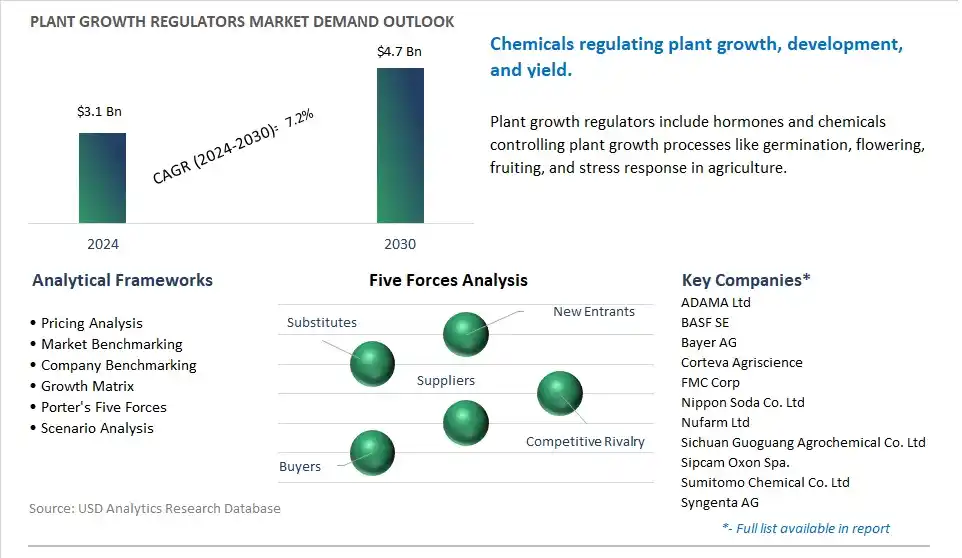
The global Plant Growth Regulators Market is poised to register a 7.2% CAGR from $3.1 Billion in 2024 to $4.7 Billion in 2030.
The global Plant Growth Regulators Market Study analyzes and forecasts the market size across 6 regions and 24 countries for diverse segments -By Type (Cytokinins, Auxins, Gibberellins, Ethylene, Others), By Crop (Cereals & Grains, Oilseeds & Pulses, Fruits & Vegetables, Turfs & Ornamentals), By Formulation (Water-Dispersible & Water-soluble Granules, Wettable Powders, Solutions), By Function (Plant Growth Promoters, Plant Growth Inhibitors).
An Introduction to Global Plant Growth Regulators Market in 2024
The key trend shaping the future of the plant growth regulators industry is the increasing adoption of biostimulants, biofertilizers, and precision agriculture technologies to enhance crop yield, quality, and resilience in response to climate change, resource constraints, and evolving consumer preferences. Plant growth regulators (PGRs) are natural or synthetic compounds that influence plant physiological processes such as growth, development, and stress responses, offering opportunities to optimize plant performance and productivity in agriculture, horticulture, and turf management. With growing pressure to feed a growing global population while minimizing environmental impact and resource usage, there is a rising need for plant growth regulators that improve nutrient uptake, water efficiency, and stress tolerance in crops. Manufacturers are investing in the development of novel PGR formulations, application methods, and delivery systems to maximize efficacy, minimize environmental impact, and ensure regulatory compliance in agriculture. Additionally, there is a trend towards the integration of PGRs into integrated pest management (IPM) programs, organic farming systems, and sustainable agriculture practices to enhance crop resilience to biotic and abiotic stresses, reduce reliance on chemical inputs, and promote soil health and biodiversity. Furthermore, with increasing consumer demand for sustainably produced, nutritious, and flavorful food, there is a growing interest in PGRs that enhance crop quality attributes such as taste, texture, color, and shelf life, meeting the preferences of discerning consumers and food industry stakeholders. As agriculture continues to evolve towards more sustainable and resilient production systems, the demand for plant growth regulators is expected to grow, driving market expansion and technological innovation in crop protection and enhancement products.
Plant Growth Regulators Market Competitive Landscape
The market report analyses the leading companies in the industry including ADAMA Ltd, BASF SE, Bayer AG, Corteva Agriscience, FMC Corp, Nippon Soda Co. Ltd, Nufarm Ltd, Sichuan Guoguang Agrochemical Co. Ltd, Sipcam Oxon Spa., Sumitomo Chemical Co. Ltd, Syngenta AG, Tata Chemicals Ltd, UPL Ltd, Xinyi Industrial Co. Ltd, Zagro.
Plant Growth Regulators Market Dynamics
Plant Growth Regulators Market Trend: Increasing Adoption of Organic Farming Practices
A prominent trend in the plant growth regulators market is the rising adoption of organic farming practices. With growing awareness about the environmental impact of conventional agriculture and the health benefits of organic produce, farmers are shifting towards organic cultivation methods. Plant growth regulators play a crucial role in organic farming by promoting plant growth, enhancing stress tolerance, and improving crop yield and quality. Accordingly, there is a growing demand for natural and eco-friendly plant growth regulators derived from organic sources, such as seaweed extracts, humic substances, and microbial inoculants, to support sustainable agriculture practices and meet the needs of environmentally conscious consumers.
Plant Growth Regulators Market Driver: Need for Enhanced Crop Yield and Quality
The primary driver fueling the plant growth regulators market is the need to achieve enhanced crop yield and quality in agriculture. With a growing global population and increasing food demand, there is mounting pressure on farmers to maximize crop productivity and optimize resource utilization. Plant growth regulators offer valuable solutions to address this challenge by regulating various physiological processes in plants, including germination, flowering, fruit development, and stress response. By applying plant growth regulators strategically, farmers can stimulate root development, increase nutrient uptake, improve flowering and fruit set, and enhance crop tolerance to biotic and abiotic stresses, ultimately leading to higher yields, better quality produce, and improved farm profitability.
Plant Growth Regulators Market Opportunity: Development of Novel Formulations and Delivery Systems
An opportunity for the plant growth regulators market lies in the development of novel formulations and delivery systems that enhance the efficacy, safety, and convenience of plant growth regulator applications. Innovations in formulation technology, such as microencapsulation, nanoemulsions, and biopolymer matrices, enable the controlled release and targeted delivery of active ingredients, ensuring optimal plant response and minimizing environmental impact. Additionally, advancements in precision agriculture technologies, including drones, sensors, and automated sprayers, facilitate precise and efficient application of plant growth regulators, reducing wastage and maximizing efficacy. By investing in research and development of innovative formulations and delivery systems tailored to specific crops and growing conditions, manufacturers can capitalize on the growing demand for effective and sustainable plant growth enhancement solutions and expand their market presence in the agricultural sector.
Plant Growth Regulators Market Share Analysis: Auxins generated the highest revenue in 2024
The largest segment in the Plant Growth Regulators Market is the Auxins category. Auxins play a crucial role in regulating various aspects of plant growth and development, including cell elongation, root initiation, apical dominance, and fruit development. They are involved in tropic responses such as phototropism and gravitropism, as well as in the formation of vascular tissues and the coordination of plant responses to environmental stimuli. Due to their diverse functions and widespread effects on plant physiology, auxins are widely used in agriculture, horticulture, and forestry for various applications such as rooting of cuttings, fruit thinning, and weed control. Additionally, auxin-based herbicides are commonly used to control broadleaf weeds in crops such as cereals, soybeans, and cotton. Further, advancements in biotechnology and genetic engineering have led to the development of novel auxin formulations and genetically modified crops with altered auxin signaling pathways, further driving the demand for auxin-based plant growth regulators. Accordingly, the Auxins segment is the largest in the Plant Growth Regulators Market due to the widespread use and importance of auxins in plant growth and crop management.
Plant Growth Regulators Market Share Analysis: Fruits & Vegetables segment is poised to register the fastest growth rate (CAGR) over the forecast period to 2030
The fastest-growing segment in the Plant Growth Regulators Market is the Fruits & Vegetables category. This is driving increased demand for plant growth regulators in fruit and vegetable production. There is a growing emphasis on improving crop yield, quality, and post-harvest characteristics to meet the rising demand for fresh produce in both domestic and international markets. Plant growth regulators offer valuable tools for growers to manipulate plant growth, flowering, fruit set, ripening, and shelf-life, thereby optimizing yield and quality parameters. Additionally, the intensification of fruit and vegetable production systems, including high-density planting, protected cultivation, and off-season production, creates challenges related to plant vigor, fruit size, and uniformity that can be addressed through the use of growth regulators. Further, consumer preferences for premium-quality fruits and vegetables with desirable attributes such as color, flavor, and nutritional content are driving the adoption of growth regulators to enhance crop traits and marketability. Furthermore, the adoption of sustainable agriculture practices, such as reduced pesticide use and integrated pest management, is driving the demand for alternative strategies like plant growth regulators to optimize crop productivity while minimizing environmental impact. Accordingly, the Fruits & Vegetables segment is the fastest-growing in the Plant Growth Regulators Market as growers increasingly recognize the benefits of growth regulators in improving yield, quality, and profitability in fruit and vegetable production systems.
Plant Growth Regulators Market Share Analysis: The water-dispersible & Water-Soluble Granules segment is poised to register the fastest growth rate (CAGR) over the forecast period to 2030
The fastest-growing segment in the Plant Growth Regulators Market is the Water-Dispersible & Water-Soluble Granules category. This is driving increased demand for granular formulations of plant growth regulators. granular formulations offer potential advantages over traditional liquid formulations, such as ease of handling, storage, and application. Granules can be easily mixed with soil or substrate, allowing for precise placement and uniform distribution of the active ingredient around the root zone of plants. Additionally, granular formulations provide improved stability and reduced risk of leaching or runoff, ensuring better uptake and efficacy of the plant growth regulator by target plants. Further, granules can be engineered to release the active ingredient gradually over time, providing sustained effects and longer-lasting benefits compared to liquid formulations. Furthermore, advancements in formulation technology have led to the development of water-dispersible and water-soluble granules that dissolve quickly in water, making them convenient and user-friendly for growers. Accordingly, the Water-Dispersible & Water-Soluble Granules segment is the fastest-growing in the Plant Growth Regulators Market as growers increasingly recognize the benefits of granular formulations in optimizing plant growth, yield, and quality while minimizing environmental impact.
Plant Growth Regulators Market Report Segmentation
By Type
Cytokinins
Auxins
Gibberellins
Ethylene
Others
By Crop
Cereals & Grains
Oilseeds & Pulses
Fruits & Vegetables
Turfs & Ornamentals
By Formulation
Water-Dispersible & Water-soluble Granules
Wettable Powders
Solutions
By Function
Plant Growth Promoters
Plant Growth Inhibitors
Regions Included
North America (US, Canada, Mexico)
Europe (Germany, UK, France, Spain, Italy, Russia, Rest of Europe)
Asia Pacific (China, India, Japan, South Korea, Australia, South East Asia, Rest of Asia)
South America (Brazil, Argentina, Rest of South America)
Middle East and Africa (Saudi Arabia, UAE, Rest of Middle East, South Africa, Egypt, Rest of Africa)
Plant Growth Regulators Companies Profiled in the Market Study
ADAMA Ltd
BASF SE
Bayer AG
Corteva Agriscience
FMC Corp
Nippon Soda Co. Ltd
Nufarm Ltd
Sichuan Guoguang Agrochemical Co. Ltd
Sipcam Oxon Spa.
Sumitomo Chemical Co. Ltd
Syngenta AG
Tata Chemicals Ltd
UPL Ltd
Xinyi Industrial Co. Ltd
Zagro
*- List Not Exhaustive
TABLE OF CONTENTS
1 Introduction to 2024 Plant Growth Regulators Market
1.1 Market Overview
1.2 Quick Facts
1.3 Scope/Objective of the Study
1.4 Market Definition
1.5 Countries and Regions Covered
1.6 Units, Currency, and Conversions
1.7 Industry Value Chain
2 Research Methodology
2.1 Market Size Estimation
2.2 Sources and Research Methodology
2.3 Data Triangulation
2.4 Assumptions and Limitations
3 Executive Summary
3.1 Global Plant Growth Regulators Market Size Outlook, $ Million, 2021 to 2030
3.2 Plant Growth Regulators Market Outlook by Type, $ Million, 2021 to 2030
3.3 Plant Growth Regulators Market Outlook by Product, $ Million, 2021 to 2030
3.4 Plant Growth Regulators Market Outlook by Application, $ Million, 2021 to 2030
3.5 Plant Growth Regulators Market Outlook by Key Countries, $ Million, 2021 to 2030
4 Market Dynamics
4.1 Key Driving Forces of Plant Growth Regulators Industry
4.2 Key Market Trends in Plant Growth Regulators Industry
4.3 Potential Opportunities in Plant Growth Regulators Industry
4.4 Key Challenges in Plant Growth Regulators Industry
5 Market Factor Analysis
5.1 Value Chain Analysis
5.2 Competitive Landscape
5.2.1 Global Plant Growth Regulators Market Share by Company (%), 2023
5.2.2 Product Offerings by Company
5.3 Porter’s Five Forces Analysis
5.4 Pricing Analysis and Outlook
6 Growth Outlook Across Scenarios
6.1 Growth Analysis-Case Scenario Definitions
6.2 Low Growth Scenario Forecasts
6.3 Reference Growth Scenario Forecasts
6.4 High Growth Scenario Forecasts
7 Global Plant Growth Regulators Market Outlook by Segments
7.1 Plant Growth Regulators Market Outlook by Segments, $ Million, 2021- 2030
By Type
Cytokinins
Auxins
Gibberellins
Ethylene
Others
By Crop
Cereals & Grains
Oilseeds & Pulses
Fruits & Vegetables
Turfs & Ornamentals
By Formulation
Water-Dispersible & Water-soluble Granules
Wettable Powders
Solutions
By Function
Plant Growth Promoters
Plant Growth Inhibitors
8 North America Plant Growth Regulators Market Analysis and Outlook To 2030
8.1 Introduction to North America Plant Growth Regulators Markets in 2024
8.2 North America Plant Growth Regulators Market Size Outlook by Country, 2021-2030
8.2.1 United States
8.2.2 Canada
8.2.3 Mexico
8.3 North America Plant Growth Regulators Market size Outlook by Segments, 2021-2030
By Type
Cytokinins
Auxins
Gibberellins
Ethylene
Others
By Crop
Cereals & Grains
Oilseeds & Pulses
Fruits & Vegetables
Turfs & Ornamentals
By Formulation
Water-Dispersible & Water-soluble Granules
Wettable Powders
Solutions
By Function
Plant Growth Promoters
Plant Growth Inhibitors
9 Europe Plant Growth Regulators Market Analysis and Outlook To 2030
9.1 Introduction to Europe Plant Growth Regulators Markets in 2024
9.2 Europe Plant Growth Regulators Market Size Outlook by Country, 2021-2030
9.2.1 Germany
9.2.2 France
9.2.3 Spain
9.2.4 United Kingdom
9.2.4 Italy
9.2.5 Russia
9.2.6 Norway
9.2.7 Rest of Europe
9.3 Europe Plant Growth Regulators Market Size Outlook by Segments, 2021-2030
By Type
Cytokinins
Auxins
Gibberellins
Ethylene
Others
By Crop
Cereals & Grains
Oilseeds & Pulses
Fruits & Vegetables
Turfs & Ornamentals
By Formulation
Water-Dispersible & Water-soluble Granules
Wettable Powders
Solutions
By Function
Plant Growth Promoters
Plant Growth Inhibitors
10 Asia Pacific Plant Growth Regulators Market Analysis and Outlook To 2030
10.1 Introduction to Asia Pacific Plant Growth Regulators Markets in 2024
10.2 Asia Pacific Plant Growth Regulators Market Size Outlook by Country, 2021-2030
10.2.1 China
10.2.2 India
10.2.3 Japan
10.2.4 South Korea
10.2.5 Indonesia
10.2.6 Malaysia
10.2.7 Australia
10.2.8 Rest of Asia Pacific
10.3 Asia Pacific Plant Growth Regulators Market size Outlook by Segments, 2021-2030
By Type
Cytokinins
Auxins
Gibberellins
Ethylene
Others
By Crop
Cereals & Grains
Oilseeds & Pulses
Fruits & Vegetables
Turfs & Ornamentals
By Formulation
Water-Dispersible & Water-soluble Granules
Wettable Powders
Solutions
By Function
Plant Growth Promoters
Plant Growth Inhibitors
11 South America Plant Growth Regulators Market Analysis and Outlook To 2030
11.1 Introduction to South America Plant Growth Regulators Markets in 2024
11.2 South America Plant Growth Regulators Market Size Outlook by Country, 2021-2030
11.2.1 Brazil
11.2.2 Argentina
11.2.3 Rest of South America
11.3 South America Plant Growth Regulators Market size Outlook by Segments, 2021-2030
By Type
Cytokinins
Auxins
Gibberellins
Ethylene
Others
By Crop
Cereals & Grains
Oilseeds & Pulses
Fruits & Vegetables
Turfs & Ornamentals
By Formulation
Water-Dispersible & Water-soluble Granules
Wettable Powders
Solutions
By Function
Plant Growth Promoters
Plant Growth Inhibitors
12 Middle East and Africa Plant Growth Regulators Market Analysis and Outlook To 2030
12.1 Introduction to Middle East and Africa Plant Growth Regulators Markets in 2024
12.2 Middle East and Africa Plant Growth Regulators Market Size Outlook by Country, 2021-2030
12.2.1 Saudi Arabia
12.2.2 UAE
12.2.3 Oman
12.2.4 Rest of Middle East
12.2.5 Egypt
12.2.6 Nigeria
12.2.7 South Africa
12.2.8 Rest of Africa
12.3 Middle East and Africa Plant Growth Regulators Market size Outlook by Segments, 2021-2030
By Type
Cytokinins
Auxins
Gibberellins
Ethylene
Others
By Crop
Cereals & Grains
Oilseeds & Pulses
Fruits & Vegetables
Turfs & Ornamentals
By Formulation
Water-Dispersible & Water-soluble Granules
Wettable Powders
Solutions
By Function
Plant Growth Promoters
Plant Growth Inhibitors
13 Company Profiles
13.1 Company Snapshot
13.2 SWOT Profiles
13.3 Products and Services
13.4 Recent Developments
13.5 Financial Profile
ADAMA Ltd
BASF SE
Bayer AG
Corteva Agriscience
FMC Corp
Nippon Soda Co. Ltd
Nufarm Ltd
Sichuan Guoguang Agrochemical Co. Ltd
Sipcam Oxon Spa.
Sumitomo Chemical Co. Ltd
Syngenta AG
Tata Chemicals Ltd
UPL Ltd
Xinyi Industrial Co. Ltd
Zagro
14 Appendix
14.1 Customization Offerings
14.2 Subscription Services
14.3 Related Reports
14.4 Publisher Expertise
By Type
Cytokinins
Auxins
Gibberellins
Ethylene
Others
By Crop
Cereals & Grains
Oilseeds & Pulses
Fruits & Vegetables
Turfs & Ornamentals
By Formulation
Water-Dispersible & Water-soluble Granules
Wettable Powders
Solutions
By Function
Plant Growth Promoters
Plant Growth Inhibitors
Countries Analyzed
North America (US, Canada, Mexico)
Europe (Germany, UK, France, Spain, Italy, Russia, Rest of Europe)
Asia Pacific (China, India, Japan, South Korea, Australia, South East Asia, Rest of Asia)
South America (Brazil, Argentina, Rest of South America)
Middle East and Africa (Saudi Arabia, UAE, Rest of Middle East, South Africa, Egypt, Rest of Africa)
