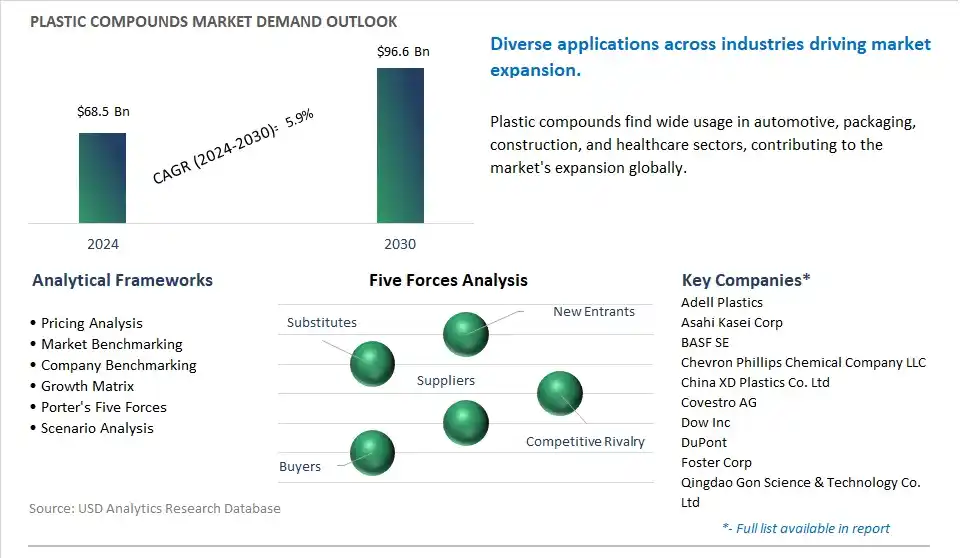
The global Plastic Compounds Market is poised to register a 5.9% CAGR from $68.5 Billion in 2024 to $96.6 Billion in 2030.
The global Plastic Compounds Market Study analyzes and forecasts the market size across 6 regions and 24 countries for diverse segments -By Resin (Polypropylene (PP), Polyethylene (PE), Thermoplastic elastomers (TPE), Polystyrene (PS), Polybutylene terephthalate (PBT), Polyamide (PA), Polycarbonates (PC), Acrylonitrile Butadiene Styrene (ABS), Bioplastic, Acrylonitrile styrene acrylate (ASA), Styrene Acrylonitrile (SAN), Polymethyl methacrylate (PMMA), Polyoxymethylene (POM), Blends (PC/ABS, ABS/PBT, PS/PP)), By Technology (Injection Molding, Extrusion, Blow Molding, Others), By Filler (Unfilled, Calcium Carbonate Filled, Talcum Filled, Glass Fiber Reinforced, Long Glass Fiber Filled, Flame Retardant, Carbon Fiber Reinforced), By End-User (Automotive, Appliances, Electronics, Building & Construction, Furniture, Power Tools, Packaging, Agriculture, Healthcare, Others).
An Introduction to Global Plastic Compounds Market in 2024
The key trend shaping the future of the plastic compounds industry is the increasing demand for versatile, sustainable, and high-performance materials to replace traditional metals, glass, and ceramics in a wide range of applications across industries such as automotive, construction, electronics, and consumer goods. Plastic compounds are engineered materials formulated by combining base polymers with additives, fillers, reinforcements, and modifiers to achieve desired properties such as strength, stiffness, impact resistance, and flame retardancy. With growing requirements for lightweighting, design flexibility, and cost efficiency, there is a rising need for plastic compounds that offer superior performance and processing characteristics while meeting regulatory requirements and industry standards. Manufacturers are investing in the development of innovative compound formulations based on thermoplastics, thermosets, and elastomers to address specific application needs such as structural components, electrical insulation, thermal management, and surface finishes. Additionally, there is a trend towards the use of recycled and bio-based materials in plastic compounds to reduce environmental impact, minimize carbon footprint, and support sustainability goals across the value chain. Furthermore, with increasing emphasis on digitalization, automation, and additive manufacturing technologies, there is a growing interest in plastic compounds that enable advanced processing techniques such as injection molding, extrusion, 3D printing, and blow molding, unlocking new possibilities for product design, customization, and mass production. As industries continue to transition towards lightweight, durable, and eco-friendly materials, the demand for innovative plastic compounds with tailored properties and functionalities is expected to grow, driving market expansion and technological innovation in the plastics industry.
Plastic Compounds Market Competitive Landscape
The market report analyses the leading companies in the industry including Adell Plastics, Asahi Kasei Corp, BASF SE, Chevron Phillips Chemical Company LLC, China XD Plastics Co. Ltd, Covestro AG, Dow Inc, DuPont, Foster Corp, Qingdao Gon Science & Technology Co. Ltd.
Plastic Compounds Market Dynamics
Plastic Compounds Market Trend: Increasing Demand for Sustainable and Specialty Compounds
A prominent trend in the plastic compounds market is the increasing demand for sustainable and specialty compounds. With growing concerns about environmental sustainability and regulatory pressures to reduce carbon footprint, there is a rising preference for compounds made from recycled or biodegradable materials. Manufacturers are also focusing on developing specialty compounds with enhanced properties such as flame retardancy, thermal stability, UV resistance, and conductivity to meet the specific requirements of various industries such as automotive, electrical and electronics, construction, and healthcare. Furthermore, innovations in compounding technologies, such as reactive extrusion and nano-composites, are driving the development of advanced compounds with improved performance characteristics, opening up new opportunities in the market.
Plastic Compounds Market Driver: Growth in End-Use Industries and Replacement of Traditional Materials
The primary driver fueling the plastic compounds market is the growth in end-use industries and the replacement of traditional materials with engineered thermoplastics. Industries such as automotive, consumer goods, packaging, electrical and electronics, and construction are increasingly adopting plastic compounds due to their superior properties, cost-effectiveness, and design flexibility. The automotive industry, in particular, is witnessing a significant surge in the use of lightweight and high-performance plastics to meet stringent fuel efficiency and emissions standards. Similarly, the packaging industry is transitioning from conventional materials like glass and metal to plastic compounds for their lightweight, durability, and barrier properties. Additionally, the replacement of traditional materials such as wood, metal, and rubber with plastic compounds in various applications is further driving market growth.
Plastic Compounds Market Opportunity: Development of Customized and Functional Compounds
An opportunity for the plastic compounds market lies in the development of customized and functional compounds tailored to meet specific customer requirements and application needs. As end-users demand materials with unique properties and performance characteristics, there is a growing need for compounds that offer enhanced functionality, aesthetics, and sustainability. Manufacturers aim to capitalize on this opportunity by offering customized compounding solutions that address niche markets and niche applications, such as medical devices, aerospace components, and electronic enclosures. By leveraging their expertise in material science, formulation development, and compounding technologies, companies can collaborate closely with customers to co-develop specialized compounds that deliver superior performance, durability, and cost-effectiveness. Furthermore, partnerships with raw material suppliers, additive manufacturers, and equipment providers can enhance innovation capabilities and expand the product portfolio, enabling companies to capture a larger share of the plastic compounds market.
Plastic Compounds Market Share Analysis: Polypropylene generated the highest revenue in 2024
The largest segment in the Plastic Compounds Market is the Polypropylene (PP) category. Polypropylene is one of the most widely used thermoplastic resins globally due to its versatility, cost-effectiveness, and favorable mechanical properties. PP compounds are extensively utilized in various industries such as automotive, packaging, consumer goods, electrical and electronics, and construction. PP offers excellent properties such as high chemical resistance, stiffness, impact strength, and heat resistance, making it suitable for a wide range of applications requiring durability and performance. Additionally, PP compounds can be easily processed using various molding techniques such as injection molding, extrusion, and blow molding, allowing for the production of complex parts and components with high efficiency and cost-effectiveness. Further, the lightweight nature of PP compounds makes them ideal for applications where weight reduction is essential, such as automotive components, packaging materials, and consumer goods. Furthermore, advancements in PP compounding technology, including the development of reinforced, filled, and modified PP grades with enhanced properties such as flame retardancy, UV resistance, and aesthetics, have further expanded the application scope and market opportunities for PP compounds. Accordingly, the Polypropylene (PP) segment is the largest in the Plastic Compounds Market due to the widespread use, versatility, and established market presence of PP compounds across multiple industries.
Plastic Compounds Market Share Analysis: Extrusion segment is poised to register the fastest growth rate (CAGR) over the forecast period to 2030
Extrusion is the fastest-growing segment in the Plastic Compounds Market. Extrusion technology offers versatility in processing various thermoplastic materials, including polyethylene (PE), polypropylene (PP), and PVC, into a wide range of products such as pipes, tubes, profiles, and sheets. The rising demand for extruded plastic products across industries like construction, automotive, and packaging is driving the expansion of extrusion processes. Additionally, advancements in extrusion technology, such as multi-layer co-extrusion and foam extrusion, enable the production of innovative and high-performance plastic compounds with enhanced properties like strength, insulation, and barrier protection. Further, the versatility and efficiency of extrusion processes in producing complex shapes and large volumes of plastic products at lower costs contribute to its rapid growth in the Plastic Compounds Market. As industries continue to seek cost-effective and sustainable solutions, extrusion technology emerges as a key driver of growth, meeting diverse application needs with its flexibility and innovation.
Plastic Compounds Market Share Analysis: Carbon Fiber Reinforced segment is poised to register the fastest growth rate (CAGR) over the forecast period to 2030
Carbon Fiber Reinforced is the fastest-growing segment in the Plastic Compounds Market. Carbon fiber reinforcement offers exceptional strength-to-weight ratio, stiffness, and dimensional stability to plastic compounds, making them ideal for applications requiring high-performance materials. Industries such as automotive, aerospace, and sports equipment are increasingly turning to carbon fiber-reinforced plastics (CFRP) to achieve lightweight yet durable components that enhance fuel efficiency, performance, and sustainability. Additionally, advancements in carbon fiber technology, such as improved manufacturing processes and cost reductions, have made CFRP more accessible and viable for a wider range of applications. Further, growing environmental concerns and regulations are driving the adoption of lightweight materials like CFRP to reduce carbon emissions and improve energy efficiency. Furthermore, the versatility of carbon fiber reinforcement allows for tailored material properties to meet specific application requirements, further fueling its rapid growth in the Plastic Compounds Market. As industries continue to prioritize lightweight and high-performance materials, carbon fiber reinforcement emerges as a key driver of growth, offering unparalleled strength and versatility for a variety of applications.
Plastic Compounds Market Report Segmentation
By Resin
Polypropylene (PP)
Polyethylene (PE)
Thermoplastic elastomers (TPE)
Polystyrene (PS)
Polybutylene terephthalate (PBT)
Polyamide (PA)
Polycarbonates (PC)
Acrylonitrile Butadiene Styrene (ABS)
Bioplastic
Acrylonitrile styrene acrylate (ASA)
Styrene Acrylonitrile (SAN)
Polymethyl methacrylate (PMMA)
Polyoxymethylene (POM)
Blends (PC/ABS
ABS/PBT
PS/PP)
By Technology
Injection Molding
Extrusion
Blow Molding
Others
By Filler
Unfilled
Calcium Carbonate Filled
Talcum Filled
Glass Fiber Reinforced
Long Glass Fiber Filled
Flame Retardant
Carbon Fiber Reinforced
By End-User
Automotive
Appliances
Electronics
Building & Construction
Furniture
Power Tools
Packaging
Agriculture
Healthcare
Others
Regions Included
North America (US, Canada, Mexico)
Europe (Germany, UK, France, Spain, Italy, Russia, Rest of Europe)
Asia Pacific (China, India, Japan, South Korea, Australia, South East Asia, Rest of Asia)
South America (Brazil, Argentina, Rest of South America)
Middle East and Africa (Saudi Arabia, UAE, Rest of Middle East, South Africa, Egypt, Rest of Africa)
Plastic Compounds Companies Profiled in the Market Study
Adell Plastics
Asahi Kasei Corp
BASF SE
Chevron Phillips Chemical Company LLC
China XD Plastics Co. Ltd
Covestro AG
Dow Inc
DuPont
Foster Corp
Qingdao Gon Science & Technology Co. Ltd
*- List Not Exhaustive
TABLE OF CONTENTS
1 Introduction to 2024 Plastic Compounds Market
1.1 Market Overview
1.2 Quick Facts
1.3 Scope/Objective of the Study
1.4 Market Definition
1.5 Countries and Regions Covered
1.6 Units, Currency, and Conversions
1.7 Industry Value Chain
2 Research Methodology
2.1 Market Size Estimation
2.2 Sources and Research Methodology
2.3 Data Triangulation
2.4 Assumptions and Limitations
3 Executive Summary
3.1 Global Plastic Compounds Market Size Outlook, $ Million, 2021 to 2030
3.2 Plastic Compounds Market Outlook by Type, $ Million, 2021 to 2030
3.3 Plastic Compounds Market Outlook by Product, $ Million, 2021 to 2030
3.4 Plastic Compounds Market Outlook by Application, $ Million, 2021 to 2030
3.5 Plastic Compounds Market Outlook by Key Countries, $ Million, 2021 to 2030
4 Market Dynamics
4.1 Key Driving Forces of Plastic Compounds Industry
4.2 Key Market Trends in Plastic Compounds Industry
4.3 Potential Opportunities in Plastic Compounds Industry
4.4 Key Challenges in Plastic Compounds Industry
5 Market Factor Analysis
5.1 Value Chain Analysis
5.2 Competitive Landscape
5.2.1 Global Plastic Compounds Market Share by Company (%), 2023
5.2.2 Product Offerings by Company
5.3 Porter’s Five Forces Analysis
5.4 Pricing Analysis and Outlook
6 Growth Outlook Across Scenarios
6.1 Growth Analysis-Case Scenario Definitions
6.2 Low Growth Scenario Forecasts
6.3 Reference Growth Scenario Forecasts
6.4 High Growth Scenario Forecasts
7 Global Plastic Compounds Market Outlook by Segments
7.1 Plastic Compounds Market Outlook by Segments, $ Million, 2021- 2030
By Resin
Polypropylene (PP)
Polyethylene (PE)
Thermoplastic elastomers (TPE)
Polystyrene (PS)
Polybutylene terephthalate (PBT)
Polyamide (PA)
Polycarbonates (PC)
Acrylonitrile Butadiene Styrene (ABS)
Bioplastic
Acrylonitrile styrene acrylate (ASA)
Styrene Acrylonitrile (SAN)
Polymethyl methacrylate (PMMA)
Polyoxymethylene (POM)
Blends (PC/ABS
ABS/PBT
PS/PP)
By Technology
Injection Molding
Extrusion
Blow Molding
Others
By Filler
Unfilled
Calcium Carbonate Filled
Talcum Filled
Glass Fiber Reinforced
Long Glass Fiber Filled
Flame Retardant
Carbon Fiber Reinforced
By End-User
Automotive
Appliances
Electronics
Building & Construction
Furniture
Power Tools
Packaging
Agriculture
Healthcare
Others
8 North America Plastic Compounds Market Analysis and Outlook To 2030
8.1 Introduction to North America Plastic Compounds Markets in 2024
8.2 North America Plastic Compounds Market Size Outlook by Country, 2021-2030
8.2.1 United States
8.2.2 Canada
8.2.3 Mexico
8.3 North America Plastic Compounds Market size Outlook by Segments, 2021-2030
By Resin
Polypropylene (PP)
Polyethylene (PE)
Thermoplastic elastomers (TPE)
Polystyrene (PS)
Polybutylene terephthalate (PBT)
Polyamide (PA)
Polycarbonates (PC)
Acrylonitrile Butadiene Styrene (ABS)
Bioplastic
Acrylonitrile styrene acrylate (ASA)
Styrene Acrylonitrile (SAN)
Polymethyl methacrylate (PMMA)
Polyoxymethylene (POM)
Blends (PC/ABS
ABS/PBT
PS/PP)
By Technology
Injection Molding
Extrusion
Blow Molding
Others
By Filler
Unfilled
Calcium Carbonate Filled
Talcum Filled
Glass Fiber Reinforced
Long Glass Fiber Filled
Flame Retardant
Carbon Fiber Reinforced
By End-User
Automotive
Appliances
Electronics
Building & Construction
Furniture
Power Tools
Packaging
Agriculture
Healthcare
Others
9 Europe Plastic Compounds Market Analysis and Outlook To 2030
9.1 Introduction to Europe Plastic Compounds Markets in 2024
9.2 Europe Plastic Compounds Market Size Outlook by Country, 2021-2030
9.2.1 Germany
9.2.2 France
9.2.3 Spain
9.2.4 United Kingdom
9.2.4 Italy
9.2.5 Russia
9.2.6 Norway
9.2.7 Rest of Europe
9.3 Europe Plastic Compounds Market Size Outlook by Segments, 2021-2030
By Resin
Polypropylene (PP)
Polyethylene (PE)
Thermoplastic elastomers (TPE)
Polystyrene (PS)
Polybutylene terephthalate (PBT)
Polyamide (PA)
Polycarbonates (PC)
Acrylonitrile Butadiene Styrene (ABS)
Bioplastic
Acrylonitrile styrene acrylate (ASA)
Styrene Acrylonitrile (SAN)
Polymethyl methacrylate (PMMA)
Polyoxymethylene (POM)
Blends (PC/ABS
ABS/PBT
PS/PP)
By Technology
Injection Molding
Extrusion
Blow Molding
Others
By Filler
Unfilled
Calcium Carbonate Filled
Talcum Filled
Glass Fiber Reinforced
Long Glass Fiber Filled
Flame Retardant
Carbon Fiber Reinforced
By End-User
Automotive
Appliances
Electronics
Building & Construction
Furniture
Power Tools
Packaging
Agriculture
Healthcare
Others
10 Asia Pacific Plastic Compounds Market Analysis and Outlook To 2030
10.1 Introduction to Asia Pacific Plastic Compounds Markets in 2024
10.2 Asia Pacific Plastic Compounds Market Size Outlook by Country, 2021-2030
10.2.1 China
10.2.2 India
10.2.3 Japan
10.2.4 South Korea
10.2.5 Indonesia
10.2.6 Malaysia
10.2.7 Australia
10.2.8 Rest of Asia Pacific
10.3 Asia Pacific Plastic Compounds Market size Outlook by Segments, 2021-2030
By Resin
Polypropylene (PP)
Polyethylene (PE)
Thermoplastic elastomers (TPE)
Polystyrene (PS)
Polybutylene terephthalate (PBT)
Polyamide (PA)
Polycarbonates (PC)
Acrylonitrile Butadiene Styrene (ABS)
Bioplastic
Acrylonitrile styrene acrylate (ASA)
Styrene Acrylonitrile (SAN)
Polymethyl methacrylate (PMMA)
Polyoxymethylene (POM)
Blends (PC/ABS
ABS/PBT
PS/PP)
By Technology
Injection Molding
Extrusion
Blow Molding
Others
By Filler
Unfilled
Calcium Carbonate Filled
Talcum Filled
Glass Fiber Reinforced
Long Glass Fiber Filled
Flame Retardant
Carbon Fiber Reinforced
By End-User
Automotive
Appliances
Electronics
Building & Construction
Furniture
Power Tools
Packaging
Agriculture
Healthcare
Others
11 South America Plastic Compounds Market Analysis and Outlook To 2030
11.1 Introduction to South America Plastic Compounds Markets in 2024
11.2 South America Plastic Compounds Market Size Outlook by Country, 2021-2030
11.2.1 Brazil
11.2.2 Argentina
11.2.3 Rest of South America
11.3 South America Plastic Compounds Market size Outlook by Segments, 2021-2030
By Resin
Polypropylene (PP)
Polyethylene (PE)
Thermoplastic elastomers (TPE)
Polystyrene (PS)
Polybutylene terephthalate (PBT)
Polyamide (PA)
Polycarbonates (PC)
Acrylonitrile Butadiene Styrene (ABS)
Bioplastic
Acrylonitrile styrene acrylate (ASA)
Styrene Acrylonitrile (SAN)
Polymethyl methacrylate (PMMA)
Polyoxymethylene (POM)
Blends (PC/ABS
ABS/PBT
PS/PP)
By Technology
Injection Molding
Extrusion
Blow Molding
Others
By Filler
Unfilled
Calcium Carbonate Filled
Talcum Filled
Glass Fiber Reinforced
Long Glass Fiber Filled
Flame Retardant
Carbon Fiber Reinforced
By End-User
Automotive
Appliances
Electronics
Building & Construction
Furniture
Power Tools
Packaging
Agriculture
Healthcare
Others
12 Middle East and Africa Plastic Compounds Market Analysis and Outlook To 2030
12.1 Introduction to Middle East and Africa Plastic Compounds Markets in 2024
12.2 Middle East and Africa Plastic Compounds Market Size Outlook by Country, 2021-2030
12.2.1 Saudi Arabia
12.2.2 UAE
12.2.3 Oman
12.2.4 Rest of Middle East
12.2.5 Egypt
12.2.6 Nigeria
12.2.7 South Africa
12.2.8 Rest of Africa
12.3 Middle East and Africa Plastic Compounds Market size Outlook by Segments, 2021-2030
By Resin
Polypropylene (PP)
Polyethylene (PE)
Thermoplastic elastomers (TPE)
Polystyrene (PS)
Polybutylene terephthalate (PBT)
Polyamide (PA)
Polycarbonates (PC)
Acrylonitrile Butadiene Styrene (ABS)
Bioplastic
Acrylonitrile styrene acrylate (ASA)
Styrene Acrylonitrile (SAN)
Polymethyl methacrylate (PMMA)
Polyoxymethylene (POM)
Blends (PC/ABS
ABS/PBT
PS/PP)
By Technology
Injection Molding
Extrusion
Blow Molding
Others
By Filler
Unfilled
Calcium Carbonate Filled
Talcum Filled
Glass Fiber Reinforced
Long Glass Fiber Filled
Flame Retardant
Carbon Fiber Reinforced
By End-User
Automotive
Appliances
Electronics
Building & Construction
Furniture
Power Tools
Packaging
Agriculture
Healthcare
Others
13 Company Profiles
13.1 Company Snapshot
13.2 SWOT Profiles
13.3 Products and Services
13.4 Recent Developments
13.5 Financial Profile
Adell Plastics
Asahi Kasei Corp
BASF SE
Chevron Phillips Chemical Company LLC
China XD Plastics Co. Ltd
Covestro AG
Dow Inc
DuPont
Foster Corp
Qingdao Gon Science & Technology Co. Ltd
14 Appendix
14.1 Customization Offerings
14.2 Subscription Services
14.3 Related Reports
14.4 Publisher Expertise
