
The global Plastic Dielectric Films Market Study analyzes and forecasts the market size across 6 regions and 24 countries for diverse segments -By Product (Polyethylene Naphthalate, Polyethylene Terephthalate, Polytetrafluoroethylene, Polypropylene, Polyphenylene Sulfide & Polyvinylidene Difluoride), By Application (Electrical & Electronics, Solar & Wind Energy Systems, Automobiles, Aircraft, Others).
The key trend shaping the future of the plastic dielectric films industry is the increasing demand for high-performance, miniaturized, and flexible electronic components in applications such as capacitors, insulators, printed circuit boards, and flexible displays. Plastic dielectric films are thin, non-conductive materials used to store electrical energy, isolate conductive components, and provide insulation in electronic devices and systems. With the proliferation of electronic devices, IoT technologies, and smart devices, there is a rising need for dielectric films that offer high dielectric strength, low dielectric loss, and excellent thermal stability to withstand harsh operating conditions and enable high-speed, high-frequency performance. Manufacturers are investing in the development of advanced dielectric film materials such as polyethylene terephthalate (PET), polypropylene (PP), polyimide (PI), and polycarbonate (PC) with tailored properties and processing characteristics to meet the evolving needs of electronics manufacturers for miniaturization, reliability, and performance optimization. Additionally, there is a trend towards the integration of dielectric films into flexible and stretchable substrates, enabling the development of bendable, foldable, and wearable electronic devices for applications such as flexible displays, smart textiles, and biomedical sensors. Furthermore, with increasing demand for energy storage solutions, renewable energy integration, and electric vehicle technology, there is a growing interest in dielectric films for energy storage capacitors, supercapacitors, and electric vehicle batteries to improve energy density, efficiency, and safety. As electronic devices become more compact, interconnected, and energy-efficient, the demand for innovative plastic dielectric films with advanced properties and functionalities is expected to grow, driving market expansion and technological innovation in the electronics and energy storage sectors.
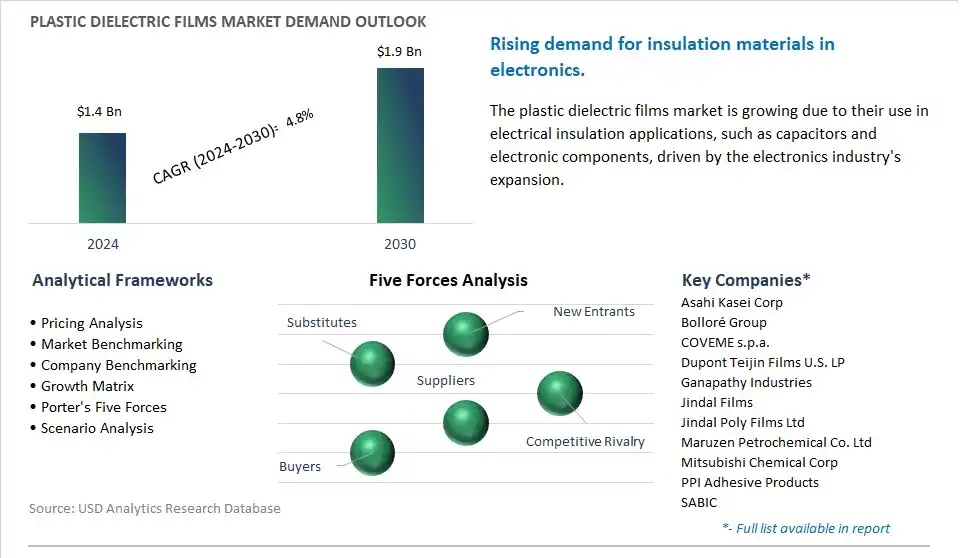
The market report analyses the leading companies in the industry including Asahi Kasei Corp, Bolloré Group, COVEME s.p.a., Dupont Teijin Films U.S. LP, Ganapathy Industries, Jindal Films, Jindal Poly Films Ltd, Maruzen Petrochemical Co. Ltd, Mitsubishi Chemical Corp, PPI Adhesive Products, SABIC, SK geo-centric Co. Ltd, Steiner GmbH & CO. KG, Tervakoski Film, Toray Industries Inc.
A prominent trend in the plastic dielectric films market is the growing demand for high-performance electronics. As technology continues to advance, there is an increasing need for electronic components that offer improved functionality, miniaturization, and reliability. Plastic dielectric films play a crucial role in various electronic applications, including capacitors, printed circuit boards (PCBs), flexible displays, and photovoltaic cells. The trend towards smaller, lighter, and more energy-efficient electronic devices, such as smartphones, tablets, wearables, and IoT devices, is driving the demand for plastic dielectric films with superior electrical properties, thermal stability, and mechanical flexibility.
The primary driver fueling the plastic dielectric films market is the expansion of the renewable energy sector. Plastic dielectric films are widely used in photovoltaic modules for solar energy generation. With the increasing focus on sustainable energy sources and the global transition towards clean energy, the demand for solar panels and other renewable energy technologies is growing rapidly. Plastic dielectric films are essential components in solar cells, where they serve as encapsulants, back sheets, and insulating layers, providing electrical insulation, weather resistance, and protection against moisture and UV radiation. As governments worldwide implement policies to promote renewable energy adoption and reduce carbon emissions, the demand for plastic dielectric films in the solar energy sector is expected to continue growing.
An opportunity for the plastic dielectric films market lies in the development of next-generation films with enhanced performance characteristics and advanced functionalities. Manufacturers aim to capitalize on this opportunity by investing in research and development to create films with improved electrical insulation properties, higher breakdown strength, lower dielectric losses, and better thermal stability. Additionally, there is a growing demand for films that offer enhanced moisture barrier properties, fire resistance, and resistance to harsh environmental conditions, such as extreme temperatures and humidity. Developing innovative coating technologies, nanostructured materials, and hybrid film composites can enable the production of plastic dielectric films tailored to specific applications and performance requirements. Moreover, collaborating with end-users and industry stakeholders to understand their evolving needs and challenges can help drive innovation and create new opportunities for growth in the market.
Polyethylene Terephthalate (PET) is the largest segment in the Plastic Dielectric Films Market. PET is widely favored for its excellent electrical properties, including high dielectric strength, low dielectric loss, and good thermal stability, making it ideal for a wide range of electrical insulation applications. PET films are extensively used in capacitors, transformers, motors, and electrical appliances to provide insulation and protection against electrical breakdown and moisture ingress. Additionally, PET films offer advantages such as high tensile strength, chemical resistance, and dimensional stability, further enhancing their suitability for demanding electrical and electronic applications. Further, the widespread adoption of PET films in industries such as automotive, aerospace, electronics, and renewable energy drives their demand, further consolidating PET's position as the largest segment in the Plastic Dielectric Films Market. Furthermore, advancements in PET film manufacturing technology, such as improved coating processes, surface treatments, and metallization techniques, continue to expand the application scope and market opportunities for PET films in emerging sectors, reinforcing their dominance in the Plastic Dielectric Films Market.
Solar & Wind Energy Systems is the fastest-growing segment in the Plastic Dielectric Films Market. With increasing global emphasis on renewable energy sources, there has been a significant expansion in the deployment of solar and wind energy systems worldwide. Plastic dielectric films play a crucial role in these systems, particularly in photovoltaic (PV) modules and wind turbine components. Dielectric films are used as encapsulants and backsheet materials in solar panels to provide electrical insulation, moisture protection, and durability against harsh environmental conditions. Similarly, in wind energy systems, dielectric films are utilized in blade coatings and electrical components to enhance performance and reliability. The growing adoption of solar and wind energy systems, driven by environmental concerns, energy security, and government incentives, fuels the demand for plastic dielectric films. Further, advancements in film technology, such as improved thermal stability, UV resistance, and moisture barrier properties, further support their application in solar and wind energy systems, contributing to their rapid growth in the Plastic Dielectric Films Market. Additionally, ongoing research and development efforts aimed at enhancing the efficiency and lifespan of solar and wind energy systems are expected to drive further growth in demand for plastic dielectric films in this segment.
By Product
Polyethylene Naphthalate
Polyethylene Terephthalate
Polytetrafluoroethylene
Polypropylene
Polyphenylene Sulfide & Polyvinylidene Difluoride
By Application
Electrical & Electronics
Solar & Wind Energy Systems
Automobiles
Aircraft
Others
Regions Included
North America (US, Canada, Mexico)
Europe (Germany, UK, France, Spain, Italy, Russia, Rest of Europe)
Asia Pacific (China, India, Japan, South Korea, Australia, South East Asia, Rest of Asia)
South America (Brazil, Argentina, Rest of South America)
Middle East and Africa (Saudi Arabia, UAE, Rest of Middle East, South Africa, Egypt, Rest of Africa)
Asahi Kasei Corp
Bolloré Group
COVEME s.p.a.
Dupont Teijin Films U.S. LP
Ganapathy Industries
Jindal Films
Jindal Poly Films Ltd
Maruzen Petrochemical Co. Ltd
Mitsubishi Chemical Corp
PPI Adhesive Products
SABIC
SK geo-centric Co. Ltd
Steiner GmbH & CO. KG
Tervakoski Film
Toray Industries Inc
*- List Not Exhaustive
TABLE OF CONTENTS
1 Introduction to 2024 Plastic Dielectric Films Market
1.1 Market Overview
1.2 Quick Facts
1.3 Scope/Objective of the Study
1.4 Market Definition
1.5 Countries and Regions Covered
1.6 Units, Currency, and Conversions
1.7 Industry Value Chain
2 Research Methodology
2.1 Market Size Estimation
2.2 Sources and Research Methodology
2.3 Data Triangulation
2.4 Assumptions and Limitations
3 Executive Summary
3.1 Global Plastic Dielectric Films Market Size Outlook, $ Million, 2021 to 2030
3.2 Plastic Dielectric Films Market Outlook by Type, $ Million, 2021 to 2030
3.3 Plastic Dielectric Films Market Outlook by Product, $ Million, 2021 to 2030
3.4 Plastic Dielectric Films Market Outlook by Application, $ Million, 2021 to 2030
3.5 Plastic Dielectric Films Market Outlook by Key Countries, $ Million, 2021 to 2030
4 Market Dynamics
4.1 Key Driving Forces of Plastic Dielectric Films Industry
4.2 Key Market Trends in Plastic Dielectric Films Industry
4.3 Potential Opportunities in Plastic Dielectric Films Industry
4.4 Key Challenges in Plastic Dielectric Films Industry
5 Market Factor Analysis
5.1 Value Chain Analysis
5.2 Competitive Landscape
5.2.1 Global Plastic Dielectric Films Market Share by Company (%), 2023
5.2.2 Product Offerings by Company
5.3 Porter’s Five Forces Analysis
5.4 Pricing Analysis and Outlook
6 Growth Outlook Across Scenarios
6.1 Growth Analysis-Case Scenario Definitions
6.2 Low Growth Scenario Forecasts
6.3 Reference Growth Scenario Forecasts
6.4 High Growth Scenario Forecasts
7 Global Plastic Dielectric Films Market Outlook by Segments
7.1 Plastic Dielectric Films Market Outlook by Segments, $ Million, 2021- 2030
By Product
Polyethylene Naphthalate
Polyethylene Terephthalate
Polytetrafluoroethylene
Polypropylene
Polyphenylene Sulfide & Polyvinylidene Difluoride
By Application
Electrical & Electronics
Solar & Wind Energy Systems
Automobiles
Aircraft
Others
8 North America Plastic Dielectric Films Market Analysis and Outlook To 2030
8.1 Introduction to North America Plastic Dielectric Films Markets in 2024
8.2 North America Plastic Dielectric Films Market Size Outlook by Country, 2021-2030
8.2.1 United States
8.2.2 Canada
8.2.3 Mexico
8.3 North America Plastic Dielectric Films Market size Outlook by Segments, 2021-2030
By Product
Polyethylene Naphthalate
Polyethylene Terephthalate
Polytetrafluoroethylene
Polypropylene
Polyphenylene Sulfide & Polyvinylidene Difluoride
By Application
Electrical & Electronics
Solar & Wind Energy Systems
Automobiles
Aircraft
Others
9 Europe Plastic Dielectric Films Market Analysis and Outlook To 2030
9.1 Introduction to Europe Plastic Dielectric Films Markets in 2024
9.2 Europe Plastic Dielectric Films Market Size Outlook by Country, 2021-2030
9.2.1 Germany
9.2.2 France
9.2.3 Spain
9.2.4 United Kingdom
9.2.4 Italy
9.2.5 Russia
9.2.6 Norway
9.2.7 Rest of Europe
9.3 Europe Plastic Dielectric Films Market Size Outlook by Segments, 2021-2030
By Product
Polyethylene Naphthalate
Polyethylene Terephthalate
Polytetrafluoroethylene
Polypropylene
Polyphenylene Sulfide & Polyvinylidene Difluoride
By Application
Electrical & Electronics
Solar & Wind Energy Systems
Automobiles
Aircraft
Others
10 Asia Pacific Plastic Dielectric Films Market Analysis and Outlook To 2030
10.1 Introduction to Asia Pacific Plastic Dielectric Films Markets in 2024
10.2 Asia Pacific Plastic Dielectric Films Market Size Outlook by Country, 2021-2030
10.2.1 China
10.2.2 India
10.2.3 Japan
10.2.4 South Korea
10.2.5 Indonesia
10.2.6 Malaysia
10.2.7 Australia
10.2.8 Rest of Asia Pacific
10.3 Asia Pacific Plastic Dielectric Films Market size Outlook by Segments, 2021-2030
By Product
Polyethylene Naphthalate
Polyethylene Terephthalate
Polytetrafluoroethylene
Polypropylene
Polyphenylene Sulfide & Polyvinylidene Difluoride
By Application
Electrical & Electronics
Solar & Wind Energy Systems
Automobiles
Aircraft
Others
11 South America Plastic Dielectric Films Market Analysis and Outlook To 2030
11.1 Introduction to South America Plastic Dielectric Films Markets in 2024
11.2 South America Plastic Dielectric Films Market Size Outlook by Country, 2021-2030
11.2.1 Brazil
11.2.2 Argentina
11.2.3 Rest of South America
11.3 South America Plastic Dielectric Films Market size Outlook by Segments, 2021-2030
By Product
Polyethylene Naphthalate
Polyethylene Terephthalate
Polytetrafluoroethylene
Polypropylene
Polyphenylene Sulfide & Polyvinylidene Difluoride
By Application
Electrical & Electronics
Solar & Wind Energy Systems
Automobiles
Aircraft
Others
12 Middle East and Africa Plastic Dielectric Films Market Analysis and Outlook To 2030
12.1 Introduction to Middle East and Africa Plastic Dielectric Films Markets in 2024
12.2 Middle East and Africa Plastic Dielectric Films Market Size Outlook by Country, 2021-2030
12.2.1 Saudi Arabia
12.2.2 UAE
12.2.3 Oman
12.2.4 Rest of Middle East
12.2.5 Egypt
12.2.6 Nigeria
12.2.7 South Africa
12.2.8 Rest of Africa
12.3 Middle East and Africa Plastic Dielectric Films Market size Outlook by Segments, 2021-2030
By Product
Polyethylene Naphthalate
Polyethylene Terephthalate
Polytetrafluoroethylene
Polypropylene
Polyphenylene Sulfide & Polyvinylidene Difluoride
By Application
Electrical & Electronics
Solar & Wind Energy Systems
Automobiles
Aircraft
Others
13 Company Profiles
13.1 Company Snapshot
13.2 SWOT Profiles
13.3 Products and Services
13.4 Recent Developments
13.5 Financial Profile
Asahi Kasei Corp
Bolloré Group
COVEME s.p.a.
Dupont Teijin Films U.S. LP
Ganapathy Industries
Jindal Films
Jindal Poly Films Ltd
Maruzen Petrochemical Co. Ltd
Mitsubishi Chemical Corp
PPI Adhesive Products
SABIC
SK geo-centric Co. Ltd
Steiner GmbH & CO. KG
Tervakoski Film
Toray Industries Inc
14 Appendix
14.1 Customization Offerings
14.2 Subscription Services
14.3 Related Reports
14.4 Publisher Expertise
By Product
Polyethylene Naphthalate
Polyethylene Terephthalate
Polytetrafluoroethylene
Polypropylene
Polyphenylene Sulfide & Polyvinylidene Difluoride
By Application
Electrical & Electronics
Solar & Wind Energy Systems
Automobiles
Aircraft
Others
Countries Analyzed
North America (US, Canada, Mexico)
Europe (Germany, UK, France, Spain, Italy, Russia, Rest of Europe)
Asia Pacific (China, India, Japan, South Korea, Australia, South East Asia, Rest of Asia)
South America (Brazil, Argentina, Rest of South America)
Middle East and Africa (Saudi Arabia, UAE, Rest of Middle East, South Africa, Egypt, Rest of Africa)
Global Plastic Dielectric Films is forecast to reach $1.9 Billion in 2030 from $1.4 Billion in 2024, registering a CAGR of 4.8%
Emerging Markets across Asia Pacific, Europe, and Americas present robust growth prospects.
Asahi Kasei Corp, Bolloré Group, COVEME s.p.a., Dupont Teijin Films U.S. LP, Ganapathy Industries, Jindal Films, Jindal Poly Films Ltd, Maruzen Petrochemical Co. Ltd, Mitsubishi Chemical Corp, PPI Adhesive Products, SABIC, SK geo-centric Co. Ltd, Steiner GmbH & CO. KG, Tervakoski Film, Toray Industries Inc
Base Year- 2023; Estimated Year- 2024; Historic Period- 2018-2023; Forecast period- 2024 to 2030; Currency: Revenue (USD); Volume