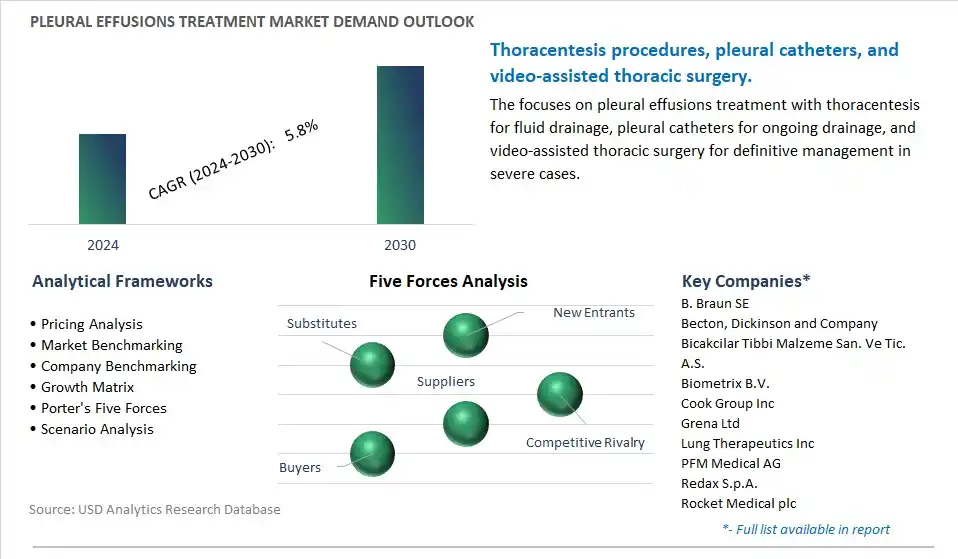
Pleural Effusions Treatment Market is estimated to increase at a Compounded Annual Growth Rate of 5.8% CAGR over the forecast period from 2024 to 2030
The Pleural Effusions Treatment Market study analyzes and forecasts the market size across 6 regions and 24 countries for diverse segments- By Disease (Transudative, Exudative), By End-User (Hospitals, Ambulatory Clinics, Others).
An Introduction to Pleural Effusions Treatment Market in 2024
In 2024, the market for pleural effusions treatment is witnessing advancements aimed at addressing the complexities of this challenging medical condition. Pleural effusions, characterized by the accumulation of fluid in the pleural space surrounding the lungs, can arise from various underlying etiologies, including congestive heart failure, pneumonia, and malignancies. The treatment landscape encompasses a spectrum of modalities, ranging from conservative management with diuretics and thoracentesis to more invasive interventions such as pleurodesis and pleural catheter placement. With a focus on optimizing patient outcomes and minimizing procedural risks, innovative techniques such as thoracoscopic surgery and indwelling pleural catheters are gaining traction, offering tailored approaches for individualized care.
Market Trend: Minimally Invasive Procedures and Interventional Techniques
A prominent trend in the Pleural effusion treatment market is the increasing adoption of minimally invasive procedures and interventional techniques. As medical technology advances, there is a growing shift towards less invasive approaches for diagnosing and treating pleural effusions, which are abnormal accumulations of fluid in the pleural cavity surrounding the lungs. Minimally invasive procedures such as thoracentesis, pleurodesis, and indwelling pleural catheter placement offer effective management of pleural effusions with reduced risk, shorter recovery times, and improved patient outcomes compared to traditional surgical interventions. The trend towards minimally invasive treatments reflects a focus on enhancing patient comfort, reducing hospitalization durations, and optimizing healthcare resource utilization in the management of pleural effusions.
Market Driver: Rising Incidence of Respiratory Diseases and Thoracic Disorders
A primary driver fueling the growth of the Pleural Effusions Treatment market is the rising incidence of respiratory diseases and thoracic disorders. Pleural effusions can occur as a complication of various medical conditions, including congestive heart failure, pneumonia, cancer, and pulmonary embolism, among others. With an aging population and increasing prevalence of chronic respiratory conditions, such as chronic obstructive pulmonary disease (COPD) and lung cancer, the incidence of pleural effusions is expected to rise. The need for prompt and effective treatment of pleural effusions to relieve symptoms, prevent complications, and improve quality of life drives the demand for therapeutic interventions and procedures among patients with respiratory and thoracic disorders.
Market Opportunity: Development of Novel Drug Therapies and Targeted Treatments
An emerging opportunity in the Pleural Effusions Treatment market lies in the development of novel drug therapies and targeted treatments for specific etiologies of pleural effusions. While invasive procedures such as thoracentesis and pleurodesis are effective in draining and managing pleural fluid accumulation, there is potential for pharmaceutical interventions to address underlying causes and reduce the recurrence of effusions. Targeted therapies that modulate inflammation, inhibit tumor growth, or enhance pleural fluid absorption offer potential treatment options for certain types of pleural effusions, such as malignant pleural effusions or effusions related to inflammatory conditions. Additionally, advancements in drug delivery technologies, including intrapleural drug administration and nanoparticle-based formulations, enable localized treatment delivery to the pleural space, maximizing therapeutic efficacy while minimizing systemic side effects. Collaborations between pharmaceutical companies, academic researchers, and healthcare institutions can drive innovation in drug development for pleural effusions, unlocking new treatment options and improving outcomes for patients with respiratory and thoracic disorders. By investing in research and development of targeted drug therapies, stakeholders in the Pleural Effusions Treatment market can address unmet medical needs, expand their product portfolios, and contribute to advancements in personalized medicine for pleural effusion management.
Pleural Effusions Treatment Market Share Analysis: Exudative Pleural Effusions Treatment in Hospitals
Among the various diseases and end-users in the pleural effusions treatment market, the treatment of exudative pleural effusions in hospitals is experiencing rapid growth. Exudative pleural effusions occur due to the accumulation of fluid rich in protein and inflammatory cells in the pleural space, often resulting from conditions such as pneumonia, cancer, or pulmonary embolism. Hospitals are equipped with specialized facilities and a multidisciplinary team of healthcare professionals, including pulmonologists, thoracic surgeons, and interventional radiologists, who collaborate to diagnose and manage complex cases of pleural effusions effectively. Treatment options for exudative pleural effusions in hospitals may include thoracentesis, pleurodesis, chest tube placement, or minimally invasive procedures such as thoracoscopy or pleuroscopy. Additionally, hospitals offer comprehensive medical care and support services, including intensive care units and specialized diagnostic imaging, to address underlying conditions contributing to exudative pleural effusions and manage associated complications. With the increasing prevalence of conditions predisposing to exudative pleural effusions, such as cancer and infectious diseases, and the growing emphasis on timely and effective management to improve patient outcomes, the demand for treatments for exudative pleural effusions in hospitals is expected to continue to grow significantly. Moreover, advancements in diagnostic modalities and minimally invasive treatment techniques further drive the market's expansion, offering patients more options for personalized and minimally disruptive care in the hospital setting.
Pleural Effusions Treatment Competitive Analysis
The market research study provides in-depth insights into leading companies including the SWOT analyses, product profile, financial details, and recent developments acrossB. Braun SE, Becton, Dickinson and Company, Bicakcilar Tibbi Malzeme San. Ve Tic. A.S., Biometrix B.V., Cook Group Inc, Grena Ltd, Lung Therapeutics Inc, PFM Medical AG, Redax S.p.A., Rocket Medical plc, Smiths Medical International Ltd, Taiho Pharmaceutical Co. Ltd
Pleural Effusions Treatment Market Segmentation
By Disease
Transudative
Exudative
By End-User
Hospitals
Ambulatory Clinics
Others
Geographical Analysis
North America (United States, Canada, Mexico)
Europe (Germany, France, United Kingdom, Spain, Italy, Rest of Europe)
Asia Pacific (China, India, Japan, South Korea, Rest of Asia Pacific)
South America (Brazil, Argentina, Rest of South America)
Middle East and Africa (Saudi Arabia, UAE, Rest of Middle East, South Africa, Egypt, Rest of Africa)
Pleural Effusions Treatment Market Companies
B. Braun SE
Becton, Dickinson and Company
Bicakcilar Tibbi Malzeme San. Ve Tic. A.S.
Biometrix B.V.
Cook Group Inc
Grena Ltd
Lung Therapeutics Inc
PFM Medical AG
Redax S.p.A.
Rocket Medical plc
Smiths Medical International Ltd
Taiho Pharmaceutical Co. Ltd
Reasons to Buy the Pleural Effusions Treatment Market Study
• Deepen your industry insights and navigate uncertainties for strategy formulation, CAPEX, and Operational decisions
• Gain access to detailed insights on the Pleural Effusions Treatment Market, encompassing current market size, growth trends, and forecasts till 2030.
• Access detailed competitor analysis, enabling competitive advantage through a thorough understanding of market players, strategies, and potential differentiation opportunities
• Stay ahead of the curve with insights on technological advancements, innovations, and upcoming trends
• Identify lucrative investment avenues and expansion opportunities within the Pleural Effusions Treatment Market industry, guided by robust, data-backed analysis.
• Understand regional and global markets through country-wise analysis, regional market potential, regulatory nuances, and dynamics
• Execute strategies with confidence and speed through information, analytics, and insights on the industry value chain
• Corporate leaders, strategists, financial experts, shareholders, asset managers, and governmental representatives can make long-term planning scenarios and build an integrated and timely understanding of market dynamics
• Benefit from tailored solutions and expert consultation based on report insights, providing personalized strategies aligned with specific business needs.
TABLE OF CONTENTS
1 Introduction to 2024 Pleural Effusions Treatment Market
1.1 Market Overview
1.2 Quick Facts
1.3 Scope/Objective of the Study
1.4 Market Definition
1.5 Countries and Regions Covered
1.6 Units, Currency, and Conversions
1.7 Industry Value Chain
2 Research Methodology
2.1 Market Size Estimation
2.2 Sources and Research Methodology
2.3 Data Triangulation
2.4 Assumptions and Limitations
3 Executive Summary
3.1 Global Pleural Effusions Treatment Market Size Outlook, $ Million, 2021 to 2030
3.2 Pleural Effusions Treatment Market Outlook by Type, $ Million, 2021 to 2030
3.3 Pleural Effusions Treatment Market Outlook by Product, $ Million, 2021 to 2030
3.4 Pleural Effusions Treatment Market Outlook by Application, $ Million, 2021 to 2030
3.5 Pleural Effusions Treatment Market Outlook by Key Countries, $ Million, 2021 to 2030
4 Market Dynamics
4.1 Key Driving Forces of Pleural Effusions Treatment Industry
4.2 Key Market Trends in Pleural Effusions Treatment Industry
4.3 Potential Opportunities in Pleural Effusions Treatment Industry
4.4 Key Challenges in Pleural Effusions Treatment Industry
5 Market Factor Analysis
5.1 Value Chain Analysis
5.2 Competitive Landscape
5.2.1 Global Pleural Effusions Treatment Market Share by Company (%), 2023
5.2.2 Product Offerings by Company
5.3 Porter’s Five Forces Analysis
5.4 Pricing Analysis and Outlook
6 Growth Outlook Across Scenarios
6.1 Growth Analysis-Case Scenario Definitions
6.2 Low Growth Scenario Forecasts
6.3 Reference Growth Scenario Forecasts
6.4 High Growth Scenario Forecasts
7 Global Pleural Effusions Treatment Market Outlook by Segments
7.1 Pleural Effusions Treatment Market Outlook by Segments, $ Million, 2021- 2030
By Disease
Transudative
Exudative
By End-User
Hospitals
Ambulatory Clinics
Others
8 North America Pleural Effusions Treatment Market Analysis and Outlook To 2030
8.1 Introduction to North America Pleural Effusions Treatment Markets in 2024
8.2 North America Pleural Effusions Treatment Market Size Outlook by Country, 2021-2030
8.2.1 United States
8.2.2 Canada
8.2.3 Mexico
8.3 North America Pleural Effusions Treatment Market size Outlook by Segments, 2021-2030
By Disease
Transudative
Exudative
By End-User
Hospitals
Ambulatory Clinics
Others
9 Europe Pleural Effusions Treatment Market Analysis and Outlook To 2030
9.1 Introduction to Europe Pleural Effusions Treatment Markets in 2024
9.2 Europe Pleural Effusions Treatment Market Size Outlook by Country, 2021-2030
9.2.1 Germany
9.2.2 France
9.2.3 Spain
9.2.4 United Kingdom
9.2.4 Italy
9.2.5 Russia
9.2.6 Norway
9.2.7 Rest of Europe
9.3 Europe Pleural Effusions Treatment Market Size Outlook by Segments, 2021-2030
By Disease
Transudative
Exudative
By End-User
Hospitals
Ambulatory Clinics
Others
10 Asia Pacific Pleural Effusions Treatment Market Analysis and Outlook To 2030
10.1 Introduction to Asia Pacific Pleural Effusions Treatment Markets in 2024
10.2 Asia Pacific Pleural Effusions Treatment Market Size Outlook by Country, 2021-2030
10.2.1 China
10.2.2 India
10.2.3 Japan
10.2.4 South Korea
10.2.5 Indonesia
10.2.6 Malaysia
10.2.7 Australia
10.2.8 Rest of Asia Pacific
10.3 Asia Pacific Pleural Effusions Treatment Market size Outlook by Segments, 2021-2030
By Disease
Transudative
Exudative
By End-User
Hospitals
Ambulatory Clinics
Others
11 South America Pleural Effusions Treatment Market Analysis and Outlook To 2030
11.1 Introduction to South America Pleural Effusions Treatment Markets in 2024
11.2 South America Pleural Effusions Treatment Market Size Outlook by Country, 2021-2030
11.2.1 Brazil
11.2.2 Argentina
11.2.3 Rest of South America
11.3 South America Pleural Effusions Treatment Market size Outlook by Segments, 2021-2030
By Disease
Transudative
Exudative
By End-User
Hospitals
Ambulatory Clinics
Others
12 Middle East and Africa Pleural Effusions Treatment Market Analysis and Outlook To 2030
12.1 Introduction to Middle East and Africa Pleural Effusions Treatment Markets in 2024
12.2 Middle East and Africa Pleural Effusions Treatment Market Size Outlook by Country, 2021-2030
12.2.1 Saudi Arabia
12.2.2 UAE
12.2.3 Oman
12.2.4 Rest of Middle East
12.2.5 Egypt
12.2.6 Nigeria
12.2.7 South Africa
12.2.8 Rest of Africa
12.3 Middle East and Africa Pleural Effusions Treatment Market size Outlook by Segments, 2021-2030
By Disease
Transudative
Exudative
By End-User
Hospitals
Ambulatory Clinics
Others
13 Company Profiles
13.1 Company Snapshot
13.2 SWOT Profiles
13.3 Products and Services
13.4 Recent Developments
13.5 Financial Profile
List of Companies
B. Braun SE
Becton, Dickinson and Company
Bicakcilar Tibbi Malzeme San. Ve Tic. A.S.
Biometrix B.V.
Cook Group Inc
Grena Ltd
Lung Therapeutics Inc
PFM Medical AG
Redax S.p.A.
Rocket Medical plc
Smiths Medical International Ltd
Taiho Pharmaceutical Co. Ltd
14 Appendix
14.1 Customization Offerings
14.2 Subscription Services
14.3 Related Reports
14.4 Publisher Expertise
By Disease
Transudative
Exudative
By End-User
Hospitals
Ambulatory Clinics
Others
Countries Analyzed
North America (United States, Canada, Mexico)
Europe (Germany, France, United Kingdom, Spain, Italy, Rest of Europe)
Asia Pacific (China, India, Japan, South Korea, Rest of Asia Pacific)
South America (Brazil, Argentina, Rest of South America)
Middle East and Africa (Saudi Arabia, UAE, Rest of Middle East, South Africa, Egypt, Rest of Africa)
