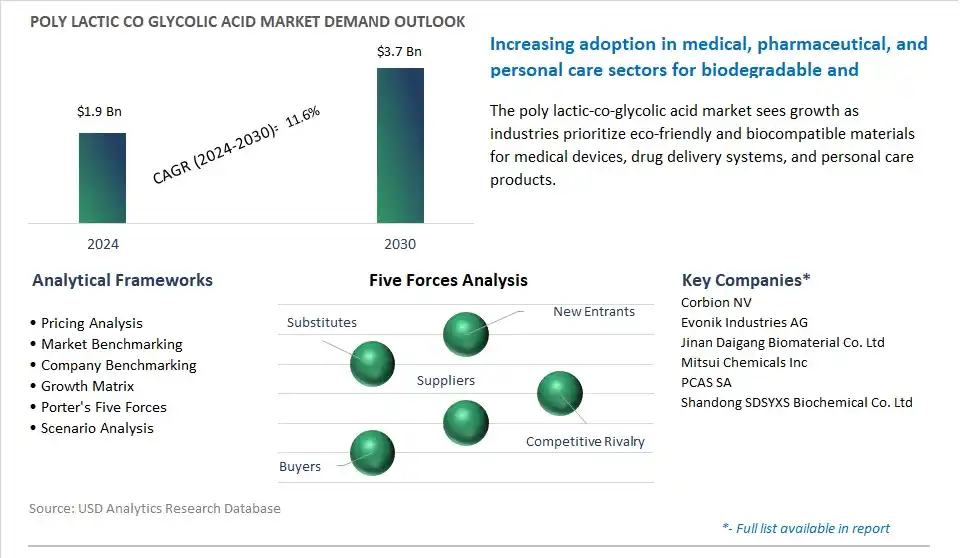
The global Poly Lactic Co Glycolic Acid Market is poised to register a 11.6% CAGR from $1.9 Billion in 2024 to $3.7 Billion in 2030.
The global Poly Lactic Co Glycolic Acid Market Study analyzes and forecasts the market size across 6 regions and 24 countries for diverse segments -By Type (PLGA 5050, PLGA 6535, PLGA 7525, PLGA 8515), By Application (Suture, Fracture Fixation, Oral Implant, Drug Delivery Microsphere).
An Introduction to Global Poly Lactic Co Glycolic Acid Market in 2024
The Poly Lactic Co Glycolic Acid (PLGA) market is experiencing growth driven by the increasing demand for biodegradable and biocompatible polymers in biomedical, pharmaceutical, and tissue engineering applications. Key trends shaping the future of this industry include the development of PLGA copolymers with tailored properties such as molecular weight, degradation rate, and drug release kinetics to meet specific application requirements. Manufacturers are investing in advanced polymerization techniques, purification methods, and formulation technologies to produce PLGA materials with enhanced mechanical strength, thermal stability, and controlled degradation profiles for sustained drug delivery systems, tissue scaffolds, and medical implants. Moreover, innovations in PLGA processing, such as electrospinning, 3D printing, and microencapsulation, are enabling the fabrication of complex structures and functional materials with precise control over morphology, porosity, and drug encapsulation efficiency. Additionally, collaborations between PLGA suppliers, biomedical researchers, and regulatory agencies are driving the development of standardized testing protocols, safety assessments, and regulatory approvals to ensure the quality, safety, and efficacy of PLGA-based products in medical and healthcare applications. Furthermore, investments in biocompatibility testing, preclinical studies, and clinical trials are expanding the market opportunities and commercialization potential of PLGA materials as versatile and sustainable solutions for advanced healthcare and regenerative medicine therapies.
Poly Lactic Co Glycolic Acid Market Competitive Landscape
The market report analyses the leading companies in the industry including Corbion NV, Evonik Industries AG, Jinan Daigang Biomaterial Co. Ltd, Mitsui Chemicals Inc, PCAS SA, Shandong SDSYXS Biochemical Co. Ltd.
Poly Lactic Co Glycolic Acid Market Dynamics
Poly Lactic Co Glycolic Acid Market Trend: Increasing Demand for Biodegradable Polymers
A significant trend in the poly lactic-co-glycolic acid (PLGA) market is the increasing demand for biodegradable polymers. PLGA is a biodegradable copolymer derived from lactic acid and glycolic acid, offering properties such as biocompatibility, tunable degradation rates, and versatility in applications. This trend is driven by growing concerns about environmental sustainability, regulatory initiatives to reduce plastic waste, and industry efforts to develop eco-friendly materials. PLGA finds widespread use in biomedical, pharmaceutical, and cosmetic industries for applications such as drug delivery, tissue engineering, and controlled release formulations. Manufacturers are responding by expanding their PLGA product offerings, optimizing production processes, and collaborating with research institutions to develop novel applications for biodegradable polymers in response to market demand for sustainable materials.
Poly Lactic Co Glycolic Acid Market Driver: Growth in Biomedical and Pharmaceutical Applications
A key driver behind the growth of the PLGA market is the increasing adoption of biodegradable polymers in biomedical and pharmaceutical applications. PLGA is widely used in these industries for its biocompatibility, controlled release properties, and ability to degrade into non-toxic byproducts, making it suitable for drug delivery systems, implants, sutures, and tissue engineering scaffolds. With advancements in healthcare technology, increasing prevalence of chronic diseases, and growing demand for personalized medicine, there's a rising need for biodegradable polymers such as PLGA to address complex therapeutic challenges and improve patient outcomes. As the biomedical and pharmaceutical industries continue to grow, driven by factors such as aging populations, healthcare reforms, and advancements in biotechnology, there's a corresponding increase in the demand for PLGA materials to support innovation, research, and development of advanced healthcare solutions.
Poly Lactic Co Glycolic Acid Market Opportunity: Expansion into Sustainable Packaging Solutions
One potential opportunity in the PLGA market lies in the expansion into sustainable packaging solutions. While PLGA is primarily known for its biomedical and pharmaceutical applications, there's an opportunity for manufacturers to leverage its biodegradable properties and versatility to develop eco-friendly packaging materials for food, cosmetics, and consumer goods industries. By innovating PLGA-based packaging solutions, manufacturers can address consumer preferences for sustainable packaging, regulatory requirements for biodegradability, and industry trends towards circular economy principles. With increasing awareness of plastic pollution and environmental conservation, PLGA offers a viable alternative to traditional petroleum-based plastics, providing opportunities for manufacturers to enter new markets, differentiate their product portfolios, and contribute to the transition towards a more sustainable packaging industry.
Poly(Lactic-Co-Glycolic Acid) (PLGA) Market Share Analysis: The PLGA 5050 segment generated the highest revenue in 2024
PLGA 5050 is the largest segment in the Poly(Lactic-Co-Glycolic Acid) (PLGA) Market due to its dominance. PLGA 5050 is a copolymer consisting of equal parts of lactic acid and glycolic acid, offering a balanced ratio of hydrophilic and hydrophobic properties. This balanced composition makes PLGA 5050 versatile and suitable for a wide range of biomedical applications, including drug delivery systems, tissue engineering scaffolds, and medical devices. PLGA 5050 exhibits excellent biocompatibility, biodegradability, and tunable degradation rates, allowing for controlled release of therapeutic agents and optimal tissue regeneration. Additionally, PLGA 5050 can be easily processed into various forms such as microspheres, nanoparticles, films, and fibers, facilitating its use in different fabrication techniques and applications. With increasing research and development activities in the field of biodegradable polymers and the growing demand for advanced biomedical materials, PLGA 5050 continues to be the preferred choice for biomedical applications, solidifying its position as the largest segment in the PLGA Market.
Poly(Lactic-Co-Glycolic Acid) (PLGA) Market Share Analysis: The Drug Delivery Microsphere segment is poised to register the fastest growth rate (CAGR) over the forecast period to 2030
The drug delivery microsphere segment is the fastest-growing segment in the Poly(Lactic-Co-Glycolic Acid) (PLGA) Market due to its growth. PLGA microspheres offer a versatile and efficient platform for controlled drug delivery, enabling precise modulation of drug release kinetics and targeting of specific tissues or organs. PLGA microspheres can encapsulate a wide range of therapeutic agents, including small molecules, proteins, peptides, and nucleic acids, protecting them from degradation and providing sustained release over an extended period. This controlled release profile enhances therapeutic efficacy, reduces dosing frequency, and minimizes side effects, making PLGA microspheres attractive for various medical applications. Additionally, PLGA microspheres can be tailored to achieve specific release profiles, such as zero-order, first-order, or pulsatile release kinetics, to meet the diverse needs of different drug therapies. Further, PLGA microspheres offer biodegradability, biocompatibility, and minimal immunogenicity, ensuring safety and compatibility with biological systems. With the increasing demand for targeted and controlled drug delivery systems in pharmaceutical and healthcare industries, the drug delivery microsphere segment is expected to experience rapid growth in the PLGA Market, driven by its versatility, efficacy, and potential for therapeutic innovation.
Poly Lactic Co Glycolic Acid Market Report Segmentation
By Type
PLGA 5050
PLGA 6535
PLGA 7525
PLGA 8515
By Application
Suture
Fracture Fixation
Oral Implant
Drug Delivery Microsphere
Regions Included
North America (US, Canada, Mexico)
Europe (Germany, UK, France, Spain, Italy, Russia, Rest of Europe)
Asia Pacific (China, India, Japan, South Korea, Australia, South East Asia, Rest of Asia)
South America (Brazil, Argentina, Rest of South America)
Middle East and Africa (Saudi Arabia, UAE, Rest of Middle East, South Africa, Egypt, Rest of Africa)
Poly Lactic Co Glycolic Acid Companies Profiled in the Market Study
Corbion NV
Evonik Industries AG
Jinan Daigang Biomaterial Co. Ltd
Mitsui Chemicals Inc
PCAS SA
Shandong SDSYXS Biochemical Co. Ltd
*- List Not Exhaustive
TABLE OF CONTENTS
1 Introduction to 2024 Poly Lactic Co Glycolic Acid Market
1.1 Market Overview
1.2 Quick Facts
1.3 Scope/Objective of the Study
1.4 Market Definition
1.5 Countries and Regions Covered
1.6 Units, Currency, and Conversions
1.7 Industry Value Chain
2 Research Methodology
2.1 Market Size Estimation
2.2 Sources and Research Methodology
2.3 Data Triangulation
2.4 Assumptions and Limitations
3 Executive Summary
3.1 Global Poly Lactic Co Glycolic Acid Market Size Outlook, $ Million, 2021 to 2030
3.2 Poly Lactic Co Glycolic Acid Market Outlook by Type, $ Million, 2021 to 2030
3.3 Poly Lactic Co Glycolic Acid Market Outlook by Product, $ Million, 2021 to 2030
3.4 Poly Lactic Co Glycolic Acid Market Outlook by Application, $ Million, 2021 to 2030
3.5 Poly Lactic Co Glycolic Acid Market Outlook by Key Countries, $ Million, 2021 to 2030
4 Market Dynamics
4.1 Key Driving Forces of Poly Lactic Co Glycolic Acid Industry
4.2 Key Market Trends in Poly Lactic Co Glycolic Acid Industry
4.3 Potential Opportunities in Poly Lactic Co Glycolic Acid Industry
4.4 Key Challenges in Poly Lactic Co Glycolic Acid Industry
5 Market Factor Analysis
5.1 Value Chain Analysis
5.2 Competitive Landscape
5.2.1 Global Poly Lactic Co Glycolic Acid Market Share by Company (%), 2023
5.2.2 Product Offerings by Company
5.3 Porter’s Five Forces Analysis
5.4 Pricing Analysis and Outlook
6 Growth Outlook Across Scenarios
6.1 Growth Analysis-Case Scenario Definitions
6.2 Low Growth Scenario Forecasts
6.3 Reference Growth Scenario Forecasts
6.4 High Growth Scenario Forecasts
7 Global Poly Lactic Co Glycolic Acid Market Outlook by Segments
7.1 Poly Lactic Co Glycolic Acid Market Outlook by Segments, $ Million, 2021- 2030
By Type
PLGA 5050
PLGA 6535
PLGA 7525
PLGA 8515
By Application
Suture
Fracture Fixation
Oral Implant
Drug Delivery Microsphere
8 North America Poly Lactic Co Glycolic Acid Market Analysis and Outlook To 2030
8.1 Introduction to North America Poly Lactic Co Glycolic Acid Markets in 2024
8.2 North America Poly Lactic Co Glycolic Acid Market Size Outlook by Country, 2021-2030
8.2.1 United States
8.2.2 Canada
8.2.3 Mexico
8.3 North America Poly Lactic Co Glycolic Acid Market size Outlook by Segments, 2021-2030
By Type
PLGA 5050
PLGA 6535
PLGA 7525
PLGA 8515
By Application
Suture
Fracture Fixation
Oral Implant
Drug Delivery Microsphere
9 Europe Poly Lactic Co Glycolic Acid Market Analysis and Outlook To 2030
9.1 Introduction to Europe Poly Lactic Co Glycolic Acid Markets in 2024
9.2 Europe Poly Lactic Co Glycolic Acid Market Size Outlook by Country, 2021-2030
9.2.1 Germany
9.2.2 France
9.2.3 Spain
9.2.4 United Kingdom
9.2.4 Italy
9.2.5 Russia
9.2.6 Norway
9.2.7 Rest of Europe
9.3 Europe Poly Lactic Co Glycolic Acid Market Size Outlook by Segments, 2021-2030
By Type
PLGA 5050
PLGA 6535
PLGA 7525
PLGA 8515
By Application
Suture
Fracture Fixation
Oral Implant
Drug Delivery Microsphere
10 Asia Pacific Poly Lactic Co Glycolic Acid Market Analysis and Outlook To 2030
10.1 Introduction to Asia Pacific Poly Lactic Co Glycolic Acid Markets in 2024
10.2 Asia Pacific Poly Lactic Co Glycolic Acid Market Size Outlook by Country, 2021-2030
10.2.1 China
10.2.2 India
10.2.3 Japan
10.2.4 South Korea
10.2.5 Indonesia
10.2.6 Malaysia
10.2.7 Australia
10.2.8 Rest of Asia Pacific
10.3 Asia Pacific Poly Lactic Co Glycolic Acid Market size Outlook by Segments, 2021-2030
By Type
PLGA 5050
PLGA 6535
PLGA 7525
PLGA 8515
By Application
Suture
Fracture Fixation
Oral Implant
Drug Delivery Microsphere
11 South America Poly Lactic Co Glycolic Acid Market Analysis and Outlook To 2030
11.1 Introduction to South America Poly Lactic Co Glycolic Acid Markets in 2024
11.2 South America Poly Lactic Co Glycolic Acid Market Size Outlook by Country, 2021-2030
11.2.1 Brazil
11.2.2 Argentina
11.2.3 Rest of South America
11.3 South America Poly Lactic Co Glycolic Acid Market size Outlook by Segments, 2021-2030
By Type
PLGA 5050
PLGA 6535
PLGA 7525
PLGA 8515
By Application
Suture
Fracture Fixation
Oral Implant
Drug Delivery Microsphere
12 Middle East and Africa Poly Lactic Co Glycolic Acid Market Analysis and Outlook To 2030
12.1 Introduction to Middle East and Africa Poly Lactic Co Glycolic Acid Markets in 2024
12.2 Middle East and Africa Poly Lactic Co Glycolic Acid Market Size Outlook by Country, 2021-2030
12.2.1 Saudi Arabia
12.2.2 UAE
12.2.3 Oman
12.2.4 Rest of Middle East
12.2.5 Egypt
12.2.6 Nigeria
12.2.7 South Africa
12.2.8 Rest of Africa
12.3 Middle East and Africa Poly Lactic Co Glycolic Acid Market size Outlook by Segments, 2021-2030
By Type
PLGA 5050
PLGA 6535
PLGA 7525
PLGA 8515
By Application
Suture
Fracture Fixation
Oral Implant
Drug Delivery Microsphere
13 Company Profiles
13.1 Company Snapshot
13.2 SWOT Profiles
13.3 Products and Services
13.4 Recent Developments
13.5 Financial Profile
Corbion NV
Evonik Industries AG
Jinan Daigang Biomaterial Co. Ltd
Mitsui Chemicals Inc
PCAS SA
Shandong SDSYXS Biochemical Co. Ltd
14 Appendix
14.1 Customization Offerings
14.2 Subscription Services
14.3 Related Reports
14.4 Publisher Expertise
By Type
PLGA 5050
PLGA 6535
PLGA 7525
PLGA 8515
By Application
Suture
Fracture Fixation
Oral Implant
Drug Delivery Microsphere
Countries Analyzed
North America (US, Canada, Mexico)
Europe (Germany, UK, France, Spain, Italy, Russia, Rest of Europe)
Asia Pacific (China, India, Japan, South Korea, Australia, South East Asia, Rest of Asia)
South America (Brazil, Argentina, Rest of South America)
Middle East and Africa (Saudi Arabia, UAE, Rest of Middle East, South Africa, Egypt, Rest of Africa)
