The global Polybutylene Succinate Market is poised to register a 16.5% CAGR from $1.16 Billion in 2024 to $2.9 Billion in 2030.
The global Polybutylene Succinate Market Study analyzes and forecasts the market size across 6 regions and 24 countries for diverse segments -By Type (Bio-based, Petro-based), By Application (Mulch Films, Packaging, Tissue Engineering, Others).
An Introduction to Global Polybutylene Succinate Market in 2024
The key trend shaping the future of the polybutylene succinate (PBS) industry is the increasing demand for sustainable and biodegradable thermoplastic materials to replace conventional plastics in packaging, textiles, automotive components, and disposable products. Polybutylene succinate is a biodegradable polyester derived from renewable resources such as plant-based feedstocks or bio-based succinic acid and 1,4-butanediol. PBS offers properties comparable to traditional petroleum-based plastics such as polyethylene and polypropylene, including good mechanical strength, thermal stability, and processability, while offering the added benefit of biodegradability in composting environments. With growing concerns over plastic pollution, landfill accumulation, and marine litter, there is a rising need for PBS-based materials that offer sustainable alternatives for single-use plastics and non-recyclable packaging. Manufacturers are investing in the development of advanced PBS formulations, compounding techniques, and processing technologies to improve material properties such as tensile strength, elongation at break, and biodegradation rate while maintaining compatibility with existing manufacturing infrastructure and end-user applications. Additionally, there is a trend towards the use of PBS blends, copolymers, and hybrid materials with other biodegradable polymers or functional additives to tailor material characteristics and enhance performance attributes such as barrier properties, UV resistance, and thermal stability for specific application requirements. Furthermore, with increasing regulatory pressures and consumer preferences for eco-friendly products, there is a growing interest in bio-based PBS alternatives and closed-loop recycling systems that promote resource efficiency, waste reduction, and circular economy principles in the plastics industry. As industries seek to address sustainability challenges and transition towards more environmentally friendly materials, the demand for innovative PBS-based solutions with enhanced performance attributes and biodegradability is expected to grow, driving market expansion and technological innovation in the bioplastics sector.
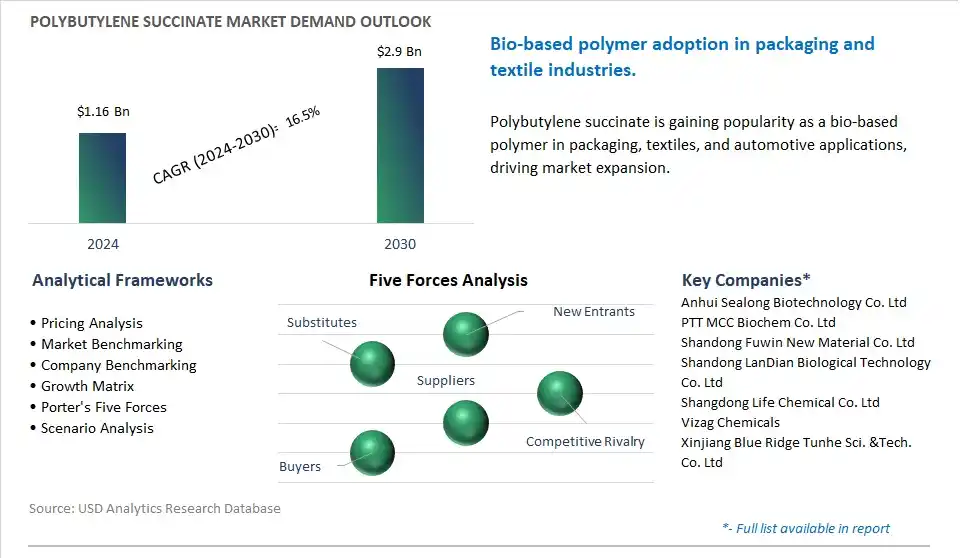
Polybutylene Succinate Market Competitive Landscape
The market report analyses the leading companies in the industry including Anhui Sealong Biotechnology Co. Ltd, PTT MCC Biochem Co. Ltd, Shandong Fuwin New Material Co. Ltd, Shandong LanDian Biological Technology Co. Ltd, Shangdong Life Chemical Co. Ltd, Vizag Chemicals, Xinjiang Blue Ridge Tunhe Sci. &Tech. Co. Ltd.
Polybutylene Succinate Market Dynamics
Polybutylene Succinate Market Trend: Increasing Demand for Sustainable Biodegradable Polymers
One prominent trend in the polybutylene succinate (PBS) market is the increasing demand for sustainable biodegradable polymers. With growing environmental concerns and regulations aimed at reducing plastic waste, there is a rising preference for eco-friendly alternatives to conventional plastics derived from fossil fuels. Polybutylene succinate, being a biodegradable polyester derived from renewable resources such as succinic acid and 1,4-butanediol, is gaining traction as a sustainable substitute for traditional plastics in various applications. This is driven by the need for environmentally friendly packaging materials, disposable products, and compostable plastics, leading to the expansion of the PBS market globally.
Polybutylene Succinate Market Driver: Shift Towards Circular Economy and Plastic Waste Reduction Initiatives
A key driver propelling the polybutylene succinate market is the global shift towards a circular economy and initiatives focused on plastic waste reduction. Governments, businesses, and consumers are increasingly emphasizing the importance of recycling, reuse, and sustainable materials to minimize the environmental impact of plastic pollution. Polybutylene succinate, being compostable and biodegradable under certain conditions, aligns with the principles of a circular economy by offering a solution to reduce plastic waste and promote resource efficiency. The growing emphasis on sustainable packaging solutions, bio-based materials, and compostable plastics drives the demand for PBS as a viable alternative to conventional plastics, presenting opportunities for manufacturers and suppliers in the market.
Polybutylene Succinate Market Opportunity: Expansion of Applications in Packaging and Textile Industries
An opportunity for the polybutylene succinate market lies in the expansion of applications in the packaging and textile industries. As awareness of environmental issues grows and regulations on single-use plastics tighten, there is a growing demand for biodegradable and compostable packaging materials across various sectors, including food and beverage, cosmetics, and consumer goods. Polybutylene succinate offers excellent properties such as good mechanical strength, flexibility, and biodegradability, making it suitable for applications in flexible films, bags, bottles, and disposable packaging. Furthermore, PBS can also be utilized in the textile industry for the production of biodegradable fibers, non-woven fabrics, and technical textiles. By tapping into these emerging application areas and leveraging the sustainable attributes of polybutylene succinate, companies can capitalize on market opportunities and drive growth in the PBS segment.
Polybutylene Succinate Market Share Analysis: Bio-based Segment generated the highest revenue in 2024
In the Polybutylene Succinate Market, the Bio-based segment is the largest category, driven by the increasing focus on sustainability and environmental conservation across industries. Bio-based polybutylene succinate (PBS) is derived from renewable resources such as plant-based feedstocks, agricultural residues, or biomass, offering a more eco-friendly alternative to petro-based PBS. With growing concerns about climate change and finite fossil fuel reserves, industries are actively seeking bio-based materials to reduce their carbon footprint and dependence on non-renewable resources. Bio-based PBS exhibits similar properties to its petro-based counterpart, including biodegradability, thermal stability, and mechanical strength, making it suitable for various applications such as packaging, textiles, automotive parts, and disposable goods. Further, government regulations promoting the use of bio-based materials further drive the demand for bio-based PBS, encouraging manufacturers to adopt sustainable alternatives in their products and packaging. As sustainability becomes a key driver of consumer preferences and corporate strategies, the Bio-based segment maintains its dominance as the largest segment in the Polybutylene Succinate Market.
Polybutylene Succinate Market Share Analysis: Tissue Engineering Segment is poised to register the fastest growth rate (CAGR) over the forecast period to 2030
In the Polybutylene Succinate Market, the Tissue Engineering segment is the fastest-growing category, driven by the increasing applications of polybutylene succinate (PBS) in regenerative medicine and tissue engineering. PBS exhibits biocompatibility, biodegradability, and mechanical properties that make it suitable for scaffolds used in tissue engineering applications. Tissue engineering involves the fabrication of artificial tissues and organs using biomaterial scaffolds to repair or replace damaged tissues in the body. PBS-based scaffolds offer potential advantages, including the ability to mimic the extracellular matrix, promote cell adhesion and proliferation, and degrade into non-toxic byproducts, facilitating tissue regeneration and integration with the host tissue. Further, advancements in 3D printing technologies enable the precise fabrication of complex PBS scaffolds tailored to specific tissue engineering applications, further driving the growth of the Tissue Engineering segment. As research and development in regenerative medicine continue to expand, the demand for PBS-based materials for tissue engineering applications is expected to soar, positioning the Tissue Engineering segment as the fastest-growing category in the Polybutylene Succinate Market.
Polybutylene Succinate Market Report Segmentation
By Type
Bio-based
Petro-based
By Application
Mulch Films
Packaging
Tissue Engineering
Others
Regions Included
North America (US, Canada, Mexico)
Europe (Germany, UK, France, Spain, Italy, Russia, Rest of Europe)
Asia Pacific (China, India, Japan, South Korea, Australia, South East Asia, Rest of Asia)
South America (Brazil, Argentina, Rest of South America)
Middle East and Africa (Saudi Arabia, UAE, Rest of Middle East, South Africa, Egypt, Rest of Africa)
Polybutylene Succinate Companies Profiled in the Market Study
Anhui Sealong Biotechnology Co. Ltd
PTT MCC Biochem Co. Ltd
Shandong Fuwin New Material Co. Ltd
Shandong LanDian Biological Technology Co. Ltd
Shangdong Life Chemical Co. Ltd
Vizag Chemicals
Xinjiang Blue Ridge Tunhe Sci. &Tech. Co. Ltd
*- List Not Exhaustive
TABLE OF CONTENTS
1 Introduction to 2024 Polybutylene Succinate Market
1.1 Market Overview
1.2 Quick Facts
1.3 Scope/Objective of the Study
1.4 Market Definition
1.5 Countries and Regions Covered
1.6 Units, Currency, and Conversions
1.7 Industry Value Chain
2 Research Methodology
2.1 Market Size Estimation
2.2 Sources and Research Methodology
2.3 Data Triangulation
2.4 Assumptions and Limitations
3 Executive Summary
3.1 Global Polybutylene Succinate Market Size Outlook, $ Million, 2021 to 2030
3.2 Polybutylene Succinate Market Outlook by Type, $ Million, 2021 to 2030
3.3 Polybutylene Succinate Market Outlook by Product, $ Million, 2021 to 2030
3.4 Polybutylene Succinate Market Outlook by Application, $ Million, 2021 to 2030
3.5 Polybutylene Succinate Market Outlook by Key Countries, $ Million, 2021 to 2030
4 Market Dynamics
4.1 Key Driving Forces of Polybutylene Succinate Industry
4.2 Key Market Trends in Polybutylene Succinate Industry
4.3 Potential Opportunities in Polybutylene Succinate Industry
4.4 Key Challenges in Polybutylene Succinate Industry
5 Market Factor Analysis
5.1 Value Chain Analysis
5.2 Competitive Landscape
5.2.1 Global Polybutylene Succinate Market Share by Company (%), 2023
5.2.2 Product Offerings by Company
5.3 Porter’s Five Forces Analysis
5.4 Pricing Analysis and Outlook
6 Growth Outlook Across Scenarios
6.1 Growth Analysis-Case Scenario Definitions
6.2 Low Growth Scenario Forecasts
6.3 Reference Growth Scenario Forecasts
6.4 High Growth Scenario Forecasts
7 Global Polybutylene Succinate Market Outlook by Segments
7.1 Polybutylene Succinate Market Outlook by Segments, $ Million, 2021- 2030
By Type
Bio-based
Petro-based
By Application
Mulch Films
Packaging
Tissue Engineering
Others
8 North America Polybutylene Succinate Market Analysis and Outlook To 2030
8.1 Introduction to North America Polybutylene Succinate Markets in 2024
8.2 North America Polybutylene Succinate Market Size Outlook by Country, 2021-2030
8.2.1 United States
8.2.2 Canada
8.2.3 Mexico
8.3 North America Polybutylene Succinate Market size Outlook by Segments, 2021-2030
By Type
Bio-based
Petro-based
By Application
Mulch Films
Packaging
Tissue Engineering
Others
9 Europe Polybutylene Succinate Market Analysis and Outlook To 2030
9.1 Introduction to Europe Polybutylene Succinate Markets in 2024
9.2 Europe Polybutylene Succinate Market Size Outlook by Country, 2021-2030
9.2.1 Germany
9.2.2 France
9.2.3 Spain
9.2.4 United Kingdom
9.2.4 Italy
9.2.5 Russia
9.2.6 Norway
9.2.7 Rest of Europe
9.3 Europe Polybutylene Succinate Market Size Outlook by Segments, 2021-2030
By Type
Bio-based
Petro-based
By Application
Mulch Films
Packaging
Tissue Engineering
Others
10 Asia Pacific Polybutylene Succinate Market Analysis and Outlook To 2030
10.1 Introduction to Asia Pacific Polybutylene Succinate Markets in 2024
10.2 Asia Pacific Polybutylene Succinate Market Size Outlook by Country, 2021-2030
10.2.1 China
10.2.2 India
10.2.3 Japan
10.2.4 South Korea
10.2.5 Indonesia
10.2.6 Malaysia
10.2.7 Australia
10.2.8 Rest of Asia Pacific
10.3 Asia Pacific Polybutylene Succinate Market size Outlook by Segments, 2021-2030
By Type
Bio-based
Petro-based
By Application
Mulch Films
Packaging
Tissue Engineering
Others
11 South America Polybutylene Succinate Market Analysis and Outlook To 2030
11.1 Introduction to South America Polybutylene Succinate Markets in 2024
11.2 South America Polybutylene Succinate Market Size Outlook by Country, 2021-2030
11.2.1 Brazil
11.2.2 Argentina
11.2.3 Rest of South America
11.3 South America Polybutylene Succinate Market size Outlook by Segments, 2021-2030
By Type
Bio-based
Petro-based
By Application
Mulch Films
Packaging
Tissue Engineering
Others
12 Middle East and Africa Polybutylene Succinate Market Analysis and Outlook To 2030
12.1 Introduction to Middle East and Africa Polybutylene Succinate Markets in 2024
12.2 Middle East and Africa Polybutylene Succinate Market Size Outlook by Country, 2021-2030
12.2.1 Saudi Arabia
12.2.2 UAE
12.2.3 Oman
12.2.4 Rest of Middle East
12.2.5 Egypt
12.2.6 Nigeria
12.2.7 South Africa
12.2.8 Rest of Africa
12.3 Middle East and Africa Polybutylene Succinate Market size Outlook by Segments, 2021-2030
By Type
Bio-based
Petro-based
By Application
Mulch Films
Packaging
Tissue Engineering
Others
13 Company Profiles
13.1 Company Snapshot
13.2 SWOT Profiles
13.3 Products and Services
13.4 Recent Developments
13.5 Financial Profile
Anhui Sealong Biotechnology Co. Ltd
PTT MCC Biochem Co. Ltd
Shandong Fuwin New Material Co. Ltd
Shandong LanDian Biological Technology Co. Ltd
Shangdong Life Chemical Co. Ltd
Vizag Chemicals
Xinjiang Blue Ridge Tunhe Sci. &Tech. Co. Ltd
14 Appendix
14.1 Customization Offerings
14.2 Subscription Services
14.3 Related Reports
14.4 Publisher Expertise
By Type
Bio-based
Petro-based
By Application
Mulch Films
Packaging
Tissue Engineering
Others
Countries Analyzed
North America (US, Canada, Mexico)
Europe (Germany, UK, France, Spain, Italy, Russia, Rest of Europe)
Asia Pacific (China, India, Japan, South Korea, Australia, South East Asia, Rest of Asia)
South America (Brazil, Argentina, Rest of South America)
Middle East and Africa (Saudi Arabia, UAE, Rest of Middle East, South Africa, Egypt, Rest of Africa)
