
The global Polyphenylene Sulfide Market Study analyzes and forecasts the market size across 6 regions and 24 countries for diverse segments -By Type (Linear PPS, Cured PPS, Branched PPS), By Application (Automotive, Electrical & Electronics, Industrial, Coatings, Others).
Polyphenylene sulfide (PPS) is a high-performance thermoplastic polymer known for its excellent thermal stability, chemical resistance, flame retardancy, and mechanical properties, making it a preferred material choice for various automotive, electrical, and industrial applications. In 2024, the market for polyphenylene sulfide s to grow as industries demand lightweight, durable, and reliable materials for harsh operating conditions and aggressive environments. PPS offers advantages such as high heat resistance, dimensional stability, corrosion resistance, and electrical insulation properties, allowing for long-term performance in applications exposed to high temperatures, chemicals, and electrical stresses. This polymer is used in automotive components such as under-the-hood parts, electrical connectors, and fuel system components for its resistance to fuels, oils, and automotive fluids, as well as in electrical and electronic applications such as circuit breakers, switches, and connectors for its electrical properties and thermal stability. In industrial applications, polyphenylene sulfide is used in components such as pumps, valves, and filtration systems for its resistance to abrasion, wear, and chemical attack. The demand for polyphenylene sulfide is driven by factors such as the growth of automotive electrification and lightweighting trends, increasing demand for high-temperature and chemically resistant materials in industrial sectors, and the expansion of electronics and electrical infrastructure. Market trends include the development of advanced PPS grades with improved flowability, impact resistance, and processing stability, the optimization of polymer compounding and molding techniques for enhanced part quality and productivity, and the integration of advanced testing and simulation tools for predictive material design and performance optimization.
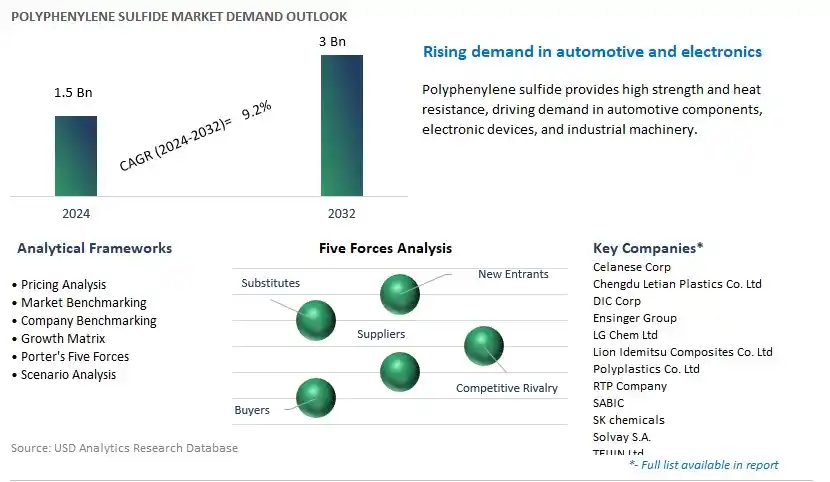
The market report analyses the leading companies in the industry including Celanese Corp, Chengdu Letian Plastics Co. Ltd, DIC Corp, Ensinger Group, LG Chem Ltd, Lion Idemitsu Composites Co. Ltd, Polyplastics Co. Ltd, RTP Company, SABIC, SK chemicals, Solvay S.A., TEIJIN Ltd, Toray Industries Inc, Tosoh Corp, Zhejiang NHU Co. Ltd, and others.
Polyphenylene sulfide (PPS) market is witnessing a significant trend towards the adoption of lightweight and high-performance materials across various industries such as automotive, electronics, and aerospace. This trend is driven by the increasing need for fuel efficiency, emission reduction, and improved performance in end-use applications. PPS, with its exceptional mechanical properties, chemical resistance, and thermal stability, is gaining traction as a preferred material choice for lightweight components in these industries. Additionally, the growing emphasis on sustainability and environmental regulations is further fueling the demand for PPS due to its recyclability and eco-friendly nature.
One of the primary drivers propelling the growth of the PPS market is the continuous technological advancements and innovations in PPS manufacturing processes and applications. With ongoing research and development efforts, manufacturers are introducing enhanced grades of PPS with improved mechanical, thermal, and electrical properties to cater to diverse end-user requirements. Moreover, the development of novel processing techniques, such as additive manufacturing and compounding technologies, is expanding the application scope of PPS in emerging sectors like healthcare, renewable energy, and consumer goods. These advancements not only contribute to the expansion of the PPS market but also foster product differentiation and competitiveness among market players.
An opportunity for the PPS market lies in the increasing penetration of PPS in emerging economies, driven by rapid industrialization, urbanization, and infrastructural development. As these economies strive to modernize their manufacturing sectors and upgrade their infrastructure, there is a growing demand for high-performance materials like PPS to meet the stringent requirements of various applications. Moreover, the rising disposable income levels and changing consumer preferences in these regions are fueling the demand for advanced electronic devices, automobiles, and industrial equipment, thereby creating a conducive environment for the expansion of the PPS market. By strategically investing in market penetration strategies and establishing robust distribution networks, manufacturers can capitalize on the untapped potential of emerging economies and gain a competitive edge in the global PPS market.
Among the types of Polyphenylene Sulfide (PPS), the Linear PPS segment is the largest. Linear PPS exhibits exceptional properties such as high thermal stability, chemical resistance, mechanical strength, and dimensional stability, making it a preferred choice across various industries. Its linear molecular structure allows for better processability and a broader range of applications compared to other types of PPS. Linear PPS finds extensive usage in automotive, electrical and electronics, industrial, and aerospace applications due to its ability to withstand harsh environments and extreme temperatures. Additionally, the increasing demand for lightweight materials, coupled with stringent regulatory standards, further boosts the adoption of Linear PPS in various industries. As manufacturers continue to prioritize efficiency, performance, and sustainability, the dominance of Linear PPS in the polyphenylene sulfide market is expected to persist, solidifying its position as the largest segment.
The Electrical & Electronics segment is the fastest-growing within the Polyphenylene Sulfide (PPS) market. In particular, the increasing demand for lightweight, high-performance materials in the electrical and electronics industry fuels the adoption of PPS. PPS offers exceptional electrical insulation properties, thermal stability, and resistance to chemicals, making it an ideal choice for various components such as connectors, sockets, switches, and circuit boards. Moreover, the rapid growth of the consumer electronics market, coupled with advancements in technology and the rise of smart devices, further boosts the demand for PPS. Additionally, stringent regulatory standards regarding energy efficiency and safety in electronic products drive the preference for durable and reliable materials like PPS. As the demand for innovative electronic products continues to rise globally, the Electrical & Electronics segment is poised for significant growth, establishing itself as the fastest-growing segment in the Polyphenylene Sulfide market.
By Type
Linear PPS
Cured PPS
Branched PPS
By Application
Automotive
Electrical & Electronics
Industrial
Coatings
Others
Countries Analyzed
North America (US, Canada, Mexico)
Europe (Germany, UK, France, Spain, Italy, Russia, Rest of Europe)
Asia Pacific (China, India, Japan, South Korea, Australia, South East Asia, Rest of Asia)
South America (Brazil, Argentina, Rest of South America)
Middle East and Africa (Saudi Arabia, UAE, Rest of Middle East, South Africa, Egypt, Rest of Africa)
Celanese Corp
Chengdu Letian Plastics Co. Ltd
DIC Corp
Ensinger Group
LG Chem Ltd
Lion Idemitsu Composites Co. Ltd
Polyplastics Co. Ltd
RTP Company
SABIC
SK chemicals
Solvay S.A.
TEIJIN Ltd
Toray Industries Inc
Tosoh Corp
Zhejiang NHU Co. Ltd
*- List Not Exhaustive
TABLE OF CONTENTS
1 Introduction to 2024 Polyphenylene Sulfide Market
1.1 Market Overview
1.2 Quick Facts
1.3 Scope/Objective of the Study
1.4 Market Definition
1.5 Countries and Regions Covered
1.6 Units, Currency, and Conversions
1.7 Industry Value Chain
2 Research Methodology
2.1 Market Size Estimation
2.2 Sources and Research Methodology
2.3 Data Triangulation
2.4 Assumptions and Limitations
3 Executive Summary
3.1 Global Polyphenylene Sulfide Market Size Outlook, $ Million, 2021 to 2032
3.2 Polyphenylene Sulfide Market Outlook by Type, $ Million, 2021 to 2032
3.3 Polyphenylene Sulfide Market Outlook by Product, $ Million, 2021 to 2032
3.4 Polyphenylene Sulfide Market Outlook by Application, $ Million, 2021 to 2032
3.5 Polyphenylene Sulfide Market Outlook by Key Countries, $ Million, 2021 to 2032
4 Market Dynamics
4.1 Key Driving Forces of Polyphenylene Sulfide Industry
4.2 Key Market Trends in Polyphenylene Sulfide Industry
4.3 Potential Opportunities in Polyphenylene Sulfide Industry
4.4 Key Challenges in Polyphenylene Sulfide Industry
5 Market Factor Analysis
5.1 Value Chain Analysis
5.2 Competitive Landscape
5.2.1 Global Polyphenylene Sulfide Market Share by Company (%), 2023
5.2.2 Product Offerings by Company
5.3 Porter’s Five Forces Analysis
5.4 Pricing Analysis and Outlook
6 Growth Outlook Across Scenarios
6.1 Growth Analysis-Case Scenario Definitions
6.2 Low Growth Scenario Forecasts
6.3 Reference Growth Scenario Forecasts
6.4 High Growth Scenario Forecasts
7 Global Polyphenylene Sulfide Market Outlook by Segments
7.1 Polyphenylene Sulfide Market Outlook by Segments, $ Million, 2021- 2032
By Type
Linear PPS
Cured PPS
Branched PPS
By Application
Automotive
Electrical & Electronics
Industrial
Coatings
Others
8 North America Polyphenylene Sulfide Market Analysis and Outlook To 2032
8.1 Introduction to North America Polyphenylene Sulfide Markets in 2024
8.2 North America Polyphenylene Sulfide Market Size Outlook by Country, 2021-2032
8.2.1 United States
8.2.2 Canada
8.2.3 Mexico
8.3 North America Polyphenylene Sulfide Market size Outlook by Segments, 2021-2032
By Type
Linear PPS
Cured PPS
Branched PPS
By Application
Automotive
Electrical & Electronics
Industrial
Coatings
Others
9 Europe Polyphenylene Sulfide Market Analysis and Outlook To 2032
9.1 Introduction to Europe Polyphenylene Sulfide Markets in 2024
9.2 Europe Polyphenylene Sulfide Market Size Outlook by Country, 2021-2032
9.2.1 Germany
9.2.2 France
9.2.3 Spain
9.2.4 United Kingdom
9.2.4 Italy
9.2.5 Russia
9.2.6 Norway
9.2.7 Rest of Europe
9.3 Europe Polyphenylene Sulfide Market Size Outlook by Segments, 2021-2032
By Type
Linear PPS
Cured PPS
Branched PPS
By Application
Automotive
Electrical & Electronics
Industrial
Coatings
Others
10 Asia Pacific Polyphenylene Sulfide Market Analysis and Outlook To 2032
10.1 Introduction to Asia Pacific Polyphenylene Sulfide Markets in 2024
10.2 Asia Pacific Polyphenylene Sulfide Market Size Outlook by Country, 2021-2032
10.2.1 China
10.2.2 India
10.2.3 Japan
10.2.4 South Korea
10.2.5 Indonesia
10.2.6 Malaysia
10.2.7 Australia
10.2.8 Rest of Asia Pacific
10.3 Asia Pacific Polyphenylene Sulfide Market size Outlook by Segments, 2021-2032
By Type
Linear PPS
Cured PPS
Branched PPS
By Application
Automotive
Electrical & Electronics
Industrial
Coatings
Others
11 South America Polyphenylene Sulfide Market Analysis and Outlook To 2032
11.1 Introduction to South America Polyphenylene Sulfide Markets in 2024
11.2 South America Polyphenylene Sulfide Market Size Outlook by Country, 2021-2032
11.2.1 Brazil
11.2.2 Argentina
11.2.3 Rest of South America
11.3 South America Polyphenylene Sulfide Market size Outlook by Segments, 2021-2032
By Type
Linear PPS
Cured PPS
Branched PPS
By Application
Automotive
Electrical & Electronics
Industrial
Coatings
Others
12 Middle East and Africa Polyphenylene Sulfide Market Analysis and Outlook To 2032
12.1 Introduction to Middle East and Africa Polyphenylene Sulfide Markets in 2024
12.2 Middle East and Africa Polyphenylene Sulfide Market Size Outlook by Country, 2021-2032
12.2.1 Saudi Arabia
12.2.2 UAE
12.2.3 Oman
12.2.4 Rest of Middle East
12.2.5 Egypt
12.2.6 Nigeria
12.2.7 South Africa
12.2.8 Rest of Africa
12.3 Middle East and Africa Polyphenylene Sulfide Market size Outlook by Segments, 2021-2032
By Type
Linear PPS
Cured PPS
Branched PPS
By Application
Automotive
Electrical & Electronics
Industrial
Coatings
Others
13 Company Profiles
13.1 Company Snapshot
13.2 SWOT Profiles
13.3 Products and Services
13.4 Recent Developments
13.5 Financial Profile
Celanese Corp
Chengdu Letian Plastics Co. Ltd
DIC Corp
Ensinger Group
LG Chem Ltd
Lion Idemitsu Composites Co. Ltd
Polyplastics Co. Ltd
RTP Company
SABIC
SK chemicals
Solvay S.A.
TEIJIN Ltd
Toray Industries Inc
Tosoh Corp
Zhejiang NHU Co. Ltd
14 Appendix
14.1 Customization Offerings
14.2 Subscription Services
14.3 Related Reports
14.4 Publisher Expertise
By Type
Linear PPS
Cured PPS
Branched PPS
By Application
Automotive
Electrical & Electronics
Industrial
Coatings
Others
Countries Analyzed
North America (US, Canada, Mexico)
Europe (Germany, UK, France, Spain, Italy, Russia, Rest of Europe)
Asia Pacific (China, India, Japan, South Korea, Australia, South East Asia, Rest of Asia)
South America (Brazil, Argentina, Rest of South America)
Middle East and Africa (Saudi Arabia, UAE, Rest of Middle East, South Africa, Egypt, Rest of Africa)
Global Polyphenylene Sulfide Market Size is valued at $1.5 Billion in 2024 and is forecast to register a growth rate (CAGR) of 9.2% to reach $3 Billion by 2032.
Emerging Markets across Asia Pacific, Europe, and Americas present robust growth prospects.
Celanese Corp, Chengdu Letian Plastics Co. Ltd, DIC Corp, Ensinger Group, LG Chem Ltd, Lion Idemitsu Composites Co. Ltd, Polyplastics Co. Ltd, RTP Company, SABIC, SK chemicals, Solvay S.A., TEIJIN Ltd, Toray Industries Inc, Tosoh Corp, Zhejiang NHU Co. Ltd
Base Year- 2023; Estimated Year- 2024; Historic Period- 2018-2023; Forecast period- 2024 to 2032; Currency: Revenue (USD); Volume