
The global Polyurethane Catalysts Market Study analyzes and forecasts the market size across 6 regions and 24 countries for diverse segments -By Type (Amine Catalyst, Metal Catalyst), By Functionality (Gelling catalyst, Blowing Catalyst, Curing Catalyst, Foam Stabilizing Catalyst, Cross linking Catalyst, Others), By Application (Foams, Elastomer, Sealant and adhesive, Coating, Others).
The polyurethane catalysts market is undergoing significant developments driven by key trends that are shaping its future trajectory. These trends include the increasing demand for polyurethane materials in construction, automotive, and furniture industries due to their versatility, durability, and performance characteristics. Manufacturers are focusing on developing innovative catalyst formulations that enable faster curing, improved mechanical properties, and enhanced processing efficiency in polyurethane production processes. Moreover, there is a growing emphasis on sustainability, leading to the development of eco-friendly catalysts that reduce emissions, energy consumption, and waste generation during polyurethane manufacturing. Additionally, advancements in catalyst technology and application methods are driving the optimization of polyurethane formulations for specific end-use applications, offering customized solutions that meet performance requirements and regulatory standards while maximizing resource efficiency and cost-effectiveness.
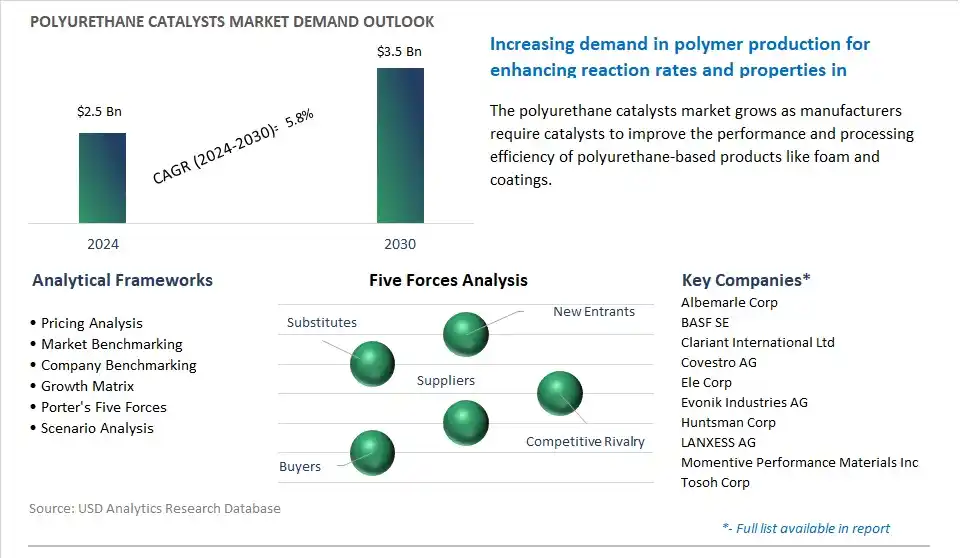
The market report analyses the leading companies in the industry including Albemarle Corp, BASF SE, Clariant International Ltd, Covestro AG, Ele Corp, Evonik Industries AG, Huntsman Corp, LANXESS AG, Momentive Performance Materials Inc, Tosoh Corp.
Polyurethane catalysts are experiencing a prominent market trend driven by the increasing demand for sustainable and high-performance polyurethane formulations across various industries. With the growing emphasis on environmental sustainability, regulatory compliance, and product innovation, there is a rising need for catalysts that enable the production of polyurethane materials with enhanced properties such as durability, flexibility, and thermal stability. Polyurethane catalysts play a crucial role in controlling the reaction kinetics and properties of polyurethane foams, coatings, adhesives, and elastomers, thereby influencing product performance, process efficiency, and environmental impact. This trend is fueled by the shift towards bio-based and renewable raw materials, the development of low-VOC (volatile organic compound) formulations, and the demand for polyurethane products with improved sustainability credentials, driving the adoption of advanced catalyst technologies in the polyurethane industry.
The market for polyurethane catalysts is being driven by the growth in construction and automotive industries worldwide, which are significant consumers of polyurethane-based products. With increasing urbanization, infrastructure development, and demand for energy-efficient building materials, there is a rising need for polyurethane foams, sealants, and insulation materials in construction applications such as insulation panels, roofing systems, and sealant joints. Similarly, in the automotive sector, polyurethane coatings, adhesives, and foams are used for interior components, exterior finishes, and structural reinforcements to enhance vehicle performance, safety, and comfort. Polyurethane catalysts enable the efficient production of polyurethane materials with desired properties, enabling manufacturers to meet the stringent performance requirements and quality standards of the construction and automotive industries. The growth of these key end-user industries drives the demand for polyurethane catalysts and fosters innovation in catalyst technologies to address evolving market needs and regulatory requirements.
The market for polyurethane catalysts presents a significant opportunity for the development of next-generation catalyst formulations and technologies that offer improved performance, efficiency, and sustainability. With ongoing advancements in chemistry, catalysis, and materials science, there is potential to enhance the catalytic activity, selectivity, and processability of polyurethane catalysts to optimize polyurethane production processes and product performance. Opportunities exist for the development of catalysts with enhanced reactivity, reduced toxicity, and increased stability under varying processing conditions, enabling the production of polyurethane materials with tailored properties and reduced environmental impact. Additionally, innovations in catalyst delivery systems, such as encapsulated catalysts, reactive additives, and on-demand catalyst activation technologies, offer opportunities to improve process efficiency, reduce waste, and enhance control over polyurethane synthesis processes. By investing in research and development of next-generation catalyst formulations and technologies, stakeholders can differentiate their products in the market, address emerging challenges in polyurethane production, and capitalize on the growing demand for high-performance and sustainable polyurethane materials.
The amine catalyst segment is the largest in the Polyurethane Catalysts Market due to its dominance. amine catalysts are widely used in the production of polyurethane foams, coatings, adhesives, sealants, and elastomers, which are essential materials in industries such as construction, automotive, furniture, and footwear. Amine catalysts play a crucial role in promoting the urethane reaction between isocyanates and polyols, facilitating the formation of polyurethane polymers with desired properties such as strength, flexibility, and curing characteristics. Additionally, amine catalysts offer potential advantages over metal catalysts in polyurethane production. Amine catalysts exhibit faster reaction kinetics, allowing for shorter curing times and increased productivity in manufacturing processes. Further, amine catalysts are more versatile and compatible with a wide range of polyurethane formulations, offering greater formulation flexibility and enabling the production of tailored products to meet specific performance requirements. Furthermore, amine catalysts are cost-effective and readily available compared to metal catalysts, contributing to their widespread adoption in the polyurethane industry. With the growing demand for polyurethane materials in various applications and industries, the amine catalyst segment continues to dominate the Polyurethane Catalysts Market.
The Foam Stabilizing Catalyst segment is the fastest-growing sector in the Polyurethane Catalysts Market. This catalyst plays a pivotal role in enhancing the stability and quality of polyurethane foam, which finds extensive applications across various industries including construction, automotive, and furniture. The burgeoning demand for lightweight and durable materials in these sectors is fueling the growth of polyurethane foam, consequently driving the demand for foam stabilizing catalysts. Additionally, the increasing focus on energy efficiency and sustainability is boosting the adoption of polyurethane foam as an insulation material, further propelling the demand for foam stabilizing catalysts. Furthermore, advancements in technology leading to the development of more efficient and eco-friendly catalysts are anticipated to contribute to the rapid growth of this segment in the coming years.
Among the segments in the Polyurethane Catalysts Market, the Coating segment is experiencing notable growth. This growth is driven by to the rising demand for polyurethane coatings across various end-user industries such as automotive, construction, and aerospace. Polyurethane coatings offer superior properties such as durability, weather resistance, and chemical resistance, making them ideal for applications where protection and aesthetics are crucial. With increasing investments in infrastructure development and the automotive sector globally, the demand for high-performance coatings is on the rise, thus driving the need for efficient polyurethane catalysts to ensure optimal coating performance. Further, ongoing research and development efforts aimed at enhancing the properties of polyurethane coatings and reducing their environmental impact are further fueling the growth of this segment.
By Type
Amine Catalyst
Metal Catalyst
By Functionality
Gelling catalyst
Blowing Catalyst
Curing Catalyst
Foam Stabilizing Catalyst
Cross linking Catalyst
Others
By Application
Foams
Elastomer
Sealant and adhesive
Coating
Others
Regions Included
North America (US, Canada, Mexico)
Europe (Germany, UK, France, Spain, Italy, Russia, Rest of Europe)
Asia Pacific (China, India, Japan, South Korea, Australia, South East Asia, Rest of Asia)
South America (Brazil, Argentina, Rest of South America)
Middle East and Africa (Saudi Arabia, UAE, Rest of Middle East, South Africa, Egypt, Rest of Africa)
Albemarle Corp
BASF SE
Clariant International Ltd
Covestro AG
Ele Corp
Evonik Industries AG
Huntsman Corp
LANXESS AG
Momentive Performance Materials Inc
Tosoh Corp
*- List Not Exhaustive
TABLE OF CONTENTS
1 Introduction to 2024 Polyurethane Catalysts Market
1.1 Market Overview
1.2 Quick Facts
1.3 Scope/Objective of the Study
1.4 Market Definition
1.5 Countries and Regions Covered
1.6 Units, Currency, and Conversions
1.7 Industry Value Chain
2 Research Methodology
2.1 Market Size Estimation
2.2 Sources and Research Methodology
2.3 Data Triangulation
2.4 Assumptions and Limitations
3 Executive Summary
3.1 Global Polyurethane Catalysts Market Size Outlook, $ Million, 2021 to 2030
3.2 Polyurethane Catalysts Market Outlook by Type, $ Million, 2021 to 2030
3.3 Polyurethane Catalysts Market Outlook by Product, $ Million, 2021 to 2030
3.4 Polyurethane Catalysts Market Outlook by Application, $ Million, 2021 to 2030
3.5 Polyurethane Catalysts Market Outlook by Key Countries, $ Million, 2021 to 2030
4 Market Dynamics
4.1 Key Driving Forces of Polyurethane Catalysts Industry
4.2 Key Market Trends in Polyurethane Catalysts Industry
4.3 Potential Opportunities in Polyurethane Catalysts Industry
4.4 Key Challenges in Polyurethane Catalysts Industry
5 Market Factor Analysis
5.1 Value Chain Analysis
5.2 Competitive Landscape
5.2.1 Global Polyurethane Catalysts Market Share by Company (%), 2023
5.2.2 Product Offerings by Company
5.3 Porter’s Five Forces Analysis
5.4 Pricing Analysis and Outlook
6 Growth Outlook Across Scenarios
6.1 Growth Analysis-Case Scenario Definitions
6.2 Low Growth Scenario Forecasts
6.3 Reference Growth Scenario Forecasts
6.4 High Growth Scenario Forecasts
7 Global Polyurethane Catalysts Market Outlook by Segments
7.1 Polyurethane Catalysts Market Outlook by Segments, $ Million, 2021- 2030
By Type
Amine Catalyst
Metal Catalyst
By Functionality
Gelling catalyst
Blowing Catalyst
Curing Catalyst
Foam Stabilizing Catalyst
Cross linking Catalyst
Others
By Application
Foams
Elastomer
Sealant and adhesive
Coating
Others
8 North America Polyurethane Catalysts Market Analysis and Outlook To 2030
8.1 Introduction to North America Polyurethane Catalysts Markets in 2024
8.2 North America Polyurethane Catalysts Market Size Outlook by Country, 2021-2030
8.2.1 United States
8.2.2 Canada
8.2.3 Mexico
8.3 North America Polyurethane Catalysts Market size Outlook by Segments, 2021-2030
By Type
Amine Catalyst
Metal Catalyst
By Functionality
Gelling catalyst
Blowing Catalyst
Curing Catalyst
Foam Stabilizing Catalyst
Cross linking Catalyst
Others
By Application
Foams
Elastomer
Sealant and adhesive
Coating
Others
9 Europe Polyurethane Catalysts Market Analysis and Outlook To 2030
9.1 Introduction to Europe Polyurethane Catalysts Markets in 2024
9.2 Europe Polyurethane Catalysts Market Size Outlook by Country, 2021-2030
9.2.1 Germany
9.2.2 France
9.2.3 Spain
9.2.4 United Kingdom
9.2.4 Italy
9.2.5 Russia
9.2.6 Norway
9.2.7 Rest of Europe
9.3 Europe Polyurethane Catalysts Market Size Outlook by Segments, 2021-2030
By Type
Amine Catalyst
Metal Catalyst
By Functionality
Gelling catalyst
Blowing Catalyst
Curing Catalyst
Foam Stabilizing Catalyst
Cross linking Catalyst
Others
By Application
Foams
Elastomer
Sealant and adhesive
Coating
Others
10 Asia Pacific Polyurethane Catalysts Market Analysis and Outlook To 2030
10.1 Introduction to Asia Pacific Polyurethane Catalysts Markets in 2024
10.2 Asia Pacific Polyurethane Catalysts Market Size Outlook by Country, 2021-2030
10.2.1 China
10.2.2 India
10.2.3 Japan
10.2.4 South Korea
10.2.5 Indonesia
10.2.6 Malaysia
10.2.7 Australia
10.2.8 Rest of Asia Pacific
10.3 Asia Pacific Polyurethane Catalysts Market size Outlook by Segments, 2021-2030
By Type
Amine Catalyst
Metal Catalyst
By Functionality
Gelling catalyst
Blowing Catalyst
Curing Catalyst
Foam Stabilizing Catalyst
Cross linking Catalyst
Others
By Application
Foams
Elastomer
Sealant and adhesive
Coating
Others
11 South America Polyurethane Catalysts Market Analysis and Outlook To 2030
11.1 Introduction to South America Polyurethane Catalysts Markets in 2024
11.2 South America Polyurethane Catalysts Market Size Outlook by Country, 2021-2030
11.2.1 Brazil
11.2.2 Argentina
11.2.3 Rest of South America
11.3 South America Polyurethane Catalysts Market size Outlook by Segments, 2021-2030
By Type
Amine Catalyst
Metal Catalyst
By Functionality
Gelling catalyst
Blowing Catalyst
Curing Catalyst
Foam Stabilizing Catalyst
Cross linking Catalyst
Others
By Application
Foams
Elastomer
Sealant and adhesive
Coating
Others
12 Middle East and Africa Polyurethane Catalysts Market Analysis and Outlook To 2030
12.1 Introduction to Middle East and Africa Polyurethane Catalysts Markets in 2024
12.2 Middle East and Africa Polyurethane Catalysts Market Size Outlook by Country, 2021-2030
12.2.1 Saudi Arabia
12.2.2 UAE
12.2.3 Oman
12.2.4 Rest of Middle East
12.2.5 Egypt
12.2.6 Nigeria
12.2.7 South Africa
12.2.8 Rest of Africa
12.3 Middle East and Africa Polyurethane Catalysts Market size Outlook by Segments, 2021-2030
By Type
Amine Catalyst
Metal Catalyst
By Functionality
Gelling catalyst
Blowing Catalyst
Curing Catalyst
Foam Stabilizing Catalyst
Cross linking Catalyst
Others
By Application
Foams
Elastomer
Sealant and adhesive
Coating
Others
13 Company Profiles
13.1 Company Snapshot
13.2 SWOT Profiles
13.3 Products and Services
13.4 Recent Developments
13.5 Financial Profile
Albemarle Corp
BASF SE
Clariant International Ltd
Covestro AG
Ele Corp
Evonik Industries AG
Huntsman Corp
LANXESS AG
Momentive Performance Materials Inc
Tosoh Corp
14 Appendix
14.1 Customization Offerings
14.2 Subscription Services
14.3 Related Reports
14.4 Publisher Expertise
By Type
Amine Catalyst
Metal Catalyst
By Functionality
Gelling catalyst
Blowing Catalyst
Curing Catalyst
Foam Stabilizing Catalyst
Cross linking Catalyst
Others
By Application
Foams
Elastomer
Sealant and adhesive
Coating
Others
Countries Analyzed
North America (US, Canada, Mexico)
Europe (Germany, UK, France, Spain, Italy, Russia, Rest of Europe)
Asia Pacific (China, India, Japan, South Korea, Australia, South East Asia, Rest of Asia)
South America (Brazil, Argentina, Rest of South America)
Middle East and Africa (Saudi Arabia, UAE, Rest of Middle East, South Africa, Egypt, Rest of Africa)
Global Polyurethane Catalysts is forecast to reach $3.5 Billion in 2030 from $2.5 Billion in 2024, registering a CAGR of 5.8%
Emerging Markets across Asia Pacific, Europe, and Americas present robust growth prospects.
Albemarle Corp, BASF SE, Clariant International Ltd, Covestro AG, Ele Corp, Evonik Industries AG, Huntsman Corp, LANXESS AG, Momentive Performance Materials Inc, Tosoh Corp
Base Year- 2023; Estimated Year- 2024; Historic Period- 2018-2023; Forecast period- 2024 to 2030; Currency: Revenue (USD); Volume