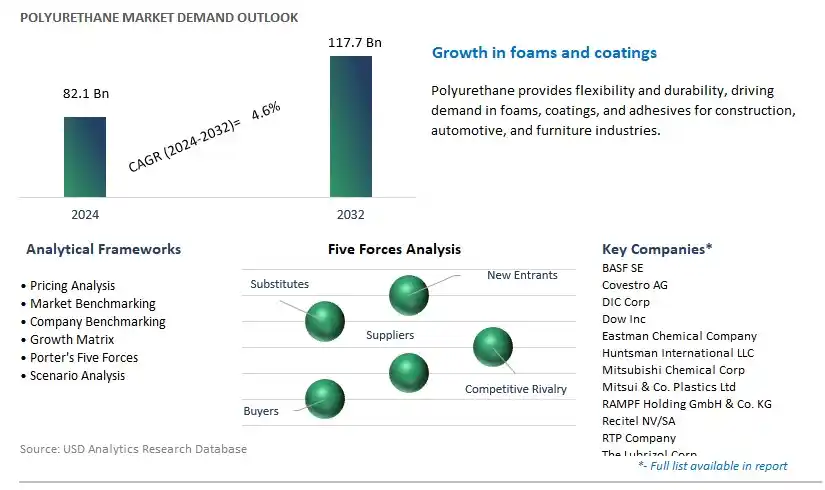
Global Polyurethane Market Size is valued at $82.1 Billion in 2024 and is forecast to register a growth rate (CAGR) of 4.6% to reach $117.7 Billion by 2032.
The global Polyurethane Market Study analyzes and forecasts the market size across 6 regions and 24 countries for diverse segments -By Raw Material (Toluene Di-isocyanate, Methylene Diphenyl Di-isocyanate, Polyols, Others), By Product (Rigid Foam, Flexible Foam, Coatings, Adhesives & Sealants, Elastomers, Others), By Application (Furniture and Interiors, Construction, Electronics & Appliances, Automotive, Footwear, Packaging, Others).
An Introduction to Polyurethane Market in 2024
Polyurethane (PU) is a versatile polymer known for its wide range of properties, including flexibility, durability, chemical resistance, and thermal insulation, making it one of the most commonly used materials in various industrial, automotive, construction, and consumer applications. In 2024, the market for polyurethane s to expand as industries seek customizable, high-performance, and cost-effective materials for diverse end-use requirements in a global market landscape. PU offers advantages such as versatility, toughness, resilience, and adhesion, making it essential for applications such as foam insulation, elastomers, adhesives, coatings, and sealants. This polymer is used in construction materials such as insulation panels, spray foam insulation, and sealants for its thermal insulation and weatherproofing properties, as well as in automotive components such as seating, interior trim, and bumpers for its impact resistance and comfort. In industrial applications, polyurethane is used in rollers, belts, and gaskets for its wear resistance and elasticity, as well as in consumer products such as footwear, furniture, and sporting goods for its comfort and aesthetics. The demand for polyurethane is driven by factors such as the growth of construction and infrastructure projects, increasing demand for energy-efficient and sustainable materials, and the expansion of automotive and consumer goods markets. Market trends include the development of bio-based and recycled polyurethane formulations, the optimization of polymerization processes for improved efficiency and cost-effectiveness, and the integration of advanced additive and compounding technologies for enhanced performance and functionality.
Polyurethane Market Competitive Landscape
The market report analyses the leading companies in the industry including BASF SE, Covestro AG, DIC Corp, Dow Inc, Eastman Chemical Company, Huntsman International LLC, Mitsubishi Chemical Corp, Mitsui & Co. Plastics Ltd, RAMPF Holding GmbH & Co. KG, Recitel NV/SA, RTP Company, The Lubrizol Corp, Tosoh Corp, Woodbridge, and others.
Polyurethane Market Dynamics
Market Trend: Shift Towards Sustainable and Green Materials
Polyurethane market is witnessing a significant trend towards the shift to sustainable and green materials. This trend is driven by increasing environmental awareness, stringent regulations, and consumer demand for eco-friendly products. Manufacturers are focusing on developing bio-based and renewable polyurethane formulations, reducing reliance on fossil fuels, and minimizing carbon footprint throughout the production process. Additionally, the adoption of recycled and recyclable polyurethane materials in various applications, such as furniture, construction, and automotive, is gaining momentum as industries strive to achieve sustainability goals and meet consumer preferences for environmentally responsible products.
Market Driver: Growth in Construction and Building Insulation Applications
An important driver propelling the growth of the Polyurethane market is the expansion of construction and building insulation applications. As energy efficiency regulations become more stringent and the need for sustainable building solutions increases, there's a growing demand for high-performance insulation materials like polyurethane foam. Polyurethane foam insulation offers superior thermal resistance, air sealing properties, and versatility in application, making it a preferred choice for residential, commercial, and industrial buildings. The construction industry's emphasis on energy-efficient building envelopes, reduced heating and cooling costs, and improved indoor air quality drives the demand for polyurethane insulation materials, supporting market growth.
Market Opportunity: Penetration into Automotive Lightweighting
A significant opportunity for the Polyurethane market lies in penetration into automotive lightweighting. With the automotive industry's focus on reducing vehicle weight to improve fuel efficiency, lower emissions, and enhance performance, there's a growing demand for lightweight materials like polyurethane. Polyurethane's high strength-to-weight ratio, impact resistance, and design flexibility make it suitable for various automotive applications, including interior components, seating, and structural reinforcements. By collaborating with automotive manufacturers to develop innovative polyurethane solutions that meet stringent performance and safety standards while reducing overall vehicle weight, polyurethane producers can capitalize on the expanding opportunities in the automotive lightweighting market and strengthen their market position.
Polyurethane Market Share Analysis: Polyols segment generated the highest revenue in 2024
Within the Polyurethane market, the Polyols segment is the largest. Polyols are a key raw material used in the production of polyurethane, serving as the polymeric backbone of the material. They react with isocyanates to form the polyurethane polymer, imparting various desirable properties such as flexibility, durability, and resilience. Polyols are derived from renewable or petrochemical sources and are available in a wide range of types and compositions, allowing for the formulation of polyurethane materials tailored to specific application requirements. Polyols are extensively used in the manufacturing of flexible foams, rigid foams, coatings, adhesives, sealants, and elastomers across diverse industries including construction, automotive, furniture, appliances, and footwear. Additionally, advancements in polyol chemistry and processing technologies have further expanded the versatility and performance capabilities of polyurethane products. As industries continue to seek innovative materials with superior properties and sustainability credentials, the Polyols segment is expected to maintain its dominance in the Polyurethane market.
Polyurethane Market Share Analysis: Coatings, Adhesives & Sealants is poised to register the fastest CAGR over the forecast period
Among the products in the Polyurethane market, the Coatings, Adhesives & Sealants segment is the fastest-growing. Polyurethane coatings, adhesives, and sealants offer a wide range of desirable properties such as durability, chemical resistance, weatherability, and adhesion to various substrates. These products find extensive applications in industries such as construction, automotive, aerospace, marine, and manufacturing. Polyurethane coatings are used for protective and decorative purposes on surfaces exposed to harsh environments, while polyurethane adhesives provide strong bonding capabilities for diverse materials. Additionally, polyurethane sealants are utilized for sealing joints and gaps in construction and automotive applications, ensuring waterproofing and weatherproofing. The growing demand for high-performance coatings, adhesives, and sealants in construction, automotive, and industrial sectors, driven by infrastructure development, technological advancements, and increasing awareness of sustainability, fuels the rapid growth of the Coatings, Adhesives & Sealants segment in the Polyurethane market. As industries continue to prioritize efficiency, durability, and environmental sustainability in their applications, the Coatings, Adhesives & Sealants segment is expected to experience sustained growth, solidifying its position as the fastest-growing segment in the Polyurethane market.
Polyurethane Market Share Analysis: Construction segment generated the highest revenue in 2024
Within the Polyurethane market, the Construction segment is the largest. Polyurethane materials find extensive applications in the construction industry due to their versatile properties and wide range of uses. Polyurethane foam insulation is commonly used in residential, commercial, and industrial buildings to enhance energy efficiency by providing thermal insulation and air sealing. Additionally, polyurethane adhesives and sealants are utilized for bonding and sealing applications in construction projects, ensuring structural integrity and waterproofing. Polyurethane coatings are also employed for protective and decorative purposes on various surfaces such as floors, walls, and roofs, providing durability and aesthetic appeal. Moreover, the construction industry's growth, driven by urbanization, infrastructure development, and green building initiatives, further fuels the demand for polyurethane products. As construction projects continue to prioritize energy efficiency, durability, and sustainability, the Construction segment is expected to maintain its dominance in the Polyurethane market.
Polyurethane Market
By Raw Material
Toluene Di-isocyanate
Methylene Diphenyl Di-isocyanate
Polyols
Others
By Product
Rigid Foam
Flexible Foam
Coatings
Adhesives & Sealants
Elastomers
Others
By Application
Furniture and Interiors
Construction
Electronics & Appliances
Automotive
Footwear
Packaging
Others
Countries Analyzed
North America (US, Canada, Mexico)
Europe (Germany, UK, France, Spain, Italy, Russia, Rest of Europe)
Asia Pacific (China, India, Japan, South Korea, Australia, South East Asia, Rest of Asia)
South America (Brazil, Argentina, Rest of South America)
Middle East and Africa (Saudi Arabia, UAE, Rest of Middle East, South Africa, Egypt, Rest of Africa)
Polyurethane Companies Profiled in the Study
BASF SE
Covestro AG
DIC Corp
Dow Inc
Eastman Chemical Company
Huntsman International LLC
Mitsubishi Chemical Corp
Mitsui & Co. Plastics Ltd
RAMPF Holding GmbH & Co. KG
Recitel NV/SA
RTP Company
The Lubrizol Corp
Tosoh Corp
Woodbridge
*- List Not Exhaustive
TABLE OF CONTENTS
1 Introduction to 2024 Polyurethane Market
1.1 Market Overview
1.2 Quick Facts
1.3 Scope/Objective of the Study
1.4 Market Definition
1.5 Countries and Regions Covered
1.6 Units, Currency, and Conversions
1.7 Industry Value Chain
2 Research Methodology
2.1 Market Size Estimation
2.2 Sources and Research Methodology
2.3 Data Triangulation
2.4 Assumptions and Limitations
3 Executive Summary
3.1 Global Polyurethane Market Size Outlook, $ Million, 2021 to 2032
3.2 Polyurethane Market Outlook by Type, $ Million, 2021 to 2032
3.3 Polyurethane Market Outlook by Product, $ Million, 2021 to 2032
3.4 Polyurethane Market Outlook by Application, $ Million, 2021 to 2032
3.5 Polyurethane Market Outlook by Key Countries, $ Million, 2021 to 2032
4 Market Dynamics
4.1 Key Driving Forces of Polyurethane Industry
4.2 Key Market Trends in Polyurethane Industry
4.3 Potential Opportunities in Polyurethane Industry
4.4 Key Challenges in Polyurethane Industry
5 Market Factor Analysis
5.1 Value Chain Analysis
5.2 Competitive Landscape
5.2.1 Global Polyurethane Market Share by Company (%), 2023
5.2.2 Product Offerings by Company
5.3 Porter’s Five Forces Analysis
5.4 Pricing Analysis and Outlook
6 Growth Outlook Across Scenarios
6.1 Growth Analysis-Case Scenario Definitions
6.2 Low Growth Scenario Forecasts
6.3 Reference Growth Scenario Forecasts
6.4 High Growth Scenario Forecasts
7 Global Polyurethane Market Outlook by Segments
7.1 Polyurethane Market Outlook by Segments, $ Million, 2021- 2032
By Raw Material
Toluene Di-isocyanate
Methylene Diphenyl Di-isocyanate
Polyols
Others
By Product
Rigid Foam
Flexible Foam
Coatings
Adhesives & Sealants
Elastomers
Others
By Application
Furniture and Interiors
Construction
Electronics & Appliances
Automotive
Footwear
Packaging
Others
8 North America Polyurethane Market Analysis and Outlook To 2032
8.1 Introduction to North America Polyurethane Markets in 2024
8.2 North America Polyurethane Market Size Outlook by Country, 2021-2032
8.2.1 United States
8.2.2 Canada
8.2.3 Mexico
8.3 North America Polyurethane Market size Outlook by Segments, 2021-2032
By Raw Material
Toluene Di-isocyanate
Methylene Diphenyl Di-isocyanate
Polyols
Others
By Product
Rigid Foam
Flexible Foam
Coatings
Adhesives & Sealants
Elastomers
Others
By Application
Furniture and Interiors
Construction
Electronics & Appliances
Automotive
Footwear
Packaging
Others
9 Europe Polyurethane Market Analysis and Outlook To 2032
9.1 Introduction to Europe Polyurethane Markets in 2024
9.2 Europe Polyurethane Market Size Outlook by Country, 2021-2032
9.2.1 Germany
9.2.2 France
9.2.3 Spain
9.2.4 United Kingdom
9.2.4 Italy
9.2.5 Russia
9.2.6 Norway
9.2.7 Rest of Europe
9.3 Europe Polyurethane Market Size Outlook by Segments, 2021-2032
By Raw Material
Toluene Di-isocyanate
Methylene Diphenyl Di-isocyanate
Polyols
Others
By Product
Rigid Foam
Flexible Foam
Coatings
Adhesives & Sealants
Elastomers
Others
By Application
Furniture and Interiors
Construction
Electronics & Appliances
Automotive
Footwear
Packaging
Others
10 Asia Pacific Polyurethane Market Analysis and Outlook To 2032
10.1 Introduction to Asia Pacific Polyurethane Markets in 2024
10.2 Asia Pacific Polyurethane Market Size Outlook by Country, 2021-2032
10.2.1 China
10.2.2 India
10.2.3 Japan
10.2.4 South Korea
10.2.5 Indonesia
10.2.6 Malaysia
10.2.7 Australia
10.2.8 Rest of Asia Pacific
10.3 Asia Pacific Polyurethane Market size Outlook by Segments, 2021-2032
By Raw Material
Toluene Di-isocyanate
Methylene Diphenyl Di-isocyanate
Polyols
Others
By Product
Rigid Foam
Flexible Foam
Coatings
Adhesives & Sealants
Elastomers
Others
By Application
Furniture and Interiors
Construction
Electronics & Appliances
Automotive
Footwear
Packaging
Others
11 South America Polyurethane Market Analysis and Outlook To 2032
11.1 Introduction to South America Polyurethane Markets in 2024
11.2 South America Polyurethane Market Size Outlook by Country, 2021-2032
11.2.1 Brazil
11.2.2 Argentina
11.2.3 Rest of South America
11.3 South America Polyurethane Market size Outlook by Segments, 2021-2032
By Raw Material
Toluene Di-isocyanate
Methylene Diphenyl Di-isocyanate
Polyols
Others
By Product
Rigid Foam
Flexible Foam
Coatings
Adhesives & Sealants
Elastomers
Others
By Application
Furniture and Interiors
Construction
Electronics & Appliances
Automotive
Footwear
Packaging
Others
12 Middle East and Africa Polyurethane Market Analysis and Outlook To 2032
12.1 Introduction to Middle East and Africa Polyurethane Markets in 2024
12.2 Middle East and Africa Polyurethane Market Size Outlook by Country, 2021-2032
12.2.1 Saudi Arabia
12.2.2 UAE
12.2.3 Oman
12.2.4 Rest of Middle East
12.2.5 Egypt
12.2.6 Nigeria
12.2.7 South Africa
12.2.8 Rest of Africa
12.3 Middle East and Africa Polyurethane Market size Outlook by Segments, 2021-2032
By Raw Material
Toluene Di-isocyanate
Methylene Diphenyl Di-isocyanate
Polyols
Others
By Product
Rigid Foam
Flexible Foam
Coatings
Adhesives & Sealants
Elastomers
Others
By Application
Furniture and Interiors
Construction
Electronics & Appliances
Automotive
Footwear
Packaging
Others
13 Company Profiles
13.1 Company Snapshot
13.2 SWOT Profiles
13.3 Products and Services
13.4 Recent Developments
13.5 Financial Profile
BASF SE
Covestro AG
DIC Corp
Dow Inc
Eastman Chemical Company
Huntsman International LLC
Mitsubishi Chemical Corp
Mitsui & Co. Plastics Ltd
RAMPF Holding GmbH & Co. KG
Recitel NV/SA
RTP Company
The Lubrizol Corp
Tosoh Corp
Woodbridge
14 Appendix
14.1 Customization Offerings
14.2 Subscription Services
14.3 Related Reports
14.4 Publisher Expertise
By Raw Material
Toluene Di-isocyanate
Methylene Diphenyl Di-isocyanate
Polyols
Others
By Product
Rigid Foam
Flexible Foam
Coatings
Adhesives & Sealants
Elastomers
Others
By Application
Furniture and Interiors
Construction
Electronics & Appliances
Automotive
Footwear
Packaging
Others
Countries Analyzed
North America (US, Canada, Mexico)
Europe (Germany, UK, France, Spain, Italy, Russia, Rest of Europe)
Asia Pacific (China, India, Japan, South Korea, Australia, South East Asia, Rest of Asia)
South America (Brazil, Argentina, Rest of South America)
Middle East and Africa (Saudi Arabia, UAE, Rest of Middle East, South Africa, Egypt, Rest of Africa)
