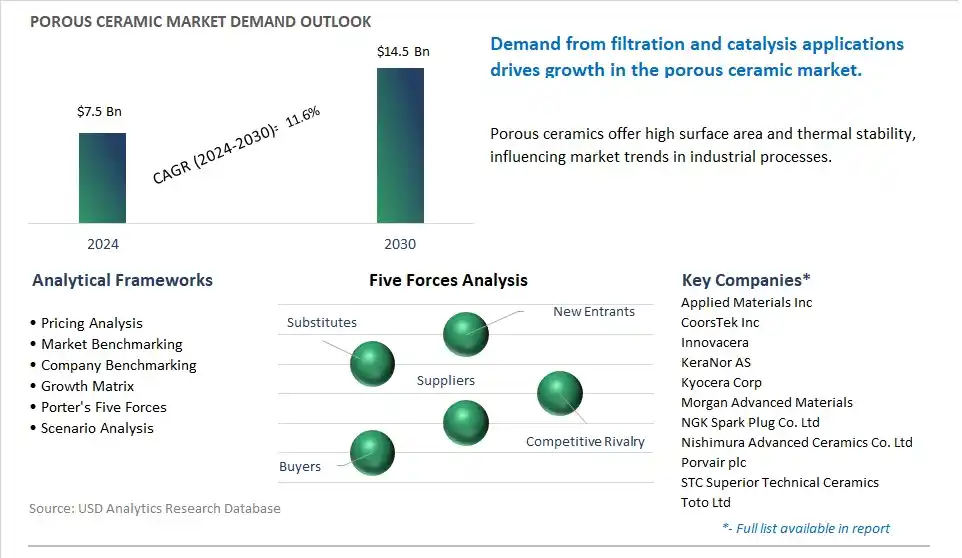
The global Porous Ceramic Market is poised to register a 11.6% CAGR from $7.5 Billion in 2024 to $14.5 Billion in 2030.
The global Porous Ceramic Market Study analyzes and forecasts the market size across 6 regions and 24 countries for diverse segments -By Raw Material (Alumina Ceramics, Titanate Ceramics, Zirconate Ceramics, Ferrite Ceramics, Aluminum Nitride, Others), By Product (Filtration, Insulation, High Purity Materials, Structural Components, Others), By Application (Automotive, Medical, Electronics & Semiconductors, Energy & Power, Industrial, Aerospace & Defense, Others).
An Introduction to Global Porous Ceramic Market in 2024
The porous ceramic market is experiencing steady growth driven by its versatile applications in industries such as automotive, aerospace, healthcare, and electronics. Porous ceramics offer unique properties including high thermal resistance, excellent chemical stability, and tailored pore structures, making them ideal for applications such as filtration, catalysis, insulation, and biomedical implants. Technological advancements in ceramic processing techniques, such as sol-gel, foam replication, and sacrificial template methods, are enabling the production of porous ceramics with precisely controlled pore sizes, distributions, and compositions, expanding their utility in demanding environments. Additionally, the growing focus on sustainability and environmental regulations is driving the adoption of porous ceramic materials for wastewater treatment, air purification, and renewable energy applications, further fueling market growth.
Porous Ceramic Market Competitive Landscape
The market report analyses the leading companies in the industry including Applied Materials Inc, CoorsTek Inc, Innovacera, KeraNor AS, Kyocera Corp, Morgan Advanced Materials, NGK Spark Plug Co. Ltd, Nishimura Advanced Ceramics Co. Ltd, Porvair plc, STC Superior Technical Ceramics, Toto Ltd.
Porous Ceramic Market Dynamics
Porous Ceramic Market Trend: Increasing Demand for High-Performance Filtration Solutions
A prominent trend in the porous ceramic market is the increasing demand for high-performance filtration solutions. Porous ceramics, known for their excellent thermal stability, chemical resistance, and controllable pore structures, are widely utilized in various filtration applications across industries such as automotive, aerospace, healthcare, and water treatment. With growing concerns about environmental pollution, water scarcity, and air quality, there is a rising need for efficient and reliable filtration systems capable of removing contaminants, particulates, and pathogens from air, gas, and liquid streams. This trend is driving the adoption of porous ceramic materials in filter elements, membranes, catalyst supports, and porous media, leading to market growth and technological advancements in filtration technologies.
Porous Ceramic Market Driver: Stringent Regulations and Quality Standards
A key driver for the porous ceramic market is stringent regulations and quality standards governing environmental protection, workplace safety, and product performance. Governments and regulatory bodies worldwide are imposing stricter requirements on emissions control, water quality, and industrial hygiene, driving industries to invest in advanced filtration and purification technologies to comply with regulatory mandates. Porous ceramics, with their ability to withstand high temperatures, corrosive environments, and mechanical stress, play a vital role in meeting these regulatory requirements by providing durable and effective filtration solutions. Additionally, the demand for porous ceramics is driven by quality standards in industries such as healthcare, semiconductor manufacturing, and food and beverage processing, where product purity and performance are critical for ensuring consumer safety and product integrity.
Porous Ceramic Market Opportunity: Expansion into Energy Storage and Renewable Energy
An opportunity within the porous ceramic market lies in expansion into energy storage and renewable energy applications. Porous ceramics exhibit excellent properties such as high porosity, thermal stability, and chemical inertness, making them ideal candidates for energy storage devices such as batteries, fuel cells, and supercapacitors. With the increasing focus on renewable energy sources and electrification of transportation, there is a growing demand for advanced materials that enable efficient energy conversion, storage, and utilization. Porous ceramic materials can be utilized as electrode substrates, electrolyte membranes, and separator materials in energy storage systems, offering advantages such as enhanced conductivity, stability, and durability. By leveraging their unique properties, porous ceramics present opportunities for innovation and market penetration in the rapidly growing energy storage and renewable energy sectors, contributing to the transition towards a sustainable and low-carbon future.
Porous Ceramic Market Share Analysis: Alumina Ceramics segment generated the highest revenue in the industry
The Alumina Ceramics segment is the largest segment in the Porous Ceramic Market due to diverse key factors contributing to its dominance. Alumina ceramics, also known as aluminum oxide ceramics, are widely used in various industries due to their excellent properties, including high temperature resistance, mechanical strength, chemical inertness, and electrical insulation. One of the primary reasons for the dominance of the Alumina Ceramics segment is the extensive range of applications where alumina ceramics find utility across diverse industries such as aerospace, automotive, electronics, energy, healthcare, and manufacturing. Alumina ceramics offer superior performance and reliability in demanding environments, making them suitable for critical applications requiring high thermal stability, corrosion resistance, wear resistance, and dimensional stability. In addition, alumina ceramics exhibit excellent dielectric properties, making them ideal materials for electronic components such as substrates, insulators, sensors, and capacitors. Additionally, alumina ceramics are commonly used in the production of porous ceramic materials, including filters, membranes, catalyst supports, and porous substrates, due to their ability to be processed into complex shapes and structures with controlled porosity and pore size distribution. Further, alumina ceramics are cost-effective compared to other advanced ceramic materials, offering favorable performance-to-cost ratios for many applications. As industries continue to demand high-performance materials capable of withstanding extreme conditions and providing superior functionality, the Alumina Ceramics segment in the Porous Ceramic Market is expected to maintain its dominance. Additionally, ongoing advancements in material science, manufacturing technologies, and product innovation further support the growth of this segment, driving the development of new alumina-based porous ceramic products tailored to specific industrial requirements.
Porous Ceramic Market Share Analysis: Filtration Segment is poised to register the fastest growth rate (CAGR) over the forecast period to 2030
The Filtration segment is the fastest growing segment in the Porous Ceramic Market due to diverse key factors driving its rapid expansion. Porous ceramic materials offer exceptional filtration capabilities due to their unique pore structure, high surface area, and chemical inertness, making them highly effective in separating solids from liquids or gases across various industries. One of the primary reasons for the rapid growth of the Filtration segment is the increasing demand for efficient and reliable filtration solutions in applications such as water treatment, air purification, industrial processes, healthcare, and environmental protection. Porous ceramic filters are utilized in diverse filtration processes, including microfiltration, ultrafiltration, nanofiltration, and membrane filtration, for the removal of contaminants, particles, bacteria, viruses, and other impurities from liquids or gases. In addition, porous ceramic filters offer diverse advantages over traditional filtration media such as metal, polymer, or cellulose-based filters, including superior chemical resistance, thermal stability, mechanical strength, and long service life. Additionally, porous ceramic filters can be tailored to specific pore sizes, porosities, and surface chemistries to meet the requirements of different filtration applications, ensuring optimal performance and efficiency. Further, the growing emphasis on environmental sustainability, water conservation, and air quality improvement drives the adoption of porous ceramic filters in municipal and industrial water treatment plants, wastewater treatment facilities, air pollution control systems, and clean energy technologies. As industries continue to prioritize clean and safe production processes, regulatory compliance, and resource efficiency, the demand for porous ceramic filtration solutions is expected to surge, making the Filtration segment the fastest growing segment in the Porous Ceramic Market. Additionally, ongoing advancements in ceramic processing techniques, material formulations, and filter design further enhance the performance and applicability of porous ceramic filters, driving innovation and expansion in the filtration industry.
Porous Ceramic Market Share Analysis: Electronics & Semiconductors Segment is poised to register the fastest growth rate (CAGR) over the forecast period to 2030
The Electronics & Semiconductors segment is the fastest growing segment in the Porous Ceramic Market due to diverse key factors driving its rapid expansion. Porous ceramics play a crucial role in various electronic and semiconductor applications where precise control over thermal management, insulation, and filtration is essential for optimal device performance and reliability. One of the primary reasons for the rapid growth of the Electronics & Semiconductors segment is the increasing demand for advanced electronic components, devices, and systems across diverse industries such as consumer electronics, telecommunications, automotive, healthcare, and aerospace. Porous ceramics are utilized in electronic applications for thermal management, where they provide efficient heat dissipation, thermal insulation, and temperature uniformity to electronic components, ensuring their safe and reliable operation. In addition, porous ceramic materials offer excellent electrical insulation properties, making them suitable for use in high-voltage applications such as electrical insulators, circuit substrates, and electronic packaging materials. Additionally, porous ceramics find utility in semiconductor manufacturing processes for applications such as chemical filtration, gas separation, wafer processing, and photolithography, where precise control over particle size, pore size distribution, and surface chemistry is critical for achieving desired process outcomes and device performance. Further, the growing demand for miniaturized and high-performance electronic devices, advancements in semiconductor technology, and the proliferation of emerging technologies such as 5G, Internet of Things (IoT), and electric vehicles (EVs) drive the adoption of porous ceramic materials in the electronics and semiconductor industry. As industries continue to innovate and develop next-generation electronic products and technologies, the demand for porous ceramics with tailored properties and functionalities is expected to surge, making the Electronics & Semiconductors segment the fastest growing segment in the Porous Ceramic Market. Additionally, ongoing research and development efforts, collaborations between industry players, and investments in advanced manufacturing technologies further support the growth of this segment, driving innovation and market expansion in the electronics and semiconductor sectors.
Porous Ceramic Market Report Segmentation
By Raw Material
Alumina Ceramics
Titanate Ceramics
Zirconate Ceramics
Ferrite Ceramics
Aluminum Nitride
Others
By Product
Filtration
Insulation
High Purity Materials
Structural Components
Others
By Application
Automotive
Medical
Electronics & Semiconductors
Energy & Power
Industrial
Aerospace & Defense
Others
Regions Included
North America (US, Canada, Mexico)
Europe (Germany, UK, France, Spain, Italy, Russia, Rest of Europe)
Asia Pacific (China, India, Japan, South Korea, Australia, South East Asia, Rest of Asia)
South America (Brazil, Argentina, Rest of South America)
Middle East and Africa (Saudi Arabia, UAE, Rest of Middle East, South Africa, Egypt, Rest of Africa)
Porous Ceramic Companies Profiled in the Market Study
Applied Materials Inc
CoorsTek Inc
Innovacera
KeraNor AS
Kyocera Corp
Morgan Advanced Materials
NGK Spark Plug Co. Ltd
Nishimura Advanced Ceramics Co. Ltd
Porvair plc
STC Superior Technical Ceramics
Toto Ltd
*- List Not Exhaustive
