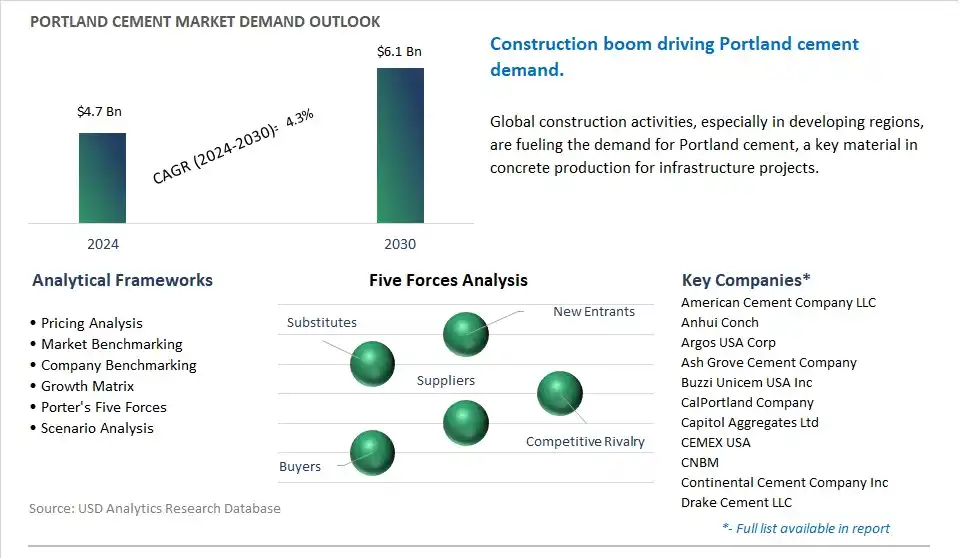
The global Portland Cement Market is poised to register a 4.3% CAGR from $4.7 Billion in 2024 to $6.1 Billion in 2030.
The global Portland Cement Market Study analyzes and forecasts the market size across 6 regions and 24 countries for diverse segments -By Type (Gray Portland Cement, White Portland Cement), By Application (Residential, Non-residential).
An Introduction to Global Portland Cement Market in 2024
The future of the Portland cement market is influenced by key trends such as sustainable construction practices, technological advancements, and infrastructure development. As the construction industry embraces sustainability, there's a growing demand for low-carbon and eco-friendly cement formulations. Manufacturers are investing in research and development to develop alternative binders, such as fly ash, slag, and calcined clays, which reduce carbon emissions and energy consumption during production. Additionally, advancements in cement manufacturing technologies, including alternative fuels and waste heat recovery systems, improve energy efficiency and reduce environmental impact. Moreover, the global infrastructure development projects, particularly in emerging economies, drive the demand for Portland cement as a fundamental building material for roads, bridges, buildings, and other construction projects. As the construction sector evolves to meet sustainability goals and infrastructure demands, the Portland cement market will continue to innovate and adapt to changing industry needs.
Portland Cement Market Competitive Landscape
The market report analyses the leading companies in the industry including American Cement Company LLC, Anhui Conch, Argos USA Corp, Ash Grove Cement Company, Buzzi Unicem USA Inc, CalPortland Company, Capitol Aggregates Ltd, CEMEX USA, CNBM, Continental Cement Company Inc, Drake Cement LLC, ESSROC Cement Corp, Federal White Cement Ltd, GCC of America Inc Inc Lehigh Hanson Inc, Heidelberg Cement, Holcim, Italcementi, Lafarge SA, Lehigh Hanson Materials Ltd, Martin Marietta Materials Inc, Mitsubishi Cement Corp, National Cement Company of Alabama Inc, National Cement Company of California, QUIKRETE, Salt River Materials Group, Tanzania Portland Cement Company, UltraTech Cement Ltd.
Portland Cement Market Dynamics
Portland Cement Market Trend: Shift towards Sustainable and Eco-Friendly Cement Production
A prominent trend in the Portland cement market is the industry's shift towards sustainable and eco-friendly cement production methods. With increasing environmental awareness and regulatory pressure to reduce carbon emissions, cement manufacturers are adopting alternative fuels, renewable energy sources, and innovative technologies to minimize their environmental footprint. Additionally, there is a growing demand for low-carbon cements, such as blended cements and supplementary cementitious materials (SCMs), which incorporate industrial by-products like fly ash, slag, and silica fume to reduce the clinker content in cement production. This is driving the commitment to sustainability and its efforts to mitigate the environmental impact of cement manufacturing, driving market growth in the sustainable cement segment.
Portland Cement Market Driver: Infrastructure Development and Construction Activities
The market for Portland cement is primarily driven by infrastructure development and construction activities, which demand a reliable and cost-effective building material for various construction projects worldwide. Portland cement, known for its versatility, strength, and durability, is widely used in residential, commercial, and infrastructure projects for constructing buildings, bridges, roads, dams, and other structures. With increasing urbanization, population growth, and investments in infrastructure projects, there is a continuous need for Portland cement to meet the demand for new construction, maintenance, and renovation projects. This driver fuels market demand and consumption of Portland cement in the construction sector, contributing to market expansion and growth opportunities.
Portland Cement Market Opportunity: Innovation in Cement Technology and Product Development
A potential opportunity in the Portland cement market lies in innovation in cement technology and product development to meet evolving industry requirements and market demands. Manufacturers can invest in research and development to improve cement performance, enhance durability, and reduce environmental impact through innovations such as alternative raw materials, advanced blending techniques, and carbon capture technologies. Additionally, there is an opportunity to develop specialty cements tailored to specific applications such as high-strength concrete, self-healing concrete, and low-heat cement for specialized construction needs. By embracing innovation and product differentiation, cement manufacturers can create value-added solutions, address market gaps, and capitalize on emerging opportunities in the Portland cement market. Expanding into innovative cement products presents an opportunity for differentiation, market leadership, and long-term growth in the cement industry.
Portland Cement Market Share Analysis: Gray Portland Cement generated the highest revenue in 2024
The largest segment in the Portland Cement Market is Gray Portland Cement. Gray Portland Cement is the most commonly used type of cement worldwide, constituting the majority of cement production and consumption. It is widely utilized in various construction applications such as residential buildings, commercial complexes, infrastructure projects, roads, bridges, and dams. Gray Portland Cement offers potential advantages, including high compressive strength, durability, versatility, and cost-effectiveness, making it suitable for a wide range of concrete and mortar applications. Additionally, the availability of raw materials and established manufacturing infrastructure for Gray Portland Cement production contribute to its widespread use and dominance in the market. Further, Gray Portland Cement is preferred for general-purpose applications where color consistency is not critical, further solidifying its position as the largest segment in the Portland Cement Market.
Portland Cement Market Share Analysis: Non-residential segment is poised to register the fastest growth rate (CAGR) over the forecast period to 2030
The fastest-growing segment in the Portland Cement Market is Non-residential. Non-residential construction includes a wide range of projects such as commercial buildings, industrial facilities, infrastructure projects, educational institutions, healthcare facilities, and public works. The demand for Portland cement in non-residential construction is driven by urbanization, industrialization, population growth, and government investments in infrastructure development projects such as roads, bridges, airports, railways, ports, and utilities. Additionally, the increasing adoption of sustainable construction practices, green building certifications, and energy-efficient building designs further boosts the demand for Portland cement in non-residential applications. Further, non-residential construction projects often require large volumes of Portland cement for structural elements, foundations, floors, walls, and precast components, contributing to the segment's rapid growth in the Portland Cement Market. Furthermore, the growth of sectors such as commercial real estate, manufacturing, logistics, and healthcare drives the demand for non-residential construction, further fueling the demand for Portland cement in this segment.
Portland Cement Market Report Segmentation
By Type
Gray Portland Cement
White Portland Cement
By Application
Residential
Non-residential
Regions Included
North America (US, Canada, Mexico)
Europe (Germany, UK, France, Spain, Italy, Russia, Rest of Europe)
Asia Pacific (China, India, Japan, South Korea, Australia, South East Asia, Rest of Asia)
South America (Brazil, Argentina, Rest of South America)
Middle East and Africa (Saudi Arabia, UAE, Rest of Middle East, South Africa, Egypt, Rest of Africa)
Portland Cement Companies Profiled in the Market Study
American Cement Company LLC
Anhui Conch
Argos USA Corp
Ash Grove Cement Company
Buzzi Unicem USA Inc
CalPortland Company
Capitol Aggregates Ltd
CEMEX USA
CNBM
Continental Cement Company Inc
Drake Cement LLC
ESSROC Cement Corp
Federal White Cement Ltd
GCC of America Inc Inc Lehigh Hanson Inc
Heidelberg Cement
Holcim
Italcementi
Lafarge SA
Lehigh Hanson Materials Ltd
Martin Marietta Materials Inc
Mitsubishi Cement Corp
National Cement Company of Alabama Inc
National Cement Company of California
QUIKRETE
Salt River Materials Group
Tanzania Portland Cement Company
UltraTech Cement Ltd
*- List Not Exhaustive
TABLE OF CONTENTS
1 Introduction to 2024 Portland Cement Market
1.1 Market Overview
1.2 Quick Facts
1.3 Scope/Objective of the Study
1.4 Market Definition
1.5 Countries and Regions Covered
1.6 Units, Currency, and Conversions
1.7 Industry Value Chain
2 Research Methodology
2.1 Market Size Estimation
2.2 Sources and Research Methodology
2.3 Data Triangulation
2.4 Assumptions and Limitations
3 Executive Summary
3.1 Global Portland Cement Market Size Outlook, $ Million, 2021 to 2030
3.2 Portland Cement Market Outlook by Type, $ Million, 2021 to 2030
3.3 Portland Cement Market Outlook by Product, $ Million, 2021 to 2030
3.4 Portland Cement Market Outlook by Application, $ Million, 2021 to 2030
3.5 Portland Cement Market Outlook by Key Countries, $ Million, 2021 to 2030
4 Market Dynamics
4.1 Key Driving Forces of Portland Cement Industry
4.2 Key Market Trends in Portland Cement Industry
4.3 Potential Opportunities in Portland Cement Industry
4.4 Key Challenges in Portland Cement Industry
5 Market Factor Analysis
5.1 Value Chain Analysis
5.2 Competitive Landscape
5.2.1 Global Portland Cement Market Share by Company (%), 2023
5.2.2 Product Offerings by Company
5.3 Porter’s Five Forces Analysis
5.4 Pricing Analysis and Outlook
6 Growth Outlook Across Scenarios
6.1 Growth Analysis-Case Scenario Definitions
6.2 Low Growth Scenario Forecasts
6.3 Reference Growth Scenario Forecasts
6.4 High Growth Scenario Forecasts
7 Global Portland Cement Market Outlook by Segments
7.1 Portland Cement Market Outlook by Segments, $ Million, 2021- 2030
By Type
Gray Portland Cement
White Portland Cement
By Application
Residential
Non-residential
8 North America Portland Cement Market Analysis and Outlook To 2030
8.1 Introduction to North America Portland Cement Markets in 2024
8.2 North America Portland Cement Market Size Outlook by Country, 2021-2030
8.2.1 United States
8.2.2 Canada
8.2.3 Mexico
8.3 North America Portland Cement Market size Outlook by Segments, 2021-2030
By Type
Gray Portland Cement
White Portland Cement
By Application
Residential
Non-residential
9 Europe Portland Cement Market Analysis and Outlook To 2030
9.1 Introduction to Europe Portland Cement Markets in 2024
9.2 Europe Portland Cement Market Size Outlook by Country, 2021-2030
9.2.1 Germany
9.2.2 France
9.2.3 Spain
9.2.4 United Kingdom
9.2.4 Italy
9.2.5 Russia
9.2.6 Norway
9.2.7 Rest of Europe
9.3 Europe Portland Cement Market Size Outlook by Segments, 2021-2030
By Type
Gray Portland Cement
White Portland Cement
By Application
Residential
Non-residential
10 Asia Pacific Portland Cement Market Analysis and Outlook To 2030
10.1 Introduction to Asia Pacific Portland Cement Markets in 2024
10.2 Asia Pacific Portland Cement Market Size Outlook by Country, 2021-2030
10.2.1 China
10.2.2 India
10.2.3 Japan
10.2.4 South Korea
10.2.5 Indonesia
10.2.6 Malaysia
10.2.7 Australia
10.2.8 Rest of Asia Pacific
10.3 Asia Pacific Portland Cement Market size Outlook by Segments, 2021-2030
By Type
Gray Portland Cement
White Portland Cement
By Application
Residential
Non-residential
11 South America Portland Cement Market Analysis and Outlook To 2030
11.1 Introduction to South America Portland Cement Markets in 2024
11.2 South America Portland Cement Market Size Outlook by Country, 2021-2030
11.2.1 Brazil
11.2.2 Argentina
11.2.3 Rest of South America
11.3 South America Portland Cement Market size Outlook by Segments, 2021-2030
By Type
Gray Portland Cement
White Portland Cement
By Application
Residential
Non-residential
12 Middle East and Africa Portland Cement Market Analysis and Outlook To 2030
12.1 Introduction to Middle East and Africa Portland Cement Markets in 2024
12.2 Middle East and Africa Portland Cement Market Size Outlook by Country, 2021-2030
12.2.1 Saudi Arabia
12.2.2 UAE
12.2.3 Oman
12.2.4 Rest of Middle East
12.2.5 Egypt
12.2.6 Nigeria
12.2.7 South Africa
12.2.8 Rest of Africa
12.3 Middle East and Africa Portland Cement Market size Outlook by Segments, 2021-2030
By Type
Gray Portland Cement
White Portland Cement
By Application
Residential
Non-residential
13 Company Profiles
13.1 Company Snapshot
13.2 SWOT Profiles
13.3 Products and Services
13.4 Recent Developments
13.5 Financial Profile
American Cement Company LLC
Anhui Conch
Argos USA Corp
Ash Grove Cement Company
Buzzi Unicem USA Inc
CalPortland Company
Capitol Aggregates Ltd
CEMEX USA
CNBM
Continental Cement Company Inc
Drake Cement LLC
ESSROC Cement Corp
Federal White Cement Ltd
GCC of America Inc Inc Lehigh Hanson Inc
Heidelberg Cement
Holcim
Italcementi
Lafarge SA
Lehigh Hanson Materials Ltd
Martin Marietta Materials Inc
Mitsubishi Cement Corp
National Cement Company of Alabama Inc
National Cement Company of California
QUIKRETE
Salt River Materials Group
Tanzania Portland Cement Company
UltraTech Cement Ltd
14 Appendix
14.1 Customization Offerings
14.2 Subscription Services
14.3 Related Reports
14.4 Publisher Expertise
By Type
Gray Portland Cement
White Portland Cement
By Application
Residential
Non-residential
Countries Analyzed
North America (US, Canada, Mexico)
Europe (Germany, UK, France, Spain, Italy, Russia, Rest of Europe)
Asia Pacific (China, India, Japan, South Korea, Australia, South East Asia, Rest of Asia)
South America (Brazil, Argentina, Rest of South America)
Middle East and Africa (Saudi Arabia, UAE, Rest of Middle East, South Africa, Egypt, Rest of Africa)
