The global Post Harvest Treatment Market is poised to register a 7.2% CAGR from $2.1 Billion in 2024 to $3.2 Billion in 2030.
The global Post Harvest Treatment Market Study analyzes and forecasts the market size across 6 regions and 24 countries for diverse segments -By Type (Coatings, Ethylene Blockers, Cleaners, Fungicides, Sprout Inhibitors, Sanitizers, Others), By Crop (Fruits, Vegetables, Flowers, Others), By Origin (Natural, Synthetic).
An Introduction to Global Post Harvest Treatment Market in 2024
Post-harvest treatment methods are evolving to meet increasing demands for food safety, quality preservation, and extended shelf life. Key trends include the adoption of advanced technologies such as controlled atmosphere storage and modified atmosphere packaging to mitigate spoilage and maintain product freshness. Additionally, there's a growing emphasis on sustainable practices, with the integration of bio-based and natural treatments to replace conventional chemical agents, aligning with consumer preferences for eco-friendly solutions. Furthermore, the implementation of blockchain and IoT (Internet of Things) solutions is enhancing traceability and transparency throughout the post-harvest supply chain, bolstering food safety measures and enabling more informed decision-making.
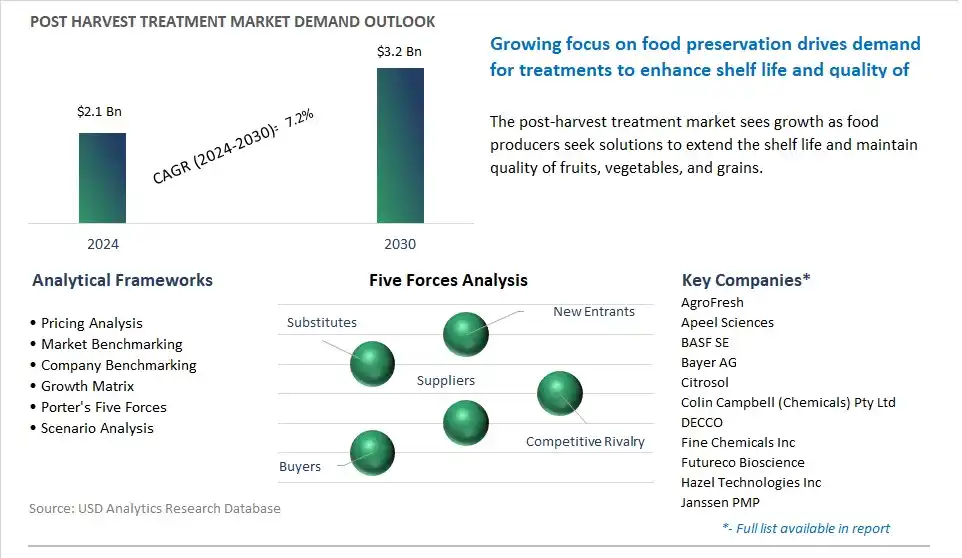
Post Harvest Treatment Market Competitive Landscape
The market report analyses the leading companies in the industry including AgroFresh, Apeel Sciences, BASF SE, Bayer AG, Citrosol, Colin Campbell (Chemicals) Pty Ltd, DECCO, Fine Chemicals Inc, Futureco Bioscience, Hazel Technologies Inc, Janssen PMP, JBT, Lytone Enterprise Inc, Nufarm, Pace International LLC, Shandong Aoweite Biotechnology Co., Syngenta Crop Protection AG, Xeda International S. A. S..
Post Harvest Treatment Market Dynamics
Post Harvest Treatment Market Trend: Increasing Focus on Food Safety and Quality Standards
Post harvest treatment is experiencing a prominent market trend driven by the increasing focus on food safety and quality standards across the agricultural industry. As consumers become more conscious of the origin and quality of their food products, there is a growing demand for post harvest treatments that can effectively preserve freshness, extend shelf life, and reduce post-harvest losses. Manufacturers and growers are adopting advanced treatments such as cold storage, controlled atmosphere storage, and post-harvest fungicides to minimize microbial contamination, delay ripening, and maintain the nutritional value of fruits, vegetables, and grains throughout the supply chain. This trend is fueled by regulatory requirements, consumer preferences for minimally processed foods, and the need to meet international standards for food safety and hygiene, driving the adoption of post harvest treatment solutions to ensure the integrity and safety of agricultural products from farm to fork.
Post Harvest Treatment Market Driver: Globalization of Food Supply Chains and Growing Export Markets
The market for post harvest treatment is being driven by the globalization of food supply chains and the growing export markets for agricultural products. With increasing international trade and cross-border transportation of perishable goods, there is a greater emphasis on implementing effective post harvest treatments to maintain product quality and meet regulatory requirements in destination markets. Post harvest treatments such as irradiation, heat treatments, and modified atmosphere packaging play a crucial role in controlling pests, pathogens, and spoilage microorganisms, ensuring compliance with phytosanitary regulations and quarantine measures. Additionally, the expansion of export-oriented agriculture sectors in emerging economies and the rise of e-commerce platforms for fresh produce create opportunities for post harvest treatment providers to offer tailored solutions and value-added services to growers, exporters, and food retailers seeking to access global markets and meet the diverse needs of consumers worldwide.
Post Harvest Treatment Market Opportunity: Development of Sustainable and Organic Post Harvest Treatment Solutions
The market for post harvest treatment presents a significant opportunity for the development of sustainable and organic treatment solutions that align with consumer preferences for natural and environmentally friendly food preservation methods. With increasing concerns about chemical residues, pesticide use, and environmental impact, there is a demand for post harvest treatments derived from natural sources, bio-based materials, and eco-friendly technologies. Opportunities exist for the development of organic post harvest treatments such as biocontrol agents, botanical extracts, and essential oils that offer effective protection against pests and pathogens while minimizing ecological footprint and preserving the nutritional quality of agricultural products. Additionally, investments in research and development of sustainable packaging materials, smart packaging technologies, and blockchain-based traceability systems can complement post harvest treatment strategies and enhance transparency, trust, and sustainability across the food supply chain. By offering innovative and sustainable post harvest treatment solutions, stakeholders can position themselves as leaders in the evolving market for food safety and quality assurance, driving growth and differentiation in the agricultural industry.
Post Harvest Treatment Market Share Analysis: The Coatings segment generated the highest revenue in 2024
The largest segment in the Post Harvest Treatment Market is Coatings. Coatings play a crucial role in post-harvest treatment by providing a protective layer over fruits and vegetables, thereby extending their shelf life and preserving their quality. coatings offer a cost-effective and efficient method of preserving perishable produce by reducing moisture loss, respiration rates, and microbial growth. Additionally, coatings help maintain the appearance, texture, and nutritional value of fruits and vegetables during storage and transportation, thereby enhancing their marketability. Further, advancements in coating technologies, such as the development of eco-friendly and edible coatings derived from natural sources, are further driving the demand for coatings in post-harvest treatment. As the need for extending the shelf life of fresh produce continues to rise globally, the Coatings segment maintains its position as the largest segment in the Post Harvest Treatment Market.
Post Harvest Treatment Market Share Analysis: The Vegetables segment is poised to register the fastest growth rate (CAGR) over the forecast period to 2030
The fastest-growing segment in the Post Harvest Treatment Market is Vegetables. This is driving the demand for post-harvest treatments in the vegetable sector. There's a growing global population coupled with increasing urbanization, leading to higher demand for fresh and processed vegetables. Accordingly, there's a greater focus on extending the shelf life of vegetables to meet this rising demand and reduce food waste. Additionally, with changing consumer preferences towards healthier and convenient food options, there's an increased emphasis on maintaining the quality and freshness of vegetables throughout the supply chain. Further, stringent regulations regarding food safety and quality standards further drive the adoption of post-harvest treatments in vegetable production and distribution. As a result of these factors, the Vegetable segment is experiencing rapid growth in the Post Harvest Treatment Market.
Post Harvest Treatment Market Share Analysis: The Natural segment is poised to register the fastest growth rate (CAGR) over the forecast period to 2030
The fastest-growing segment in the Post Harvest Treatment Market is the Natural origin segment. This growth is primarily driven by shifting consumer preferences towards sustainable and eco-friendly products. Natural post-harvest treatments, derived from plant extracts, essential oils, and other bio-based sources, are gaining traction due to their perceived safety, minimal environmental impact, and compliance with organic farming practices. Additionally, increasing awareness of the harmful effects of synthetic chemicals on human health and the environment is prompting consumers and producers alike to seek natural alternatives for post-harvest treatment. Further, stringent regulations regarding pesticide residues and chemical usage in food production are further accelerating the demand for natural origin post-harvest treatments. Accordingly, the Natural origin segment is experiencing rapid growth and is poised to continue expanding in the Post Harvest Treatment Market.
Post Harvest Treatment Market Report Segmentation
By Type
Coatings
Ethylene Blockers
Cleaners
Fungicides
Sprout Inhibitors
Sanitizers
Others
By Crop
Fruits
Vegetables
Flowers
Others
By Origin
Natural
Synthetic
Regions Included
North America (US, Canada, Mexico)
Europe (Germany, UK, France, Spain, Italy, Russia, Rest of Europe)
Asia Pacific (China, India, Japan, South Korea, Australia, South East Asia, Rest of Asia)
South America (Brazil, Argentina, Rest of South America)
Middle East and Africa (Saudi Arabia, UAE, Rest of Middle East, South Africa, Egypt, Rest of Africa)
Post Harvest Treatment Companies Profiled in the Market Study
AgroFresh
Apeel Sciences
BASF SE
Bayer AG
Citrosol
Colin Campbell (Chemicals) Pty Ltd
DECCO
Fine Chemicals Inc
Futureco Bioscience
Hazel Technologies Inc
Janssen PMP
JBT
Lytone Enterprise Inc
Nufarm
Pace International LLC
Shandong Aoweite Biotechnology Co.
Syngenta Crop Protection AG
Xeda International S. A. S.
*- List Not Exhaustive
TABLE OF CONTENTS
1 Introduction to 2024 Post Harvest Treatment Market
1.1 Market Overview
1.2 Quick Facts
1.3 Scope/Objective of the Study
1.4 Market Definition
1.5 Countries and Regions Covered
1.6 Units, Currency, and Conversions
1.7 Industry Value Chain
2 Research Methodology
2.1 Market Size Estimation
2.2 Sources and Research Methodology
2.3 Data Triangulation
2.4 Assumptions and Limitations
3 Executive Summary
3.1 Global Post Harvest Treatment Market Size Outlook, $ Million, 2021 to 2030
3.2 Post Harvest Treatment Market Outlook by Type, $ Million, 2021 to 2030
3.3 Post Harvest Treatment Market Outlook by Product, $ Million, 2021 to 2030
3.4 Post Harvest Treatment Market Outlook by Application, $ Million, 2021 to 2030
3.5 Post Harvest Treatment Market Outlook by Key Countries, $ Million, 2021 to 2030
4 Market Dynamics
4.1 Key Driving Forces of Post Harvest Treatment Industry
4.2 Key Market Trends in Post Harvest Treatment Industry
4.3 Potential Opportunities in Post Harvest Treatment Industry
4.4 Key Challenges in Post Harvest Treatment Industry
5 Market Factor Analysis
5.1 Value Chain Analysis
5.2 Competitive Landscape
5.2.1 Global Post Harvest Treatment Market Share by Company (%), 2023
5.2.2 Product Offerings by Company
5.3 Porter’s Five Forces Analysis
5.4 Pricing Analysis and Outlook
6 Growth Outlook Across Scenarios
6.1 Growth Analysis-Case Scenario Definitions
6.2 Low Growth Scenario Forecasts
6.3 Reference Growth Scenario Forecasts
6.4 High Growth Scenario Forecasts
7 Global Post Harvest Treatment Market Outlook by Segments
7.1 Post Harvest Treatment Market Outlook by Segments, $ Million, 2021- 2030
By Type
Coatings
Ethylene Blockers
Cleaners
Fungicides
Sprout Inhibitors
Sanitizers
Others
By Crop
Fruits
Vegetables
Flowers
Others
By Origin
Natural
Synthetic
8 North America Post Harvest Treatment Market Analysis and Outlook To 2030
8.1 Introduction to North America Post Harvest Treatment Markets in 2024
8.2 North America Post Harvest Treatment Market Size Outlook by Country, 2021-2030
8.2.1 United States
8.2.2 Canada
8.2.3 Mexico
8.3 North America Post Harvest Treatment Market size Outlook by Segments, 2021-2030
By Type
Coatings
Ethylene Blockers
Cleaners
Fungicides
Sprout Inhibitors
Sanitizers
Others
By Crop
Fruits
Vegetables
Flowers
Others
By Origin
Natural
Synthetic
9 Europe Post Harvest Treatment Market Analysis and Outlook To 2030
9.1 Introduction to Europe Post Harvest Treatment Markets in 2024
9.2 Europe Post Harvest Treatment Market Size Outlook by Country, 2021-2030
9.2.1 Germany
9.2.2 France
9.2.3 Spain
9.2.4 United Kingdom
9.2.4 Italy
9.2.5 Russia
9.2.6 Norway
9.2.7 Rest of Europe
9.3 Europe Post Harvest Treatment Market Size Outlook by Segments, 2021-2030
By Type
Coatings
Ethylene Blockers
Cleaners
Fungicides
Sprout Inhibitors
Sanitizers
Others
By Crop
Fruits
Vegetables
Flowers
Others
By Origin
Natural
Synthetic
10 Asia Pacific Post Harvest Treatment Market Analysis and Outlook To 2030
10.1 Introduction to Asia Pacific Post Harvest Treatment Markets in 2024
10.2 Asia Pacific Post Harvest Treatment Market Size Outlook by Country, 2021-2030
10.2.1 China
10.2.2 India
10.2.3 Japan
10.2.4 South Korea
10.2.5 Indonesia
10.2.6 Malaysia
10.2.7 Australia
10.2.8 Rest of Asia Pacific
10.3 Asia Pacific Post Harvest Treatment Market size Outlook by Segments, 2021-2030
By Type
Coatings
Ethylene Blockers
Cleaners
Fungicides
Sprout Inhibitors
Sanitizers
Others
By Crop
Fruits
Vegetables
Flowers
Others
By Origin
Natural
Synthetic
11 South America Post Harvest Treatment Market Analysis and Outlook To 2030
11.1 Introduction to South America Post Harvest Treatment Markets in 2024
11.2 South America Post Harvest Treatment Market Size Outlook by Country, 2021-2030
11.2.1 Brazil
11.2.2 Argentina
11.2.3 Rest of South America
11.3 South America Post Harvest Treatment Market size Outlook by Segments, 2021-2030
By Type
Coatings
Ethylene Blockers
Cleaners
Fungicides
Sprout Inhibitors
Sanitizers
Others
By Crop
Fruits
Vegetables
Flowers
Others
By Origin
Natural
Synthetic
12 Middle East and Africa Post Harvest Treatment Market Analysis and Outlook To 2030
12.1 Introduction to Middle East and Africa Post Harvest Treatment Markets in 2024
12.2 Middle East and Africa Post Harvest Treatment Market Size Outlook by Country, 2021-2030
12.2.1 Saudi Arabia
12.2.2 UAE
12.2.3 Oman
12.2.4 Rest of Middle East
12.2.5 Egypt
12.2.6 Nigeria
12.2.7 South Africa
12.2.8 Rest of Africa
12.3 Middle East and Africa Post Harvest Treatment Market size Outlook by Segments, 2021-2030
By Type
Coatings
Ethylene Blockers
Cleaners
Fungicides
Sprout Inhibitors
Sanitizers
Others
By Crop
Fruits
Vegetables
Flowers
Others
By Origin
Natural
Synthetic
13 Company Profiles
13.1 Company Snapshot
13.2 SWOT Profiles
13.3 Products and Services
13.4 Recent Developments
13.5 Financial Profile
AgroFresh
Apeel Sciences
BASF SE
Bayer AG
Citrosol
Colin Campbell (Chemicals) Pty Ltd
DECCO
Fine Chemicals Inc
Futureco Bioscience
Hazel Technologies Inc
Janssen PMP
JBT
Lytone Enterprise Inc
Nufarm
Pace International LLC
Shandong Aoweite Biotechnology Co.
Syngenta Crop Protection AG
Xeda International S. A. S.
14 Appendix
14.1 Customization Offerings
14.2 Subscription Services
14.3 Related Reports
14.4 Publisher Expertise
By Type
Coatings
Ethylene Blockers
Cleaners
Fungicides
Sprout Inhibitors
Sanitizers
Others
By Crop
Fruits
Vegetables
Flowers
Others
By Origin
Natural
Synthetic
Countries Analyzed
North America (US, Canada, Mexico)
Europe (Germany, UK, France, Spain, Italy, Russia, Rest of Europe)
Asia Pacific (China, India, Japan, South Korea, Australia, South East Asia, Rest of Asia)
South America (Brazil, Argentina, Rest of South America)
Middle East and Africa (Saudi Arabia, UAE, Rest of Middle East, South Africa, Egypt, Rest of Africa)
