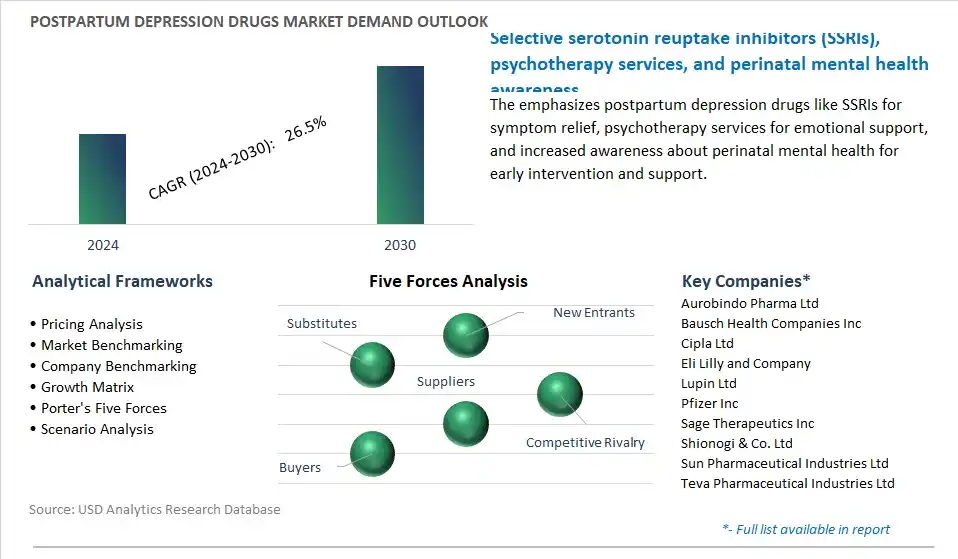
Postpartum Depression Drugs Market is estimated to increase at a Compounded Annual Growth Rate of 26.5% CAGR over the forecast period from 2024 to 2030
The Postpartum Depression Drugs Market study analyzes and forecasts the market size across 6 regions and 24 countries for diverse segments- By Type (Postpartum Anxiety, Postpartum Post-Traumatic Stress Disorder, Postpartum Panic Disorder, Postpartum Psychosis, Others), By Treatment (Psychotherapy, Supplements, Others), By Route of Administration (Oral, Others), By End-User (Hospitals, Clinics, Specialty Centers, Others).
An Introduction to Postpartum Depression Drugs Market in 2024
In 2024, the market for postpartum depression drugs is expanding rapidly, fueled by increased awareness of maternal mental health and advancements in psychopharmacology. Postpartum depression, a common and debilitating condition affecting new mothers, necessitates effective pharmacological interventions to alleviate symptoms and improve maternal-infant outcomes. Antidepressant medications, such as selective serotonin reuptake inhibitors and serotonin-norepinephrine reuptake inhibitors, form the cornerstone of pharmacotherapy for postpartum depression. Additionally, novel therapeutic approaches targeting hormonal dysregulation and neuroinflammatory pathways are under investigation, offering promising avenues for the development of more targeted and personalized treatment strategies. With a growing emphasis on integrated care models and holistic approaches to maternal mental health, the market for postpartum depression drugs is poised for continued growth and innovation.
Market Trend: Growing Awareness and Recognition of Postpartum Depression
A prominent trend in the Postpartum Depression Drugs market is the growing awareness and recognition of postpartum depression (PPD) as a significant mental health issue affecting new mothers. There is increasing acknowledgment among healthcare professionals, policymakers, and the public about the prevalence and impact of PPD on maternal well-being, infant development, and family dynamics. This trend is driving efforts to improve screening, diagnosis, and treatment of PPD, leading to greater demand for effective pharmacological interventions tailored to the unique needs of postpartum women. The trend towards increased awareness and recognition of PPD underscores the importance of addressing maternal mental health and promoting early intervention strategies to support the mental and emotional well-being of new mothers during the postpartum period.
Market Driver: Rising Incidence of Postpartum Depression and Mental Health Advocacy
A primary driver fueling the growth of the Postpartum Depression Drugs market is the rising incidence of postpartum depression and the growing advocacy for maternal mental health support. With changes in societal norms, lifestyle stressors, and perinatal healthcare practices, there is a heightened risk of PPD among new mothers, contributing to the overall burden of maternal mental health disorders. Mental health advocacy organizations, healthcare providers, and policymakers are increasingly advocating for improved access to screening, diagnosis, and treatment of PPD, leading to increased awareness and demand for pharmacological interventions to manage PPD symptoms. The rising incidence of PPD and the advocacy efforts to address maternal mental health needs drive the market for postpartum depression drugs, creating opportunities for pharmaceutical companies to develop innovative treatments and expand their market presence in the field of perinatal psychiatry.
Market Opportunity: Development of Targeted Therapies and Personalized Treatment Approaches
An emerging opportunity in the Postpartum Depression Drugs market lies in the development of targeted therapies and personalized treatment approaches for PPD. With advances in neuroscience, psychopharmacology, and precision medicine, there is a growing opportunity to identify biomarkers, genetic factors, and neurobiological pathways associated with PPD susceptibility and treatment response. Personalized medicine initiatives aim to tailor pharmacological interventions to the individual patient's genetic profile, hormonal status, psychiatric history, and symptom severity, optimizing treatment outcomes and minimizing adverse effects. By embracing personalized treatment approaches, pharmaceutical companies can enhance the efficacy, safety, and tolerability of postpartum depression drugs, improving patient adherence and satisfaction while advancing the field of perinatal psychiatry. Collaborations between academia, industry, and regulatory agencies can facilitate the development and validation of targeted therapies for PPD, unlocking new opportunities for market growth and innovation in the treatment of postpartum depression.
Postpartum Depression Drugs Market Share Analysis: Psychotherapy for Postpartum Anxiety
Within the postpartum depression drugs market, the segment focusing on psychotherapy for postpartum anxiety is experiencing rapid growth. Postpartum anxiety is a prevalent mental health condition characterized by excessive worry, fear, and apprehension experienced by mothers after childbirth. Psychotherapy, also known as talk therapy, encompasses various therapeutic approaches such as cognitive-behavioral therapy (CBT), interpersonal therapy (IPT), and mindfulness-based interventions, which aim to address the psychological and emotional challenges associated with postpartum anxiety. Psychotherapy provides mothers with a supportive and non-invasive treatment option, empowering them to develop coping strategies, enhance self-awareness, and navigate the stressors and transitions of motherhood more effectively. With increasing awareness of postpartum mental health disorders and the importance of early intervention and holistic care, the demand for psychotherapy for postpartum anxiety is rising. Healthcare providers, including hospitals, clinics, specialty centers, and others, are incorporating psychotherapy into their postpartum care protocols to ensure comprehensive support for mothers experiencing postpartum anxiety. Additionally, the accessibility of psychotherapy through various channels, including in-person sessions, teletherapy, and online platforms, further contributes to its rapid growth within the postpartum depression drugs market. As the understanding of postpartum mental health disorders evolves and the stigma surrounding seeking help diminishes, psychotherapy is poised to play an increasingly integral role in addressing postpartum anxiety and improving maternal well-being.
Postpartum Depression Drugs Competitive Analysis
The market research study provides in-depth insights into leading companies including the SWOT analyses, product profile, financial details, and recent developments acrossAurobindo Pharma Ltd, Bausch Health Companies Inc, Cipla Ltd, Eli Lilly and Company, Lupin Ltd, Pfizer Inc, Sage Therapeutics Inc, Shionogi & Co. Ltd, Sun Pharmaceutical Industries Ltd, Teva Pharmaceutical Industries Ltd
Postpartum Depression Drugs Market Segmentation
By Type
Postpartum Anxiety
Postpartum Post-Traumatic Stress Disorder
Postpartum Panic Disorder
Postpartum Psychosis
Others
By Treatment
Psychotherapy
Supplements
Others
By Route of Administration
Oral
Others
By End-User
Hospitals
Clinics
Specialty Centers
Others
Geographical Analysis
North America (United States, Canada, Mexico)
Europe (Germany, France, United Kingdom, Spain, Italy, Rest of Europe)
Asia Pacific (China, India, Japan, South Korea, Rest of Asia Pacific)
South America (Brazil, Argentina, Rest of South America)
Middle East and Africa (Saudi Arabia, UAE, Rest of Middle East, South Africa, Egypt, Rest of Africa)
Postpartum Depression Drugs Market Companies
Aurobindo Pharma Ltd
Bausch Health Companies Inc
Cipla Ltd
Eli Lilly and Company
Lupin Ltd
Pfizer Inc
Sage Therapeutics Inc
Shionogi & Co. Ltd
Sun Pharmaceutical Industries Ltd
Teva Pharmaceutical Industries Ltd
Reasons to Buy the Postpartum Depression Drugs Market Study
• Deepen your industry insights and navigate uncertainties for strategy formulation, CAPEX, and Operational decisions
• Gain access to detailed insights on the Postpartum Depression Drugs Market, encompassing current market size, growth trends, and forecasts till 2030.
• Access detailed competitor analysis, enabling competitive advantage through a thorough understanding of market players, strategies, and potential differentiation opportunities
• Stay ahead of the curve with insights on technological advancements, innovations, and upcoming trends
• Identify lucrative investment avenues and expansion opportunities within the Postpartum Depression Drugs Market industry, guided by robust, data-backed analysis.
• Understand regional and global markets through country-wise analysis, regional market potential, regulatory nuances, and dynamics
• Execute strategies with confidence and speed through information, analytics, and insights on the industry value chain
• Corporate leaders, strategists, financial experts, shareholders, asset managers, and governmental representatives can make long-term planning scenarios and build an integrated and timely understanding of market dynamics
• Benefit from tailored solutions and expert consultation based on report insights, providing personalized strategies aligned with specific business needs.
TABLE OF CONTENTS
1 Introduction to 2024 Postpartum Depression Drugs Market
1.1 Market Overview
1.2 Quick Facts
1.3 Scope/Objective of the Study
1.4 Market Definition
1.5 Countries and Regions Covered
1.6 Units, Currency, and Conversions
1.7 Industry Value Chain
2 Research Methodology
2.1 Market Size Estimation
2.2 Sources and Research Methodology
2.3 Data Triangulation
2.4 Assumptions and Limitations
3 Executive Summary
3.1 Global Postpartum Depression Drugs Market Size Outlook, $ Million, 2021 to 2030
3.2 Postpartum Depression Drugs Market Outlook by Type, $ Million, 2021 to 2030
3.3 Postpartum Depression Drugs Market Outlook by Product, $ Million, 2021 to 2030
3.4 Postpartum Depression Drugs Market Outlook by Application, $ Million, 2021 to 2030
3.5 Postpartum Depression Drugs Market Outlook by Key Countries, $ Million, 2021 to 2030
4 Market Dynamics
4.1 Key Driving Forces of Postpartum Depression Drugs Industry
4.2 Key Market Trends in Postpartum Depression Drugs Industry
4.3 Potential Opportunities in Postpartum Depression Drugs Industry
4.4 Key Challenges in Postpartum Depression Drugs Industry
5 Market Factor Analysis
5.1 Value Chain Analysis
5.2 Competitive Landscape
5.2.1 Global Postpartum Depression Drugs Market Share by Company (%), 2023
5.2.2 Product Offerings by Company
5.3 Porter’s Five Forces Analysis
5.4 Pricing Analysis and Outlook
6 Growth Outlook Across Scenarios
6.1 Growth Analysis-Case Scenario Definitions
6.2 Low Growth Scenario Forecasts
6.3 Reference Growth Scenario Forecasts
6.4 High Growth Scenario Forecasts
7 Global Postpartum Depression Drugs Market Outlook by Segments
7.1 Postpartum Depression Drugs Market Outlook by Segments, $ Million, 2021- 2030
By Type
Postpartum Anxiety
Postpartum Post-Traumatic Stress Disorder
Postpartum Panic Disorder
Postpartum Psychosis
Others
By Treatment
Psychotherapy
Supplements
Others
By Route of Administration
Oral
Others
By End-User
Hospitals
Clinics
Specialty Centers
Others
8 North America Postpartum Depression Drugs Market Analysis and Outlook To 2030
8.1 Introduction to North America Postpartum Depression Drugs Markets in 2024
8.2 North America Postpartum Depression Drugs Market Size Outlook by Country, 2021-2030
8.2.1 United States
8.2.2 Canada
8.2.3 Mexico
8.3 North America Postpartum Depression Drugs Market size Outlook by Segments, 2021-2030
By Type
Postpartum Anxiety
Postpartum Post-Traumatic Stress Disorder
Postpartum Panic Disorder
Postpartum Psychosis
Others
By Treatment
Psychotherapy
Supplements
Others
By Route of Administration
Oral
Others
By End-User
Hospitals
Clinics
Specialty Centers
Others
9 Europe Postpartum Depression Drugs Market Analysis and Outlook To 2030
9.1 Introduction to Europe Postpartum Depression Drugs Markets in 2024
9.2 Europe Postpartum Depression Drugs Market Size Outlook by Country, 2021-2030
9.2.1 Germany
9.2.2 France
9.2.3 Spain
9.2.4 United Kingdom
9.2.4 Italy
9.2.5 Russia
9.2.6 Norway
9.2.7 Rest of Europe
9.3 Europe Postpartum Depression Drugs Market Size Outlook by Segments, 2021-2030
By Type
Postpartum Anxiety
Postpartum Post-Traumatic Stress Disorder
Postpartum Panic Disorder
Postpartum Psychosis
Others
By Treatment
Psychotherapy
Supplements
Others
By Route of Administration
Oral
Others
By End-User
Hospitals
Clinics
Specialty Centers
Others
10 Asia Pacific Postpartum Depression Drugs Market Analysis and Outlook To 2030
10.1 Introduction to Asia Pacific Postpartum Depression Drugs Markets in 2024
10.2 Asia Pacific Postpartum Depression Drugs Market Size Outlook by Country, 2021-2030
10.2.1 China
10.2.2 India
10.2.3 Japan
10.2.4 South Korea
10.2.5 Indonesia
10.2.6 Malaysia
10.2.7 Australia
10.2.8 Rest of Asia Pacific
10.3 Asia Pacific Postpartum Depression Drugs Market size Outlook by Segments, 2021-2030
By Type
Postpartum Anxiety
Postpartum Post-Traumatic Stress Disorder
Postpartum Panic Disorder
Postpartum Psychosis
Others
By Treatment
Psychotherapy
Supplements
Others
By Route of Administration
Oral
Others
By End-User
Hospitals
Clinics
Specialty Centers
Others
11 South America Postpartum Depression Drugs Market Analysis and Outlook To 2030
11.1 Introduction to South America Postpartum Depression Drugs Markets in 2024
11.2 South America Postpartum Depression Drugs Market Size Outlook by Country, 2021-2030
11.2.1 Brazil
11.2.2 Argentina
11.2.3 Rest of South America
11.3 South America Postpartum Depression Drugs Market size Outlook by Segments, 2021-2030
By Type
Postpartum Anxiety
Postpartum Post-Traumatic Stress Disorder
Postpartum Panic Disorder
Postpartum Psychosis
Others
By Treatment
Psychotherapy
Supplements
Others
By Route of Administration
Oral
Others
By End-User
Hospitals
Clinics
Specialty Centers
Others
12 Middle East and Africa Postpartum Depression Drugs Market Analysis and Outlook To 2030
12.1 Introduction to Middle East and Africa Postpartum Depression Drugs Markets in 2024
12.2 Middle East and Africa Postpartum Depression Drugs Market Size Outlook by Country, 2021-2030
12.2.1 Saudi Arabia
12.2.2 UAE
12.2.3 Oman
12.2.4 Rest of Middle East
12.2.5 Egypt
12.2.6 Nigeria
12.2.7 South Africa
12.2.8 Rest of Africa
12.3 Middle East and Africa Postpartum Depression Drugs Market size Outlook by Segments, 2021-2030
By Type
Postpartum Anxiety
Postpartum Post-Traumatic Stress Disorder
Postpartum Panic Disorder
Postpartum Psychosis
Others
By Treatment
Psychotherapy
Supplements
Others
By Route of Administration
Oral
Others
By End-User
Hospitals
Clinics
Specialty Centers
Others
13 Company Profiles
13.1 Company Snapshot
13.2 SWOT Profiles
13.3 Products and Services
13.4 Recent Developments
13.5 Financial Profile
List of Companies
Aurobindo Pharma Ltd
Bausch Health Companies Inc
Cipla Ltd
Eli Lilly and Company
Lupin Ltd
Pfizer Inc
Sage Therapeutics Inc
Shionogi & Co. Ltd
Sun Pharmaceutical Industries Ltd
Teva Pharmaceutical Industries Ltd
14 Appendix
14.1 Customization Offerings
14.2 Subscription Services
14.3 Related Reports
14.4 Publisher Expertise
By Type
Postpartum Anxiety
Postpartum Post-Traumatic Stress Disorder
Postpartum Panic Disorder
Postpartum Psychosis
Others
By Treatment
Psychotherapy
Supplements
Others
By Route of Administration
Oral
Others
By End-User
Hospitals
Clinics
Specialty Centers
Others
Countries Analyzed
North America (United States, Canada, Mexico)
Europe (Germany, France, United Kingdom, Spain, Italy, Rest of Europe)
Asia Pacific (China, India, Japan, South Korea, Rest of Asia Pacific)
South America (Brazil, Argentina, Rest of South America)
Middle East and Africa (Saudi Arabia, UAE, Rest of Middle East, South Africa, Egypt, Rest of Africa)
