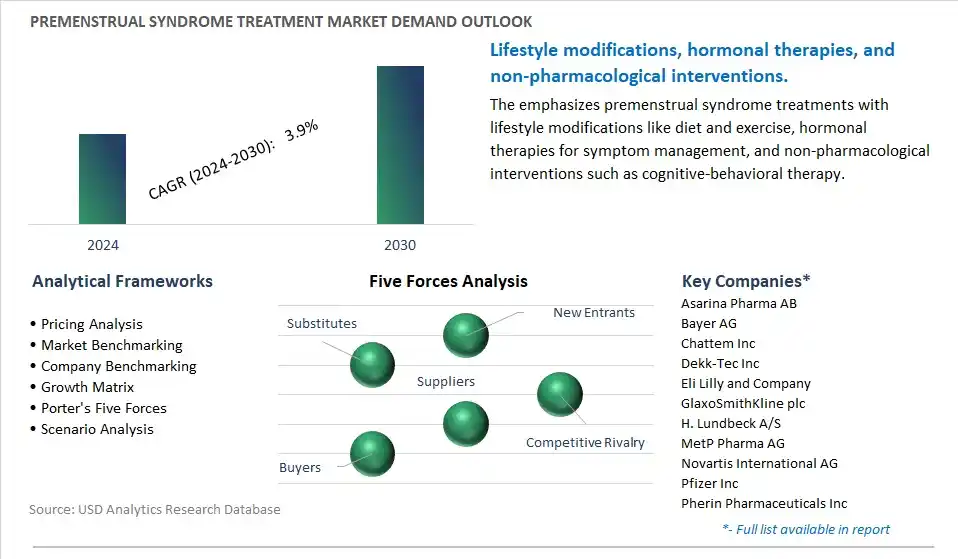
Premenstrual Syndrome Treatment Market is estimated to increase at a Compounded Annual Growth Rate of 3.9% CAGR over the forecast period from 2024 to 2030
The Premenstrual Syndrome Treatment Market study analyzes and forecasts the market size across 6 regions and 24 countries for diverse segments- By Drug (Analgesics, Antidepressant, Oral Contraceptives, Gonadotropin-Releasing Harmone (GnRH) Analogues, Selective Serotonin Reuptake Inhibitor (SSRI), Others), By Product (Prescription, OTC), By Distribution Channel (Hospital Pharmacies, Drug Store and Retail Pharmacies, E-commerce).
An Introduction to Premenstrual Syndrome Treatment Market in 2024
In 2024, the market for premenstrual syndrome (PMS) treatment is witnessing growth driven by a deeper understanding of the condition and the development of targeted therapeutic interventions. Premenstrual syndrome, characterized by physical and emotional symptoms occurring in the luteal phase of the menstrual cycle, affects a significant portion of menstruating individuals. The treatment landscape encompasses a variety of approaches, including lifestyle modifications, dietary supplements, hormonal therapies, and antidepressant medications. Additionally, emerging research into the underlying neurobiological mechanisms of PMS is paving the way for novel treatment modalities targeting neurotransmitter pathways and hormonal regulation. With a growing emphasis on personalized medicine and holistic approaches to women's health, the market for PMS treatment is poised for further innovation in symptom management and patient-centered care.
Market Trend: Shift Towards Holistic and Multimodal Treatment Approaches
A prominent trend in the Premenstrual Syndrome (PMS) Treatment market is the shift towards holistic and multimodal treatment approaches. With a growing understanding of the complex etiology and multifaceted nature of PMS, there is increasing recognition of the need for comprehensive treatment strategies that address both physical and psychological symptoms. This trend involves integrating pharmacological interventions with lifestyle modifications, dietary changes, stress management techniques, and complementary therapies such as acupuncture, yoga, and herbal supplements. Healthcare providers and patients alike are embracing holistic approaches to PMS treatment, aiming to improve symptom management, enhance overall well-being, and empower women to take an active role in their menstrual health. The trend towards holistic and multimodal treatment approaches reflects a patient-centered approach to PMS management, creating opportunities for market growth and innovation in the development of comprehensive PMS treatment options.
Market Driver: Impact of Hormonal Fluctuations and Menstrual Cycle
A primary driver fueling the growth of the Premenstrual Syndrome (PMS) Treatment market is the impact of hormonal fluctuations and the menstrual cycle on symptom severity. PMS is characterized by a range of physical, emotional, and behavioral symptoms that occur cyclically in the luteal phase of the menstrual cycle, typically resolving with the onset of menstruation. Hormonal changes, particularly fluctuations in estrogen and progesterone levels, play a significant role in the pathophysiology of PMS, contributing to mood swings, irritability, fatigue, bloating, and pain. The cyclical nature of PMS symptoms and their correlation with the menstrual cycle drive the demand for effective treatment options to alleviate symptom burden and improve quality of life for affected individuals. The impact of hormonal fluctuations on PMS symptomatology underscores the importance of developing targeted pharmacological interventions and personalized treatment regimens to address the specific needs of women with PMS, driving opportunities for market growth and advancement in PMS treatment strategies.
Market Opportunity: Development of Novel Pharmacological Therapies
An emerging opportunity in the Premenstrual Syndrome (PMS) Treatment market lies in the development of novel pharmacological therapies targeting the underlying mechanisms of PMS symptomatology. While existing treatment options for PMS primarily focus on symptom management through hormonal modulation, analgesia, and mood stabilization, there remains a need for more targeted and efficacious pharmacological interventions that address the diverse array of PMS symptoms. Opportunities exist for pharmaceutical companies to explore novel drug targets, innovative delivery systems, and combination therapies that offer improved efficacy, tolerability, and convenience for women with PMS. Additionally, research into the neurobiological, endocrine, and inflammatory pathways implicated in PMS pathophysiology can inform the development of targeted pharmacological therapies tailored to the individual patient's symptom profile and menstrual cycle characteristics. Collaborations between academia, industry, and regulatory agencies can drive investment and innovation in the development of novel pharmacological treatments for PMS, unlocking new opportunities for market growth and advancement in PMS management.
Premenstrual Syndrome Treatment Market Share Analysis: Selective Serotonin Reuptake Inhibitor (SSRI)
Among the drugs used for premenstrual syndrome (PMS) treatment, Selective Serotonin Reuptake Inhibitors (SSRIs) are experiencing rapid growth. SSRIs are a class of antidepressant medications that work by increasing the levels of serotonin in the brain, which helps regulate mood and emotional stability. While SSRIs are primarily prescribed to treat depression and anxiety disorders, they are also commonly used off-label to alleviate the symptoms of PMS, including mood swings, irritability, anxiety, and depression. The effectiveness of SSRIs in managing PMS symptoms has led to their increasing adoption by healthcare providers and women seeking relief from menstrual-related mood disturbances. Moreover, SSRIs are generally well-tolerated and have a favorable safety profile when used appropriately, further contributing to their popularity as a treatment option for PMS. As awareness of PMS and its impact on women's quality of life continues to grow, along with advancements in pharmacological treatments, the demand for SSRIs in the premenstrual syndrome treatment market is expected to rise significantly. Additionally, the availability of SSRIs both as prescription and over-the-counter (OTC) products, and their distribution through various channels including hospital pharmacies, drug stores, retail pharmacies, and e-commerce platforms, further facilitates their accessibility and market growth.
Premenstrual Syndrome Treatment Competitive Analysis
The market research study provides in-depth insights into leading companies including the SWOT analyses, product profile, financial details, and recent developments acrossAsarina Pharma AB, Bayer AG, Chattem Inc, Dekk-Tec Inc, Eli Lilly and Company, GlaxoSmithKline plc, H. Lundbeck A/S, MetP Pharma AG, Novartis International AG, Pfizer Inc, Pherin Pharmaceuticals Inc, Umecrine Mood AB
Premenstrual Syndrome Treatment Market Segmentation
By Drug
Analgesics
Antidepressant
Oral Contraceptives
Gonadotropin-Releasing Harmone (GnRH) Analogues
Selective Serotonin Reuptake Inhibitor (SSRI)
Others
By Product
Prescription
OTC
By Distribution Channel
Hospital Pharmacies
Drug Store and Retail Pharmacies
E-commerce
Geographical Analysis
North America (United States, Canada, Mexico)
Europe (Germany, France, United Kingdom, Spain, Italy, Rest of Europe)
Asia Pacific (China, India, Japan, South Korea, Rest of Asia Pacific)
South America (Brazil, Argentina, Rest of South America)
Middle East and Africa (Saudi Arabia, UAE, Rest of Middle East, South Africa, Egypt, Rest of Africa)
Premenstrual Syndrome Treatment Market Companies
Asarina Pharma AB
Bayer AG
Chattem Inc
Dekk-Tec Inc
Eli Lilly and Company
GlaxoSmithKline plc
H. Lundbeck A/S
MetP Pharma AG
Novartis International AG
Pfizer Inc
Pherin Pharmaceuticals Inc
Umecrine Mood AB
Reasons to Buy the Premenstrual Syndrome Treatment Market Study
• Deepen your industry insights and navigate uncertainties for strategy formulation, CAPEX, and Operational decisions
• Gain access to detailed insights on the Premenstrual Syndrome Treatment Market, encompassing current market size, growth trends, and forecasts till 2030.
• Access detailed competitor analysis, enabling competitive advantage through a thorough understanding of market players, strategies, and potential differentiation opportunities
• Stay ahead of the curve with insights on technological advancements, innovations, and upcoming trends
• Identify lucrative investment avenues and expansion opportunities within the Premenstrual Syndrome Treatment Market industry, guided by robust, data-backed analysis.
• Understand regional and global markets through country-wise analysis, regional market potential, regulatory nuances, and dynamics
• Execute strategies with confidence and speed through information, analytics, and insights on the industry value chain
• Corporate leaders, strategists, financial experts, shareholders, asset managers, and governmental representatives can make long-term planning scenarios and build an integrated and timely understanding of market dynamics
• Benefit from tailored solutions and expert consultation based on report insights, providing personalized strategies aligned with specific business needs.
TABLE OF CONTENTS
1 Introduction to 2024 Premenstrual Syndrome Treatment Market
1.1 Market Overview
1.2 Quick Facts
1.3 Scope/Objective of the Study
1.4 Market Definition
1.5 Countries and Regions Covered
1.6 Units, Currency, and Conversions
1.7 Industry Value Chain
2 Research Methodology
2.1 Market Size Estimation
2.2 Sources and Research Methodology
2.3 Data Triangulation
2.4 Assumptions and Limitations
3 Executive Summary
3.1 Global Premenstrual Syndrome Treatment Market Size Outlook, $ Million, 2021 to 2030
3.2 Premenstrual Syndrome Treatment Market Outlook by Type, $ Million, 2021 to 2030
3.3 Premenstrual Syndrome Treatment Market Outlook by Product, $ Million, 2021 to 2030
3.4 Premenstrual Syndrome Treatment Market Outlook by Application, $ Million, 2021 to 2030
3.5 Premenstrual Syndrome Treatment Market Outlook by Key Countries, $ Million, 2021 to 2030
4 Market Dynamics
4.1 Key Driving Forces of Premenstrual Syndrome Treatment Industry
4.2 Key Market Trends in Premenstrual Syndrome Treatment Industry
4.3 Potential Opportunities in Premenstrual Syndrome Treatment Industry
4.4 Key Challenges in Premenstrual Syndrome Treatment Industry
5 Market Factor Analysis
5.1 Value Chain Analysis
5.2 Competitive Landscape
5.2.1 Global Premenstrual Syndrome Treatment Market Share by Company (%), 2023
5.2.2 Product Offerings by Company
5.3 Porter’s Five Forces Analysis
5.4 Pricing Analysis and Outlook
6 Growth Outlook Across Scenarios
6.1 Growth Analysis-Case Scenario Definitions
6.2 Low Growth Scenario Forecasts
6.3 Reference Growth Scenario Forecasts
6.4 High Growth Scenario Forecasts
7 Global Premenstrual Syndrome Treatment Market Outlook by Segments
7.1 Premenstrual Syndrome Treatment Market Outlook by Segments, $ Million, 2021- 2030
By Drug
Analgesics
Antidepressant
Oral Contraceptives
Gonadotropin-Releasing Harmone (GnRH) Analogues
Selective Serotonin Reuptake Inhibitor (SSRI)
Others
By Product
Prescription
OTC
By Distribution Channel
Hospital Pharmacies
Drug Store and Retail Pharmacies
E-commerce
8 North America Premenstrual Syndrome Treatment Market Analysis and Outlook To 2030
8.1 Introduction to North America Premenstrual Syndrome Treatment Markets in 2024
8.2 North America Premenstrual Syndrome Treatment Market Size Outlook by Country, 2021-2030
8.2.1 United States
8.2.2 Canada
8.2.3 Mexico
8.3 North America Premenstrual Syndrome Treatment Market size Outlook by Segments, 2021-2030
By Drug
Analgesics
Antidepressant
Oral Contraceptives
Gonadotropin-Releasing Harmone (GnRH) Analogues
Selective Serotonin Reuptake Inhibitor (SSRI)
Others
By Product
Prescription
OTC
By Distribution Channel
Hospital Pharmacies
Drug Store and Retail Pharmacies
E-commerce
9 Europe Premenstrual Syndrome Treatment Market Analysis and Outlook To 2030
9.1 Introduction to Europe Premenstrual Syndrome Treatment Markets in 2024
9.2 Europe Premenstrual Syndrome Treatment Market Size Outlook by Country, 2021-2030
9.2.1 Germany
9.2.2 France
9.2.3 Spain
9.2.4 United Kingdom
9.2.4 Italy
9.2.5 Russia
9.2.6 Norway
9.2.7 Rest of Europe
9.3 Europe Premenstrual Syndrome Treatment Market Size Outlook by Segments, 2021-2030
By Drug
Analgesics
Antidepressant
Oral Contraceptives
Gonadotropin-Releasing Harmone (GnRH) Analogues
Selective Serotonin Reuptake Inhibitor (SSRI)
Others
By Product
Prescription
OTC
By Distribution Channel
Hospital Pharmacies
Drug Store and Retail Pharmacies
E-commerce
10 Asia Pacific Premenstrual Syndrome Treatment Market Analysis and Outlook To 2030
10.1 Introduction to Asia Pacific Premenstrual Syndrome Treatment Markets in 2024
10.2 Asia Pacific Premenstrual Syndrome Treatment Market Size Outlook by Country, 2021-2030
10.2.1 China
10.2.2 India
10.2.3 Japan
10.2.4 South Korea
10.2.5 Indonesia
10.2.6 Malaysia
10.2.7 Australia
10.2.8 Rest of Asia Pacific
10.3 Asia Pacific Premenstrual Syndrome Treatment Market size Outlook by Segments, 2021-2030
By Drug
Analgesics
Antidepressant
Oral Contraceptives
Gonadotropin-Releasing Harmone (GnRH) Analogues
Selective Serotonin Reuptake Inhibitor (SSRI)
Others
By Product
Prescription
OTC
By Distribution Channel
Hospital Pharmacies
Drug Store and Retail Pharmacies
E-commerce
11 South America Premenstrual Syndrome Treatment Market Analysis and Outlook To 2030
11.1 Introduction to South America Premenstrual Syndrome Treatment Markets in 2024
11.2 South America Premenstrual Syndrome Treatment Market Size Outlook by Country, 2021-2030
11.2.1 Brazil
11.2.2 Argentina
11.2.3 Rest of South America
11.3 South America Premenstrual Syndrome Treatment Market size Outlook by Segments, 2021-2030
By Drug
Analgesics
Antidepressant
Oral Contraceptives
Gonadotropin-Releasing Harmone (GnRH) Analogues
Selective Serotonin Reuptake Inhibitor (SSRI)
Others
By Product
Prescription
OTC
By Distribution Channel
Hospital Pharmacies
Drug Store and Retail Pharmacies
E-commerce
12 Middle East and Africa Premenstrual Syndrome Treatment Market Analysis and Outlook To 2030
12.1 Introduction to Middle East and Africa Premenstrual Syndrome Treatment Markets in 2024
12.2 Middle East and Africa Premenstrual Syndrome Treatment Market Size Outlook by Country, 2021-2030
12.2.1 Saudi Arabia
12.2.2 UAE
12.2.3 Oman
12.2.4 Rest of Middle East
12.2.5 Egypt
12.2.6 Nigeria
12.2.7 South Africa
12.2.8 Rest of Africa
12.3 Middle East and Africa Premenstrual Syndrome Treatment Market size Outlook by Segments, 2021-2030
By Drug
Analgesics
Antidepressant
Oral Contraceptives
Gonadotropin-Releasing Harmone (GnRH) Analogues
Selective Serotonin Reuptake Inhibitor (SSRI)
Others
By Product
Prescription
OTC
By Distribution Channel
Hospital Pharmacies
Drug Store and Retail Pharmacies
E-commerce
13 Company Profiles
13.1 Company Snapshot
13.2 SWOT Profiles
13.3 Products and Services
13.4 Recent Developments
13.5 Financial Profile
List of Companies
Asarina Pharma AB
Bayer AG
Chattem Inc
Dekk-Tec Inc
Eli Lilly and Company
GlaxoSmithKline plc
H. Lundbeck A/S
MetP Pharma AG
Novartis International AG
Pfizer Inc
Pherin Pharmaceuticals Inc
Umecrine Mood AB
14 Appendix
14.1 Customization Offerings
14.2 Subscription Services
14.3 Related Reports
14.4 Publisher Expertise
By Drug
Analgesics
Antidepressant
Oral Contraceptives
Gonadotropin-Releasing Harmone (GnRH) Analogues
Selective Serotonin Reuptake Inhibitor (SSRI)
Others
By Product
Prescription
OTC
By Distribution Channel
Hospital Pharmacies
Drug Store and Retail Pharmacies
E-commerce
Countries Analyzed
North America (United States, Canada, Mexico)
Europe (Germany, France, United Kingdom, Spain, Italy, Rest of Europe)
Asia Pacific (China, India, Japan, South Korea, Rest of Asia Pacific)
South America (Brazil, Argentina, Rest of South America)
Middle East and Africa (Saudi Arabia, UAE, Rest of Middle East, South Africa, Egypt, Rest of Africa)
