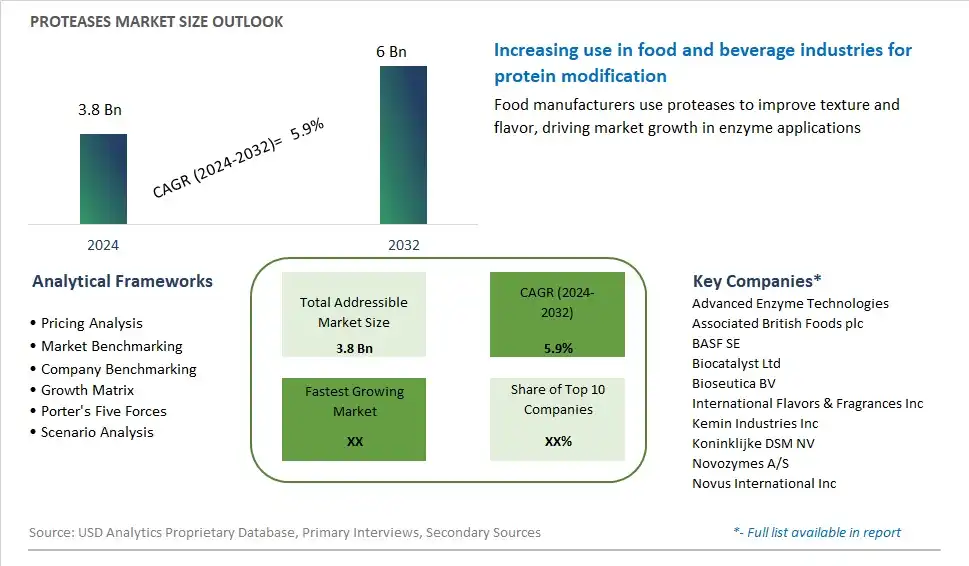
Global Proteases Market Size is valued at $3.8 Billion in 2024 and is forecast to register a growth rate (CAGR) of 5.9% to reach $6 Billion by 2032.
The global Proteases Market Comprehensive Study analyzes and forecasts the market size across 6 regions and 24 countries for diverse segments -By Source (Animal, Plant, Microbial), By Application (Food & beverages, Livestock feed, Soaps & detergent, Pharmaceuticals, Others), By Method (Fermentation, Extraction), By Form (Liquid, Lyophilized powder, Others), By Product (Animal, Plant, Microbial)
An Introduction to Proteases Market
Proteases are enzymes that catalyze the hydrolysis of peptide bonds in proteins, facilitating their breakdown into smaller peptides and amino acids, used in various industries including food, pharmaceuticals, and detergents in 2024. These enzymes play a crucial role in protein digestion, food processing, and biotechnological applications, where they contribute to flavor development, tenderization, and texture modification in food products such as cheese, meat, and baked goods. In the pharmaceutical industry, proteases are used in drug manufacturing processes to produce active pharmaceutical ingredients and improve drug delivery and efficacy. In the detergent industry, proteases are incorporated into laundry detergents and cleaning products to remove protein-based stains and soils from fabrics and surfaces. With advancements in enzyme engineering, biotechnology, and fermentation technology, the market for proteases is growing, driven by innovations in enzyme specificity, stability, and performance that enable manufacturers to develop highly efficient and sustainable enzyme solutions for diverse industrial applications.
Proteases Competitive Landscape
The market report analyses the leading companies in the industry including Advanced Enzyme Technologies, Associated British Foods plc, BASF SE, Biocatalyst Ltd, Bioseutica BV, International Flavors & Fragrances Inc, Kemin Industries Inc, Koninklijke DSM NV, Novozymes A/S, Novus International Inc, and Others.
Proteases Market Dynamics
Proteases Market Trend: Increasing Demand for Enzyme-Based Solutions in Various Industries
One prominent market trend in proteases is the increasing demand for enzyme-based solutions across various industries. Proteases, a type of enzyme that catalyzes the breakdown of proteins into smaller peptides and amino acids, find widespread applications in sectors such as food and beverage, pharmaceuticals, detergents, and animal feed. This trend is driven by the growing recognition of the benefits of enzyme technology in enhancing process efficiency, product quality, and sustainability. Proteases are valued for their ability to improve protein extraction, tenderize meat, facilitate fermentation, remove stains, and enhance nutrient absorption, among other functions. As industries seek eco-friendly and cost-effective solutions to address manufacturing challenges and consumer demands, the market for proteases is expected to grow steadily, driven by the versatility and efficacy of enzyme-based formulations.
Market Driver: Demand for Enhanced Performance and Sustainability
A key driver propelling the market for proteases is the demand for enhanced performance and sustainability in industrial processes and products. Proteases offer several advantages over traditional chemical methods, including milder reaction conditions, higher specificity, and reduced environmental impact. In industries such as food processing and detergents, proteases enable manufacturers to achieve higher yields, cleaner formulations, and improved product performance while minimizing the use of harsh chemicals and energy consumption. Moreover, with growing concerns about resource conservation, waste reduction, and regulatory compliance, there's increasing pressure on industries to adopt sustainable manufacturing practices. Proteases play a crucial role in supporting sustainability initiatives by enabling cleaner production processes, reducing water and energy usage, and lowering carbon emissions. As companies strive to meet sustainability goals and consumer expectations for eco-friendly products, the demand for proteases is expected to rise, driving market growth and innovation in enzyme technology.
Market Opportunity: Expansion into New Applications and Markets
An opportunity within the proteases market lies in the expansion into new applications and markets to capitalize on the versatility and versatility of enzyme-based solutions. While proteases have traditionally been used in industries such as food processing, textiles, and detergents, there's potential to explore emerging applications and niche markets where enzymatic solutions can offer unique benefits. For example, proteases are increasingly being utilized in the production of biofuels, animal feed additives, leather processing, and bioremediation, presenting opportunities for enzyme manufacturers to diversify their product portfolios and address unmet needs in these sectors. Additionally, there's scope for geographical expansion into regions with growing industrialization and demand for enzyme technology, such as Asia-Pacific and Latin America. By identifying and tapping into new applications and markets, protease manufacturers can unlock new revenue streams, strengthen their competitive position, and drive long-term growth in the dynamic enzyme industry.
Proteases Market Share Analysis: Microbial held the dominant market share in 2024
The microbial segment, encompassing proteases derived from fungi, bacteria, and viruses, holds the largest share in the proteases market due to the widespread use and commercial viability of microbial proteases. Microbial proteases offer numerous advantages, including high specificity, stability over a wide range of pH and temperature, and ease of production through fermentation processes. Fungi, such as Aspergillus and Trichoderma species, and bacteria, including Bacillus species, are prominent sources of microbial proteases widely utilized in various industries such as food, detergent, pharmaceuticals, and textiles. Their robustness, cost-effectiveness, and compatibility with modern biotechnological methods have cemented microbial proteases as preferred enzymes for diverse applications, driving their dominance in the proteases market. Additionally, ongoing research and advancements in microbial fermentation technologies continue to enhance the production efficiency and characteristics of microbial proteases, further solidifying their position as the largest segment in the proteases market.
Proteases Market Share Analysis: Soaps & Detergent held the dominant market share in 2024
The soaps and detergent segment is experiencing rapid growth in the proteases market, fueled by the increasing demand for enzyme-based cleaning solutions and the shift towards environmentally friendly and biodegradable formulations. Proteases play a crucial role in detergent formulations by breaking down protein-based stains and soils, enhancing the cleaning efficiency of laundry detergents and dishwashing liquids. As consumers become more conscious of sustainability and the environmental impact of chemical detergents, there is a growing preference for enzyme-based detergents that offer superior stain removal performance while reducing the need for harsh chemicals. Proteases derived from microbial sources, particularly fungi and bacteria, are favored for their effectiveness in breaking down proteinaceous stains and their compatibility with low-temperature washing conditions. Furthermore, technological advancements in enzyme engineering and formulation have led to the development of proteases with enhanced stability, specificity, and compatibility with different detergent formulations, driving their adoption in the soaps and detergent industry. With increasing awareness of the benefits of enzyme-based cleaning solutions and the growing emphasis on sustainable living practices, the soaps and detergent segment is poised for continued growth in the proteases market.
Proteases Market Share Analysis: Fermentation held the dominant market share in 2024
The fermentation method represents the largest segment in the proteases market due to its efficiency, scalability, and cost-effectiveness in enzyme production. Fermentation processes, particularly microbial fermentation, offer several advantages for protease production compared to extraction methods. Microbial fermentation allows for the cultivation of microorganisms such as bacteria and fungi in controlled bioreactor conditions, facilitating the production of high yields of proteases with consistent quality and purity. This method also offers flexibility in terms of substrate utilization and fermentation parameters, enabling optimization for specific protease production requirements. Additionally, fermentation processes can be easily scaled up to meet growing demand, making them suitable for large-scale industrial production of proteases for various applications in food, pharmaceuticals, detergents, and other industries. The robustness and versatility of fermentation-based protease production have solidified the method as the preferred choice for enzyme manufacturers, driving its dominance in the proteases market.
Proteases Market Segmentation
By Source
Animal
Plant
Microbial
-Fungal
-Bacterial
-Viral
By Application
Food & beverages
Livestock feed
Soaps & detergent
Pharmaceuticals
Others
By Method
Fermentation
Extraction
By Form
Liquid
Lyophilized powder
Others
By Product
Animal
-Trypsin
-Renin
-Pepsin
-Others
Plant
-Papain
-Bromelain
-Others
Microbial
-Alkaline
-Acid stable
-Neutral
-Others
Countries Analyzed
North America (US, Canada, Mexico)
Europe (Germany, UK, France, Spain, Italy, Russia, Rest of Europe)
Asia Pacific (China, India, Japan, South Korea, Australia, South East Asia, Rest of Asia)
South America (Brazil, Argentina, Rest of South America)
Middle East and Africa (Saudi Arabia, UAE, Rest of Middle East, South Africa, Egypt, Rest of Africa)
Proteases Companies Profiled in the Study
Advanced Enzyme Technologies
Associated British Foods plc
BASF SE
Biocatalyst Ltd
Bioseutica BV
International Flavors & Fragrances Inc
Kemin Industries Inc
Koninklijke DSM NV
Novozymes A/S
Novus International Inc
*- List Not Exhaustive
Chapter 1. TABLE OF CONTENTS
Chapter 2. Introduction to Proteases Market
2.1. Market Overview
2.2. Key Statistics and Report Highlights
2.3. Scope of the Comprehensive Study
2.3.1. Market Definition
2.3.2 Countries and Regions Covered
2.3.3 Research Objective
2.3.4 Units, Currency, and Conversions
2.3.5 Industry Value Chain
2.4. Key Market Segments
2.5. Key Companies
2.6. Study Period
Chapter 3. Strategic Analysis Review
3.1. Proteases Pricing Analysis and Forecast
3.2. Porter’s Five Forces
3.3. Market Ecosystem
3.4. SWOT Analysis
3.5. Regulatory Scenario
3.3. Effects of Inflation, Russia-Ukraine War, moderating economic growth, and other macroeconomic factors
Chapter 4. Competitive Landscape
4.1. Market Share Analysis
4.1.1. Global Proteases Market Share by Company, 2023
4.1.2. Product Offerings of Leading Proteases Companies
4.2. Market Entropy
4.2.1. New Product Launches in the Industry
4.2.2. Mergers, Acquisitions, Joint ventures, and Partnerships
4.3. Key Strategies and Best Practices
Chapter 5. Global Market Projections: Best, Reference, and Low Case Scenarios
5.1. Growth Analysis- Case Scenario Definitions
5.2. Low Growth Case Scenario Forecasts
5.3. Reference Growth Case Scenario Forecasts
5.4. High Growth Case Scenario Forecasts
Chapter 6. Market Dynamics
6.1. Proteases Market Drivers
6.2. Proteases Market Challenges
6.6. Proteases Market Opportunities
6.4. Proteases Market Trends
Chapter 7. Global Proteases Market Outlook Trends
7.1. Global Proteases Revenue (USD Million) and CAGR (%) by Type (2021-2032)
7.2. Global Proteases Revenue (USD Million) and CAGR (%) by Application (2021-2032)
7.3. Global Proteases Revenue (USD Million) and CAGR (%) by Product (2021-2032)
By Source
Animal
Plant
Microbial
-Fungal
-Bacterial
-Viral
By Application
Food & beverages
Livestock feed
Soaps & detergent
Pharmaceuticals
Others
By Method
Fermentation
Extraction
By Form
Liquid
Lyophilized powder
Others
By Product
Animal
-Trypsin
-Renin
-Pepsin
-Others
Plant
-Papain
-Bromelain
-Others
Microbial
-Alkaline
-Acid stable
-Neutral
-Others
Chapter 8. Global Proteases Regional Analysis and Outlook
8.1. Global Proteases Revenue (USD Million) By Regions (2021- 2032)
8.2. North America Proteases Revenue (USD Million) by Country (2021-2032)
8.2.1. United States Proteases Regional Analysis and Outlook
8.2.2. Canada Proteases Regional Analysis and Outlook
8.2.3. Mexico Proteases Regional Analysis and Outlook
8.3. Europe Proteases Revenue (USD Million), by Country (2021-2032)
8.3.1. Germany Proteases Regional Analysis and Outlook
8.3.2. France Proteases Regional Analysis and Outlook
8.3.3. United Kingdom Proteases Regional Analysis and Outlook
8.3.4. Spain Proteases Regional Analysis and Outlook
8.3.5. Italy Proteases Regional Analysis and Outlook
8.3.6. Russia Proteases Regional Analysis and Outlook
8.3.7. Rest of Europe Proteases Regional Analysis and Outlook
8.4. Asia Pacific Proteases Revenue (USD Million) by Country (2021-2032)
8.4.1. China Proteases Regional Analysis and Outlook
8.4.2. Japan Proteases Regional Analysis and Outlook
8.4.3. India Proteases Regional Analysis and Outlook
8.4.4. South Korea Proteases Regional Analysis and Outlook
8.4.5. Australia Proteases Regional Analysis and Outlook
8.4.6. South East Asia Proteases Regional Analysis and Outlook
8.4.7. Rest of Asia Pacific Proteases Regional Analysis and Outlook
8.5. South America Proteases Revenue (USD Million), by Country (2021-2032)
8.5.1. Brazil Proteases Regional Analysis and Outlook
8.5.2. Argentina Proteases Regional Analysis and Outlook
8.5.3. Rest of South America Proteases Regional Analysis and Outlook
8.6. Middle East and Africa Proteases Revenue (USD Million) by Country (2021-2032)
8.6.1. Middle East Proteases Regional Analysis and Outlook
8.6.2. Africa Proteases Regional Analysis and Outlook
Chapter 9. North America Proteases Analysis and Outlook
9.1. North America Proteases Revenue (USD Million) by Segments (2021-2032)
9.1.1. North America Proteases Revenue (USD Million) by Type (2021-2032)
9.1.2. North America Proteases Revenue (USD Million) by Application (2021-2032)
9.1.3. North America Proteases Revenue (USD Million) by Product (2021-2032)
By Source
Animal
Plant
Microbial
-Fungal
-Bacterial
-Viral
By Application
Food & beverages
Livestock feed
Soaps & detergent
Pharmaceuticals
Others
By Method
Fermentation
Extraction
By Form
Liquid
Lyophilized powder
Others
By Product
Animal
-Trypsin
-Renin
-Pepsin
-Others
Plant
-Papain
-Bromelain
-Others
Microbial
-Alkaline
-Acid stable
-Neutral
-Others
Chapter 10. Europe Proteases Analysis and Outlook
10.1. Europe Proteases Revenue (USD Million), by Segments (USD Million) (2021-2032)
10.1.1. Europe Proteases Revenue (USD Million) by Type (2021-2032)
10.1.2. Europe Proteases Revenue (USD Million) by Application (2021-2032)
10.1.3. Europe Proteases Revenue (USD Million) by Product (2021-2032)
By Source
Animal
Plant
Microbial
-Fungal
-Bacterial
-Viral
By Application
Food & beverages
Livestock feed
Soaps & detergent
Pharmaceuticals
Others
By Method
Fermentation
Extraction
By Form
Liquid
Lyophilized powder
Others
By Product
Animal
-Trypsin
-Renin
-Pepsin
-Others
Plant
-Papain
-Bromelain
-Others
Microbial
-Alkaline
-Acid stable
-Neutral
-Others
Chapter 11. Asia Pacific Proteases Analysis and Outlook
11.1. Asia Pacific Proteases Revenue (USD Million), and Revenue (USD Million) by Segments (2021-2032)
11.1.1. Asia Pacific Proteases Revenue (USD Million) by Type (2021-2032)
11.1.2. Asia Pacific Proteases Revenue (USD Million) by Application (2021-2032)
11.1.3. Asia Pacific Proteases Revenue (USD Million) by Product (2021-2032)
By Source
Animal
Plant
Microbial
-Fungal
-Bacterial
-Viral
By Application
Food & beverages
Livestock feed
Soaps & detergent
Pharmaceuticals
Others
By Method
Fermentation
Extraction
By Form
Liquid
Lyophilized powder
Others
By Product
Animal
-Trypsin
-Renin
-Pepsin
-Others
Plant
-Papain
-Bromelain
-Others
Microbial
-Alkaline
-Acid stable
-Neutral
-Others
Chapter 12. South America Proteases Analysis and Outlook
12.1. South America Proteases Revenue (USD Million), by Segments (2021-2032)
12.1.1. South America Proteases Revenue (USD Million) by Type (2021-2032)
12.1.2. South America Proteases Revenue (USD Million) by Application (2021-2032)
12.1.3. South America Proteases Revenue (USD Million) by Product (2021-2032)
By Source
Animal
Plant
Microbial
-Fungal
-Bacterial
-Viral
By Application
Food & beverages
Livestock feed
Soaps & detergent
Pharmaceuticals
Others
By Method
Fermentation
Extraction
By Form
Liquid
Lyophilized powder
Others
By Product
Animal
-Trypsin
-Renin
-Pepsin
-Others
Plant
-Papain
-Bromelain
-Others
Microbial
-Alkaline
-Acid stable
-Neutral
-Others
Chapter 13. Middle East and Africa Proteases Analysis and Outlook
13.1. Middle East and Africa Proteases Revenue (USD Million), by Segments (2021-2032)
13.1.1. Middle East and Africa Proteases Revenue (USD Million) by Type (2021-2032)
13.1.2. Middle East and Africa Proteases Revenue (USD Million) by Application (2021-2032)
13.1.3. Middle East and Africa Proteases Revenue (USD Million) by Product (2021-2032)
By Source
Animal
Plant
Microbial
-Fungal
-Bacterial
-Viral
By Application
Food & beverages
Livestock feed
Soaps & detergent
Pharmaceuticals
Others
By Method
Fermentation
Extraction
By Form
Liquid
Lyophilized powder
Others
By Product
Animal
-Trypsin
-Renin
-Pepsin
-Others
Plant
-Papain
-Bromelain
-Others
Microbial
-Alkaline
-Acid stable
-Neutral
-Others
Chapter 14. Proteases Company Profiles
14.1 Business Overview
14.2 Product Profiles
14.3 SWOT Profiles
14.5 Recent Developments
14.6 Financial Profile
List of Companies
Advanced Enzyme Technologies
Associated British Foods plc
BASF SE
Biocatalyst Ltd
Bioseutica BV
International Flavors & Fragrances Inc
Kemin Industries Inc
Koninklijke DSM NV
Novozymes A/S
Novus International Inc
15. Methodology and Data Sources
15.1 Customization Offerings
15.2 Subscription Services
15.3 Related Reports
15.4 Publisher Expertise
LIST OF TABLES
Table 1 Market Segmentation Analysis
Table 2 Global Proteases Market Share of Leading Companies, 2023
Table 3 Product Offerings of Leading Companies
Table 4 Low Growth Scenario Forecasts
Table 5 Reference Case Growth Scenario
Table 6 High Growth Case Scenario
Table 7 Global Proteases Revenue (USD Million) And CAGR (%) By Type (2021-2032)
Table 8 Global Proteases Revenue (USD Million) And CAGR (%) By Application (2021-2032)
Table 9 Global Proteases Revenue (USD Million) And CAGR (%) By Product (2021-2032)
Table 10 Global Proteases Market Revenue (USD Million) By Regions (2021-2032)
Table 11 Global Proteases Market Share (%) By Regions (2021-2032)
Table 12 North America Proteases Revenue (USD Million) By Country (2021-2032)
Table 13 Europe Proteases Revenue (USD Million) By Country (2021-2032)
Table 14 Asia Pacific Proteases Revenue (USD Million) By Country (2021-2032)
Table 15 South America Proteases Revenue (USD Million) By Country (2021-2032)
Table 16 Middle East and Africa Proteases Revenue (USD Million) By Region (2021-2032)
Table 17 North America Proteases Revenue (USD Million) By Type (2021-2032)
Table 18 North America Proteases Revenue (USD Million) By Application (2021-2032)
Table 19 North America Proteases Revenue (USD Million) By Product (2021-2032)
Table 20 Europe Proteases Revenue (USD Million) By Type (2021-2032)
Table 21 Europe Proteases Revenue (USD Million) By Application (2021-2032)
Table 22 Europe Proteases Revenue (USD Million) By Product (2021-2032)
Table 23 Asia Pacific Proteases Revenue (USD Million) By Type (2021-2032)
Table 24 Asia Pacific Proteases Revenue (USD Million) By Application (2021-2032)
Table 25 Asia Pacific Proteases Revenue (USD Million) By Product (2021-2032)
Table 26 South America Proteases Revenue (USD Million) By Type (2021-2032)
Table 27 South America Proteases Revenue (USD Million) By Application (2021-2032)
Table 28 South America Proteases Revenue (USD Million) By Product (2021-2032)
Table 29 Middle East and Africa Proteases Revenue (USD Million) By Type (2021-2032)
Table 30 Middle East and Africa Proteases Revenue (USD Million) By Application (2021-2032)
Table 31 Middle East and Africa Proteases Revenue (USD Million) By Product (2021-2032)
LIST OF FIGURES
Figure 1. Market Scope
Figure 2. Pricing Forecasts Per Unit, 2023- 2032
Figure 3. Porter’s Five Forces
Figure 4. Global Proteases Market Revenue (USD Million) By Regions (2021-2032)
Figure 5. Global Proteases Market Share (%) By Regions (2023)
Figure 6. North America Proteases Revenue (USD Million) By Country (2021-2032)
Figure 7. United States Proteases Revenue (USD Million) By Country (2021-2032)
Figure 8. Canada Proteases Revenue (USD Million) By Country (2021-2032)
Figure 9. Mexico Proteases Revenue (USD Million) By Country (2021-2032)
Figure 10. Europe Proteases Revenue (USD Million) By Country (2021-2032)
Figure 11. Germany Proteases Revenue (USD Million) By Country (2021-2032)
Figure 12. France Proteases Revenue (USD Million) By Country (2021-2032)
Figure 13. United Kingdom Proteases Revenue (USD Million) By Country (2021-2032)
Figure 14. Spain Proteases Revenue (USD Million) By Country (2021-2032)
Figure 15. Italy Proteases Revenue (USD Million) By Country (2021-2032)
Figure 16. Russia Proteases Revenue (USD Million) By Country (2021-2032)
Figure 17. Rest of Europe Proteases Revenue (USD Million) By Country (2021-2032)
Figure 11. Asia Pacific Proteases Revenue (USD Million) By Country (2021-2032)
Figure 12. China Proteases Revenue (USD Million) By Country (2021-2032)
Figure 13. Japan Proteases Revenue (USD Million) By Country (2021-2032)
Figure 14. India Proteases Revenue (USD Million) By Country (2021-2032)
Figure 15. South Korea Proteases Revenue (USD Million) By Country (2021-2032)
Figure 16. Australia Proteases Revenue (USD Million) By Country (2021-2032)
Figure 17. South East Asia Proteases Revenue (USD Million) By Country (2021-2032)
Figure 18. South America Proteases Revenue (USD Million) By Country (2021-2032)
Figure 19. Brazil Proteases Revenue (USD Million) By Country (2021-2032)
Figure 20. Argentina Proteases Revenue (USD Million) By Country (2021-2032)
Figure 21. Rest of Asia Pacific Proteases Revenue (USD Million) By Country (2021-2032)
Figure 22. Middle East and Africa Proteases Revenue (USD Million) By Region (2021-2032)
Figure 23. Saudi Arabia Proteases Revenue (USD Million) By Region (2021-2032)
Figure 24. The UAE Proteases Revenue (USD Million) By Region (2021-2032)
Figure 25. Rest of Middle East Proteases Revenue (USD Million) By Region (2021-2032)
Figure 26. South Africa Proteases Revenue (USD Million) By Region (2021-2032)
Figure 27. Africa Proteases Revenue (USD Million) By Region (2021-2032)
Figure 28. North America Proteases Revenue (USD Million) By Type (2021-2032)
Figure 29. North America Proteases Revenue (USD Million) By Application (2021-2032)
Figure 30. North America Proteases Revenue (USD Million) By Product (2021-2032)
Figure 31. Europe Proteases Revenue (USD Million) By Type (2021-2032)
Figure 32. Europe Proteases Revenue (USD Million) By Application (2021-2032)
Figure 33. Europe Proteases Revenue (USD Million) By Product (2021-2032)
Figure 34. Asia Pacific Proteases Revenue (USD Million) By Type (2021-2032)
Figure 35. Asia Pacific Proteases Revenue (USD Million) By Application (2021-2032)
Figure 36. Asia Pacific Proteases Revenue (USD Million) By Product (2021-2032)
Figure 37. South America Proteases Revenue (USD Million) By Type (2021-2032)
Figure 38. South America Proteases Revenue (USD Million) By Application (2021-2032)
Figure 39. South America Proteases Revenue (USD Million) By Product (2021-2032)
Figure 40. Middle East and Africa Proteases Revenue (USD Million) By Type (2021-2032)
Figure 41. Middle East and Africa Proteases Revenue (USD Million) By Application (2021-2032)
Figure 42. Middle East and Africa Proteases Revenue (USD Million) By Product (2021-2032)
By Source
Animal
Plant
Microbial
-Fungal
-Bacterial
-Viral
By Application
Food & beverages
Livestock feed
Soaps & detergent
Pharmaceuticals
Others
By Method
Fermentation
Extraction
By Form
Liquid
Lyophilized powder
Others
By Product
Animal
-Trypsin
-Renin
-Pepsin
-Others
Plant
-Papain
-Bromelain
-Others
Microbial
-Alkaline
-Acid stable
-Neutral
-Others
Countries Analyzed
North America (US, Canada, Mexico)
Europe (Germany, UK, France, Spain, Italy, Russia, Rest of Europe)
Asia Pacific (China, India, Japan, South Korea, Australia, South East Asia, Rest of Asia)
South America (Brazil, Argentina, Rest of South America)
Middle East and Africa (Saudi Arabia, UAE, Rest of Middle East, South Africa, Egypt, Rest of Africa)
