
The global Racing Vehicles Market study analyzes and forecasts the market size across 6 regions and 24 countries for diverse segments including By Type (Racing Cars, Racing Motorcycles, Racing Trucks, Others), By Application (F1, NASCAR, WRC, Grassroots Car Racing, Formula E, Others), By Fuel (Diesel, Gasoline, Petrol), By Sales Channel (OEMs, Aftermarket).
The Racing Vehicles Market in 2024 caters to motorsport enthusiasts and professional racing teams, offering purpose-built vehicles engineered for high-performance competition across various disciplines, including circuit racing, rally, drag racing, and off-road events. Racing vehicles are meticulously designed and constructed to optimize aerodynamics, power-to-weight ratio, and handling characteristics, providing drivers with the agility, speed, and precision required to succeed on the track. With advancements in materials, engine technology, and vehicle dynamics, manufacturers of racing vehicles are pushing the boundaries of performance, reliability, and safety to gain a competitive edge in motorsport competitions worldwide. Moreover, customization options such as chassis setup, suspension tuning, and drivetrain configurations allow teams to fine-tune vehicle behavior and adapt to different racing conditions and track layouts. Additionally, the integration of advanced telemetry systems and data acquisition technologies enable engineers and drivers to analyze performance metrics and make informed adjustments for continuous improvement. As motorsport disciplines continue to evolve and capture the imagination of enthusiasts, the Racing Vehicles Market remains at the forefront of innovation, pushing the limits of automotive engineering and performance optimization.
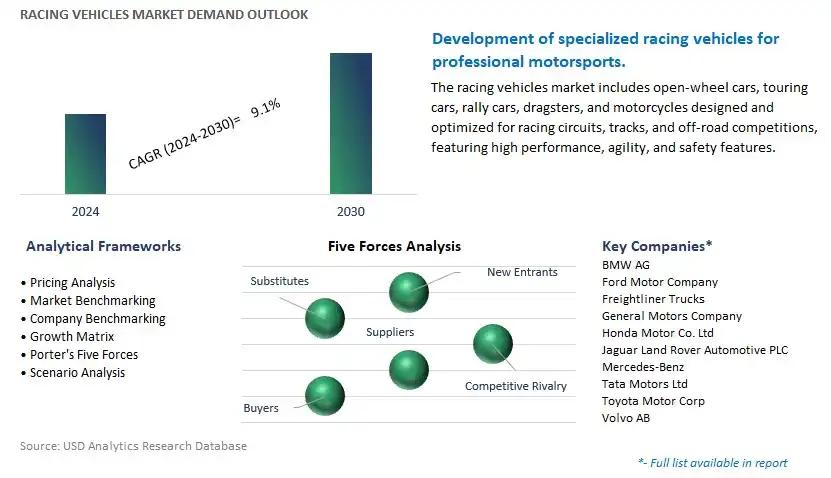
The global Racing Vehicles market is highly competitive with a large number of companies focusing on niche market segments. Amidst intense competitive conditions, Racing Vehicles Companies are investing in new product launches and strengthening distribution channels. Key companies operating in the Racing Vehicles Market Industry include- BMW AG, Ford Motor Company, Freightliner Trucks, General Motors Company, Honda Motor Co. Ltd, Jaguar Land Rover Automotive PLC, Mercedes-Benz , Tata Motors Ltd, Toyota Motor Corp, Volvo AB.
A prominent trend in the Racing Vehicles market is the advancements in electric and autonomous racing vehicles, driven by the automotive industry's focus on sustainability, technological innovation, and safety. Electric racing vehicles, powered by electric motors and high-capacity batteries, offer environmentally friendly alternatives to traditional combustion engine vehicles, reducing emissions and noise pollution on the track. Additionally, there's increasing interest in autonomous racing vehicles equipped with artificial intelligence (AI), sensors, and advanced driver assistance systems (ADAS) to autonomously navigate race circuits and compete in organized racing events. These technological advancements are reshaping the racing vehicles market, with a growing emphasis on developing electric and autonomous racing platforms that offer exhilarating performance, enhanced safety features, and opportunities for innovation and competition in motorsport.
A key driver for the Racing Vehicles market is the growing interest in sustainable and technologically advanced racing among participants, spectators, and stakeholders in the motorsport industry. With increasing awareness of environmental issues and the need to reduce carbon emissions, there's a corresponding shift towards sustainable racing initiatives such as electric racing series and zero-emission competitions. Moreover, advancements in vehicle electrification, battery technology, and renewable energy sources are enabling the development of high-performance electric racing vehicles that rival their combustion engine counterparts in speed, agility, and excitement. Additionally, the pursuit of technological innovation and engineering excellence in motorsport drives the demand for racing vehicles equipped with cutting-edge features such as AI-driven autonomous capabilities, predictive analytics, and connectivity solutions. This driver is fueled by factors such as regulatory incentives, corporate sustainability goals, and the desire to showcase technological prowess, driving the growth of the racing vehicles market as a dynamic and forward-thinking segment within the motorsport industry.
An emerging opportunity within the Racing Vehicles market lies in the expansion into e-sports and virtual racing platforms, offering new avenues for engagement, entertainment, and brand exposure. As the popularity of e-sports continues to rise, fueled by advancements in gaming technology, online streaming platforms, and social media, there's increasing interest in virtual racing simulations that replicate the thrill and intensity of real-world racing events. Racing vehicle manufacturers can leverage their expertise in vehicle design, performance tuning, and aerodynamics to collaborate with game developers, racing leagues, and e-sports teams to create immersive virtual racing experiences for gamers and sim racers. Additionally, partnerships with automotive OEMs, racing teams, and sponsorship networks can facilitate the integration of branded racing vehicles and components into virtual racing platforms, enhancing brand visibility and engagement with gaming audiences. By seizing this opportunity, manufacturers can expand their reach, cultivate new fan bases, and capitalize on the growing intersection between motorsport and gaming culture.
By Type
Racing Cars
Racing Motorcycle
Racing Trucks
Others
By Application
F1
NASCAR
WRC
Grassroots Car Racing
Formula E
Others
By Fuel Vehicles
Diesel
Gasoline
Petrol
By Sales Channel
OEMs
AftermarketGeographical Analysis
North America (United States, Canada, Mexico)
Europe (Germany, France, United Kingdom, Spain, Italy, Rest of Europe)
Asia Pacific (China, India, Japan, South Korea, Rest of Asia Pacific)
South America (Brazil, Argentina, Rest of South America)
Middle East and Africa (Saudi Arabia, UAE, Rest of Middle East, South Africa, Egypt, Rest of Africa
BMW AG
Ford Motor Company
Freightliner Trucks
General Motors Company
Honda Motor Co. Ltd
Jaguar Land Rover Automotive PLC
Mercedes-Benz
Tata Motors Ltd
Toyota Motor Corp
Volvo AB
*- List not Exhaustive
TABLE OF CONTENTS
1 Introduction to 2024 Racing Vehicles Market
1.1 Market Overview
1.2 Quick Facts
1.3 Scope/Objective of the Study
1.4 Market Definition
1.5 Countries and Regions Analyzed
1.6 Units, Currency, and Conversions
1.7 Industry Value Chain
2 Research Methodology
2.1 Market Size Estimation
2.2 Sources and Research Methodology
2.3 Data Triangulation
2.4 Assumptions and Limitations
3 Executive Summary
3.1 Global Racing Vehicles Market Size Outlook, $ Million, 2021 to 2030
3.2 Racing Vehicles Market Outlook by Type, $ Million, 2021 to 2030
3.3 Racing Vehicles Market Outlook by Product, $ Million, 2021 to 2030
3.4 Racing Vehicles Market Outlook by Application, $ Million, 2021 to 2030
3.5 Racing Vehicles Market Outlook by Key Countries, $ Million, 2021 to 2030
4 Market Dynamics
4.1 Key Driving Forces of Racing Vehicles Industry
4.2 Key Market Trends in Racing Vehicles Industry
4.3 Potential Opportunities in Racing Vehicles Industry
4.4 Key Challenges in Racing Vehicles Industry
5 Market Factor Analysis
5.1 Value Chain Analysis
5.2 Competitive Landscape
5.2.1 Global Racing Vehicles Market Share by Company (%), 2023
5.2.2 Product Offerings by Company
5.3 Porter’s Five Forces Analysis
5.4 Pricing Analysis and Outlook
6 Growth Outlook Across Scenarios
6.1 Growth Analysis-Case Scenario Definitions
6.2 Low Growth Scenario Forecasts
6.3 Reference Growth Scenario Forecasts
6.4 High Growth Scenario Forecasts
7 Global Racing Vehicles Market Outlook by Segments
7.1 Racing Vehicles Market Outlook by Segments, $ Million, 2021- 2030
By Type
Racing Cars
Racing Motorcycle
Racing Trucks
Others
By Application
F1
NASCAR
WRC
Grassroots Car Racing
Formula E
Others
By Fuel Vehicles
Diesel
Gasoline
Petrol
By Sales Channel
OEMs
Aftermarket
8 North America Racing Vehicles Market Analysis and Outlook To 2030
8.1 Introduction to North America Racing Vehicles Markets in 2024
8.2 North America Racing Vehicles Market Size Outlook by Country, 2021-2030
8.2.1 United States
8.2.2 Canada
8.2.3 Mexico
8.3 North America Racing Vehicles Market size Outlook by Segments, 2021-2030
By Type
Racing Cars
Racing Motorcycle
Racing Trucks
Others
By Application
F1
NASCAR
WRC
Grassroots Car Racing
Formula E
Others
By Fuel Vehicles
Diesel
Gasoline
Petrol
By Sales Channel
OEMs
Aftermarket
9 Europe Racing Vehicles Market Analysis and Outlook To 2030
9.1 Introduction to Europe Racing Vehicles Markets in 2024
9.2 Europe Racing Vehicles Market Size Outlook by Country, 2021-2030
9.2.1 Germany
9.2.2 France
9.2.3 Spain
9.2.4 United Kingdom
9.2.4 Italy
9.2.5 Russia
9.2.6 Norway
9.2.7 Rest of Europe
9.3 Europe Racing Vehicles Market Size Outlook by Segments, 2021-2030
By Type
Racing Cars
Racing Motorcycle
Racing Trucks
Others
By Application
F1
NASCAR
WRC
Grassroots Car Racing
Formula E
Others
By Fuel Vehicles
Diesel
Gasoline
Petrol
By Sales Channel
OEMs
Aftermarket
10 Asia Pacific Racing Vehicles Market Analysis and Outlook To 2030
10.1 Introduction to Asia Pacific Racing Vehicles Markets in 2024
10.2 Asia Pacific Racing Vehicles Market Size Outlook by Country, 2021-2030
10.2.1 China
10.2.2 India
10.2.3 Japan
10.2.4 South Korea
10.2.5 Indonesia
10.2.6 Malaysia
10.2.7 Australia
10.2.8 Rest of Asia Pacific
10.3 Asia Pacific Racing Vehicles Market size Outlook by Segments, 2021-2030
By Type
Racing Cars
Racing Motorcycle
Racing Trucks
Others
By Application
F1
NASCAR
WRC
Grassroots Car Racing
Formula E
Others
By Fuel Vehicles
Diesel
Gasoline
Petrol
By Sales Channel
OEMs
Aftermarket
11 South America Racing Vehicles Market Analysis and Outlook To 2030
11.1 Introduction to South America Racing Vehicles Markets in 2024
11.2 South America Racing Vehicles Market Size Outlook by Country, 2021-2030
11.2.1 Brazil
11.2.2 Argentina
11.2.3 Rest of South America
11.3 South America Racing Vehicles Market size Outlook by Segments, 2021-2030
By Type
Racing Cars
Racing Motorcycle
Racing Trucks
Others
By Application
F1
NASCAR
WRC
Grassroots Car Racing
Formula E
Others
By Fuel Vehicles
Diesel
Gasoline
Petrol
By Sales Channel
OEMs
Aftermarket
12 Middle East and Africa Racing Vehicles Market Analysis and Outlook To 2030
12.1 Introduction to Middle East and Africa Racing Vehicles Markets in 2024
12.2 Middle East and Africa Racing Vehicles Market Size Outlook by Country, 2021-2030
12.2.1 Saudi Arabia
12.2.2 UAE
12.2.3 Oman
12.2.4 Rest of Middle East
12.2.5 Egypt
12.2.6 Nigeria
12.2.7 South Africa
12.2.8 Rest of Africa
12.3 Middle East and Africa Racing Vehicles Market size Outlook by Segments, 2021-2030
By Type
Racing Cars
Racing Motorcycle
Racing Trucks
Others
By Application
F1
NASCAR
WRC
Grassroots Car Racing
Formula E
Others
By Fuel Vehicles
Diesel
Gasoline
Petrol
By Sales Channel
OEMs
Aftermarket
13 Company Profiles
13.1 Company Snapshot
13.2 SWOT Profiles
13.3 Products and Services
13.4 Recent Developments
13.5 Financial Profile
List of Companies
BMW AG
Ford Motor Company
Freightliner Trucks
General Motors Company
Honda Motor Co. Ltd
Jaguar Land Rover Automotive PLC
Mercedes-Benz
Tata Motors Ltd
Toyota Motor Corp
Volvo AB
14 Appendix
14.1 Customization Offerings
14.2 Subscription Services
14.3 Related Reports
14.4 Publisher Expertise
By Type
Racing Cars
Racing Motorcycle
Racing Trucks
Others
By Application
F1
NASCAR
WRC
Grassroots Car Racing
Formula E
Others
By Fuel Vehicles
Diesel
Gasoline
Petrol
By Sales Channel
OEMs
Aftermarket
The global Racing Vehicles Market is one of the lucrative growth markets, poised to register a 9.1% growth (CAGR) between 2024 and 2030.
Emerging Markets across Asia Pacific, Europe, and Americas present robust growth prospects.
BMW AG, Ford Motor Company, Freightliner Trucks, General Motors Company, Honda Motor Co. Ltd, Jaguar Land Rover Automotive PLC, Mercedes-Benz , Tata Motors Ltd, Toyota Motor Corp, Volvo AB
Base Year- 2023; Estimated Year- 2024; Historic Period- 2018-2023; Forecast period- 2024 to 2030; Currency: USD; Volume