The global Recycled Asphalt Market is poised to register a 8.6% CAGR from $7.5 Billion in 2024 to $12.3 Billion in 2030.
The global Recycled Asphalt Market Study analyzes and forecasts the market size across 6 regions and 24 countries for diverse segments -By Type (Hot Recycling, Cold Recycling ), By Application (Patch Material, Hot-mix Asphalt, Temporary Driveways & Roads, Road Aggregate for Unpaved Roadways, Interlocking Bricks, New Asphalt Shingles, Energy Recovery).
An Introduction to Global Recycled Asphalt Market in 2024
The future of the recycled asphalt market is shaped by key trends such as sustainability, infrastructure development, and technological advancements. Recycled asphalt, also known as reclaimed asphalt pavement (RAP), is a sustainable alternative to conventional asphalt paving materials, produced by milling and reprocessing old asphalt pavement for reuse in new construction projects. As governments and municipalities invest in infrastructure maintenance, rehabilitation, and expansion, there is a growing demand for recycled asphalt to meet pavement requirements while reducing costs and environmental impact. Moreover, sustainability initiatives drive the adoption of recycled asphalt in road construction and rehabilitation projects, as it conserves natural resources, reduces energy consumption, and minimizes waste generation compared to conventional asphalt production. Additionally, advancements in asphalt recycling technologies, such as cold recycling, foamed asphalt, and rejuvenation additives, improve the performance, durability, and workability of recycled asphalt mixes, enhancing their competitiveness and acceptance in the market. As the construction industry seeks sustainable solutions for road infrastructure projects, the recycled asphalt market will continue to grow and innovate with new recycling methods, product formulations, and applications to meet the evolving needs of infrastructure development and environmental stewardship.
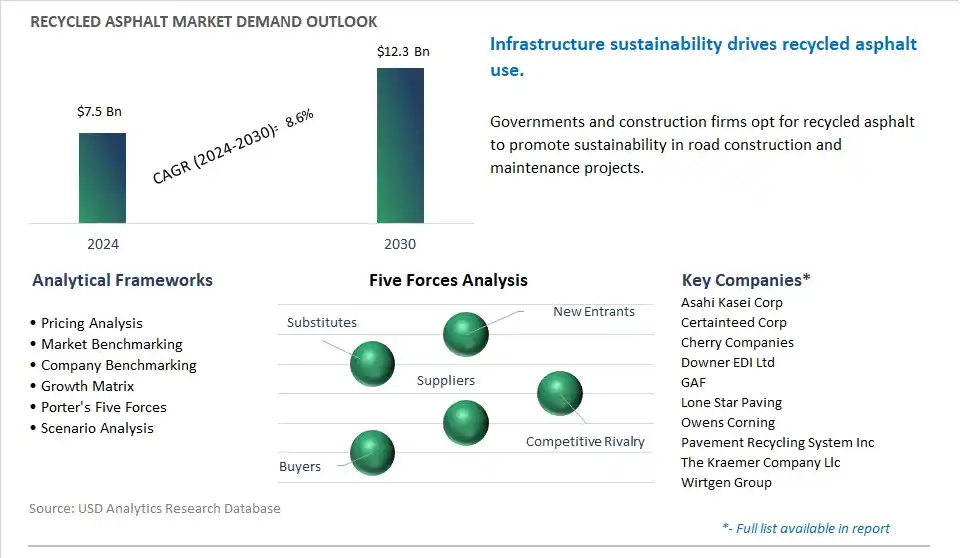
Recycled Asphalt Market Competitive Landscape
The market report analyses the leading companies in the industry including Asahi Kasei Corp, Certainteed Corp, Cherry Companies, Downer EDI Ltd, GAF, Lone Star Paving, Owens Corning, Pavement Recycling System Inc, The Kraemer Company Llc, Wirtgen Group.
Recycled Asphalt Market Dynamics
Recycled Asphalt Market Trend: Increased Adoption of Sustainable Infrastructure Solutions
One prominent trend in the recycled asphalt market is the increased adoption of sustainable infrastructure solutions. With growing concerns about environmental sustainability and the need to reduce carbon emissions, there is a rising demand for recycled asphalt in road construction and maintenance projects. Recycled asphalt offers several environmental benefits, including the conservation of natural resources, reduction of landfill waste, and lower greenhouse gas emissions compared to conventional asphalt production. Moreover, the use of recycled asphalt helps to mitigate the environmental impact of road construction activities by promoting the reuse of existing materials and minimizing the extraction and transportation of virgin aggregates. This is driven by government initiatives promoting sustainable infrastructure development, as well as the adoption of green building standards and certifications that prioritize the use of recycled materials in construction projects.
Recycled Asphalt Market Driver: Cost Savings and Economic Benefits for Pavement Owners
The primary driver fueling the demand for recycled asphalt is the cost savings and economic benefits it offers to pavement owners and road agencies. Recycled asphalt typically costs less than virgin asphalt due to reduced material and transportation expenses, making it an attractive option for budget-conscious agencies and contractors. By using recycled asphalt in pavement rehabilitation and resurfacing projects, pavement owners can achieve significant cost savings while maintaining or improving the performance and longevity of road surfaces. Additionally, the use of recycled asphalt allows for faster construction timelines and reduced disruption to traffic, leading to lower project costs and improved efficiency. The driver is propelled by factors such as limited budgets for infrastructure maintenance, aging road networks requiring rehabilitation, and the need to optimize resources and maximize the value of existing asphalt materials.
Recycled Asphalt Market Opportunity: Development of High-Quality Recycled Asphalt Mixtures
An attractive opportunity for the recycled asphalt market lies in the development of high-quality recycled asphalt mixtures that meet or exceed performance specifications for road construction applications. While recycled asphalt offers environmental and economic benefits, challenges remain in achieving consistent quality and performance in recycled asphalt pavements. Opportunities exist to innovate and optimize asphalt recycling processes, including asphalt milling, crushing, and blending, to produce recycled asphalt mixtures with superior properties such as durability, stability, and resistance to rutting and cracking. By investing in research and development, as well as quality control measures, manufacturers and contractors can overcome technical barriers and demonstrate the viability of recycled asphalt as a reliable and high-performance paving material. This opportunity allows for differentiation, value creation, and market leadership in the competitive landscape of recycled asphalt, positioning companies as providers of sustainable and cost-effective solutions for road infrastructure projects.
Recycled Asphalt Market Share Analysis: Hot Recycling generated the highest revenue in 2024
In the domain of the recycled asphalt market, hot recycling is the largest segment, driven by Diverse critical factors. Hot recycling involves reheating reclaimed asphalt pavement (RAP) materials to high temperatures and combining them with new asphalt binder to produce recycled asphalt mixtures. This method offers potential advantages over cold recycling, including superior blending of RAP materials with fresh asphalt, resulting in improved performance and durability of the recycled asphalt pavement. Additionally, hot recycling allows for greater flexibility in asphalt mix design and quality control, enabling pavement engineers to tailor the recycled asphalt mixture to specific project requirements. Furthermore, the widespread availability of hot mix asphalt plants and established infrastructure for hot recycling processes contribute to the dominance of this segment in the market. As infrastructure development projects and road maintenance initiatives continue to drive demand for sustainable pavement solutions, hot recycling is expected to maintain its leading position in the recycled asphalt market, serving as a cornerstone of sustainable pavement practices worldwide.
Recycled Asphalt Market Share Analysis: Interlocking Bricks segment is poised to register the fastest growth rate (CAGR) over the forecast period to 2030
Among the segments in the recycled asphalt market, interlocking bricks emerge as the fastest-growing segment. Interlocking bricks made from recycled asphalt offer a sustainable alternative to traditional paving materials such as concrete or clay bricks. These bricks are manufactured using a combination of reclaimed asphalt pavement (RAP) materials and binding agents, resulting in durable and environmentally friendly paving solutions. The growing trend towards sustainable construction practices, coupled with increasing awareness of the benefits of recycled materials, has spurred the demand for interlocking bricks in various applications, including pedestrian walkways, driveways, and landscaping projects. Further, interlocking bricks provide excellent permeability, allowing for efficient water drainage and minimizing the risk of flooding or erosion. As municipalities, homeowners, and commercial developers seek cost-effective and eco-friendly paving solutions, the demand for interlocking bricks made from recycled asphalt is expected to continue its rapid growth trajectory, driving significant expansion in this market segment.
Recycled Asphalt Market Report Segmentation
By Type
Hot Recycling
Cold Recycling
By Application
Patch Material
Hot-mix Asphalt
Temporary Driveways & Roads
Road Aggregate for Unpaved Roadways
Interlocking Bricks
New Asphalt Shingles
Energy Recovery
Regions Included
North America (US, Canada, Mexico)
Europe (Germany, UK, France, Spain, Italy, Russia, Rest of Europe)
Asia Pacific (China, India, Japan, South Korea, Australia, South East Asia, Rest of Asia)
South America (Brazil, Argentina, Rest of South America)
Middle East and Africa (Saudi Arabia, UAE, Rest of Middle East, South Africa, Egypt, Rest of Africa)
Recycled Asphalt Companies Profiled in the Market Study
Asahi Kasei Corp
Certainteed Corp
Cherry Companies
Downer EDI Ltd
GAF
Lone Star Paving
Owens Corning
Pavement Recycling System Inc
The Kraemer Company Llc
Wirtgen Group
*- List Not Exhaustive
TABLE OF CONTENTS
1 Introduction to 2024 Recycled Asphalt Market
1.1 Market Overview
1.2 Quick Facts
1.3 Scope/Objective of the Study
1.4 Market Definition
1.5 Countries and Regions Covered
1.6 Units, Currency, and Conversions
1.7 Industry Value Chain
2 Research Methodology
2.1 Market Size Estimation
2.2 Sources and Research Methodology
2.3 Data Triangulation
2.4 Assumptions and Limitations
3 Executive Summary
3.1 Global Recycled Asphalt Market Size Outlook, $ Million, 2021 to 2030
3.2 Recycled Asphalt Market Outlook by Type, $ Million, 2021 to 2030
3.3 Recycled Asphalt Market Outlook by Product, $ Million, 2021 to 2030
3.4 Recycled Asphalt Market Outlook by Application, $ Million, 2021 to 2030
3.5 Recycled Asphalt Market Outlook by Key Countries, $ Million, 2021 to 2030
4 Market Dynamics
4.1 Key Driving Forces of Recycled Asphalt Industry
4.2 Key Market Trends in Recycled Asphalt Industry
4.3 Potential Opportunities in Recycled Asphalt Industry
4.4 Key Challenges in Recycled Asphalt Industry
5 Market Factor Analysis
5.1 Value Chain Analysis
5.2 Competitive Landscape
5.2.1 Global Recycled Asphalt Market Share by Company (%), 2023
5.2.2 Product Offerings by Company
5.3 Porter’s Five Forces Analysis
5.4 Pricing Analysis and Outlook
6 Growth Outlook Across Scenarios
6.1 Growth Analysis-Case Scenario Definitions
6.2 Low Growth Scenario Forecasts
6.3 Reference Growth Scenario Forecasts
6.4 High Growth Scenario Forecasts
7 Global Recycled Asphalt Market Outlook by Segments
7.1 Recycled Asphalt Market Outlook by Segments, $ Million, 2021- 2030
By Type
Hot Recycling
Cold Recycling
By Application
Patch Material
Hot-mix Asphalt
Temporary Driveways & Roads
Road Aggregate for Unpaved Roadways
Interlocking Bricks
New Asphalt Shingles
Energy Recovery
8 North America Recycled Asphalt Market Analysis and Outlook To 2030
8.1 Introduction to North America Recycled Asphalt Markets in 2024
8.2 North America Recycled Asphalt Market Size Outlook by Country, 2021-2030
8.2.1 United States
8.2.2 Canada
8.2.3 Mexico
8.3 North America Recycled Asphalt Market size Outlook by Segments, 2021-2030
By Type
Hot Recycling
Cold Recycling
By Application
Patch Material
Hot-mix Asphalt
Temporary Driveways & Roads
Road Aggregate for Unpaved Roadways
Interlocking Bricks
New Asphalt Shingles
Energy Recovery
9 Europe Recycled Asphalt Market Analysis and Outlook To 2030
9.1 Introduction to Europe Recycled Asphalt Markets in 2024
9.2 Europe Recycled Asphalt Market Size Outlook by Country, 2021-2030
9.2.1 Germany
9.2.2 France
9.2.3 Spain
9.2.4 United Kingdom
9.2.4 Italy
9.2.5 Russia
9.2.6 Norway
9.2.7 Rest of Europe
9.3 Europe Recycled Asphalt Market Size Outlook by Segments, 2021-2030
By Type
Hot Recycling
Cold Recycling
By Application
Patch Material
Hot-mix Asphalt
Temporary Driveways & Roads
Road Aggregate for Unpaved Roadways
Interlocking Bricks
New Asphalt Shingles
Energy Recovery
10 Asia Pacific Recycled Asphalt Market Analysis and Outlook To 2030
10.1 Introduction to Asia Pacific Recycled Asphalt Markets in 2024
10.2 Asia Pacific Recycled Asphalt Market Size Outlook by Country, 2021-2030
10.2.1 China
10.2.2 India
10.2.3 Japan
10.2.4 South Korea
10.2.5 Indonesia
10.2.6 Malaysia
10.2.7 Australia
10.2.8 Rest of Asia Pacific
10.3 Asia Pacific Recycled Asphalt Market size Outlook by Segments, 2021-2030
By Type
Hot Recycling
Cold Recycling
By Application
Patch Material
Hot-mix Asphalt
Temporary Driveways & Roads
Road Aggregate for Unpaved Roadways
Interlocking Bricks
New Asphalt Shingles
Energy Recovery
11 South America Recycled Asphalt Market Analysis and Outlook To 2030
11.1 Introduction to South America Recycled Asphalt Markets in 2024
11.2 South America Recycled Asphalt Market Size Outlook by Country, 2021-2030
11.2.1 Brazil
11.2.2 Argentina
11.2.3 Rest of South America
11.3 South America Recycled Asphalt Market size Outlook by Segments, 2021-2030
By Type
Hot Recycling
Cold Recycling
By Application
Patch Material
Hot-mix Asphalt
Temporary Driveways & Roads
Road Aggregate for Unpaved Roadways
Interlocking Bricks
New Asphalt Shingles
Energy Recovery
12 Middle East and Africa Recycled Asphalt Market Analysis and Outlook To 2030
12.1 Introduction to Middle East and Africa Recycled Asphalt Markets in 2024
12.2 Middle East and Africa Recycled Asphalt Market Size Outlook by Country, 2021-2030
12.2.1 Saudi Arabia
12.2.2 UAE
12.2.3 Oman
12.2.4 Rest of Middle East
12.2.5 Egypt
12.2.6 Nigeria
12.2.7 South Africa
12.2.8 Rest of Africa
12.3 Middle East and Africa Recycled Asphalt Market size Outlook by Segments, 2021-2030
By Type
Hot Recycling
Cold Recycling
By Application
Patch Material
Hot-mix Asphalt
Temporary Driveways & Roads
Road Aggregate for Unpaved Roadways
Interlocking Bricks
New Asphalt Shingles
Energy Recovery
13 Company Profiles
13.1 Company Snapshot
13.2 SWOT Profiles
13.3 Products and Services
13.4 Recent Developments
13.5 Financial Profile
Asahi Kasei Corp
Certainteed Corp
Cherry Companies
Downer EDI Ltd
GAF
Lone Star Paving
Owens Corning
Pavement Recycling System Inc
The Kraemer Company Llc
Wirtgen Group
14 Appendix
14.1 Customization Offerings
14.2 Subscription Services
14.3 Related Reports
14.4 Publisher Expertise
By Type
Hot Recycling
Cold Recycling
By Application
Patch Material
Hot-mix Asphalt
Temporary Driveways & Roads
Road Aggregate for Unpaved Roadways
Interlocking Bricks
New Asphalt Shingles
Energy Recovery
Countries Analyzed
North America (US, Canada, Mexico)
Europe (Germany, UK, France, Spain, Italy, Russia, Rest of Europe)
Asia Pacific (China, India, Japan, South Korea, Australia, South East Asia, Rest of Asia)
South America (Brazil, Argentina, Rest of South America)
Middle East and Africa (Saudi Arabia, UAE, Rest of Middle East, South Africa, Egypt, Rest of Africa)
