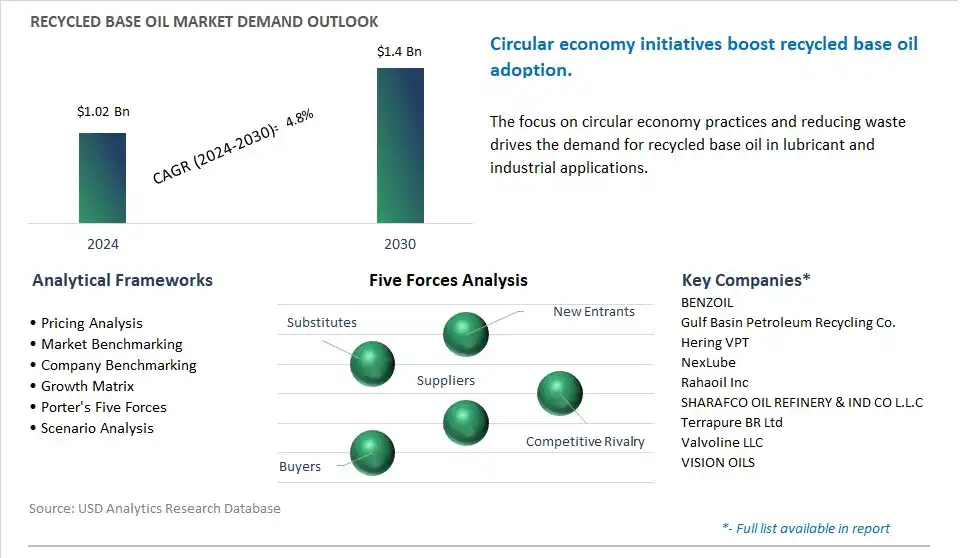
The global Recycled Base Oil Market is poised to register a 4.8% CAGR from $1.02 Billion in 2024 to $1.4 Billion in 2030.
The global Recycled Base Oil Market Study analyzes and forecasts the market size across 6 regions and 24 countries for diverse segments -By Type (High Viscosity Recycled Base Oil, Medium Viscosity Recycled Base Oil, Low Viscosity Recycled Base Oil), By Application (Automotive Oil, Industrial Oil, Metalworking Fluids, Others).
An Introduction to Global Recycled Base Oil Market in 2024
The future of the recycled base oil market is influenced by key trends such as resource conservation, circular economy initiatives, and regulatory compliance. Recycled base oil, produced from used lubricating oils through re-refining processes, offers environmental and economic benefits compared to virgin base oil production, including reduced energy consumption, greenhouse gas emissions, and waste generation. As industries and governments increasingly prioritize resource conservation and waste reduction, there is a growing demand for recycled base oil as a sustainable alternative to virgin base oil in lubricant manufacturing and industrial applications. Moreover, circular economy initiatives drive the adoption of recycled base oil in various industries such as automotive, transportation, manufacturing, and power generation, where lubricants play a critical role in equipment performance and reliability. Additionally, regulatory requirements governing waste management, hazardous materials, and environmental protection impact the market dynamics and adoption of recycled base oil, driving the need for compliant and environmentally responsible solutions. As industries seek to minimize environmental impact, optimize resource utilization, and meet regulatory requirements, the recycled base oil market will continue to grow and evolve as a key contributor to sustainable lubricant supply chains and circular economy principles.
Recycled Base Oil Market Competitive Landscape
The market report analyses the leading companies in the industry including BENZOIL, Gulf Basin Petroleum Recycling Co., Hering VPT, NexLube, Rahaoil Inc, SHARAFCO OIL REFINERY & IND CO L.L.C, Terrapure BR Ltd, Valvoline LLC, VISION OILS.
Recycled Base Oil Market Dynamics
Recycled Base Oil Market Trend: Growing Demand for Environmentally Friendly Lubricants
One prominent trend in the recycled base oil market is the growing demand for environmentally friendly lubricants. With increasing awareness of environmental conservation and sustainability, there is a rising preference for lubricants derived from recycled base oils among industries such as automotive, manufacturing, and machinery. Recycled base oils offer several environmental benefits, including reduced carbon emissions, conservation of natural resources, and diversion of used oil from landfills. Moreover, the use of recycled base oils aligns with corporate sustainability goals and regulatory requirements for reducing the environmental impact of industrial operations. This is driven by the need to minimize environmental footprint, improve air quality, and enhance corporate social responsibility, fostering a transition towards the adoption of eco-friendly lubrication solutions in various applications.
Recycled Base Oil Market Driver: Cost-Effective Alternative to Virgin Base Oils
The primary driver fueling the demand for recycled base oil is its cost-effectiveness as an alternative to virgin base oils. Recycled base oils are typically available at lower prices compared to virgin oils, making them an attractive option for businesses seeking to reduce operating costs without compromising on performance. By utilizing recycled base oils in lubricant formulations, industries can achieve significant cost savings while maintaining lubrication efficiency and equipment reliability. Additionally, the use of recycled base oils helps to minimize dependence on finite fossil fuel resources and reduce the need for new oil production, contributing to resource conservation and energy efficiency. The driver is propelled by factors such as volatile oil prices, economic pressures on businesses, and the need to optimize resource utilization and mitigate price fluctuations in the lubricants market.
Recycled Base Oil Market Opportunity: Expansion into Niche Markets and Specialized Applications
An attractive opportunity for the recycled base oil market lies in the expansion into niche markets and specialized applications where recycled lubricants can offer unique advantages. While recycled base oils are commonly used in general industrial lubrication, there is potential to target specific industries and applications that require specialized lubrication solutions. Opportunities exist in sectors such as renewable energy, marine, aviation, and food processing, where stringent performance requirements, environmental regulations, and safety standards drive demand for high-quality lubricants with tailored properties. By developing customized formulations and certifications for niche markets, manufacturers of recycled base oil can address specific customer needs, differentiate their products from competitors, and capture market share in lucrative segments. This opportunity allows for diversification, value creation, and market expansion in the competitive landscape of recycled base oils, positioning companies as providers of sustainable lubrication solutions for diverse industries and applications.
Recycled Base Oil Market Share Analysis: Low Viscosity Recycled Base Oil generated the highest revenue in 2024
In the realm of the recycled base oil market, low viscosity recycled base oil is the largest segment, owing to Diverse pivotal factors. Low viscosity recycled base oil finds extensive application across various industries, including automotive, industrial lubricants, and metalworking fluids, due to its versatility and compatibility with a wide range of machinery and equipment. Further, low viscosity base oils offer excellent thermal and oxidative stability, which are essential properties for lubricants operating under high-temperature conditions. Additionally, the demand for low viscosity recycled base oil is bolstered by its cost-effectiveness compared to virgin base oils, making it an attractive option for manufacturers seeking to reduce production costs without compromising on quality. As industries worldwide increasingly prioritize sustainability and environmental stewardship, the demand for recycled base oils, particularly low viscosity variants, is expected to continue its robust growth trajectory, solidifying its position as the largest segment in the market.
Recycled Base Oil Market Share Analysis: Metalworking Fluids segment is poised to register the fastest growth rate (CAGR) over the forecast period to 2030
Among the segments in the recycled base oil market, metalworking fluids emerge as the fastest-growing segment. Metalworking fluids play a crucial role in machining, grinding, and forming processes across various industries, including automotive, aerospace, and manufacturing. Recycled base oils offer a sustainable and cost-effective solution for formulating metalworking fluids, providing lubrication, cooling, and corrosion protection to machining operations. With increasing regulatory pressures to minimize environmental impact and reduce waste generation, industries are increasingly turning to recycled base oils as a viable alternative to virgin oils in metalworking fluid formulations. Additionally, the superior performance and compatibility of recycled base oils with additives further enhance their appeal in metalworking applications. As manufacturers strive to achieve operational efficiency and environmental sustainability goals, the demand for recycled base oils in metalworking fluids is expected to experience rapid growth, positioning it as a key driver of market expansion in the foreseeable future.
Recycled Base Oil Market Report Segmentation
By Type
High Viscosity Recycled Base Oil
Medium Viscosity Recycled Base Oil
Low Viscosity Recycled Base Oil
By Application
Automotive Oil
Industrial Oil
Metalworking Fluids
Others
Regions Included
North America (US, Canada, Mexico)
Europe (Germany, UK, France, Spain, Italy, Russia, Rest of Europe)
Asia Pacific (China, India, Japan, South Korea, Australia, South East Asia, Rest of Asia)
South America (Brazil, Argentina, Rest of South America)
Middle East and Africa (Saudi Arabia, UAE, Rest of Middle East, South Africa, Egypt, Rest of Africa)
Recycled Base Oil Companies Profiled in the Market Study
BENZOIL
Gulf Basin Petroleum Recycling Co.
Hering VPT
NexLube
Rahaoil Inc
SHARAFCO OIL REFINERY & IND CO L.L.C
Terrapure BR Ltd
Valvoline LLC
VISION OILS
*- List Not Exhaustive
TABLE OF CONTENTS
1 Introduction to 2024 Recycled Base Oil Market
1.1 Market Overview
1.2 Quick Facts
1.3 Scope/Objective of the Study
1.4 Market Definition
1.5 Countries and Regions Covered
1.6 Units, Currency, and Conversions
1.7 Industry Value Chain
2 Research Methodology
2.1 Market Size Estimation
2.2 Sources and Research Methodology
2.3 Data Triangulation
2.4 Assumptions and Limitations
3 Executive Summary
3.1 Global Recycled Base Oil Market Size Outlook, $ Million, 2021 to 2030
3.2 Recycled Base Oil Market Outlook by Type, $ Million, 2021 to 2030
3.3 Recycled Base Oil Market Outlook by Product, $ Million, 2021 to 2030
3.4 Recycled Base Oil Market Outlook by Application, $ Million, 2021 to 2030
3.5 Recycled Base Oil Market Outlook by Key Countries, $ Million, 2021 to 2030
4 Market Dynamics
4.1 Key Driving Forces of Recycled Base Oil Industry
4.2 Key Market Trends in Recycled Base Oil Industry
4.3 Potential Opportunities in Recycled Base Oil Industry
4.4 Key Challenges in Recycled Base Oil Industry
5 Market Factor Analysis
5.1 Value Chain Analysis
5.2 Competitive Landscape
5.2.1 Global Recycled Base Oil Market Share by Company (%), 2023
5.2.2 Product Offerings by Company
5.3 Porter’s Five Forces Analysis
5.4 Pricing Analysis and Outlook
6 Growth Outlook Across Scenarios
6.1 Growth Analysis-Case Scenario Definitions
6.2 Low Growth Scenario Forecasts
6.3 Reference Growth Scenario Forecasts
6.4 High Growth Scenario Forecasts
7 Global Recycled Base Oil Market Outlook by Segments
7.1 Recycled Base Oil Market Outlook by Segments, $ Million, 2021- 2030
By Type
High Viscosity Recycled Base Oil
Medium Viscosity Recycled Base Oil
Low Viscosity Recycled Base Oil
By Application
Automotive Oil
Industrial Oil
Metalworking Fluids
Others
8 North America Recycled Base Oil Market Analysis and Outlook To 2030
8.1 Introduction to North America Recycled Base Oil Markets in 2024
8.2 North America Recycled Base Oil Market Size Outlook by Country, 2021-2030
8.2.1 United States
8.2.2 Canada
8.2.3 Mexico
8.3 North America Recycled Base Oil Market size Outlook by Segments, 2021-2030
By Type
High Viscosity Recycled Base Oil
Medium Viscosity Recycled Base Oil
Low Viscosity Recycled Base Oil
By Application
Automotive Oil
Industrial Oil
Metalworking Fluids
Others
9 Europe Recycled Base Oil Market Analysis and Outlook To 2030
9.1 Introduction to Europe Recycled Base Oil Markets in 2024
9.2 Europe Recycled Base Oil Market Size Outlook by Country, 2021-2030
9.2.1 Germany
9.2.2 France
9.2.3 Spain
9.2.4 United Kingdom
9.2.4 Italy
9.2.5 Russia
9.2.6 Norway
9.2.7 Rest of Europe
9.3 Europe Recycled Base Oil Market Size Outlook by Segments, 2021-2030
By Type
High Viscosity Recycled Base Oil
Medium Viscosity Recycled Base Oil
Low Viscosity Recycled Base Oil
By Application
Automotive Oil
Industrial Oil
Metalworking Fluids
Others
10 Asia Pacific Recycled Base Oil Market Analysis and Outlook To 2030
10.1 Introduction to Asia Pacific Recycled Base Oil Markets in 2024
10.2 Asia Pacific Recycled Base Oil Market Size Outlook by Country, 2021-2030
10.2.1 China
10.2.2 India
10.2.3 Japan
10.2.4 South Korea
10.2.5 Indonesia
10.2.6 Malaysia
10.2.7 Australia
10.2.8 Rest of Asia Pacific
10.3 Asia Pacific Recycled Base Oil Market size Outlook by Segments, 2021-2030
By Type
High Viscosity Recycled Base Oil
Medium Viscosity Recycled Base Oil
Low Viscosity Recycled Base Oil
By Application
Automotive Oil
Industrial Oil
Metalworking Fluids
Others
11 South America Recycled Base Oil Market Analysis and Outlook To 2030
11.1 Introduction to South America Recycled Base Oil Markets in 2024
11.2 South America Recycled Base Oil Market Size Outlook by Country, 2021-2030
11.2.1 Brazil
11.2.2 Argentina
11.2.3 Rest of South America
11.3 South America Recycled Base Oil Market size Outlook by Segments, 2021-2030
By Type
High Viscosity Recycled Base Oil
Medium Viscosity Recycled Base Oil
Low Viscosity Recycled Base Oil
By Application
Automotive Oil
Industrial Oil
Metalworking Fluids
Others
12 Middle East and Africa Recycled Base Oil Market Analysis and Outlook To 2030
12.1 Introduction to Middle East and Africa Recycled Base Oil Markets in 2024
12.2 Middle East and Africa Recycled Base Oil Market Size Outlook by Country, 2021-2030
12.2.1 Saudi Arabia
12.2.2 UAE
12.2.3 Oman
12.2.4 Rest of Middle East
12.2.5 Egypt
12.2.6 Nigeria
12.2.7 South Africa
12.2.8 Rest of Africa
12.3 Middle East and Africa Recycled Base Oil Market size Outlook by Segments, 2021-2030
By Type
High Viscosity Recycled Base Oil
Medium Viscosity Recycled Base Oil
Low Viscosity Recycled Base Oil
By Application
Automotive Oil
Industrial Oil
Metalworking Fluids
Others
13 Company Profiles
13.1 Company Snapshot
13.2 SWOT Profiles
13.3 Products and Services
13.4 Recent Developments
13.5 Financial Profile
BENZOIL
Gulf Basin Petroleum Recycling Co.
Hering VPT
NexLube
Rahaoil Inc
SHARAFCO OIL REFINERY & IND CO L.L.C
Terrapure BR Ltd
Valvoline LLC
VISION OILS
14 Appendix
14.1 Customization Offerings
14.2 Subscription Services
14.3 Related Reports
14.4 Publisher Expertise
By Type
High Viscosity Recycled Base Oil
Medium Viscosity Recycled Base Oil
Low Viscosity Recycled Base Oil
By Application
Automotive Oil
Industrial Oil
Metalworking Fluids
Others
Countries Analyzed
North America (US, Canada, Mexico)
Europe (Germany, UK, France, Spain, Italy, Russia, Rest of Europe)
Asia Pacific (China, India, Japan, South Korea, Australia, South East Asia, Rest of Asia)
South America (Brazil, Argentina, Rest of South America)
Middle East and Africa (Saudi Arabia, UAE, Rest of Middle East, South Africa, Egypt, Rest of Africa)
