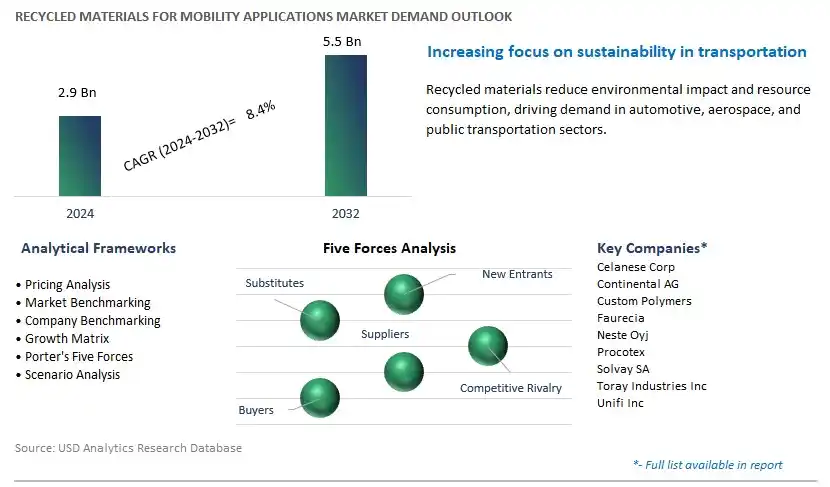
Global Recycled Materials for Mobility Applications Market Size is valued at $2.9 Billion in 2024 and is forecast to register a growth rate (CAGR) of 8.4% to reach $5.5 Billion by 2032.
The global Recycled Materials for Mobility Applications Market Study analyzes and forecasts the market size across 6 regions and 24 countries for diverse segments -By Material (Polymer Materials, Composites, Others), By Vehicle (Passenger Cars, Commercial Vehicles), By Component (Interiors, Exteriors, Others), By Application (OEMs, AfterMarket).
An Introduction to Recycled Materials for Mobility Applications Market in 2024
In 2024, the market for recycled materials for mobility applications is experiencing significant growth driven by the automotive industry's commitment to sustainability, circular economy principles, and carbon footprint reduction targets. Recycled materials for mobility applications encompass a wide range of materials derived from post-consumer and post-industrial sources, including plastics, metals, textiles, and composites, used in the production of vehicles, components, and infrastructure. Automakers are increasingly incorporating recycled materials into vehicle interiors, exteriors, and under-the-hood components to reduce environmental impact, conserve natural resources, and meet consumer demand for eco-friendly products. Recycled plastics, in particular, are gaining traction in automotive applications such as bumpers, panels, and interior trim, benefiting from advancements in material processing, performance, and regulatory compliance. Further, recycled metals and composites are utilized in vehicle lightweighting initiatives, contributing to fuel efficiency improvements and emissions reductions. Additionally, the transportation infrastructure sector is embracing recycled materials for road construction, signage, and traffic management systems, supporting sustainability goals and infrastructure resilience. With advancements in material recycling technologies, supply chain collaboration, and consumer awareness, the market for recycled materials for mobility applications is poised for d expansion, driven by innovations in material sourcing, processing, and end-use applications.
Recycled Materials for Mobility Applications Market Competitive Landscape
The market report analyses the leading companies in the industry including Celanese Corp, Continental AG, Custom Polymers, Faurecia, Neste Oyj, Procotex, Solvay SA, Toray Industries Inc, Unifi Inc, and others.
Recycled Materials for Mobility Applications Market Dynamics
Market Trend: Growing Demand for Sustainable Mobility Solutions
One prominent market trend in recycled materials for mobility applications is the growing demand for sustainable mobility solutions. With increasing awareness of climate change and environmental sustainability, there is a rising preference for eco-friendly materials in the automotive, aerospace, and transportation industries. Recycled materials offer a sustainable alternative to virgin materials, reducing energy consumption, greenhouse gas emissions, and resource depletion associated with conventional manufacturing processes. As a result, there is a growing adoption of recycled materials in mobility applications, driven by regulatory mandates, consumer preferences, and corporate sustainability goals.
Market Driver: Regulatory Pressure and Emission Reduction Goals
A key market driver for recycled materials in mobility applications is regulatory pressure and emission reduction goals set by governments and international organizations. With stringent emissions standards and regulations aimed at curbing air pollution and carbon emissions, automakers, aerospace companies, and transportation providers are under pressure to reduce the environmental impact of their operations. Recycled materials offer a viable solution to meet these regulatory requirements by reducing the carbon footprint of mobility applications while maintaining performance and safety standards. The need to comply with emissions regulations and achieve sustainability targets is driving the adoption of recycled materials across the mobility sector.
Market Opportunity: Collaboration Across the Value Chain
An emerging opportunity in the recycled materials for mobility applications market lies in collaboration across the value chain. To maximize the potential of recycled materials and address the technical, logistical, and economic challenges associated with their adoption, stakeholders across the mobility industry need to collaborate closely. This includes partnerships between material suppliers, manufacturers, OEMs, research institutions, and regulatory bodies to develop innovative recycling technologies, establish robust supply chains, and ensure product quality and safety standards. By working together to overcome barriers and leverage synergies, stakeholders can unlock new opportunities for the widespread adoption of recycled materials in mobility applications, driving sustainability and innovation in the industry.
Recycled Materials for Mobility Applications Market Share Analysis: Polymer Materials segment generated the highest revenue in 2024
The polymer materials segment is the largest segment within the Recycled Materials for Mobility Applications market. Polymer materials find extensive use in various mobility applications, including automotive, aerospace, marine, and rail industries, due to their lightweight, durability, and versatility. With the increasing emphasis on sustainability and environmental responsibility across these sectors, there's a growing demand for recycled polymer materials to reduce reliance on virgin resources and minimize environmental impact. Recycled polymer materials offer comparable performance to their virgin counterparts while significantly reducing carbon emissions and waste generation. Additionally, advancements in recycling technologies and government regulations promoting the use of recycled materials further drive the adoption of recycled polymer materials in mobility applications. As industries strive to achieve sustainability goals and meet stringent regulatory requirements, the polymer materials segment is expected to maintain its dominance and witness sustained growth in the recycled materials for mobility applications market. Moreover, collaborations between manufacturers, recyclers, and policymakers to develop innovative recycling solutions and improve material circularity are anticipated to further propel the growth of the polymer materials segment in the coming years.
Recycled Materials for Mobility Applications Market Share Analysis: Commercial Vehicles is poised to register the fastest CAGR over the forecast period
The commercial vehicles segment is the fastest-growing segment within the Recycled Materials for Mobility Applications market. Commercial vehicles, including trucks, buses, and vans, experience higher wear and tear compared to passenger cars due to their frequent use and heavy-duty operations. Consequently, there's a substantial demand for durable and cost-effective materials to maintain and manufacture commercial vehicles. Recycled materials offer an attractive solution, providing comparable performance to virgin materials at a lower cost, while also contributing to environmental sustainability by reducing carbon footprint and waste generation. Moreover, government initiatives promoting the adoption of recycled materials in commercial vehicle manufacturing, coupled with increasing awareness among fleet operators about the benefits of sustainable practices, further accelerate the growth of the recycled materials market in this segment. As commercial vehicle manufacturers increasingly prioritize sustainability and cost-efficiency in their operations, the demand for recycled materials for mobility applications, particularly in the commercial vehicles segment, is expected to witness significant growth in the foreseeable future. Additionally, advancements in recycling technologies and material innovation are anticipated to further drive the adoption of recycled materials in commercial vehicle manufacturing, solidifying the segment's position as a key driver of growth in the market.
Recycled Materials for Mobility Applications Market Share Analysis: Interiors Component segment generated the highest revenue in 2024
The interiors component segment stands out as the largest segment within the Recycled Materials for Mobility Applications market. Interiors components, including seats, dashboards, door panels, and upholstery, represent a significant portion of a vehicle's overall material composition. As automotive manufacturers increasingly prioritize sustainability and environmental responsibility, there's a growing demand for recycled materials to be used in interior components. Recycled materials offer a sustainable alternative to virgin materials, contributing to reduced carbon emissions and waste generation throughout the vehicle's lifecycle. Moreover, advancements in recycling technologies have enabled the production of high-quality recycled materials that meet the stringent performance and safety standards required for automotive interiors. Additionally, consumer preferences for eco-friendly products and regulatory mandates promoting the use of recycled materials further drive the adoption of recycled materials in vehicle interiors. As automotive manufacturers continue to innovate and invest in sustainable materials, the interiors component segment is poised to maintain its dominance in the recycled materials for mobility applications market, driving substantial growth in the coming years.
Recycled Materials for Mobility Applications Market Share Analysis: Aftermarket Application is poised to register the fastest CAGR over the forecast period
The aftermarket application segment is the fastest-growing segment within the Recycled Materials for Mobility Applications market. The aftermarket segment encompasses the replacement and repair of vehicle components and materials after the original purchase. As vehicle owners and fleet operators increasingly prioritize cost-efficiency and sustainability, there's a growing demand for recycled materials in aftermarket applications. Recycled materials offer a cost-effective alternative to virgin materials, enabling vehicle owners to reduce maintenance and repair costs while also contributing to environmental sustainability by minimizing waste and resource consumption. Moreover, the aftermarket segment benefits from the growing popularity of DIY (do-it-yourself) repairs and upgrades, where consumers actively seek affordable and eco-friendly alternatives to OEM (original equipment manufacturer) parts. Additionally, government regulations promoting the use of recycled materials in automotive repair and maintenance further drive the adoption of recycled materials in the aftermarket segment. As consumers and businesses alike embrace sustainable practices and seek cost-effective solutions for vehicle maintenance and repair, the aftermarket application segment is expected to witness significant growth in the recycled materials for mobility applications market.
Recycled Materials for Mobility Applications Market
By Material
Polymer Materials
Composites
Others
By Vehicle
Passenger Cars
Commercial Vehicles
By Component
Interiors
Exteriors
Others
By Application
OEMs
AfterMarketCountries Analyzed
North America (US, Canada, Mexico)
Europe (Germany, UK, France, Spain, Italy, Russia, Rest of Europe)
Asia Pacific (China, India, Japan, South Korea, Australia, South East Asia, Rest of Asia)
South America (Brazil, Argentina, Rest of South America)
Middle East and Africa (Saudi Arabia, UAE, Rest of Middle East, South Africa, Egypt, Rest of Africa)
Recycled Materials for Mobility Application Companies Profiled in the Study
Celanese Corp
Continental AG
Custom Polymers
Faurecia
Neste Oyj
Procotex
Solvay SA
Toray Industries Inc
Unifi Inc
*- List Not Exhaustive
TABLE OF CONTENTS
1 Introduction to 2024 Recycled Materials for Mobility Application Market
1.1 Market Overview
1.2 Quick Facts
1.3 Scope/Objective of the Study
1.4 Market Definition
1.5 Countries and Regions Covered
1.6 Units, Currency, and Conversions
1.7 Industry Value Chain
2 Research Methodology
2.1 Market Size Estimation
2.2 Sources and Research Methodology
2.3 Data Triangulation
2.4 Assumptions and Limitations
3 Executive Summary
3.1 Global Recycled Materials for Mobility Application Market Size Outlook, $ Million, 2021 to 2032
3.2 Recycled Materials for Mobility Application Market Outlook by Type, $ Million, 2021 to 2032
3.3 Recycled Materials for Mobility Application Market Outlook by Product, $ Million, 2021 to 2032
3.4 Recycled Materials for Mobility Application Market Outlook by Application, $ Million, 2021 to 2032
3.5 Recycled Materials for Mobility Application Market Outlook by Key Countries, $ Million, 2021 to 2032
4 Market Dynamics
4.1 Key Driving Forces of Recycled Materials for Mobility Application Industry
4.2 Key Market Trends in Recycled Materials for Mobility Application Industry
4.3 Potential Opportunities in Recycled Materials for Mobility Application Industry
4.4 Key Challenges in Recycled Materials for Mobility Application Industry
5 Market Factor Analysis
5.1 Value Chain Analysis
5.2 Competitive Landscape
5.2.1 Global Recycled Materials for Mobility Application Market Share by Company (%), 2023
5.2.2 Product Offerings by Company
5.3 Porter’s Five Forces Analysis
5.4 Pricing Analysis and Outlook
6 Growth Outlook Across Scenarios
6.1 Growth Analysis-Case Scenario Definitions
6.2 Low Growth Scenario Forecasts
6.3 Reference Growth Scenario Forecasts
6.4 High Growth Scenario Forecasts
7 Global Recycled Materials for Mobility Application Market Outlook by Segments
7.1 Recycled Materials for Mobility Application Market Outlook by Segments, $ Million, 2021- 2032
By Material
Polymer Materials
Composites
Others
By Vehicle
Passenger Cars
Commercial Vehicles
By Component
Interiors
Exteriors
Others
By Application
OEMs
AfterMarket
8 North America Recycled Materials for Mobility Application Market Analysis and Outlook To 2032
8.1 Introduction to North America Recycled Materials for Mobility Application Markets in 2024
8.2 North America Recycled Materials for Mobility Application Market Size Outlook by Country, 2021-2032
8.2.1 United States
8.2.2 Canada
8.2.3 Mexico
8.3 North America Recycled Materials for Mobility Application Market size Outlook by Segments, 2021-2032
By Material
Polymer Materials
Composites
Others
By Vehicle
Passenger Cars
Commercial Vehicles
By Component
Interiors
Exteriors
Others
By Application
OEMs
AfterMarket
9 Europe Recycled Materials for Mobility Application Market Analysis and Outlook To 2032
9.1 Introduction to Europe Recycled Materials for Mobility Application Markets in 2024
9.2 Europe Recycled Materials for Mobility Application Market Size Outlook by Country, 2021-2032
9.2.1 Germany
9.2.2 France
9.2.3 Spain
9.2.4 United Kingdom
9.2.4 Italy
9.2.5 Russia
9.2.6 Norway
9.2.7 Rest of Europe
9.3 Europe Recycled Materials for Mobility Application Market Size Outlook by Segments, 2021-2032
By Material
Polymer Materials
Composites
Others
By Vehicle
Passenger Cars
Commercial Vehicles
By Component
Interiors
Exteriors
Others
By Application
OEMs
AfterMarket
10 Asia Pacific Recycled Materials for Mobility Application Market Analysis and Outlook To 2032
10.1 Introduction to Asia Pacific Recycled Materials for Mobility Application Markets in 2024
10.2 Asia Pacific Recycled Materials for Mobility Application Market Size Outlook by Country, 2021-2032
10.2.1 China
10.2.2 India
10.2.3 Japan
10.2.4 South Korea
10.2.5 Indonesia
10.2.6 Malaysia
10.2.7 Australia
10.2.8 Rest of Asia Pacific
10.3 Asia Pacific Recycled Materials for Mobility Application Market size Outlook by Segments, 2021-2032
By Material
Polymer Materials
Composites
Others
By Vehicle
Passenger Cars
Commercial Vehicles
By Component
Interiors
Exteriors
Others
By Application
OEMs
AfterMarket
11 South America Recycled Materials for Mobility Application Market Analysis and Outlook To 2032
11.1 Introduction to South America Recycled Materials for Mobility Application Markets in 2024
11.2 South America Recycled Materials for Mobility Application Market Size Outlook by Country, 2021-2032
11.2.1 Brazil
11.2.2 Argentina
11.2.3 Rest of South America
11.3 South America Recycled Materials for Mobility Application Market size Outlook by Segments, 2021-2032
By Material
Polymer Materials
Composites
Others
By Vehicle
Passenger Cars
Commercial Vehicles
By Component
Interiors
Exteriors
Others
By Application
OEMs
AfterMarket
12 Middle East and Africa Recycled Materials for Mobility Application Market Analysis and Outlook To 2032
12.1 Introduction to Middle East and Africa Recycled Materials for Mobility Application Markets in 2024
12.2 Middle East and Africa Recycled Materials for Mobility Application Market Size Outlook by Country, 2021-2032
12.2.1 Saudi Arabia
12.2.2 UAE
12.2.3 Oman
12.2.4 Rest of Middle East
12.2.5 Egypt
12.2.6 Nigeria
12.2.7 South Africa
12.2.8 Rest of Africa
12.3 Middle East and Africa Recycled Materials for Mobility Application Market size Outlook by Segments, 2021-2032
By Material
Polymer Materials
Composites
Others
By Vehicle
Passenger Cars
Commercial Vehicles
By Component
Interiors
Exteriors
Others
By Application
OEMs
AfterMarket
13 Company Profiles
13.1 Company Snapshot
13.2 SWOT Profiles
13.3 Products and Services
13.4 Recent Developments
13.5 Financial Profile
Celanese Corp
Continental AG
Custom Polymers
Faurecia
Neste Oyj
Procotex
Solvay SA
Toray Industries Inc
Unifi Inc
14 Appendix
14.1 Customization Offerings
14.2 Subscription Services
14.3 Related Reports
14.4 Publisher Expertise
By Material
Polymer Materials
Composites
Others
By Vehicle
Passenger Cars
Commercial Vehicles
By Component
Interiors
Exteriors
Others
By Application
OEMs
AfterMarket
Countries Analyzed
North America (US, Canada, Mexico)
Europe (Germany, UK, France, Spain, Italy, Russia, Rest of Europe)
Asia Pacific (China, India, Japan, South Korea, Australia, South East Asia, Rest of Asia)
South America (Brazil, Argentina, Rest of South America)
Middle East and Africa (Saudi Arabia, UAE, Rest of Middle East, South Africa, Egypt, Rest of Africa)
