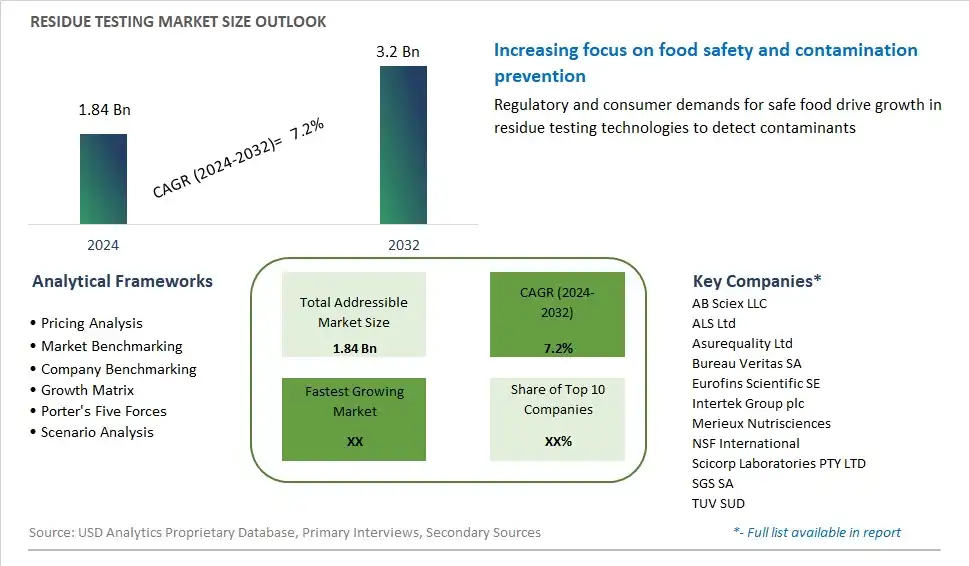
Global Residue Testing Market Size is valued at $1.84 Billion in 2024 and is forecast to register a growth rate (CAGR) of 7.2% to reach $3.2 Billion by 2032.
The global Residue Testing Market Comprehensive Study analyzes and forecasts the market size across 6 regions and 24 countries for diverse segments -By Type (Pesticide Residues, Toxins, Heavy Metals, Food Allergens, Others), By Technology (Chromatography, Spectroscopy, Immunoassay, Others), By Food Tested (Meat & Poultry, Dairy Products, Processed Foods, Fruits & Vegetables, Cereals, Grains & Pulses, Others)
An Introduction to Residue Testing Market
Residue testing involves the analysis of agricultural commodities, food products, and environmental samples to detect and quantify the presence of residues from pesticides, veterinary drugs, antibiotics, and other chemical contaminants in 2024. Residues can accumulate in food products and the environment through agricultural practices, veterinary treatments, and industrial processes, posing risks to human health and the environment. Residue testing laboratories utilize various analytical techniques such as chromatography, mass spectrometry, and immunoassays to perform sensitive and accurate testing of samples for residue contamination. With increasing concerns about food safety, environmental pollution, and regulatory compliance, the market for residue testing is growing, driven by investments in testing infrastructure, method development, and data analytics that enable manufacturers, regulators, and consumers to ensure the safety and integrity of the food supply chain and protect public health.
Residue Testing Competitive Landscape
The market report analyses the leading companies in the industry including AB Sciex LLC, ALS Ltd, Asurequality Ltd, Bureau Veritas SA, Eurofins Scientific SE, Intertek Group plc, Merieux Nutrisciences, NSF International, Scicorp Laboratories PTY LTD, SGS SA, TUV SUD, and Others.
Residue Testing Market Dynamics
Residue Testing Market Trend: Increasing Stringency of Food Safety Regulations
One prominent market trend in residue testing is the increasing stringency of food safety regulations. Governments worldwide are implementing stricter standards and regulations to ensure the safety and quality of food products consumed by the public. These regulations mandate the testing of agricultural products, such as fruits, vegetables, grains, and animal products, for the presence of pesticide residues, veterinary drug residues, heavy metals, and other contaminants. The rising concern over foodborne illnesses, chemical exposure, and environmental contamination drives the demand for comprehensive residue testing solutions across the food supply chain. As a result, food producers, processors, and regulatory agencies are increasingly investing in advanced testing methods and technologies to comply with regulatory requirements and safeguard public health.
Market Driver: Heightened Consumer Awareness and Demand for Safe Food
A key driver propelling the market for residue testing is the heightened consumer awareness and demand for safe and wholesome food products. With growing concerns about food safety, environmental sustainability, and health-conscious consumption, consumers are becoming more discerning about the food they purchase and consume. They expect transparency, traceability, and assurance that the products they buy meet stringent safety standards and contain minimal residues of harmful chemicals or contaminants. This consumer demand for safe and clean-label food products incentivizes food manufacturers, retailers, and producers to implement rigorous residue testing protocols to detect and mitigate potential risks along the supply chain. Additionally, food safety incidents, product recalls, and media coverage of contamination outbreaks further underscore the importance of robust residue testing practices in building consumer trust and brand reputation.
Market Opportunity: Adoption of Rapid and Sensitive Testing Technologies
An opportunity within the residue testing market lies in the adoption of rapid and sensitive testing technologies to improve efficiency, accuracy, and throughput in detecting residues in food and agricultural products. Traditional testing methods, such as chromatography and mass spectrometry, often require time-consuming sample preparation and analysis, leading to delays in product release and increased costs. However, advancements in analytical techniques, such as immunoassays, biosensors, molecular diagnostics, and spectroscopy, offer faster, cost-effective, and high-throughput alternatives for residue testing. These innovative technologies enable real-time monitoring, on-site testing, and multiplexed analysis of multiple residues simultaneously, enhancing the efficiency and reliability of residue testing workflows. By embracing rapid and sensitive testing technologies, laboratories, food manufacturers, and regulatory agencies can accelerate the detection of contaminants, ensure compliance with regulatory limits, and mitigate risks to public health and food safety.
Residue Testing Market Share Analysis: Pesticide Residues held the dominant market share in 2024
The pesticide residues segment holds the largest share in the residue testing market due to the widespread use of pesticides in agricultural practices and the growing concern over pesticide contamination in food and the environment. Pesticide residues are chemicals left on crops after application and pose potential health risks if consumed in excess. As a result, regulatory authorities and food safety agencies mandate rigorous testing protocols to monitor and regulate pesticide levels in food products. Residue testing for pesticide residues ensures compliance with safety standards, protects public health, and maintains consumer confidence in the food supply chain. Additionally, with increasing consumer demand for organic and pesticide-free food products, the need for accurate and reliable pesticide residue testing has intensified, further driving the growth of this segment in the residue testing market. As regulatory requirements continue to evolve and consumer awareness of food safety issues grows, the pesticide residues segment is expected to maintain its dominance in the residue testing market, driving demand for testing services and solutions worldwide.
Residue Testing Market Share Analysis: Spectroscopy market is poised to register the fastest growth rae over the forecast period to 2032
The spectroscopy segment is witnessing rapid growth in the residue testing market due to its advantages in terms of sensitivity, speed, and versatility in detecting a wide range of contaminants across various sample matrices. Spectroscopic techniques, including mass spectrometry, infrared spectroscopy, and nuclear magnetic resonance spectroscopy, offer rapid and accurate identification and quantification of residues such as pesticides, toxins, heavy metals, and food allergens in food, agricultural products, and environmental samples. Further, spectroscopic methods require minimal sample preparation, reducing analysis time and costs compared to traditional chromatography-based techniques. Additionally, advancements in spectroscopic instrumentation, data analysis software, and miniaturization have made spectroscopy more accessible and cost-effective for routine residue testing applications. As regulatory requirements become more stringent, and the demand for rapid and reliable residue testing solutions grows, the spectroscopy segment is expected to continue its rapid expansion, offering opportunities for innovation and investment in the residue testing market.
Residue Testing Market Share Analysis: Meat & Poultry held the dominant market share in 2024
The meat and poultry segment dominates the residue testing market due to the high consumption and extensive regulatory scrutiny of meat and poultry products worldwide. Meat and poultry products are susceptible to contamination from various sources, including veterinary drugs, growth promoters, antibiotics, and environmental pollutants, which pose risks to human health if consumed in excess. Consequently, regulatory agencies impose stringent residue limits and testing requirements to ensure the safety and quality of meat and poultry products. Residue testing in meat and poultry involves screening for contaminants such as antibiotics, hormones, veterinary drugs, heavy metals, and microbial pathogens to comply with regulatory standards and ensure consumer safety. Additionally, with growing concerns over foodborne illnesses and antibiotic resistance, the demand for robust residue testing solutions in the meat and poultry industry is increasing, further driving the growth of this segment in the residue testing market. As consumer awareness of food safety issues continues to rise, the meat and poultry segment is expected to maintain its dominance, driving demand for residue testing services and solutions globally.
Residue Testing Market Segmentation
By Type
Pesticide Residues
Toxins
Heavy Metals
Food Allergens
Others
By Technology
Chromatography Based
Spectroscopy
Immunoassay
Others
By Food Tested
Meat & Poultry
Dairy Products
Processed Foods
Fruits & Vegetables
Cereals
Grains & Pulses
Others
Countries Analyzed
North America (US, Canada, Mexico)
Europe (Germany, UK, France, Spain, Italy, Russia, Rest of Europe)
Asia Pacific (China, India, Japan, South Korea, Australia, South East Asia, Rest of Asia)
South America (Brazil, Argentina, Rest of South America)
Middle East and Africa (Saudi Arabia, UAE, Rest of Middle East, South Africa, Egypt, Rest of Africa)
Residue Testing Companies Profiled in the Study
AB Sciex LLC
ALS Ltd
Asurequality Ltd
Bureau Veritas SA
Eurofins Scientific SE
Intertek Group plc
Merieux Nutrisciences
NSF International
Scicorp Laboratories PTY LTD
SGS SA
TUV SUD
*- List Not Exhaustive
Chapter 1. TABLE OF CONTENTS
Chapter 2. Introduction to Residue Testing Market
2.1. Market Overview
2.2. Key Statistics and Report Highlights
2.3. Scope of the Comprehensive Study
2.3.1. Market Definition
2.3.2 Countries and Regions Covered
2.3.3 Research Objective
2.3.4 Units, Currency, and Conversions
2.3.5 Industry Value Chain
2.4. Key Market Segments
2.5. Key Companies
2.6. Study Period
Chapter 3. Strategic Analysis Review
3.1. Residue Testing Pricing Analysis and Forecast
3.2. Porter’s Five Forces
3.3. Market Ecosystem
3.4. SWOT Analysis
3.5. Regulatory Scenario
3.3. Effects of Inflation, Russia-Ukraine War, moderating economic growth, and other macroeconomic factors
Chapter 4. Competitive Landscape
4.1. Market Share Analysis
4.1.1. Global Residue Testing Market Share by Company, 2023
4.1.2. Product Offerings of Leading Residue Testing Companies
4.2. Market Entropy
4.2.1. New Product Launches in the Industry
4.2.2. Mergers, Acquisitions, Joint ventures, and Partnerships
4.3. Key Strategies and Best Practices
Chapter 5. Global Market Projections: Best, Reference, and Low Case Scenarios
5.1. Growth Analysis- Case Scenario Definitions
5.2. Low Growth Case Scenario Forecasts
5.3. Reference Growth Case Scenario Forecasts
5.4. High Growth Case Scenario Forecasts
Chapter 6. Market Dynamics
6.1. Residue Testing Market Drivers
6.2. Residue Testing Market Challenges
6.6. Residue Testing Market Opportunities
6.4. Residue Testing Market Trends
Chapter 7. Global Residue Testing Market Outlook Trends
7.1. Global Residue Testing Revenue (USD Million) and CAGR (%) by Type (2021-2032)
7.2. Global Residue Testing Revenue (USD Million) and CAGR (%) by Application (2021-2032)
7.3. Global Residue Testing Revenue (USD Million) and CAGR (%) by Product (2021-2032)
By Type
Pesticide Residues
Toxins
Heavy Metals
Food Allergens
Others
By Technology
Chromatography Based
Spectroscopy
Immunoassay
Others
By Food Tested
Meat & Poultry
Dairy Products
Processed Foods
Fruits & Vegetables
Cereals
Grains & Pulses
Others
Chapter 8. Global Residue Testing Regional Analysis and Outlook
8.1. Global Residue Testing Revenue (USD Million) By Regions (2021- 2032)
8.2. North America Residue Testing Revenue (USD Million) by Country (2021-2032)
8.2.1. United States Residue Testing Regional Analysis and Outlook
8.2.2. Canada Residue Testing Regional Analysis and Outlook
8.2.3. Mexico Residue Testing Regional Analysis and Outlook
8.3. Europe Residue Testing Revenue (USD Million), by Country (2021-2032)
8.3.1. Germany Residue Testing Regional Analysis and Outlook
8.3.2. France Residue Testing Regional Analysis and Outlook
8.3.3. United Kingdom Residue Testing Regional Analysis and Outlook
8.3.4. Spain Residue Testing Regional Analysis and Outlook
8.3.5. Italy Residue Testing Regional Analysis and Outlook
8.3.6. Russia Residue Testing Regional Analysis and Outlook
8.3.7. Rest of Europe Residue Testing Regional Analysis and Outlook
8.4. Asia Pacific Residue Testing Revenue (USD Million) by Country (2021-2032)
8.4.1. China Residue Testing Regional Analysis and Outlook
8.4.2. Japan Residue Testing Regional Analysis and Outlook
8.4.3. India Residue Testing Regional Analysis and Outlook
8.4.4. South Korea Residue Testing Regional Analysis and Outlook
8.4.5. Australia Residue Testing Regional Analysis and Outlook
8.4.6. South East Asia Residue Testing Regional Analysis and Outlook
8.4.7. Rest of Asia Pacific Residue Testing Regional Analysis and Outlook
8.5. South America Residue Testing Revenue (USD Million), by Country (2021-2032)
8.5.1. Brazil Residue Testing Regional Analysis and Outlook
8.5.2. Argentina Residue Testing Regional Analysis and Outlook
8.5.3. Rest of South America Residue Testing Regional Analysis and Outlook
8.6. Middle East and Africa Residue Testing Revenue (USD Million) by Country (2021-2032)
8.6.1. Middle East Residue Testing Regional Analysis and Outlook
8.6.2. Africa Residue Testing Regional Analysis and Outlook
Chapter 9. North America Residue Testing Analysis and Outlook
9.1. North America Residue Testing Revenue (USD Million) by Segments (2021-2032)
9.1.1. North America Residue Testing Revenue (USD Million) by Type (2021-2032)
9.1.2. North America Residue Testing Revenue (USD Million) by Application (2021-2032)
9.1.3. North America Residue Testing Revenue (USD Million) by Product (2021-2032)
By Type
Pesticide Residues
Toxins
Heavy Metals
Food Allergens
Others
By Technology
Chromatography Based
Spectroscopy
Immunoassay
Others
By Food Tested
Meat & Poultry
Dairy Products
Processed Foods
Fruits & Vegetables
Cereals
Grains & Pulses
Others
Chapter 10. Europe Residue Testing Analysis and Outlook
10.1. Europe Residue Testing Revenue (USD Million), by Segments (USD Million) (2021-2032)
10.1.1. Europe Residue Testing Revenue (USD Million) by Type (2021-2032)
10.1.2. Europe Residue Testing Revenue (USD Million) by Application (2021-2032)
10.1.3. Europe Residue Testing Revenue (USD Million) by Product (2021-2032)
By Type
Pesticide Residues
Toxins
Heavy Metals
Food Allergens
Others
By Technology
Chromatography Based
Spectroscopy
Immunoassay
Others
By Food Tested
Meat & Poultry
Dairy Products
Processed Foods
Fruits & Vegetables
Cereals
Grains & Pulses
Others
Chapter 11. Asia Pacific Residue Testing Analysis and Outlook
11.1. Asia Pacific Residue Testing Revenue (USD Million), and Revenue (USD Million) by Segments (2021-2032)
11.1.1. Asia Pacific Residue Testing Revenue (USD Million) by Type (2021-2032)
11.1.2. Asia Pacific Residue Testing Revenue (USD Million) by Application (2021-2032)
11.1.3. Asia Pacific Residue Testing Revenue (USD Million) by Product (2021-2032)
By Type
Pesticide Residues
Toxins
Heavy Metals
Food Allergens
Others
By Technology
Chromatography Based
Spectroscopy
Immunoassay
Others
By Food Tested
Meat & Poultry
Dairy Products
Processed Foods
Fruits & Vegetables
Cereals
Grains & Pulses
Others
Chapter 12. South America Residue Testing Analysis and Outlook
12.1. South America Residue Testing Revenue (USD Million), by Segments (2021-2032)
12.1.1. South America Residue Testing Revenue (USD Million) by Type (2021-2032)
12.1.2. South America Residue Testing Revenue (USD Million) by Application (2021-2032)
12.1.3. South America Residue Testing Revenue (USD Million) by Product (2021-2032)
By Type
Pesticide Residues
Toxins
Heavy Metals
Food Allergens
Others
By Technology
Chromatography Based
Spectroscopy
Immunoassay
Others
By Food Tested
Meat & Poultry
Dairy Products
Processed Foods
Fruits & Vegetables
Cereals
Grains & Pulses
Others
Chapter 13. Middle East and Africa Residue Testing Analysis and Outlook
13.1. Middle East and Africa Residue Testing Revenue (USD Million), by Segments (2021-2032)
13.1.1. Middle East and Africa Residue Testing Revenue (USD Million) by Type (2021-2032)
13.1.2. Middle East and Africa Residue Testing Revenue (USD Million) by Application (2021-2032)
13.1.3. Middle East and Africa Residue Testing Revenue (USD Million) by Product (2021-2032)
By Type
Pesticide Residues
Toxins
Heavy Metals
Food Allergens
Others
By Technology
Chromatography Based
Spectroscopy
Immunoassay
Others
By Food Tested
Meat & Poultry
Dairy Products
Processed Foods
Fruits & Vegetables
Cereals
Grains & Pulses
Others
Chapter 14. Residue Testing Company Profiles
14.1 Business Overview
14.2 Product Profiles
14.3 SWOT Profiles
14.5 Recent Developments
14.6 Financial Profile
List of Companies
AB Sciex LLC
ALS Ltd
Asurequality Ltd
Bureau Veritas SA
Eurofins Scientific SE
Intertek Group plc
Merieux Nutrisciences
NSF International
Scicorp Laboratories PTY LTD
SGS SA
TUV SUD
15. Methodology and Data Sources
15.1 Customization Offerings
15.2 Subscription Services
15.3 Related Reports
15.4 Publisher Expertise
LIST OF TABLES
Table 1 Market Segmentation Analysis
Table 2 Global Residue Testing Market Share of Leading Companies, 2023
Table 3 Product Offerings of Leading Companies
Table 4 Low Growth Scenario Forecasts
Table 5 Reference Case Growth Scenario
Table 6 High Growth Case Scenario
Table 7 Global Residue Testing Revenue (USD Million) And CAGR (%) By Type (2021-2032)
Table 8 Global Residue Testing Revenue (USD Million) And CAGR (%) By Application (2021-2032)
Table 9 Global Residue Testing Revenue (USD Million) And CAGR (%) By Product (2021-2032)
Table 10 Global Residue Testing Market Revenue (USD Million) By Regions (2021-2032)
Table 11 Global Residue Testing Market Share (%) By Regions (2021-2032)
Table 12 North America Residue Testing Revenue (USD Million) By Country (2021-2032)
Table 13 Europe Residue Testing Revenue (USD Million) By Country (2021-2032)
Table 14 Asia Pacific Residue Testing Revenue (USD Million) By Country (2021-2032)
Table 15 South America Residue Testing Revenue (USD Million) By Country (2021-2032)
Table 16 Middle East and Africa Residue Testing Revenue (USD Million) By Region (2021-2032)
Table 17 North America Residue Testing Revenue (USD Million) By Type (2021-2032)
Table 18 North America Residue Testing Revenue (USD Million) By Application (2021-2032)
Table 19 North America Residue Testing Revenue (USD Million) By Product (2021-2032)
Table 20 Europe Residue Testing Revenue (USD Million) By Type (2021-2032)
Table 21 Europe Residue Testing Revenue (USD Million) By Application (2021-2032)
Table 22 Europe Residue Testing Revenue (USD Million) By Product (2021-2032)
Table 23 Asia Pacific Residue Testing Revenue (USD Million) By Type (2021-2032)
Table 24 Asia Pacific Residue Testing Revenue (USD Million) By Application (2021-2032)
Table 25 Asia Pacific Residue Testing Revenue (USD Million) By Product (2021-2032)
Table 26 South America Residue Testing Revenue (USD Million) By Type (2021-2032)
Table 27 South America Residue Testing Revenue (USD Million) By Application (2021-2032)
Table 28 South America Residue Testing Revenue (USD Million) By Product (2021-2032)
Table 29 Middle East and Africa Residue Testing Revenue (USD Million) By Type (2021-2032)
Table 30 Middle East and Africa Residue Testing Revenue (USD Million) By Application (2021-2032)
Table 31 Middle East and Africa Residue Testing Revenue (USD Million) By Product (2021-2032)
LIST OF FIGURES
Figure 1. Market Scope
Figure 2. Pricing Forecasts Per Unit, 2023- 2032
Figure 3. Porter’s Five Forces
Figure 4. Global Residue Testing Market Revenue (USD Million) By Regions (2021-2032)
Figure 5. Global Residue Testing Market Share (%) By Regions (2023)
Figure 6. North America Residue Testing Revenue (USD Million) By Country (2021-2032)
Figure 7. United States Residue Testing Revenue (USD Million) By Country (2021-2032)
Figure 8. Canada Residue Testing Revenue (USD Million) By Country (2021-2032)
Figure 9. Mexico Residue Testing Revenue (USD Million) By Country (2021-2032)
Figure 10. Europe Residue Testing Revenue (USD Million) By Country (2021-2032)
Figure 11. Germany Residue Testing Revenue (USD Million) By Country (2021-2032)
Figure 12. France Residue Testing Revenue (USD Million) By Country (2021-2032)
Figure 13. United Kingdom Residue Testing Revenue (USD Million) By Country (2021-2032)
Figure 14. Spain Residue Testing Revenue (USD Million) By Country (2021-2032)
Figure 15. Italy Residue Testing Revenue (USD Million) By Country (2021-2032)
Figure 16. Russia Residue Testing Revenue (USD Million) By Country (2021-2032)
Figure 17. Rest of Europe Residue Testing Revenue (USD Million) By Country (2021-2032)
Figure 11. Asia Pacific Residue Testing Revenue (USD Million) By Country (2021-2032)
Figure 12. China Residue Testing Revenue (USD Million) By Country (2021-2032)
Figure 13. Japan Residue Testing Revenue (USD Million) By Country (2021-2032)
Figure 14. India Residue Testing Revenue (USD Million) By Country (2021-2032)
Figure 15. South Korea Residue Testing Revenue (USD Million) By Country (2021-2032)
Figure 16. Australia Residue Testing Revenue (USD Million) By Country (2021-2032)
Figure 17. South East Asia Residue Testing Revenue (USD Million) By Country (2021-2032)
Figure 18. South America Residue Testing Revenue (USD Million) By Country (2021-2032)
Figure 19. Brazil Residue Testing Revenue (USD Million) By Country (2021-2032)
Figure 20. Argentina Residue Testing Revenue (USD Million) By Country (2021-2032)
Figure 21. Rest of Asia Pacific Residue Testing Revenue (USD Million) By Country (2021-2032)
Figure 22. Middle East and Africa Residue Testing Revenue (USD Million) By Region (2021-2032)
Figure 23. Saudi Arabia Residue Testing Revenue (USD Million) By Region (2021-2032)
Figure 24. The UAE Residue Testing Revenue (USD Million) By Region (2021-2032)
Figure 25. Rest of Middle East Residue Testing Revenue (USD Million) By Region (2021-2032)
Figure 26. South Africa Residue Testing Revenue (USD Million) By Region (2021-2032)
Figure 27. Africa Residue Testing Revenue (USD Million) By Region (2021-2032)
Figure 28. North America Residue Testing Revenue (USD Million) By Type (2021-2032)
Figure 29. North America Residue Testing Revenue (USD Million) By Application (2021-2032)
Figure 30. North America Residue Testing Revenue (USD Million) By Product (2021-2032)
Figure 31. Europe Residue Testing Revenue (USD Million) By Type (2021-2032)
Figure 32. Europe Residue Testing Revenue (USD Million) By Application (2021-2032)
Figure 33. Europe Residue Testing Revenue (USD Million) By Product (2021-2032)
Figure 34. Asia Pacific Residue Testing Revenue (USD Million) By Type (2021-2032)
Figure 35. Asia Pacific Residue Testing Revenue (USD Million) By Application (2021-2032)
Figure 36. Asia Pacific Residue Testing Revenue (USD Million) By Product (2021-2032)
Figure 37. South America Residue Testing Revenue (USD Million) By Type (2021-2032)
Figure 38. South America Residue Testing Revenue (USD Million) By Application (2021-2032)
Figure 39. South America Residue Testing Revenue (USD Million) By Product (2021-2032)
Figure 40. Middle East and Africa Residue Testing Revenue (USD Million) By Type (2021-2032)
Figure 41. Middle East and Africa Residue Testing Revenue (USD Million) By Application (2021-2032)
Figure 42. Middle East and Africa Residue Testing Revenue (USD Million) By Product (2021-2032)
By Type
Pesticide Residues
Toxins
Heavy Metals
Food Allergens
Others
By Technology
Chromatography Based
Spectroscopy
Immunoassay
Others
By Food Tested
Meat & Poultry
Dairy Products
Processed Foods
Fruits & Vegetables
Cereals
Grains & Pulses
Others
Countries Analyzed
North America (US, Canada, Mexico)
Europe (Germany, UK, France, Spain, Italy, Russia, Rest of Europe)
Asia Pacific (China, India, Japan, South Korea, Australia, South East Asia, Rest of Asia)
South America (Brazil, Argentina, Rest of South America)
Middle East and Africa (Saudi Arabia, UAE, Rest of Middle East, South Africa, Egypt, Rest of Africa)
