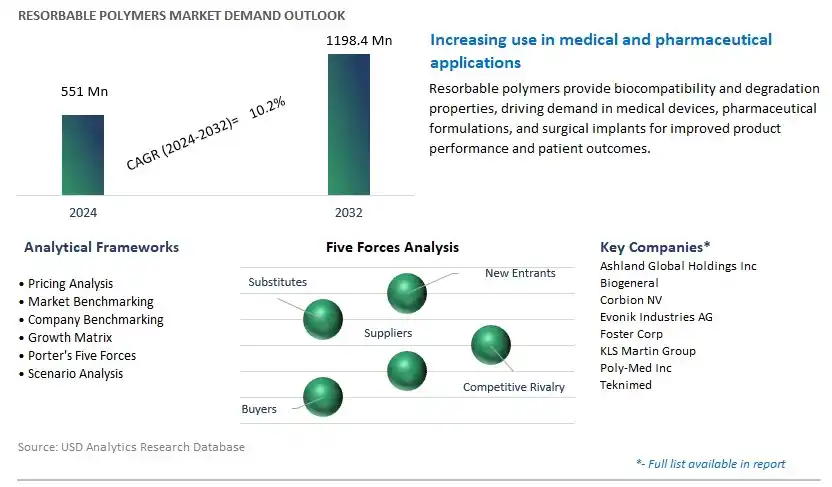
Global Resorbable Polymers Market Size is valued at $551 Million in 2024 and is forecast to register a growth rate (CAGR) of 10.2% to reach $1198.4 Million by 2032.
The global Resorbable Polymers Market Study analyzes and forecasts the market size across 6 regions and 24 countries for diverse segments -By Material (Polylactic Acid (PLA), Polyglycolic Acid (PGA), Polycaprolactone (PCL), PGA/PLA Copolymers), By Application (Drug Delivery, Orthopedics).
An Introduction to Resorbable Polymers Market in 2024
Resorbable polymers, also known as bioresorbable or biodegradable polymers, are synthetic materials designed to degrade and be absorbed by the body over time, offering temporary support or drug delivery in medical applications. In 2024, the market for resorbable polymers is witnessing rapid expansion, driven by advancements in polymer chemistry, medical device technologies, and regenerative medicine. Resorbable polymers are used in a wide range of medical devices, including sutures, implants, drug-eluting stents, and tissue engineering scaffolds, offering advantages such as reduced inflammation, minimized risk of infection, and elimination of the need for surgical removal. Further, the development of innovative resorbable polymer formulations with tailored degradation profiles, mechanical properties, and bioactivity is enabling personalized medical treatments and enhancing patient outcomes. With ongoing research efforts focused on improving biocompatibility, stability, and performance of resorbable polymers, the market is poised for d growth, driving innovation in medical device design and biomaterials science.
Resorbable Polymers Market Competitive Landscape
The market report analyses the leading companies in the industry including Ashland Global Holdings Inc, Biogeneral, Corbion NV, Evonik Industries AG, Foster Corp, KLS Martin Group, Poly-Med Inc, Teknimed, and others.
Resorbable Polymers Market Dynamics
Market Trend: Growing Demand in Medical Applications
A significant trend in the resorbable polymers market is the growing demand for these materials in medical applications. As advancements in medical technology continue, there's an increasing need for biocompatible materials that can be safely absorbed by the body over time. Resorbable polymers offer a versatile solution for various medical devices and implants, including sutures, orthopedic implants, and drug delivery systems. This trend is driven by factors such as the aging population, rising prevalence of chronic diseases, and the pursuit of minimally invasive medical procedures, which collectively fuel the demand for innovative resorbable polymer-based products in the healthcare sector.
Market Driver: Regulatory Support and Shift towards Biodegradability
A key driver behind the growth of the resorbable polymers market is the regulatory support and the broader societal shift towards biodegradable materials. Regulatory agencies are increasingly advocating for the use of environmentally friendly materials and imposing stricter regulations on non-biodegradable polymers. Additionally, consumer awareness and environmental concerns are driving demand for products that minimize ecological impact. Resorbable polymers, being biodegradable and capable of being metabolized by the body, align with these regulatory and consumer preferences, thus driving market growth.
Market Opportunity: Expansion into Tissue Engineering and Regenerative Medicine
An opportunity for the resorbable polymers market lies in expanding into tissue engineering and regenerative medicine applications. With the growing focus on regenerative therapies and personalized medicine, there's a rising demand for biomaterials that can support tissue repair and regeneration. Resorbable polymers offer a promising platform for scaffolds and matrices in tissue engineering, providing temporary support while promoting tissue regeneration before gradually degrading in the body. By leveraging their biocompatibility and tunable degradation profiles, resorbable polymers can play a pivotal role in advancing the field of regenerative medicine, presenting a lucrative opportunity for market expansion and innovation.
Resorbable Polymers Market Share Analysis: Polylactic Acid (PLA) segment generated the highest revenue in 2024
Within the Resorbable Polymers Market, the Polylactic Acid (PLA) segment is the largest. PLA is a bio-based polymer derived from renewable resources such as corn starch or sugarcane, making it an environmentally friendly alternative to traditional petroleum-based plastics. PLA is widely used in medical applications, including surgical sutures, orthopedic implants, drug delivery systems, and tissue engineering, due to its biocompatibility and biodegradability. The increasing demand for resorbable polymers in medical devices and implants, coupled with the growing emphasis on sustainability in healthcare, has propelled the adoption of PLA in the medical industry. Moreover, PLA offers versatility in processing and can be easily tailored to meet specific performance requirements, further driving its popularity among manufacturers. With its biocompatible nature, sustainable origins, and diverse applications in the medical field, the PLA segment maintains its position as the largest in the resorbable polymers market.
Resorbable Polymers Market Share Analysis: Orthopedics is poised to register the fastest CAGR over the forecast period
Within the Resorbable Polymers Market, the Orthopedics segment is the fastest-growing. Orthopedic applications of resorbable polymers, such as implants, screws, and fixation devices, are witnessing increasing adoption due to potential advantages over traditional metal implants. Resorbable polymers provide temporary support during the healing process, gradually degrading over time and being absorbed by the body without the need for removal surgery. This eliminates the risk of implant-related complications, such as infections, implant rejection, and stress shielding, which are commonly associated with permanent metal implants. Additionally, resorbable polymer implants promote bone healing and remodeling, facilitating the restoration of normal bone structure and function. The growing preference for minimally invasive surgical techniques and the demand for implants that offer better biocompatibility and patient outcomes are driving the adoption of resorbable polymers in orthopedic applications. With ongoing advancements in material science and orthopedic implant technology, the Orthopedics segment is poised for significant growth in the resorbable polymers market.
Resorbable Polymers Market
By Material
Polylactic Acid (PLA)
Polyglycolic Acid (PGA)
Polycaprolactone (PCL)
PGA/PLA Copolymers
By Application
Drug Delivery
OrthopedicsCountries Analyzed
North America (US, Canada, Mexico)
Europe (Germany, UK, France, Spain, Italy, Russia, Rest of Europe)
Asia Pacific (China, India, Japan, South Korea, Australia, South East Asia, Rest of Asia)
South America (Brazil, Argentina, Rest of South America)
Middle East and Africa (Saudi Arabia, UAE, Rest of Middle East, South Africa, Egypt, Rest of Africa)
Resorbable Polymers Companies Profiled in the Study
Ashland Global Holdings Inc
Biogeneral
Corbion NV
Evonik Industries AG
Foster Corp
KLS Martin Group
Poly-Med Inc
Teknimed
*- List Not Exhaustive
TABLE OF CONTENTS
1 Introduction to 2024 Resorbable Polymers Market
1.1 Market Overview
1.2 Quick Facts
1.3 Scope/Objective of the Study
1.4 Market Definition
1.5 Countries and Regions Covered
1.6 Units, Currency, and Conversions
1.7 Industry Value Chain
2 Research Methodology
2.1 Market Size Estimation
2.2 Sources and Research Methodology
2.3 Data Triangulation
2.4 Assumptions and Limitations
3 Executive Summary
3.1 Global Resorbable Polymers Market Size Outlook, $ Million, 2021 to 2032
3.2 Resorbable Polymers Market Outlook by Type, $ Million, 2021 to 2032
3.3 Resorbable Polymers Market Outlook by Product, $ Million, 2021 to 2032
3.4 Resorbable Polymers Market Outlook by Application, $ Million, 2021 to 2032
3.5 Resorbable Polymers Market Outlook by Key Countries, $ Million, 2021 to 2032
4 Market Dynamics
4.1 Key Driving Forces of Resorbable Polymers Industry
4.2 Key Market Trends in Resorbable Polymers Industry
4.3 Potential Opportunities in Resorbable Polymers Industry
4.4 Key Challenges in Resorbable Polymers Industry
5 Market Factor Analysis
5.1 Value Chain Analysis
5.2 Competitive Landscape
5.2.1 Global Resorbable Polymers Market Share by Company (%), 2023
5.2.2 Product Offerings by Company
5.3 Porter’s Five Forces Analysis
5.4 Pricing Analysis and Outlook
6 Growth Outlook Across Scenarios
6.1 Growth Analysis-Case Scenario Definitions
6.2 Low Growth Scenario Forecasts
6.3 Reference Growth Scenario Forecasts
6.4 High Growth Scenario Forecasts
7 Global Resorbable Polymers Market Outlook by Segments
7.1 Resorbable Polymers Market Outlook by Segments, $ Million, 2021- 2032
By Material
Polylactic Acid (PLA)
Polyglycolic Acid (PGA)
Polycaprolactone (PCL)
PGA/PLA Copolymers
By Application
Drug Delivery
Orthopedics
8 North America Resorbable Polymers Market Analysis and Outlook To 2032
8.1 Introduction to North America Resorbable Polymers Markets in 2024
8.2 North America Resorbable Polymers Market Size Outlook by Country, 2021-2032
8.2.1 United States
8.2.2 Canada
8.2.3 Mexico
8.3 North America Resorbable Polymers Market size Outlook by Segments, 2021-2032
By Material
Polylactic Acid (PLA)
Polyglycolic Acid (PGA)
Polycaprolactone (PCL)
PGA/PLA Copolymers
By Application
Drug Delivery
Orthopedics
9 Europe Resorbable Polymers Market Analysis and Outlook To 2032
9.1 Introduction to Europe Resorbable Polymers Markets in 2024
9.2 Europe Resorbable Polymers Market Size Outlook by Country, 2021-2032
9.2.1 Germany
9.2.2 France
9.2.3 Spain
9.2.4 United Kingdom
9.2.4 Italy
9.2.5 Russia
9.2.6 Norway
9.2.7 Rest of Europe
9.3 Europe Resorbable Polymers Market Size Outlook by Segments, 2021-2032
By Material
Polylactic Acid (PLA)
Polyglycolic Acid (PGA)
Polycaprolactone (PCL)
PGA/PLA Copolymers
By Application
Drug Delivery
Orthopedics
10 Asia Pacific Resorbable Polymers Market Analysis and Outlook To 2032
10.1 Introduction to Asia Pacific Resorbable Polymers Markets in 2024
10.2 Asia Pacific Resorbable Polymers Market Size Outlook by Country, 2021-2032
10.2.1 China
10.2.2 India
10.2.3 Japan
10.2.4 South Korea
10.2.5 Indonesia
10.2.6 Malaysia
10.2.7 Australia
10.2.8 Rest of Asia Pacific
10.3 Asia Pacific Resorbable Polymers Market size Outlook by Segments, 2021-2032
By Material
Polylactic Acid (PLA)
Polyglycolic Acid (PGA)
Polycaprolactone (PCL)
PGA/PLA Copolymers
By Application
Drug Delivery
Orthopedics
11 South America Resorbable Polymers Market Analysis and Outlook To 2032
11.1 Introduction to South America Resorbable Polymers Markets in 2024
11.2 South America Resorbable Polymers Market Size Outlook by Country, 2021-2032
11.2.1 Brazil
11.2.2 Argentina
11.2.3 Rest of South America
11.3 South America Resorbable Polymers Market size Outlook by Segments, 2021-2032
By Material
Polylactic Acid (PLA)
Polyglycolic Acid (PGA)
Polycaprolactone (PCL)
PGA/PLA Copolymers
By Application
Drug Delivery
Orthopedics
12 Middle East and Africa Resorbable Polymers Market Analysis and Outlook To 2032
12.1 Introduction to Middle East and Africa Resorbable Polymers Markets in 2024
12.2 Middle East and Africa Resorbable Polymers Market Size Outlook by Country, 2021-2032
12.2.1 Saudi Arabia
12.2.2 UAE
12.2.3 Oman
12.2.4 Rest of Middle East
12.2.5 Egypt
12.2.6 Nigeria
12.2.7 South Africa
12.2.8 Rest of Africa
12.3 Middle East and Africa Resorbable Polymers Market size Outlook by Segments, 2021-2032
By Material
Polylactic Acid (PLA)
Polyglycolic Acid (PGA)
Polycaprolactone (PCL)
PGA/PLA Copolymers
By Application
Drug Delivery
Orthopedics
13 Company Profiles
13.1 Company Snapshot
13.2 SWOT Profiles
13.3 Products and Services
13.4 Recent Developments
13.5 Financial Profile
Ashland Global Holdings Inc
Biogeneral
Corbion NV
Evonik Industries AG
Foster Corp
KLS Martin Group
Poly-Med Inc
Teknimed
14 Appendix
14.1 Customization Offerings
14.2 Subscription Services
14.3 Related Reports
14.4 Publisher Expertise
By Material
Polylactic Acid (PLA)
Polyglycolic Acid (PGA)
Polycaprolactone (PCL)
PGA/PLA Copolymers
By Application
Drug Delivery
Orthopedics
Countries Analyzed
North America (US, Canada, Mexico)
Europe (Germany, UK, France, Spain, Italy, Russia, Rest of Europe)
Asia Pacific (China, India, Japan, South Korea, Australia, South East Asia, Rest of Asia)
South America (Brazil, Argentina, Rest of South America)
Middle East and Africa (Saudi Arabia, UAE, Rest of Middle East, South Africa, Egypt, Rest of Africa)
