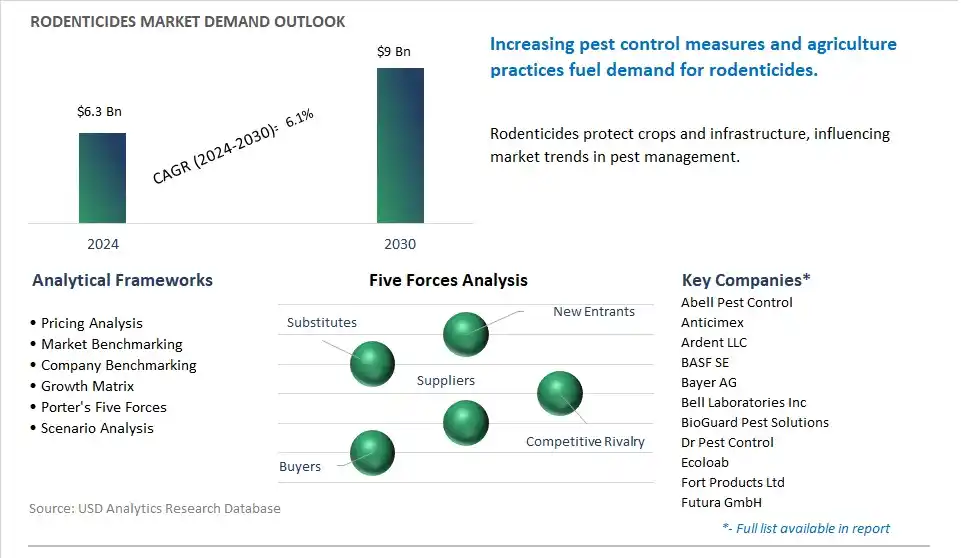
The global Rodenticides Market is poised to register a 6.1% CAGR from $6.3 Billion in 2024 to $9 Billion in 2030.
The global Rodenticides Market Study analyzes and forecasts the market size across 6 regions and 24 countries for diverse segments -By Type (Anticoagulants, FGAR, SGAR, Non- Anticoagulants), By Mode of Application (Pellets, Spray, Powder), By End-User (Agriculture, Warehouses, Urban Centers), By Rodent Type (Rats, Mice, Chipmunks, Hamsters).
An Introduction to Global Rodenticides Market in 2024
The rodenticides market is evolving in response to the increasing need for effective pest control solutions in agriculture, urban areas, and industrial facilities. Key trends shaping the future of the industry include the development of safer and more environmentally friendly rodenticide formulations that minimize risks to non-target organisms and ecosystems. Innovations in rodenticide technology, such as anticoagulant baits with reduced secondary poisoning risks and biodegradable formulations, are gaining traction among pest control professionals and regulators. Moreover, the emergence of integrated pest management (IPM) approaches, combining rodenticides with non-chemical control methods such as trapping, habitat modification, and biological control agents, is promoting sustainable and holistic pest management practices. Additionally, the increasing prevalence of rodent-borne diseases and public health concerns is driving demand for rodenticides with fast-acting and highly efficacious active ingredients to protect human health and food safety. As stakeholders collaborate to develop and promote responsible rodent control strategies, the rodenticides market is poised for continued growth while prioritizing environmental stewardship and safety.
Rodenticides Market Competitive Landscape
The market report analyses the leading companies in the industry including Abell Pest Control, Anticimex, Ardent LLC, BASF SE, Bayer AG, Bell Laboratories Inc, BioGuard Pest Solutions, Dr Pest Control, Ecoloab, Fort Products Ltd, Futura GmbH, Impex Europa S.L., JT Eaton & Co. Inc, Liphatech Inc, Native Pest Management, Neogen Corp Ltd, Pecopp, PelGar International, Rentokil Initial, Rollins Inc, Senestech Inc, Southern Suburbs Pest Control, Syngenta AG, Truly Nolen of America Inc, UPL Ltd.
Rodenticides Market Dynamics
Rodenticides Market Trend: Increased Focus on Non-Toxic and Environmentally Friendly Formulations
A prominent trend in the rodenticides market is the increased focus on non-toxic and environmentally friendly formulations. With growing concerns about the impact of traditional rodenticides on non-target wildlife, pets, and ecosystems, there is a rising demand for rodenticide products that offer effective pest control without posing significant risks to the environment and non-target species. Manufacturers are innovating and developing rodenticide formulations based on natural ingredients, biopesticides, and alternative methods of rodent control such as mechanical traps and exclusion techniques. This trend reflects a broader shift towards sustainable pest management practices and regulatory requirements for safer and eco-friendly pest control solutions.
Rodenticides Market Driver: Urbanization and Increased Urban Pest Pressure
A key driver for the rodenticides market is urbanization and increased urban pest pressure. As urban areas expand and populations grow, there is a higher prevalence of pest infestations, particularly rodents, in residential, commercial, and industrial settings. Rodents pose health risks, damage property, and contaminate food supplies, leading to increased demand for effective rodent control solutions. Rodenticides play a crucial role in urban pest management by offering a convenient and efficient means of controlling rodent populations in urban environments. The rise in urban pest pressure, coupled with the need for rapid and effective pest control measures, drives the demand for rodenticide products and solutions.
Rodenticides Market Opportunity: Development of Targeted and Species-Specific Rodenticides
An opportunity within the rodenticides market lies in the development of targeted and species-specific rodenticides. Traditional rodenticides often pose risks to non-target species such as birds of prey, mammals, and reptiles, leading to unintended secondary poisoning and environmental contamination. There is an opportunity for manufacturers to develop rodenticide formulations that target specific rodent species while minimizing risks to non-target wildlife. By incorporating species-specific attractants, bait delivery systems, and active ingredients with low toxicity to non-target species, manufacturers can create rodenticide products that offer effective pest control with reduced environmental impact. Additionally, there is potential for integrating rodenticides with pest monitoring and management programs to optimize their effectiveness and minimize risks to non-target organisms, presenting a sustainable and targeted approach to rodent control in urban and rural environments.
Rodenticides Market Share Analysis: Anticoagulants segment generated the highest revenue in the industry
Anticoagulants stand out as the largest segment in the Rodenticides Market due to their widespread use, effectiveness, and established track record in rodent control. Anticoagulant rodenticides work by interfering with the blood clotting process in rodents, leading to internal bleeding and eventual death. These rodenticides are available in both first-generation anticoagulants (FGAR) and second-generation anticoagulants (SGAR), with SGARs offering increased potency and efficacy against resistant rodent populations. Anticoagulant rodenticides are preferred by pest control professionals, agriculture, and public health agencies due to their proven effectiveness, versatility, and ease of use. In addition, anticoagulant rodenticides have a delayed lethal effect, allowing rodents to consume the bait multiple times before succumbing to the poison, which increases the likelihood of successful eradication. Additionally, anticoagulant rodenticides are available in various formulations, including bait blocks, pellets, and liquid concentrates, catering to different application needs and environments. As the global population grows and urbanization expands, the demand for effective rodent control solutions remains high, driving the dominance of anticoagulant rodenticides in the market.
Rodenticides Market Share Analysis: Spray Segment is poised to register the fastest growth rate (CAGR) over the forecast period to 2030
The spray segment is the fastest-growing segment in the Rodenticides Market due to its convenience, effectiveness, and versatility in rodent control applications. Rodenticide sprays offer a quick and targeted solution for treating infested areas, allowing users to apply the product directly to rodent habitats, entry points, and nesting sites. The spray formulation ensures thorough coverage and penetration into crevices, cracks, and hard-to-reach areas where rodents may hide or travel, effectively eliminating infestations and preventing reinfestation. Additionally, rodenticide sprays are ideal for both indoor and outdoor use, making them suitable for a wide range of environments such as residential properties, commercial buildings, agricultural facilities, and food processing plants. The ease of application and rapid action of rodenticide sprays appeal to pest control professionals, homeowners, and businesses seeking efficient and reliable rodent control solutions. In addition, advancements in spray technology, such as the development of long-lasting formulations and eco-friendly ingredients, further contribute to the growth of the spray segment in the rodenticides market. As the demand for convenient and effective pest management solutions continues to rise, particularly in urban and industrial settings, the popularity of rodenticide sprays is expected to soar, positioning it as the fastest-growing segment in the rodenticides market.
Rodenticides Market Share Analysis: Urban Centers segment generated the highest revenue in the industry
The urban centers segment is the fastest-growing segment in the Rodenticides Market due to increasing urbanization, expanding populations, and growing concerns over rodent infestations in densely populated areas. Urban centers face unique challenges when it comes to rodent control, as factors such as food waste, inadequate waste management practices, and crowded living conditions create conducive environments for rodent breeding and infestation. Rodents pose significant health and sanitation risks in urban settings, including the transmission of diseases, contamination of food and water supplies, and damage to property and infrastructure. As a result, there is a heightened demand for effective rodent control solutions in urban areas to protect public health, ensure food safety, and maintain hygiene standards. Rodenticides play a crucial role in urban pest management programs, offering fast-acting and targeted solutions for controlling rodent populations in residential neighborhoods, commercial districts, public spaces, and municipal facilities. In addition, advancements in rodenticide formulations, such as bait stations, traps, and bait blocks, cater to the diverse needs and preferences of urban users, further driving the growth of the urban centers segment in the rodenticides market. As urbanization trends continue to accelerate globally, the demand for rodenticides in urban centers is expected to experience rapid growth, positioning it as the fastest-growing segment in the market.
Rodenticides Market Report Segmentation
By Type
Anticoagulants
-FGAR
-SGAR
FGAR
-Chlorophacinone
-Diphacinone
-Coumatetrayl
-Warfarin
SGAR
-Brodifacoum
-Bromadiolone
-Difenacoum
-Difethialone
-Flocoumafone
Non- Anticoagulants
-Bromethalin
-Cholecalciferol
-Strychnine
-Zinc Phosphide
By Mode of Application
Pellets
Spray
Powder
By End-User
Agriculture
Warehouses
Urban Centers
By Rodent Type
Rats
Mice
Chipmunks
Hamsters
Regions Included
North America (US, Canada, Mexico)
Europe (Germany, UK, France, Spain, Italy, Russia, Rest of Europe)
Asia Pacific (China, India, Japan, South Korea, Australia, South East Asia, Rest of Asia)
South America (Brazil, Argentina, Rest of South America)
Middle East and Africa (Saudi Arabia, UAE, Rest of Middle East, South Africa, Egypt, Rest of Africa)
Rodenticides Companies Profiled in the Market Study
Abell Pest Control
Anticimex
Ardent LLC
BASF SE
Bayer AG
Bell Laboratories Inc
BioGuard Pest Solutions
Dr Pest Control
Ecoloab
Fort Products Ltd
Futura GmbH
Impex Europa S.L.
JT Eaton & Co. Inc
Liphatech Inc
Native Pest Management
Neogen Corp Ltd
Pecopp
PelGar International
Rentokil Initial
Rollins Inc
Senestech Inc
Southern Suburbs Pest Control
Syngenta AG
Truly Nolen of America Inc
UPL Ltd
*- List Not Exhaustive
TABLE OF CONTENTS
1 Introduction to 2024 Rodenticides Market
1.1 Market Overview
1.2 Quick Facts
1.3 Scope/Objective of the Study
1.4 Market Definition
1.5 Countries and Regions Covered
1.6 Units, Currency, and Conversions
1.7 Industry Value Chain
2 Research Methodology
2.1 Market Size Estimation
2.2 Sources and Research Methodology
2.3 Data Triangulation
2.4 Assumptions and Limitations
3 Executive Summary
3.1 Global Rodenticides Market Size Outlook, $ Million, 2021 to 2030
3.2 Rodenticides Market Outlook by Type, $ Million, 2021 to 2030
3.3 Rodenticides Market Outlook by Product, $ Million, 2021 to 2030
3.4 Rodenticides Market Outlook by Application, $ Million, 2021 to 2030
3.5 Rodenticides Market Outlook by Key Countries, $ Million, 2021 to 2030
4 Market Dynamics
4.1 Key Driving Forces of Rodenticides Industry
4.2 Key Market Trends in Rodenticides Industry
4.3 Potential Opportunities in Rodenticides Industry
4.4 Key Challenges in Rodenticides Industry
5 Market Factor Analysis
5.1 Value Chain Analysis
5.2 Competitive Landscape
5.2.1 Global Rodenticides Market Share by Company (%), 2023
5.2.2 Product Offerings by Company
5.3 Porter’s Five Forces Analysis
5.4 Pricing Analysis and Outlook
6 Growth Outlook Across Scenarios
6.1 Growth Analysis-Case Scenario Definitions
6.2 Low Growth Scenario Forecasts
6.3 Reference Growth Scenario Forecasts
6.4 High Growth Scenario Forecasts
7 Global Rodenticides Market Outlook by Segments
7.1 Rodenticides Market Outlook by Segments, $ Million, 2021- 2030
By Type
Anticoagulants
-FGAR
-SGAR
FGAR
-Chlorophacinone
-Diphacinone
-Coumatetrayl
-Warfarin
SGAR
-Brodifacoum
-Bromadiolone
-Difenacoum
-Difethialone
-Flocoumafone
Non- Anticoagulants
-Bromethalin
-Cholecalciferol
-Strychnine
-Zinc Phosphide
By Mode of Application
Pellets
Spray
Powder
By End-User
Agriculture
Warehouses
Urban Centers
By Rodent Type
Rats
Mice
Chipmunks
Hamsters
8 North America Rodenticides Market Analysis and Outlook To 2030
8.1 Introduction to North America Rodenticides Markets in 2024
8.2 North America Rodenticides Market Size Outlook by Country, 2021-2030
8.2.1 United States
8.2.2 Canada
8.2.3 Mexico
8.3 North America Rodenticides Market size Outlook by Segments, 2021-2030
By Type
Anticoagulants
-FGAR
-SGAR
FGAR
-Chlorophacinone
-Diphacinone
-Coumatetrayl
-Warfarin
SGAR
-Brodifacoum
-Bromadiolone
-Difenacoum
-Difethialone
-Flocoumafone
Non- Anticoagulants
-Bromethalin
-Cholecalciferol
-Strychnine
-Zinc Phosphide
By Mode of Application
Pellets
Spray
Powder
By End-User
Agriculture
Warehouses
Urban Centers
By Rodent Type
Rats
Mice
Chipmunks
Hamsters
9 Europe Rodenticides Market Analysis and Outlook To 2030
9.1 Introduction to Europe Rodenticides Markets in 2024
9.2 Europe Rodenticides Market Size Outlook by Country, 2021-2030
9.2.1 Germany
9.2.2 France
9.2.3 Spain
9.2.4 United Kingdom
9.2.4 Italy
9.2.5 Russia
9.2.6 Norway
9.2.7 Rest of Europe
9.3 Europe Rodenticides Market Size Outlook by Segments, 2021-2030
By Type
Anticoagulants
-FGAR
-SGAR
FGAR
-Chlorophacinone
-Diphacinone
-Coumatetrayl
-Warfarin
SGAR
-Brodifacoum
-Bromadiolone
-Difenacoum
-Difethialone
-Flocoumafone
Non- Anticoagulants
-Bromethalin
-Cholecalciferol
-Strychnine
-Zinc Phosphide
By Mode of Application
Pellets
Spray
Powder
By End-User
Agriculture
Warehouses
Urban Centers
By Rodent Type
Rats
Mice
Chipmunks
Hamsters
10 Asia Pacific Rodenticides Market Analysis and Outlook To 2030
10.1 Introduction to Asia Pacific Rodenticides Markets in 2024
10.2 Asia Pacific Rodenticides Market Size Outlook by Country, 2021-2030
10.2.1 China
10.2.2 India
10.2.3 Japan
10.2.4 South Korea
10.2.5 Indonesia
10.2.6 Malaysia
10.2.7 Australia
10.2.8 Rest of Asia Pacific
10.3 Asia Pacific Rodenticides Market size Outlook by Segments, 2021-2030
By Type
Anticoagulants
-FGAR
-SGAR
FGAR
-Chlorophacinone
-Diphacinone
-Coumatetrayl
-Warfarin
SGAR
-Brodifacoum
-Bromadiolone
-Difenacoum
-Difethialone
-Flocoumafone
Non- Anticoagulants
-Bromethalin
-Cholecalciferol
-Strychnine
-Zinc Phosphide
By Mode of Application
Pellets
Spray
Powder
By End-User
Agriculture
Warehouses
Urban Centers
By Rodent Type
Rats
Mice
Chipmunks
Hamsters
11 South America Rodenticides Market Analysis and Outlook To 2030
11.1 Introduction to South America Rodenticides Markets in 2024
11.2 South America Rodenticides Market Size Outlook by Country, 2021-2030
11.2.1 Brazil
11.2.2 Argentina
11.2.3 Rest of South America
11.3 South America Rodenticides Market size Outlook by Segments, 2021-2030
By Type
Anticoagulants
-FGAR
-SGAR
FGAR
-Chlorophacinone
-Diphacinone
-Coumatetrayl
-Warfarin
SGAR
-Brodifacoum
-Bromadiolone
-Difenacoum
-Difethialone
-Flocoumafone
Non- Anticoagulants
-Bromethalin
-Cholecalciferol
-Strychnine
-Zinc Phosphide
By Mode of Application
Pellets
Spray
Powder
By End-User
Agriculture
Warehouses
Urban Centers
By Rodent Type
Rats
Mice
Chipmunks
Hamsters
12 Middle East and Africa Rodenticides Market Analysis and Outlook To 2030
12.1 Introduction to Middle East and Africa Rodenticides Markets in 2024
12.2 Middle East and Africa Rodenticides Market Size Outlook by Country, 2021-2030
12.2.1 Saudi Arabia
12.2.2 UAE
12.2.3 Oman
12.2.4 Rest of Middle East
12.2.5 Egypt
12.2.6 Nigeria
12.2.7 South Africa
12.2.8 Rest of Africa
12.3 Middle East and Africa Rodenticides Market size Outlook by Segments, 2021-2030
By Type
Anticoagulants
-FGAR
-SGAR
FGAR
-Chlorophacinone
-Diphacinone
-Coumatetrayl
-Warfarin
SGAR
-Brodifacoum
-Bromadiolone
-Difenacoum
-Difethialone
-Flocoumafone
Non- Anticoagulants
-Bromethalin
-Cholecalciferol
-Strychnine
-Zinc Phosphide
By Mode of Application
Pellets
Spray
Powder
By End-User
Agriculture
Warehouses
Urban Centers
By Rodent Type
Rats
Mice
Chipmunks
Hamsters
13 Company Profiles
13.1 Company Snapshot
13.2 SWOT Profiles
13.3 Products and Services
13.4 Recent Developments
13.5 Financial Profile
Abell Pest Control
Anticimex
Ardent LLC
BASF SE
Bayer AG
Bell Laboratories Inc
BioGuard Pest Solutions
Dr Pest Control
Ecoloab
Fort Products Ltd
Futura GmbH
Impex Europa S.L.
JT Eaton & Co. Inc
Liphatech Inc
Native Pest Management
Neogen Corp Ltd
Pecopp
PelGar International
Rentokil Initial
Rollins Inc
Senestech Inc
Southern Suburbs Pest Control
Syngenta AG
Truly Nolen of America Inc
UPL Ltd
14 Appendix
14.1 Customization Offerings
14.2 Subscription Services
14.3 Related Reports
14.4 Publisher Expertise
By Type
Anticoagulants
-FGAR
-SGAR
FGAR
-Chlorophacinone
-Diphacinone
-Coumatetrayl
-Warfarin
SGAR
-Brodifacoum
-Bromadiolone
-Difenacoum
-Difethialone
-Flocoumafone
Non- Anticoagulants
-Bromethalin
-Cholecalciferol
-Strychnine
-Zinc Phosphide
By Mode of Application
Pellets
Spray
Powder
By End-User
Agriculture
Warehouses
Urban Centers
By Rodent Type
Rats
Mice
Chipmunks
Hamsters
Countries Analyzed
North America (US, Canada, Mexico)
Europe (Germany, UK, France, Spain, Italy, Russia, Rest of Europe)
Asia Pacific (China, India, Japan, South Korea, Australia, South East Asia, Rest of Asia)
South America (Brazil, Argentina, Rest of South America)
Middle East and Africa (Saudi Arabia, UAE, Rest of Middle East, South Africa, Egypt, Rest of Africa)
