
The global Rubber Additives Market study analyzes and forecasts the market size across 6 regions and 24 countries for diverse segments including By Type (Activators, Vulcanization Inhibitors, Plasticizers, Others), By Fillers (Carbon Black, Calcium Carbonate, Silica, Others), By Application (Tires, Conveyor Belts, Electric Cables, Others).
The Rubber Additives Market in 2024 serves as a vital segment of the chemical industry, providing essential ingredients for enhancing the performance, durability, and processing characteristics of rubber compounds used in various applications, including automotive tires, industrial belts, footwear, and consumer goods. Rubber additives, such as accelerators, antioxidants, plasticizers, and vulcanizing agents, play critical roles in improving rubber properties such as elasticity, tensile strength, heat resistance, and weathering resistance. With stringent performance requirements and evolving regulations in industries such as automotive and aerospace, manufacturers in this market focus on developing innovative additive formulations that meet or exceed industry standards while addressing emerging challenges such as sustainability and environmental regulations. Advanced rubber additives enable tire manufacturers to produce high-performance tires with superior traction, fuel efficiency, and durability, contributing to improved vehicle safety and sustainability. Moreover, innovations in additive chemistry, including nano-additives and bio-based alternatives, offer opportunities for enhancing rubber performance while reducing environmental impact and reliance on fossil fuels. Additionally, customized additive solutions tailored to specific rubber formulations and processing methods enable manufacturers to optimize product performance and manufacturing efficiency. As industries continue to demand high-performance and sustainable rubber materials, the Rubber Additives Market remains essential in supporting innovation and advancement across a wide range of applications and end-use sectors.
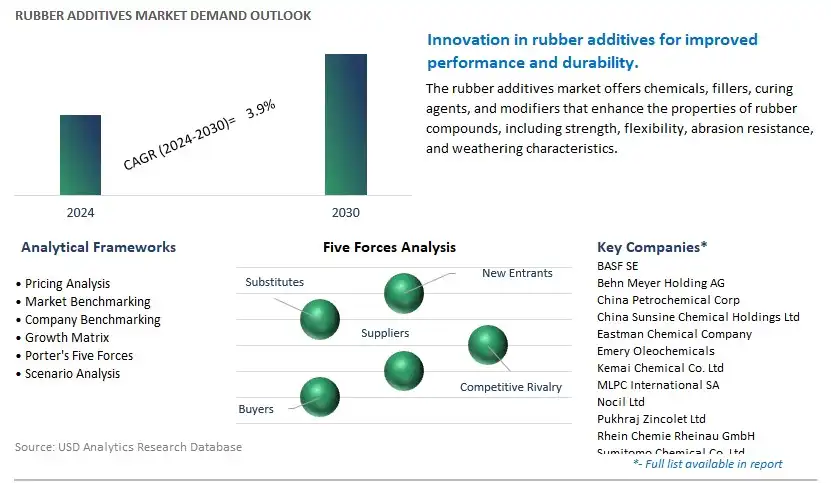
The global Rubber Additives market is highly competitive with a large number of companies focusing on niche market segments. Amidst intense competitive conditions, Rubber Additives Companies are investing in new product launches and strengthening distribution channels. Key companies operating in the Rubber Additives Market Industry include- BASF SE, Behn Meyer Holding AG, China Petrochemical Corp, China Sunsine Chemical Holdings Ltd, Eastman Chemical Company, Emery Oleochemicals, Kemai Chemical Co. Ltd, MLPC International SA, Nocil Ltd, Pukhraj Zincolet Ltd, Rhein Chemie Rheinau GmbH, Sumitomo Chemical Co. Ltd, Thomas Swan & Co. Ltd.
A prominent trend in the Rubber Additives market is the increasing focus on sustainable and environmentally friendly additives, driven by regulatory pressure, consumer demand, and industry initiatives to reduce environmental impact. Manufacturers are exploring alternative sources of rubber additives, such as bio-based additives derived from renewable resources, as well as developing eco-friendly formulations that minimize the use of hazardous chemicals and reduce emissions during production and usage. Additionally, there's a growing emphasis on additives that enhance the recyclability and biodegradability of rubber products, aligning with the principles of circular economy and sustainability. This trend is reshaping the rubber additives market, with manufacturers and suppliers investing in research and development to offer innovative solutions that meet stringent environmental standards and address the growing demand for eco-conscious products across various industries.
A key driver for the Rubber Additives market is the increasing demand from the automotive and tire industries, fueled by the growth of vehicle production, tire manufacturing, and aftermarket sales worldwide. Rubber additives play a crucial role in enhancing the performance, durability, and safety of automotive components and tires, including properties such as wear resistance, traction, weatherability, and fuel efficiency. With the expanding global automotive fleet and rising consumer demand for high-quality vehicles with advanced features, there's a corresponding need for rubber additives that meet stringent performance standards and regulatory requirements. Moreover, the ongoing trend towards lightweighting, electrification, and fuel efficiency in automotive design further drives the demand for innovative rubber additives that enable the development of lightweight, fuel-efficient vehicles and tires. This driver is fueled by factors such as urbanization, infrastructure development, increasing vehicle ownership rates, and the continuous evolution of automotive technology, driving the growth of the rubber additives market as an essential component of the automotive supply chain.
An emerging opportunity within the Rubber Additives market lies in the expansion into emerging markets and applications, offering new avenues for growth, diversification, and market penetration. As economies develop and industrialize, there's increasing demand for rubber additives in a wide range of applications beyond traditional industries such as automotive and tire manufacturing. Emerging sectors such as construction, aerospace, healthcare, and electronics present opportunities for rubber additives suppliers to offer specialized formulations that meet the unique requirements and performance standards of these applications. Additionally, there's potential for growth in niche markets such as sports equipment, consumer goods, and renewable energy, where rubber additives can enhance product performance, durability, and sustainability. By leveraging expertise in additive chemistry and application engineering, manufacturers can capitalize on these emerging opportunities to expand their market presence, establish partnerships with key stakeholders, and drive innovation in the development of new products and solutions. This opportunity is fueled by factors such as urbanization, infrastructure development, increasing consumer spending, and the growing adoption of rubber-based products in diverse industries, driving the expansion of the rubber additives market into new markets and applications.
By Type
Activators
Vulcanization Inhibitors
Plasticizers
Others
By Fillers
Carbon Black
Calcium Carbonate
Silica
Others
By Application
Tires
Conveyor Belts
Electric Cables
OthersGeographical Analysis
North America (United States, Canada, Mexico)
Europe (Germany, France, United Kingdom, Spain, Italy, Rest of Europe)
Asia Pacific (China, India, Japan, South Korea, Rest of Asia Pacific)
South America (Brazil, Argentina, Rest of South America)
Middle East and Africa (Saudi Arabia, UAE, Rest of Middle East, South Africa, Egypt, Rest of Africa
BASF SE
Behn Meyer Holding AG
China Petrochemical Corp
China Sunsine Chemical Holdings Ltd
Eastman Chemical Company
Emery Oleochemicals
Kemai Chemical Co. Ltd
MLPC International SA
Nocil Ltd
Pukhraj Zincolet Ltd
Rhein Chemie Rheinau GmbH
Sumitomo Chemical Co. Ltd
Thomas Swan & Co. Ltd
*- List not Exhaustive
TABLE OF CONTENTS
1 Introduction to 2024 Rubber Additives Market
1.1 Market Overview
1.2 Quick Facts
1.3 Scope/Objective of the Study
1.4 Market Definition
1.5 Countries and Regions Analyzed
1.6 Units, Currency, and Conversions
1.7 Industry Value Chain
2 Research Methodology
2.1 Market Size Estimation
2.2 Sources and Research Methodology
2.3 Data Triangulation
2.4 Assumptions and Limitations
3 Executive Summary
3.1 Global Rubber Additives Market Size Outlook, $ Million, 2021 to 2030
3.2 Rubber Additives Market Outlook by Type, $ Million, 2021 to 2030
3.3 Rubber Additives Market Outlook by Product, $ Million, 2021 to 2030
3.4 Rubber Additives Market Outlook by Application, $ Million, 2021 to 2030
3.5 Rubber Additives Market Outlook by Key Countries, $ Million, 2021 to 2030
4 Market Dynamics
4.1 Key Driving Forces of Rubber Additives Industry
4.2 Key Market Trends in Rubber Additives Industry
4.3 Potential Opportunities in Rubber Additives Industry
4.4 Key Challenges in Rubber Additives Industry
5 Market Factor Analysis
5.1 Value Chain Analysis
5.2 Competitive Landscape
5.2.1 Global Rubber Additives Market Share by Company (%), 2023
5.2.2 Product Offerings by Company
5.3 Porter’s Five Forces Analysis
5.4 Pricing Analysis and Outlook
6 Growth Outlook Across Scenarios
6.1 Growth Analysis-Case Scenario Definitions
6.2 Low Growth Scenario Forecasts
6.3 Reference Growth Scenario Forecasts
6.4 High Growth Scenario Forecasts
7 Global Rubber Additives Market Outlook by Segments
7.1 Rubber Additives Market Outlook by Segments, $ Million, 2021- 2030
By Type
Activators
Vulcanization Inhibitors
Plasticizers
Others
By Fillers
Carbon Black
Calcium Carbonate
Silica
Others
By Application
Tires
Conveyor Belts
Electric Cables
Others
8 North America Rubber Additives Market Analysis and Outlook To 2030
8.1 Introduction to North America Rubber Additives Markets in 2024
8.2 North America Rubber Additives Market Size Outlook by Country, 2021-2030
8.2.1 United States
8.2.2 Canada
8.2.3 Mexico
8.3 North America Rubber Additives Market size Outlook by Segments, 2021-2030
By Type
Activators
Vulcanization Inhibitors
Plasticizers
Others
By Fillers
Carbon Black
Calcium Carbonate
Silica
Others
By Application
Tires
Conveyor Belts
Electric Cables
Others
9 Europe Rubber Additives Market Analysis and Outlook To 2030
9.1 Introduction to Europe Rubber Additives Markets in 2024
9.2 Europe Rubber Additives Market Size Outlook by Country, 2021-2030
9.2.1 Germany
9.2.2 France
9.2.3 Spain
9.2.4 United Kingdom
9.2.4 Italy
9.2.5 Russia
9.2.6 Norway
9.2.7 Rest of Europe
9.3 Europe Rubber Additives Market Size Outlook by Segments, 2021-2030
By Type
Activators
Vulcanization Inhibitors
Plasticizers
Others
By Fillers
Carbon Black
Calcium Carbonate
Silica
Others
By Application
Tires
Conveyor Belts
Electric Cables
Others
10 Asia Pacific Rubber Additives Market Analysis and Outlook To 2030
10.1 Introduction to Asia Pacific Rubber Additives Markets in 2024
10.2 Asia Pacific Rubber Additives Market Size Outlook by Country, 2021-2030
10.2.1 China
10.2.2 India
10.2.3 Japan
10.2.4 South Korea
10.2.5 Indonesia
10.2.6 Malaysia
10.2.7 Australia
10.2.8 Rest of Asia Pacific
10.3 Asia Pacific Rubber Additives Market size Outlook by Segments, 2021-2030
By Type
Activators
Vulcanization Inhibitors
Plasticizers
Others
By Fillers
Carbon Black
Calcium Carbonate
Silica
Others
By Application
Tires
Conveyor Belts
Electric Cables
Others
11 South America Rubber Additives Market Analysis and Outlook To 2030
11.1 Introduction to South America Rubber Additives Markets in 2024
11.2 South America Rubber Additives Market Size Outlook by Country, 2021-2030
11.2.1 Brazil
11.2.2 Argentina
11.2.3 Rest of South America
11.3 South America Rubber Additives Market size Outlook by Segments, 2021-2030
By Type
Activators
Vulcanization Inhibitors
Plasticizers
Others
By Fillers
Carbon Black
Calcium Carbonate
Silica
Others
By Application
Tires
Conveyor Belts
Electric Cables
Others
12 Middle East and Africa Rubber Additives Market Analysis and Outlook To 2030
12.1 Introduction to Middle East and Africa Rubber Additives Markets in 2024
12.2 Middle East and Africa Rubber Additives Market Size Outlook by Country, 2021-2030
12.2.1 Saudi Arabia
12.2.2 UAE
12.2.3 Oman
12.2.4 Rest of Middle East
12.2.5 Egypt
12.2.6 Nigeria
12.2.7 South Africa
12.2.8 Rest of Africa
12.3 Middle East and Africa Rubber Additives Market size Outlook by Segments, 2021-2030
By Type
Activators
Vulcanization Inhibitors
Plasticizers
Others
By Fillers
Carbon Black
Calcium Carbonate
Silica
Others
By Application
Tires
Conveyor Belts
Electric Cables
Others
13 Company Profiles
13.1 Company Snapshot
13.2 SWOT Profiles
13.3 Products and Services
13.4 Recent Developments
13.5 Financial Profile
List of Companies
BASF SE
Behn Meyer Holding AG
China Petrochemical Corp
China Sunsine Chemical Holdings Ltd
Eastman Chemical Company
Emery Oleochemicals
Kemai Chemical Co. Ltd
MLPC International SA
Nocil Ltd
Pukhraj Zincolet Ltd
Rhein Chemie Rheinau GmbH
Sumitomo Chemical Co. Ltd
Thomas Swan & Co. Ltd
14 Appendix
14.1 Customization Offerings
14.2 Subscription Services
14.3 Related Reports
14.4 Publisher Expertise
By Type
Activators
Vulcanization Inhibitors
Plasticizers
Others
By Fillers
Carbon Black
Calcium Carbonate
Silica
Others
By Application
Tires
Conveyor Belts
Electric Cables
Others
The global Rubber Additives Market is one of the lucrative growth markets, poised to register a 3.9% growth (CAGR) between 2024 and 2030.
Emerging Markets across Asia Pacific, Europe, and Americas present robust growth prospects.
BASF SE, Behn Meyer Holding AG, China Petrochemical Corp, China Sunsine Chemical Holdings Ltd, Eastman Chemical Company, Emery Oleochemicals, Kemai Chemical Co. Ltd, MLPC International SA, Nocil Ltd, Pukhraj Zincolet Ltd, Rhein Chemie Rheinau GmbH, Sumitomo Chemical Co. Ltd, Thomas Swan & Co. Ltd
Base Year- 2023; Estimated Year- 2024; Historic Period- 2018-2023; Forecast period- 2024 to 2030; Currency: USD; Volume