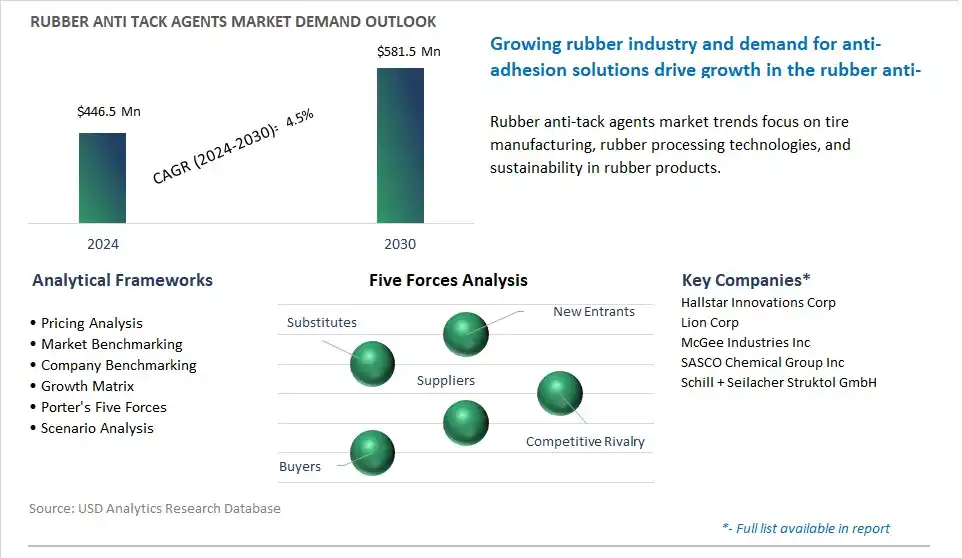
The global Rubber Anti tack Agents Market is poised to register a 4.5% CAGR from $446.5 Million in 2024 to $581.5 Million in 2030.
The global Rubber Anti tack Agents Market Study analyzes and forecasts the market size across 6 regions and 24 countries for diverse segments -By Type (Stearates, Fatty acid esters, Fatty acid amides, Soaps, Others).
An Introduction to Global Rubber Anti tack Agents Market in 2024
The market for rubber anti-tack agents is experiencing growth driven by the increasing demand for solutions to prevent the adhesion of uncured rubber compounds during processing and storage. Key trends shaping the future of the industry include innovations in anti-tack agent formulations, application methods, and sustainability initiatives to meet the requirements of rubber manufacturers for efficiency, cost-effectiveness, and environmental responsibility. Advanced rubber anti-tack agents offer benefits such as non-stick properties, ease of application, and compatibility with various rubber compounds, ensuring smooth processing, reduced waste, and improved product quality. Moreover, the integration of eco-friendly additives, such as natural oils, waxes, and silicones, addresses concerns about chemical exposure, worker safety, and environmental impact. Additionally, the growing emphasis on automation, process optimization, and waste reduction drives market demand for rubber anti-tack agents that enable manufacturers to improve production efficiency, reduce downtime, and enhance sustainability performance. As the rubber industry continues to evolve and adopt new technologies and practices, the rubber anti-tack agents market is poised for continued growth and innovation as a critical component of rubber processing and manufacturing operations.
Rubber Anti tack Agents Market Competitive Landscape
The market report analyses the leading companies in the industry including Hallstar Innovations Corp, Lion Corp, McGee Industries Inc, SASCO Chemical Group Inc, Schill + Seilacher Struktol GmbH.
Rubber Anti tack Agents Market Dynamics
Rubber Anti tack Agents Market Trend: Growing Demand for Environmentally Friendly Formulations
A prominent trend in the rubber anti-tack agents market is the increasing demand for environmentally friendly formulations. With growing environmental awareness and regulatory pressures to reduce emissions and chemical exposure, there is a rising preference for anti-tack agents that are non-toxic, biodegradable, and sustainable. Manufacturers in the rubber industry are seeking alternatives to traditional anti-tack agents based on petroleum-derived materials, such as stearates and fatty acids, in favor of bio-based or synthetic alternatives that offer comparable performance while minimizing environmental impact. This trend is driven by the need for eco-friendly solutions that meet regulatory requirements, enhance worker safety, and align with corporate sustainability goals across the supply chain.
Rubber Anti tack Agents Market Driver: Growth in the Automotive and Tire Industries
The primary driver behind the dynamics of the rubber anti-tack agents market is the growth in the automotive and tire industries, which are major consumers of rubber products. As the automotive sector continues to expand globally, driven by increasing vehicle production and demand for replacement tires, there is a corresponding rise in demand for rubber compounds used in tire manufacturing. Anti-tack agents play a crucial role in tire production by preventing the adhesion of uncured rubber compounds during processing, ensuring smooth handling and quality of the final product. Moreover, innovations in tire design, performance, and sustainability drive the need for advanced anti-tack agents that offer improved processing characteristics, compatibility with tire formulations, and environmental compliance, stimulating market growth and innovation in the rubber anti-tack agents sector.
Rubber Anti tack Agents Market Opportunity: Development of Specialty Formulations and Custom Solutions
An opportunity for market growth within the rubber anti-tack agents sector lies in the development of specialty formulations and custom solutions tailored to specific industry requirements and applications. As manufacturers seek to optimize production processes, enhance product performance, and differentiate their offerings in competitive markets, there is a demand for anti-tack agents that address unique challenges and provide value-added benefits. Companies can capitalize on this opportunity by investing in research and development to develop specialty anti-tack formulations with customized properties such as fast cure times, low transfer, improved mold release, or enhanced compatibility with specific rubber compounds. Moreover, offering custom solutions and technical support services to customers can strengthen partnerships, drive customer loyalty, and create new revenue streams in the rubber anti-tack agents market.
Rubber Anti-tack Agents Market Share Analysis: Stearates segment generated the highest revenue in the industry
The largest segment in the Rubber Anti-tack Agents Market is the Stearates segment. This dominance is primarily due to diverse factors. Stearates, such as zinc stearate and calcium stearate, are widely used as anti-tack agents in the rubber industry due to their effectiveness in preventing rubber compounds from sticking to processing equipment and molds during manufacturing processes. Additionally, stearates act as lubricants, mold release agents, and dispersants, facilitating the handling and processing of rubber compounds. In addition, stearates offer advantages such as thermal stability, chemical inertness, and compatibility with various rubber formulations, making them suitable for a wide range of applications in the rubber industry. Further, stearates are cost-effective and readily available in large quantities, making them a preferred choice for rubber manufacturers seeking efficient and reliable anti-tack solutions. Over the forecast period, the combination of performance, versatility, and cost-effectiveness positions the Stearates segment as the largest and most significant segment in the Rubber Anti-tack Agents Market.
Rubber Anti tack Agents Market Report Segmentation
By Type
Stearates
Fatty acid esters
Fatty acid amides
Soaps
Others
Regions Included
North America (US, Canada, Mexico)
Europe (Germany, UK, France, Spain, Italy, Russia, Rest of Europe)
Asia Pacific (China, India, Japan, South Korea, Australia, South East Asia, Rest of Asia)
South America (Brazil, Argentina, Rest of South America)
Middle East and Africa (Saudi Arabia, UAE, Rest of Middle East, South Africa, Egypt, Rest of Africa)
Rubber Anti tack Agents Companies Profiled in the Market Study
Hallstar Innovations Corp
Lion Corp
McGee Industries Inc
SASCO Chemical Group Inc
Schill + Seilacher Struktol GmbH
*- List Not Exhaustive
TABLE OF CONTENTS
1 Introduction to 2024 Rubber Anti tack Agents Market
1.1 Market Overview
1.2 Quick Facts
1.3 Scope/Objective of the Study
1.4 Market Definition
1.5 Countries and Regions Covered
1.6 Units, Currency, and Conversions
1.7 Industry Value Chain
2 Research Methodology
2.1 Market Size Estimation
2.2 Sources and Research Methodology
2.3 Data Triangulation
2.4 Assumptions and Limitations
3 Executive Summary
3.1 Global Rubber Anti tack Agents Market Size Outlook, $ Million, 2021 to 2030
3.2 Rubber Anti tack Agents Market Outlook by Type, $ Million, 2021 to 2030
3.3 Rubber Anti tack Agents Market Outlook by Product, $ Million, 2021 to 2030
3.4 Rubber Anti tack Agents Market Outlook by Application, $ Million, 2021 to 2030
3.5 Rubber Anti tack Agents Market Outlook by Key Countries, $ Million, 2021 to 2030
4 Market Dynamics
4.1 Key Driving Forces of Rubber Anti tack Agents Industry
4.2 Key Market Trends in Rubber Anti tack Agents Industry
4.3 Potential Opportunities in Rubber Anti tack Agents Industry
4.4 Key Challenges in Rubber Anti tack Agents Industry
5 Market Factor Analysis
5.1 Value Chain Analysis
5.2 Competitive Landscape
5.2.1 Global Rubber Anti tack Agents Market Share by Company (%), 2023
5.2.2 Product Offerings by Company
5.3 Porter’s Five Forces Analysis
5.4 Pricing Analysis and Outlook
6 Growth Outlook Across Scenarios
6.1 Growth Analysis-Case Scenario Definitions
6.2 Low Growth Scenario Forecasts
6.3 Reference Growth Scenario Forecasts
6.4 High Growth Scenario Forecasts
7 Global Rubber Anti tack Agents Market Outlook by Segments
7.1 Rubber Anti tack Agents Market Outlook by Segments, $ Million, 2021- 2030
By Type
Stearates
Fatty acid esters
Fatty acid amides
Soaps
Others
8 North America Rubber Anti tack Agents Market Analysis and Outlook To 2030
8.1 Introduction to North America Rubber Anti tack Agents Markets in 2024
8.2 North America Rubber Anti tack Agents Market Size Outlook by Country, 2021-2030
8.2.1 United States
8.2.2 Canada
8.2.3 Mexico
8.3 North America Rubber Anti tack Agents Market size Outlook by Segments, 2021-2030
By Type
Stearates
Fatty acid esters
Fatty acid amides
Soaps
Others
9 Europe Rubber Anti tack Agents Market Analysis and Outlook To 2030
9.1 Introduction to Europe Rubber Anti tack Agents Markets in 2024
9.2 Europe Rubber Anti tack Agents Market Size Outlook by Country, 2021-2030
9.2.1 Germany
9.2.2 France
9.2.3 Spain
9.2.4 United Kingdom
9.2.4 Italy
9.2.5 Russia
9.2.6 Norway
9.2.7 Rest of Europe
9.3 Europe Rubber Anti tack Agents Market Size Outlook by Segments, 2021-2030
By Type
Stearates
Fatty acid esters
Fatty acid amides
Soaps
Others
10 Asia Pacific Rubber Anti tack Agents Market Analysis and Outlook To 2030
10.1 Introduction to Asia Pacific Rubber Anti tack Agents Markets in 2024
10.2 Asia Pacific Rubber Anti tack Agents Market Size Outlook by Country, 2021-2030
10.2.1 China
10.2.2 India
10.2.3 Japan
10.2.4 South Korea
10.2.5 Indonesia
10.2.6 Malaysia
10.2.7 Australia
10.2.8 Rest of Asia Pacific
10.3 Asia Pacific Rubber Anti tack Agents Market size Outlook by Segments, 2021-2030
By Type
Stearates
Fatty acid esters
Fatty acid amides
Soaps
Others
11 South America Rubber Anti tack Agents Market Analysis and Outlook To 2030
11.1 Introduction to South America Rubber Anti tack Agents Markets in 2024
11.2 South America Rubber Anti tack Agents Market Size Outlook by Country, 2021-2030
11.2.1 Brazil
11.2.2 Argentina
11.2.3 Rest of South America
11.3 South America Rubber Anti tack Agents Market size Outlook by Segments, 2021-2030
By Type
Stearates
Fatty acid esters
Fatty acid amides
Soaps
Others
12 Middle East and Africa Rubber Anti tack Agents Market Analysis and Outlook To 2030
12.1 Introduction to Middle East and Africa Rubber Anti tack Agents Markets in 2024
12.2 Middle East and Africa Rubber Anti tack Agents Market Size Outlook by Country, 2021-2030
12.2.1 Saudi Arabia
12.2.2 UAE
12.2.3 Oman
12.2.4 Rest of Middle East
12.2.5 Egypt
12.2.6 Nigeria
12.2.7 South Africa
12.2.8 Rest of Africa
12.3 Middle East and Africa Rubber Anti tack Agents Market size Outlook by Segments, 2021-2030
By Type
Stearates
Fatty acid esters
Fatty acid amides
Soaps
Others
13 Company Profiles
13.1 Company Snapshot
13.2 SWOT Profiles
13.3 Products and Services
13.4 Recent Developments
13.5 Financial Profile
Hallstar Innovations Corp
Lion Corp
McGee Industries Inc
SASCO Chemical Group Inc
Schill + Seilacher Struktol GmbH
14 Appendix
14.1 Customization Offerings
14.2 Subscription Services
14.3 Related Reports
14.4 Publisher Expertise
By Type
Stearates
Fatty acid esters
Fatty acid amides
Soaps
Others
Countries Analyzed
North America (US, Canada, Mexico)
Europe (Germany, UK, France, Spain, Italy, Russia, Rest of Europe)
Asia Pacific (China, India, Japan, South Korea, Australia, South East Asia, Rest of Asia)
South America (Brazil, Argentina, Rest of South America)
Middle East and Africa (Saudi Arabia, UAE, Rest of Middle East, South Africa, Egypt, Rest of Africa)
