Global Ruminant Feed Market Size is valued at $91.8 Billion in 2024 and is forecast to register a growth rate (CAGR) of 4.3% to reach $128.6 Billion by 2032.
The global Ruminant Feed Market Comprehensive Study analyzes and forecasts the market size across 6 regions and 24 countries for diverse segments -By Animal (Dairy Cattle, Beef Cattle, Others), By Ingredient (Cereals, Cakes and Meals, Others), By End-User (Dairy farm, Veterinary hospitals, Others)
An Introduction to Ruminant Feed Market
The ruminant feed market in 2024 is expanding due to the increasing global demand for meat and dairy products. Ruminant feed, essential for the nutrition of cattle, sheep, and goats, includes a variety of grains, forages, and supplements designed to enhance productivity and health. The market is driven by advancements in feed formulation and a focus on optimizing animal growth, milk yield, and reproductive performance. Additionally, the growing emphasis on sustainable and organic farming practices is influencing feed production, with a shift towards natural additives and non-GMO ingredients. Major producers are also investing in research and development to create more efficient and environmentally friendly feed solutions.
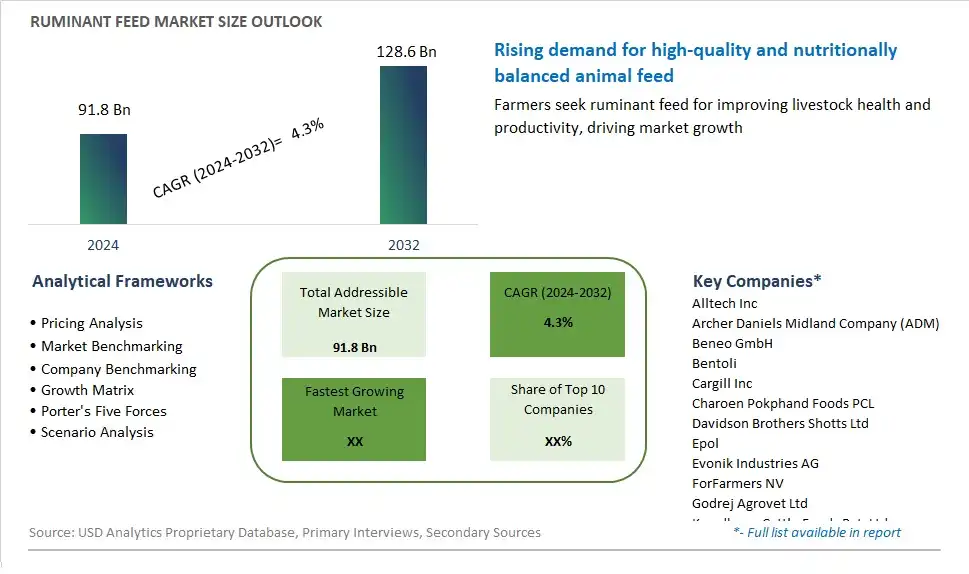
Ruminant Feed Competitive Landscape
The market report analyses the leading companies in the industry including Alltech Inc, Archer Daniels Midland Company (ADM), Beneo GmbH, Bentoli, Cargill Inc, Charoen Pokphand Foods PCL, Davidson Brothers Shotts Ltd, Epol, Evonik Industries AG, ForFarmers NV, Godrej Agrovet Ltd, Kamdhenu Cattle Feeds Pvt. Ltd, Kemin Industries Inc, Koninklijke DSM NV, Land O Lakes Inc, Neogen Corp, Perdue Farms Inc, SHV Holdings NV, Tyson Foods Inc, and Others.
Ruminant Feed Market Dynamics
Ruminant Feed Market Trend: Shift Towards Sustainable and Nutrient-Dense Ruminant Feeds
A prominent market trend in the ruminant feed segment is the shift towards sustainable and nutrient-dense feed formulations. With increasing concerns about environmental sustainability and animal welfare, there is growing demand for ruminant feeds that are not only nutritious but also sourced and produced in an environmentally responsible manner. Consumers and farmers alike are seeking feed options that minimize environmental impact, reduce greenhouse gas emissions, and promote animal health and well-being. This trend is driven by regulatory pressures, consumer preferences for sustainably sourced products, and the recognition of the importance of optimizing feed efficiency in livestock production systems to mitigate environmental impact.
Market Driver: Rising Global Demand for Animal Protein and Livestock Products
The market driver for ruminant feed is the rising global demand for animal protein and livestock products. As global populations continue to grow and incomes rise, there is increasing demand for meat, milk, and other ruminant-derived products as dietary staples and sources of essential nutrients. This driver is reinforced by changing dietary preferences, urbanization, and income growth in emerging economies, which are driving increased consumption of animal protein. To meet this growing demand sustainably and efficiently, farmers and feed manufacturers are seeking innovative feed solutions that optimize ruminant nutrition, improve feed conversion efficiency, and support the health and productivity of livestock.
Market Opportunity: Adoption of Precision Feeding Technologies and Nutritional Strategies
One potential opportunity for the ruminant feed market lies in the adoption of precision feeding technologies and nutritional strategies. Precision feeding involves the precise management of feed ingredients, quantities, and timing to meet the specific nutritional requirements of individual animals or groups of animals based on factors such as age, weight, breed, and production stage. By leveraging advances in data analytics, sensor technology, and nutritional science, farmers and feed manufacturers can optimize ruminant feed formulations, reduce feed wastage, and improve feed efficiency. Additionally, developing targeted nutritional strategies that address the unique needs of ruminants under different production systems, environmental conditions, and management practices can help enhance animal health, productivity, and profitability. By embracing precision feeding technologies and tailored nutritional approaches, stakeholders in the ruminant feed market can position themselves for long-term growth and sustainability in the livestock industry.
Ruminant Feed Market Share Analysis: Dairy Cattle held the dominant market share in 2024
In the Ruminant Feed market segmented by animal, the Dairy Cattle segment is the largest, driven by the significant demand for specialized nutrition to support milk production and overall herd health in dairy farming operations. Dairy cattle require a balanced diet rich in essential nutrients, vitamins, and minerals to maintain optimal milk yield, reproductive performance, and immune function. This segment's dominance is reinforced by the intensive management practices and technological advancements employed in modern dairy farming, which emphasize the importance of high-quality feed and nutrition management to maximize productivity and profitability. Further, dairy farmers prioritize nutritionally balanced ruminant feed formulations tailored to the specific needs of lactating cows, including energy-dense concentrates, protein supplements, and forage options such as alfalfa and grass hay. Additionally, advancements in feed processing technologies and formulation techniques enable the customization of ruminant feed blends to meet the nutritional requirements of dairy cattle at different stages of lactation and production cycles. Furthermore, the dairy industry's economic significance and the steady global demand for dairy products further drive the demand for ruminant feed for dairy cattle, consolidating the Dairy Cattle segment's position as the largest in the Ruminant Feed market. Overall, the combination of specialized nutritional requirements, technological advancements, and market demand contributes to the dominance of the Dairy Cattle segment in the Ruminant Feed market.
Ruminant Feed Market Share Analysis: Cakes and Meals market is poised to register the fastest growth rae over the forecast period to 2032
In the Ruminant Feed market segmented by ingredient, the Cakes and Meals segment is the fastest-growing, propelled by the increasing adoption of concentrated and nutritionally dense feed options to optimize ruminant health and performance. Cakes and meals offer a convenient and efficient means of delivering essential nutrients, including proteins, fats, vitamins, and minerals, to ruminant animals such as dairy and beef cattle. This segment's growth is driven by several factors, including the growing awareness among livestock producers of the importance of balanced nutrition in achieving optimal production outcomes and profitability. Cakes and meals provide a concentrated source of energy and protein, making them ideal for supplementing forage-based diets and addressing nutritional deficiencies. Additionally, the availability of specialized formulations tailored to the nutritional needs of different ruminant species and production stages further contributes to the segment's rapid growth. Further, advancements in feed processing technologies enable the production of cakes and meals with improved palatability, digestibility, and nutrient bioavailability, enhancing their appeal to livestock producers. Furthermore, the rising demand for high-performance ruminant feed options, driven by increasing global meat and dairy consumption trends, further fuels the growth of the Cakes and Meals segment in the Ruminant Feed market. Overall, the combination of nutritional benefits, convenience, and technological advancements positions the Cakes and Meals segment as the fastest-growing in the Ruminant Feed market.
Ruminant Feed Market Share Analysis: Dairy Farms held the dominant market share in 2024
In the Ruminant Feed market segmented by end-user, the Dairy Farm segment is the largest, driven by the substantial demand for specialized feed formulations to support milk production and overall herd health in dairy farming operations. Dairy farms require a comprehensive range of ruminant feed options tailored to the specific nutritional needs of lactating cows and growing replacement heifers. This segment's dominance is reinforced by the intensive management practices and technological advancements employed in modern dairy farming, which prioritize the optimization of feed efficiency, milk yield, and animal welfare. Further, dairy farmers prioritize high-quality feed formulations containing essential nutrients, vitamins, and minerals to maintain optimal herd performance and profitability. Additionally, the dairy industry's economic significance and the steady global demand for dairy products further drive the demand for ruminant feed in dairy farming operations, consolidating the Dairy Farm segment's position as the largest in the Ruminant Feed market. Overall, the combination of specialized nutritional requirements, technological advancements, and market demand contributes to the dominance of the Dairy Farm segment in the Ruminant Feed market.
Ruminant Feed Market Segmentation
By Animal
Dairy Cattle
Beef Cattle
Others
By Ingredient
Cereals
Cakes and Meals
Others
By End-User
Dairy farm
Veterinary hospitals
Others
Countries Analyzed
North America (US, Canada, Mexico)
Europe (Germany, UK, France, Spain, Italy, Russia, Rest of Europe)
Asia Pacific (China, India, Japan, South Korea, Australia, South East Asia, Rest of Asia)
South America (Brazil, Argentina, Rest of South America)
Middle East and Africa (Saudi Arabia, UAE, Rest of Middle East, South Africa, Egypt, Rest of Africa)
Ruminant Feed Companies Profiled in the Study
Alltech Inc
Archer Daniels Midland Company (ADM)
Beneo GmbH
Bentoli
Cargill Inc
Charoen Pokphand Foods PCL
Davidson Brothers Shotts Ltd
Epol
Evonik Industries AG
ForFarmers NV
Godrej Agrovet Ltd
Kamdhenu Cattle Feeds Pvt. Ltd
Kemin Industries Inc
Koninklijke DSM NV
Land O Lakes Inc
Neogen Corp
Perdue Farms Inc
SHV Holdings NV
Tyson Foods Inc
*- List Not Exhaustive
Chapter 1. TABLE OF CONTENTS
Chapter 2. Introduction to Ruminant Feed Market
2.1. Market Overview
2.2. Key Statistics and Report Highlights
2.3. Scope of the Comprehensive Study
2.3.1. Market Definition
2.3.2 Countries and Regions Covered
2.3.3 Research Objective
2.3.4 Units, Currency, and Conversions
2.3.5 Industry Value Chain
2.4. Key Market Segments
2.5. Key Companies
2.6. Study Period
Chapter 3. Strategic Analysis Review
3.1. Ruminant Feed Pricing Analysis and Forecast
3.2. Porter’s Five Forces
3.3. Market Ecosystem
3.4. SWOT Analysis
3.5. Regulatory Scenario
3.3. Effects of Inflation, Russia-Ukraine War, moderating economic growth, and other macroeconomic factors
Chapter 4. Competitive Landscape
4.1. Market Share Analysis
4.1.1. Global Ruminant Feed Market Share by Company, 2023
4.1.2. Product Offerings of Leading Ruminant Feed Companies
4.2. Market Entropy
4.2.1. New Product Launches in the Industry
4.2.2. Mergers, Acquisitions, Joint ventures, and Partnerships
4.3. Key Strategies and Best Practices
Chapter 5. Global Market Projections: Best, Reference, and Low Case Scenarios
5.1. Growth Analysis- Case Scenario Definitions
5.2. Low Growth Case Scenario Forecasts
5.3. Reference Growth Case Scenario Forecasts
5.4. High Growth Case Scenario Forecasts
Chapter 6. Market Dynamics
6.1. Ruminant Feed Market Drivers
6.2. Ruminant Feed Market Challenges
6.6. Ruminant Feed Market Opportunities
6.4. Ruminant Feed Market Trends
Chapter 7. Global Ruminant Feed Market Outlook Trends
7.1. Global Ruminant Feed Revenue (USD Million) and CAGR (%) by Type (2021-2032)
7.2. Global Ruminant Feed Revenue (USD Million) and CAGR (%) by Application (2021-2032)
7.3. Global Ruminant Feed Revenue (USD Million) and CAGR (%) by Product (2021-2032)
By Animal
Dairy Cattle
Beef Cattle
Others
By Ingredient
Cereals
Cakes and Meals
Others
By End-User
Dairy farm
Veterinary hospitals
Others
Chapter 8. Global Ruminant Feed Regional Analysis and Outlook
8.1. Global Ruminant Feed Revenue (USD Million) By Regions (2021- 2032)
8.2. North America Ruminant Feed Revenue (USD Million) by Country (2021-2032)
8.2.1. United States Ruminant Feed Regional Analysis and Outlook
8.2.2. Canada Ruminant Feed Regional Analysis and Outlook
8.2.3. Mexico Ruminant Feed Regional Analysis and Outlook
8.3. Europe Ruminant Feed Revenue (USD Million), by Country (2021-2032)
8.3.1. Germany Ruminant Feed Regional Analysis and Outlook
8.3.2. France Ruminant Feed Regional Analysis and Outlook
8.3.3. United Kingdom Ruminant Feed Regional Analysis and Outlook
8.3.4. Spain Ruminant Feed Regional Analysis and Outlook
8.3.5. Italy Ruminant Feed Regional Analysis and Outlook
8.3.6. Russia Ruminant Feed Regional Analysis and Outlook
8.3.7. Rest of Europe Ruminant Feed Regional Analysis and Outlook
8.4. Asia Pacific Ruminant Feed Revenue (USD Million) by Country (2021-2032)
8.4.1. China Ruminant Feed Regional Analysis and Outlook
8.4.2. Japan Ruminant Feed Regional Analysis and Outlook
8.4.3. India Ruminant Feed Regional Analysis and Outlook
8.4.4. South Korea Ruminant Feed Regional Analysis and Outlook
8.4.5. Australia Ruminant Feed Regional Analysis and Outlook
8.4.6. South East Asia Ruminant Feed Regional Analysis and Outlook
8.4.7. Rest of Asia Pacific Ruminant Feed Regional Analysis and Outlook
8.5. South America Ruminant Feed Revenue (USD Million), by Country (2021-2032)
8.5.1. Brazil Ruminant Feed Regional Analysis and Outlook
8.5.2. Argentina Ruminant Feed Regional Analysis and Outlook
8.5.3. Rest of South America Ruminant Feed Regional Analysis and Outlook
8.6. Middle East and Africa Ruminant Feed Revenue (USD Million) by Country (2021-2032)
8.6.1. Middle East Ruminant Feed Regional Analysis and Outlook
8.6.2. Africa Ruminant Feed Regional Analysis and Outlook
Chapter 9. North America Ruminant Feed Analysis and Outlook
9.1. North America Ruminant Feed Revenue (USD Million) by Segments (2021-2032)
9.1.1. North America Ruminant Feed Revenue (USD Million) by Type (2021-2032)
9.1.2. North America Ruminant Feed Revenue (USD Million) by Application (2021-2032)
9.1.3. North America Ruminant Feed Revenue (USD Million) by Product (2021-2032)
By Animal
Dairy Cattle
Beef Cattle
Others
By Ingredient
Cereals
Cakes and Meals
Others
By End-User
Dairy farm
Veterinary hospitals
Others
Chapter 10. Europe Ruminant Feed Analysis and Outlook
10.1. Europe Ruminant Feed Revenue (USD Million), by Segments (USD Million) (2021-2032)
10.1.1. Europe Ruminant Feed Revenue (USD Million) by Type (2021-2032)
10.1.2. Europe Ruminant Feed Revenue (USD Million) by Application (2021-2032)
10.1.3. Europe Ruminant Feed Revenue (USD Million) by Product (2021-2032)
By Animal
Dairy Cattle
Beef Cattle
Others
By Ingredient
Cereals
Cakes and Meals
Others
By End-User
Dairy farm
Veterinary hospitals
Others
Chapter 11. Asia Pacific Ruminant Feed Analysis and Outlook
11.1. Asia Pacific Ruminant Feed Revenue (USD Million), and Revenue (USD Million) by Segments (2021-2032)
11.1.1. Asia Pacific Ruminant Feed Revenue (USD Million) by Type (2021-2032)
11.1.2. Asia Pacific Ruminant Feed Revenue (USD Million) by Application (2021-2032)
11.1.3. Asia Pacific Ruminant Feed Revenue (USD Million) by Product (2021-2032)
By Animal
Dairy Cattle
Beef Cattle
Others
By Ingredient
Cereals
Cakes and Meals
Others
By End-User
Dairy farm
Veterinary hospitals
Others
Chapter 12. South America Ruminant Feed Analysis and Outlook
12.1. South America Ruminant Feed Revenue (USD Million), by Segments (2021-2032)
12.1.1. South America Ruminant Feed Revenue (USD Million) by Type (2021-2032)
12.1.2. South America Ruminant Feed Revenue (USD Million) by Application (2021-2032)
12.1.3. South America Ruminant Feed Revenue (USD Million) by Product (2021-2032)
By Animal
Dairy Cattle
Beef Cattle
Others
By Ingredient
Cereals
Cakes and Meals
Others
By End-User
Dairy farm
Veterinary hospitals
Others
Chapter 13. Middle East and Africa Ruminant Feed Analysis and Outlook
13.1. Middle East and Africa Ruminant Feed Revenue (USD Million), by Segments (2021-2032)
13.1.1. Middle East and Africa Ruminant Feed Revenue (USD Million) by Type (2021-2032)
13.1.2. Middle East and Africa Ruminant Feed Revenue (USD Million) by Application (2021-2032)
13.1.3. Middle East and Africa Ruminant Feed Revenue (USD Million) by Product (2021-2032)
By Animal
Dairy Cattle
Beef Cattle
Others
By Ingredient
Cereals
Cakes and Meals
Others
By End-User
Dairy farm
Veterinary hospitals
Others
Chapter 14. Ruminant Feed Company Profiles
14.1 Business Overview
14.2 Product Profiles
14.3 SWOT Profiles
14.5 Recent Developments
14.6 Financial Profile
List of Companies
Alltech Inc
Archer Daniels Midland Company (ADM)
Beneo GmbH
Bentoli
Cargill Inc
Charoen Pokphand Foods PCL
Davidson Brothers Shotts Ltd
Epol
Evonik Industries AG
ForFarmers NV
Godrej Agrovet Ltd
Kamdhenu Cattle Feeds Pvt. Ltd
Kemin Industries Inc
Koninklijke DSM NV
Land O Lakes Inc
Neogen Corp
Perdue Farms Inc
SHV Holdings NV
Tyson Foods Inc
15. Methodology and Data Sources
15.1 Customization Offerings
15.2 Subscription Services
15.3 Related Reports
15.4 Publisher Expertise
LIST OF TABLES
Table 1 Market Segmentation Analysis
Table 2 Global Ruminant Feed Market Share of Leading Companies, 2023
Table 3 Product Offerings of Leading Companies
Table 4 Low Growth Scenario Forecasts
Table 5 Reference Case Growth Scenario
Table 6 High Growth Case Scenario
Table 7 Global Ruminant Feed Revenue (USD Million) And CAGR (%) By Type (2021-2032)
Table 8 Global Ruminant Feed Revenue (USD Million) And CAGR (%) By Application (2021-2032)
Table 9 Global Ruminant Feed Revenue (USD Million) And CAGR (%) By Product (2021-2032)
Table 10 Global Ruminant Feed Market Revenue (USD Million) By Regions (2021-2032)
Table 11 Global Ruminant Feed Market Share (%) By Regions (2021-2032)
Table 12 North America Ruminant Feed Revenue (USD Million) By Country (2021-2032)
Table 13 Europe Ruminant Feed Revenue (USD Million) By Country (2021-2032)
Table 14 Asia Pacific Ruminant Feed Revenue (USD Million) By Country (2021-2032)
Table 15 South America Ruminant Feed Revenue (USD Million) By Country (2021-2032)
Table 16 Middle East and Africa Ruminant Feed Revenue (USD Million) By Region (2021-2032)
Table 17 North America Ruminant Feed Revenue (USD Million) By Type (2021-2032)
Table 18 North America Ruminant Feed Revenue (USD Million) By Application (2021-2032)
Table 19 North America Ruminant Feed Revenue (USD Million) By Product (2021-2032)
Table 20 Europe Ruminant Feed Revenue (USD Million) By Type (2021-2032)
Table 21 Europe Ruminant Feed Revenue (USD Million) By Application (2021-2032)
Table 22 Europe Ruminant Feed Revenue (USD Million) By Product (2021-2032)
Table 23 Asia Pacific Ruminant Feed Revenue (USD Million) By Type (2021-2032)
Table 24 Asia Pacific Ruminant Feed Revenue (USD Million) By Application (2021-2032)
Table 25 Asia Pacific Ruminant Feed Revenue (USD Million) By Product (2021-2032)
Table 26 South America Ruminant Feed Revenue (USD Million) By Type (2021-2032)
Table 27 South America Ruminant Feed Revenue (USD Million) By Application (2021-2032)
Table 28 South America Ruminant Feed Revenue (USD Million) By Product (2021-2032)
Table 29 Middle East and Africa Ruminant Feed Revenue (USD Million) By Type (2021-2032)
Table 30 Middle East and Africa Ruminant Feed Revenue (USD Million) By Application (2021-2032)
Table 31 Middle East and Africa Ruminant Feed Revenue (USD Million) By Product (2021-2032)
LIST OF FIGURES
Figure 1. Market Scope
Figure 2. Pricing Forecasts Per Unit, 2023- 2032
Figure 3. Porter’s Five Forces
Figure 4. Global Ruminant Feed Market Revenue (USD Million) By Regions (2021-2032)
Figure 5. Global Ruminant Feed Market Share (%) By Regions (2023)
Figure 6. North America Ruminant Feed Revenue (USD Million) By Country (2021-2032)
Figure 7. United States Ruminant Feed Revenue (USD Million) By Country (2021-2032)
Figure 8. Canada Ruminant Feed Revenue (USD Million) By Country (2021-2032)
Figure 9. Mexico Ruminant Feed Revenue (USD Million) By Country (2021-2032)
Figure 10. Europe Ruminant Feed Revenue (USD Million) By Country (2021-2032)
Figure 11. Germany Ruminant Feed Revenue (USD Million) By Country (2021-2032)
Figure 12. France Ruminant Feed Revenue (USD Million) By Country (2021-2032)
Figure 13. United Kingdom Ruminant Feed Revenue (USD Million) By Country (2021-2032)
Figure 14. Spain Ruminant Feed Revenue (USD Million) By Country (2021-2032)
Figure 15. Italy Ruminant Feed Revenue (USD Million) By Country (2021-2032)
Figure 16. Russia Ruminant Feed Revenue (USD Million) By Country (2021-2032)
Figure 17. Rest of Europe Ruminant Feed Revenue (USD Million) By Country (2021-2032)
Figure 11. Asia Pacific Ruminant Feed Revenue (USD Million) By Country (2021-2032)
Figure 12. China Ruminant Feed Revenue (USD Million) By Country (2021-2032)
Figure 13. Japan Ruminant Feed Revenue (USD Million) By Country (2021-2032)
Figure 14. India Ruminant Feed Revenue (USD Million) By Country (2021-2032)
Figure 15. South Korea Ruminant Feed Revenue (USD Million) By Country (2021-2032)
Figure 16. Australia Ruminant Feed Revenue (USD Million) By Country (2021-2032)
Figure 17. South East Asia Ruminant Feed Revenue (USD Million) By Country (2021-2032)
Figure 18. South America Ruminant Feed Revenue (USD Million) By Country (2021-2032)
Figure 19. Brazil Ruminant Feed Revenue (USD Million) By Country (2021-2032)
Figure 20. Argentina Ruminant Feed Revenue (USD Million) By Country (2021-2032)
Figure 21. Rest of Asia Pacific Ruminant Feed Revenue (USD Million) By Country (2021-2032)
Figure 22. Middle East and Africa Ruminant Feed Revenue (USD Million) By Region (2021-2032)
Figure 23. Saudi Arabia Ruminant Feed Revenue (USD Million) By Region (2021-2032)
Figure 24. The UAE Ruminant Feed Revenue (USD Million) By Region (2021-2032)
Figure 25. Rest of Middle East Ruminant Feed Revenue (USD Million) By Region (2021-2032)
Figure 26. South Africa Ruminant Feed Revenue (USD Million) By Region (2021-2032)
Figure 27. Africa Ruminant Feed Revenue (USD Million) By Region (2021-2032)
Figure 28. North America Ruminant Feed Revenue (USD Million) By Type (2021-2032)
Figure 29. North America Ruminant Feed Revenue (USD Million) By Application (2021-2032)
Figure 30. North America Ruminant Feed Revenue (USD Million) By Product (2021-2032)
Figure 31. Europe Ruminant Feed Revenue (USD Million) By Type (2021-2032)
Figure 32. Europe Ruminant Feed Revenue (USD Million) By Application (2021-2032)
Figure 33. Europe Ruminant Feed Revenue (USD Million) By Product (2021-2032)
Figure 34. Asia Pacific Ruminant Feed Revenue (USD Million) By Type (2021-2032)
Figure 35. Asia Pacific Ruminant Feed Revenue (USD Million) By Application (2021-2032)
Figure 36. Asia Pacific Ruminant Feed Revenue (USD Million) By Product (2021-2032)
Figure 37. South America Ruminant Feed Revenue (USD Million) By Type (2021-2032)
Figure 38. South America Ruminant Feed Revenue (USD Million) By Application (2021-2032)
Figure 39. South America Ruminant Feed Revenue (USD Million) By Product (2021-2032)
Figure 40. Middle East and Africa Ruminant Feed Revenue (USD Million) By Type (2021-2032)
Figure 41. Middle East and Africa Ruminant Feed Revenue (USD Million) By Application (2021-2032)
Figure 42. Middle East and Africa Ruminant Feed Revenue (USD Million) By Product (2021-2032)
By Animal
Dairy Cattle
Beef Cattle
Others
By Ingredient
Cereals
Cakes and Meals
Others
By End-User
Dairy farm
Veterinary hospitals
Others
Countries Analyzed
North America (US, Canada, Mexico)
Europe (Germany, UK, France, Spain, Italy, Russia, Rest of Europe)
Asia Pacific (China, India, Japan, South Korea, Australia, South East Asia, Rest of Asia)
South America (Brazil, Argentina, Rest of South America)
Middle East and Africa (Saudi Arabia, UAE, Rest of Middle East, South Africa, Egypt, Rest of Africa)
