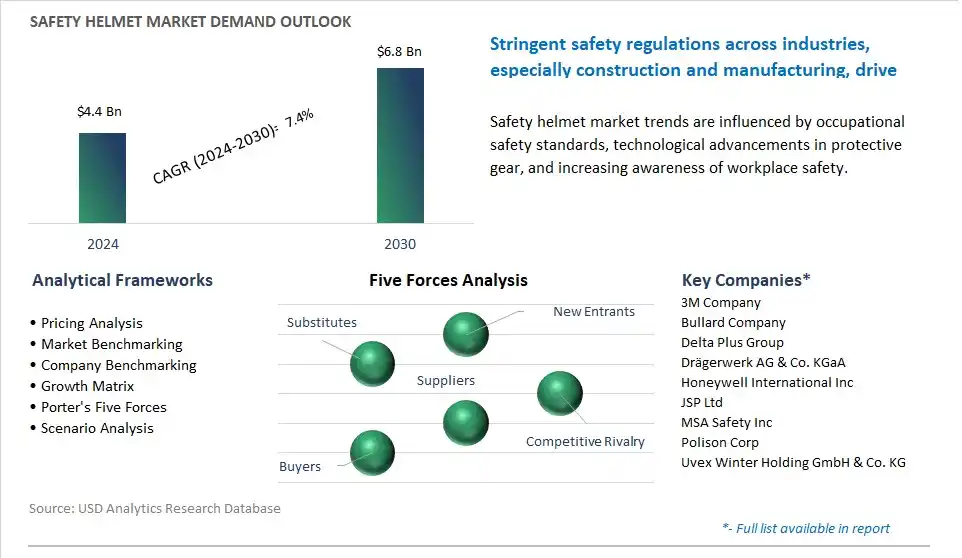
The global Safety Helmet Market is poised to register a 7.4% CAGR from $4.4 Billion in 2024 to $6.8 Billion in 2030.
The global Safety Helmet Market Study analyzes and forecasts the market size across 6 regions and 24 countries for diverse segments -By Material (Polyethylene, Acrylonitrile Butadiene Styrene, Polycarbonate), By Product (Hard Hats, Bump Caps), By End-User (Construction, Manufacturing, Mining, Others).
An Introduction to Global Safety Helmet Market in 2024
The market for safety helmets is witnessing growth driven by the increasing focus on workplace safety, regulatory compliance, and injury prevention across industries such as construction, manufacturing, mining, and utilities. Key trends shaping the future of the industry include innovations in helmet designs, materials, and technologies to enhance comfort, protection, and usability for workers exposed to occupational hazards. Advanced safety helmets offer benefits such as impact resistance, penetration protection, and ergonomics, making them essential for head protection against falling objects, electrical hazards, and traumatic injuries in hazardous environments. Moreover, the integration of advanced materials, such as high-density polyethylene (HDPE), polycarbonate (PC), and fiberglass reinforced plastic (FRP), ensures helmet durability, lightweight, and shock absorption properties, improving wearer comfort and compliance. Additionally, the growing emphasis on workplace ergonomics, risk assessment, and personal protective equipment (PPE) programs drives market demand for safety helmets that meet international safety standards, offer customizable features, and support integration with other safety gear and communication devices. As employers prioritize employee health and safety, the safety helmet market is poised for continued growth and innovation as a critical component of occupational safety programs and injury prevention initiatives across various industries.
Safety Helmet Market Competitive Landscape
The market report analyses the leading companies in the industry including 3M Company, Bullard Company, Delta Plus Group, Drägerwerk AG & Co. KGaA, Honeywell International Inc, JSP Ltd, MSA Safety Inc, Polison Corp, Uvex Winter Holding GmbH & Co. KG.
Safety Helmet Market Dynamics
Safety Helmet Market Trend: Increasing Emphasis on Workplace Safety
A prominent trend in the safety helmet market is the increasing emphasis on workplace safety. With growing awareness of occupational hazards and the importance of protecting workers from head injuries, there is a rising demand for safety helmets across various industries such as construction, manufacturing, mining, and transportation. Employers are investing in high-quality safety helmets that meet stringent safety standards and provide adequate protection against impact, penetration, and electrical hazards. This trend is driven by regulatory requirements, corporate safety initiatives, and a growing focus on employee well-being, shaping the future of the safety helmet market towards greater adoption of advanced head protection solutions.
Safety Helmet Market Driver: Stringent Occupational Safety Regulations
The primary driver behind the growth of the safety helmet market is the enforcement of stringent occupational safety regulations. Governments worldwide are implementing laws and standards that mandate the use of personal protective equipment (PPE), including safety helmets, in hazardous work environments. Occupational safety regulations specify the performance requirements, testing procedures, and certification criteria for safety helmets to ensure they provide effective protection against workplace hazards. Additionally, industries with high rates of head injuries, such as construction and mining, have specific regulations that require employers to provide appropriate head protection for workers. This driver is fueled by the need to reduce workplace accidents, prevent head injuries, and comply with legal obligations, stimulating market growth and investment in safety helmet technologies and innovations.
Safety Helmet Market Opportunity: Integration of Smart Technologies
An opportunity for market growth within the safety helmet sector lies in the integration of smart technologies. While traditional safety helmets offer basic protection against physical hazards, there is a growing demand for helmets with added functionalities such as communication, monitoring, and augmented reality (AR) capabilities. Smart helmets equipped with sensors, cameras, and communication devices can provide real-time monitoring of environmental conditions, worker location tracking, and alerts for potential safety hazards. Additionally, AR-enabled helmets can overlay digital information onto the wearer's field of view, enhancing situational awareness and facilitating remote collaboration. By integrating smart technologies into safety helmets, manufacturers can offer innovative solutions that improve workplace safety, productivity, and efficiency. This opportunity is fueled by advancements in sensor technology, wireless connectivity, and wearable computing, enabling the development of next-generation safety helmets that meet the evolving needs of modern workplaces. Additionally, collaboration with technology partners, software developers, and industry stakeholders enables safety helmet suppliers to address market demands, enhance product offerings, and drive innovation in smart PPE solutions.
Safety Helmet Market Share Analysis: Polyethylene segment generated the highest revenue in the industry
The Polyethylene segment is the largest segment in the Safety Helmet Market for diverse compelling reasons. The polyethylene helmets are widely used in industries such as construction, manufacturing, mining, and utilities due to their lightweight, durable, and cost-effective properties. Polyethylene helmets offer excellent impact resistance and protection against falling objects, debris, and other occupational hazards, making them suitable for a wide range of industrial applications. Additionally, polyethylene helmets are comfortable to wear for extended periods, thanks to their lightweight construction and adjustable suspension systems. In addition, polyethylene helmets are available in various colors, styles, and designs to meet the specific safety requirements and preferences of users and employers. Further, polyethylene helmets are compliant with industry standards and regulations for head protection, ensuring the safety and well-being of workers in hazardous work environments. As industries prioritize workplace safety and invest in personal protective equipment (PPE) to mitigate occupational risks, the Polyethylene segment maintains its dominance as the largest segment in the Safety Helmet Market.
Safety Helmet Market Share Analysis: Bump Caps Segment is poised to register the fastest growth rate (CAGR) over the forecast period to 2030
The Bump Caps segment is the fastest-growing segment in the Safety Helmet Market for diverse compelling reasons. The bump caps are gaining popularity in industries where workers face risks of minor head injuries from low-hanging obstacles, bumps, or impacts. Unlike traditional hard hats designed for protection against falling objects or high-impact hazards, bump caps provide lightweight and low-profile head protection suitable for environments with overhead hazards or confined spaces. Additionally, bump caps are often preferred in industries such as automotive, food processing, warehouse, and logistics, where workers need protection against accidental bumps, scrapes, or impacts without compromising comfort or visibility. In addition, bump caps are available in various styles and materials, including foam padding, plastic shells, and baseball cap designs, offering users customizable options to suit their specific job requirements and preferences. Further, the growing emphasis on workplace safety and injury prevention drives the adoption of bump caps as part of comprehensive personal protective equipment (PPE) programs in industries where head injuries are a concern. As employers prioritize employee safety and seek practical solutions for head protection in diverse work environments, the Bump Caps segment experiences rapid growth in the Safety Helmet Market.
Safety Helmet Market Share Analysis: Others Segment is poised to register the fastest growth rate (CAGR) over the forecast period to 2030
The "Others" segment is the fastest-growing segment in the Safety Helmet Market for diverse compelling reasons. The this segment encompasses a diverse range of end-users beyond the traditional industries of construction, manufacturing, and mining. These include industries such as utilities, oil and gas, transportation, forestry, agriculture, and emergency services, among others. Additionally, as workplace safety regulations become more stringent across various sectors, employers in non-traditional industries are increasingly prioritizing the safety and well-being of their workers by implementing comprehensive personal protective equipment (PPE) programs, including safety helmets. In addition, advancements in technology and materials have led to the development of specialized helmets tailored to the unique hazards and requirements of specific industries. For example, helmets designed for utility workers may incorporate features such as arc flash protection, while those used in forestry may include integrated face shields and hearing protection. Further, the growing awareness of head injuries and the long-term impact of traumatic brain injuries (TBIs) on worker health and productivity drive the demand for safety helmets in a wide range of industries. As employers across diverse sectors recognize the importance of providing adequate head protection to their workers, the "Others" segment experiences rapid growth in the Safety Helmet Market.
Safety Helmet Market Report Segmentation
By Material
Polyethylene
Acrylonitrile Butadiene Styrene
Polycarbonate
By Product
Hard Hats
-Type I
-Type II
Bump Caps
-Hard Bump Camps
-Soft Bump Caps
By End-User
Construction
Manufacturing
Mining
Others
Regions Included
North America (US, Canada, Mexico)
Europe (Germany, UK, France, Spain, Italy, Russia, Rest of Europe)
Asia Pacific (China, India, Japan, South Korea, Australia, South East Asia, Rest of Asia)
South America (Brazil, Argentina, Rest of South America)
Middle East and Africa (Saudi Arabia, UAE, Rest of Middle East, South Africa, Egypt, Rest of Africa)
Safety Helmet Companies Profiled in the Market Study
3M Company
Bullard Company
Delta Plus Group
Drägerwerk AG & Co. KGaA
Honeywell International Inc
JSP Ltd
MSA Safety Inc
Polison Corp
Uvex Winter Holding GmbH & Co. KG
*- List Not Exhaustive
TABLE OF CONTENTS
1 Introduction to 2024 Safety Helmet Market
1.1 Market Overview
1.2 Quick Facts
1.3 Scope/Objective of the Study
1.4 Market Definition
1.5 Countries and Regions Covered
1.6 Units, Currency, and Conversions
1.7 Industry Value Chain
2 Research Methodology
2.1 Market Size Estimation
2.2 Sources and Research Methodology
2.3 Data Triangulation
2.4 Assumptions and Limitations
3 Executive Summary
3.1 Global Safety Helmet Market Size Outlook, $ Million, 2021 to 2030
3.2 Safety Helmet Market Outlook by Type, $ Million, 2021 to 2030
3.3 Safety Helmet Market Outlook by Product, $ Million, 2021 to 2030
3.4 Safety Helmet Market Outlook by Application, $ Million, 2021 to 2030
3.5 Safety Helmet Market Outlook by Key Countries, $ Million, 2021 to 2030
4 Market Dynamics
4.1 Key Driving Forces of Safety Helmet Industry
4.2 Key Market Trends in Safety Helmet Industry
4.3 Potential Opportunities in Safety Helmet Industry
4.4 Key Challenges in Safety Helmet Industry
5 Market Factor Analysis
5.1 Value Chain Analysis
5.2 Competitive Landscape
5.2.1 Global Safety Helmet Market Share by Company (%), 2023
5.2.2 Product Offerings by Company
5.3 Porter’s Five Forces Analysis
5.4 Pricing Analysis and Outlook
6 Growth Outlook Across Scenarios
6.1 Growth Analysis-Case Scenario Definitions
6.2 Low Growth Scenario Forecasts
6.3 Reference Growth Scenario Forecasts
6.4 High Growth Scenario Forecasts
7 Global Safety Helmet Market Outlook by Segments
7.1 Safety Helmet Market Outlook by Segments, $ Million, 2021- 2030
By Material
Polyethylene
Acrylonitrile Butadiene Styrene
Polycarbonate
By Product
Hard Hats
-Type I
-Type II
Bump Caps
-Hard Bump Camps
-Soft Bump Caps
By End-User
Construction
Manufacturing
Mining
Others
8 North America Safety Helmet Market Analysis and Outlook To 2030
8.1 Introduction to North America Safety Helmet Markets in 2024
8.2 North America Safety Helmet Market Size Outlook by Country, 2021-2030
8.2.1 United States
8.2.2 Canada
8.2.3 Mexico
8.3 North America Safety Helmet Market size Outlook by Segments, 2021-2030
By Material
Polyethylene
Acrylonitrile Butadiene Styrene
Polycarbonate
By Product
Hard Hats
-Type I
-Type II
Bump Caps
-Hard Bump Camps
-Soft Bump Caps
By End-User
Construction
Manufacturing
Mining
Others
9 Europe Safety Helmet Market Analysis and Outlook To 2030
9.1 Introduction to Europe Safety Helmet Markets in 2024
9.2 Europe Safety Helmet Market Size Outlook by Country, 2021-2030
9.2.1 Germany
9.2.2 France
9.2.3 Spain
9.2.4 United Kingdom
9.2.4 Italy
9.2.5 Russia
9.2.6 Norway
9.2.7 Rest of Europe
9.3 Europe Safety Helmet Market Size Outlook by Segments, 2021-2030
By Material
Polyethylene
Acrylonitrile Butadiene Styrene
Polycarbonate
By Product
Hard Hats
-Type I
-Type II
Bump Caps
-Hard Bump Camps
-Soft Bump Caps
By End-User
Construction
Manufacturing
Mining
Others
10 Asia Pacific Safety Helmet Market Analysis and Outlook To 2030
10.1 Introduction to Asia Pacific Safety Helmet Markets in 2024
10.2 Asia Pacific Safety Helmet Market Size Outlook by Country, 2021-2030
10.2.1 China
10.2.2 India
10.2.3 Japan
10.2.4 South Korea
10.2.5 Indonesia
10.2.6 Malaysia
10.2.7 Australia
10.2.8 Rest of Asia Pacific
10.3 Asia Pacific Safety Helmet Market size Outlook by Segments, 2021-2030
By Material
Polyethylene
Acrylonitrile Butadiene Styrene
Polycarbonate
By Product
Hard Hats
-Type I
-Type II
Bump Caps
-Hard Bump Camps
-Soft Bump Caps
By End-User
Construction
Manufacturing
Mining
Others
11 South America Safety Helmet Market Analysis and Outlook To 2030
11.1 Introduction to South America Safety Helmet Markets in 2024
11.2 South America Safety Helmet Market Size Outlook by Country, 2021-2030
11.2.1 Brazil
11.2.2 Argentina
11.2.3 Rest of South America
11.3 South America Safety Helmet Market size Outlook by Segments, 2021-2030
By Material
Polyethylene
Acrylonitrile Butadiene Styrene
Polycarbonate
By Product
Hard Hats
-Type I
-Type II
Bump Caps
-Hard Bump Camps
-Soft Bump Caps
By End-User
Construction
Manufacturing
Mining
Others
12 Middle East and Africa Safety Helmet Market Analysis and Outlook To 2030
12.1 Introduction to Middle East and Africa Safety Helmet Markets in 2024
12.2 Middle East and Africa Safety Helmet Market Size Outlook by Country, 2021-2030
12.2.1 Saudi Arabia
12.2.2 UAE
12.2.3 Oman
12.2.4 Rest of Middle East
12.2.5 Egypt
12.2.6 Nigeria
12.2.7 South Africa
12.2.8 Rest of Africa
12.3 Middle East and Africa Safety Helmet Market size Outlook by Segments, 2021-2030
By Material
Polyethylene
Acrylonitrile Butadiene Styrene
Polycarbonate
By Product
Hard Hats
-Type I
-Type II
Bump Caps
-Hard Bump Camps
-Soft Bump Caps
By End-User
Construction
Manufacturing
Mining
Others
13 Company Profiles
13.1 Company Snapshot
13.2 SWOT Profiles
13.3 Products and Services
13.4 Recent Developments
13.5 Financial Profile
3M Company
Bullard Company
Delta Plus Group
Drägerwerk AG & Co. KGaA
Honeywell International Inc
JSP Ltd
MSA Safety Inc
Polison Corp
Uvex Winter Holding GmbH & Co. KG
14 Appendix
14.1 Customization Offerings
14.2 Subscription Services
14.3 Related Reports
14.4 Publisher Expertise
By Material
Polyethylene
Acrylonitrile Butadiene Styrene
Polycarbonate
By Product
Hard Hats
-Type I
-Type II
Bump Caps
-Hard Bump Camps
-Soft Bump Caps
By End-User
Construction
Manufacturing
Mining
Others
Countries Analyzed
North America (US, Canada, Mexico)
Europe (Germany, UK, France, Spain, Italy, Russia, Rest of Europe)
Asia Pacific (China, India, Japan, South Korea, Australia, South East Asia, Rest of Asia)
South America (Brazil, Argentina, Rest of South America)
Middle East and Africa (Saudi Arabia, UAE, Rest of Middle East, South Africa, Egypt, Rest of Africa)
