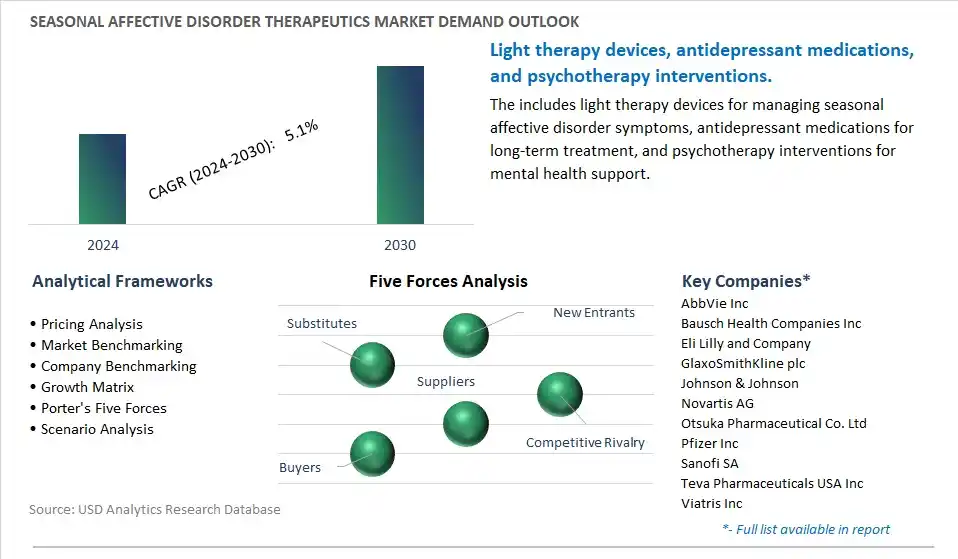
Seasonal Affective Disorder Therapeutics Market is estimated to increase at a Compounded Annual Growth Rate of 5.1% CAGR over the forecast period from 2024 to 2030
The Seasonal Affective Disorder Therapeutics Market study analyzes and forecasts the market size across 6 regions and 24 countries for diverse segments- By Drug (Selective Serotonin Reuptake Inhibitors (SSRI), Norepinephrine-Dopamine Reuptake Inhibitor (NDRI), Monoamine Oxidase Inhibitor (MAOI), Others), By Disorder (Unipolar Disorder, Bipolar Disorder), By Distribution Channel (Institutional Sales, Retail Sales).
An Introduction to Seasonal Affective Disorder Therapeutics Market in 2024
The market for seasonal affective disorder (SAD) therapeutics remains essential in 2024, addressing the mental health challenges associated with seasonal changes in light exposure and circadian rhythms. Seasonal affective disorder is a subtype of depression characterized by recurrent episodes of depressive symptoms occurring during specific seasons, typically winter months with reduced daylight hours. Therapeutic options for SAD include light therapy, antidepressant medications, psychotherapy, and lifestyle interventions aimed at regulating mood, sleep-wake cycles, and social rhythms. With advancements in light therapy devices, personalized treatment approaches, and digital health solutions, SAD therapeutics offer effective strategies for managing symptoms, improving mood stability, and enhancing overall well-being for individuals affected by this seasonal mood disorder. Moreover, the market is influenced by initiatives to raise awareness of SAD, promote mental health education, and destigmatize seeking help for seasonal depression, fostering a supportive environment for individuals to access timely and appropriate SAD therapeutics and support services.
Market Trend: Increased Awareness and Recognition of Seasonal Affective Disorder (SAD)
A significant trend in the seasonal affective disorder (SAD) therapeutics market is the increased awareness and recognition of SAD as a distinct clinical condition. Seasonal affective disorder is a subtype of major depressive disorder characterized by recurrent episodes of depression that occur at specific times of the year, typically during the fall and winter months when daylight hours are shorter. In recent years, there has been growing awareness among healthcare professionals, patients, and the general public about the prevalence and impact of SAD on mental health and well-being. This heightened awareness has led to improved recognition and diagnosis of SAD, resulting in greater demand for effective therapeutics and interventions to alleviate symptoms and improve quality of life for individuals affected by this seasonal mood disorder. As public awareness campaigns, educational initiatives, and advocacy efforts raise visibility and understanding of SAD, there is a corresponding increase in market demand for SAD therapeutics and treatment options.
Market Driver: Growing Demand for Non-Pharmacological Treatment Approaches
A primary driver propelling the seasonal affective disorder (SAD) therapeutics market forward is the growing demand for non-pharmacological treatment approaches. While pharmacotherapy, including antidepressant medications, has traditionally been a mainstay of treatment for SAD, there is increasing interest in non-pharmacological interventions that offer alternative or complementary approaches to managing symptoms. Non-pharmacological treatments for SAD may include light therapy (phototherapy), cognitive-behavioral therapy (CBT), lifestyle modifications, and dietary supplements such as vitamin D. These non-pharmacological interventions are preferred by some patients due to their perceived safety, fewer side effects, and potential for long-term efficacy. Additionally, non-pharmacological treatments align with a growing emphasis on holistic approaches to mental health care and patient-centered care models that prioritize individual preferences and needs. As patients seek evidence-based, non-drug options for managing SAD symptoms and improving mood regulation, there is a corresponding demand for innovative non-pharmacological therapeutics and treatment modalities in the SAD market.
Market Opportunity: Development of Digital Health Solutions and Mobile Applications
An opportunity within the seasonal affective disorder (SAD) therapeutics market lies in the development of digital health solutions and mobile applications for SAD management and support. With the proliferation of smartphones, wearable devices, and digital health platforms, there is a growing opportunity to leverage technology to deliver personalized, accessible, and scalable interventions for individuals with SAD. Digital health solutions for SAD may include mobile apps that provide light therapy reminders, mood tracking tools, cognitive-behavioral therapy modules, and virtual support networks for individuals experiencing seasonal mood changes. Additionally, wearable devices equipped with light sensors or biometric monitoring capabilities can offer real-time feedback on light exposure, sleep patterns, and mood fluctuations, empowering users to optimize their daily routines and self-care practices. By harnessing the power of digital health technologies, developers and healthcare providers can enhance the accessibility, affordability, and effectiveness of SAD therapeutics, reaching a broader audience and improving outcomes for individuals affected by this seasonal mood disorder.
Seasonal Affective Disorder Therapeutics Market Share Analysis: Selective Serotonin Reuptake Inhibitors (SSRI)
The fast-growing segment in the Seasonal Affective Disorder (SAD) Therapeutics Market is the Selective Serotonin Reuptake Inhibitors (SSRI) category. SSRI medications, such as fluoxetine (Prozac), sertraline (Zoloft), and escitalopram (Lexapro), are commonly prescribed as first-line treatment options for SAD. These drugs work by increasing the levels of serotonin, a neurotransmitter associated with mood regulation, in the brain. By inhibiting the reuptake of serotonin, SSRI medications help alleviate symptoms of depression, including low mood, fatigue, and loss of interest or pleasure in activities, which are often experienced by individuals with SAD during the winter months. SSRI drugs are preferred for SAD treatment due to their efficacy, relatively favorable side-effect profile, and ease of use compared to other antidepressant classes. Additionally, the availability of generic formulations has made SSRI medications more accessible and affordable for patients. As awareness about SAD and its treatment options continues to grow, coupled with the increasing prevalence of mood disorders globally, the demand for SSRI drugs for SAD therapy is expected to witness significant growth. Both institutional sales through hospitals and clinics and retail sales through pharmacies are contributing to the expansion of the SSRI segment in the SAD therapeutics market.
Seasonal Affective Disorder Therapeutics Competitive Analysis
The market research study provides in-depth insights into leading companies including the SWOT analyses, product profile, financial details, and recent developments acrossAbbVie Inc, Bausch Health Companies Inc, Eli Lilly and Company, GlaxoSmithKline plc, Johnson & Johnson, Novartis AG, Otsuka Pharmaceutical Co. Ltd, Pfizer Inc, Sanofi SA, Teva Pharmaceuticals USA Inc, Viatris Inc
Seasonal Affective Disorder Therapeutics Market Segmentation
By Drug
Selective Serotonin Reuptake Inhibitors (SSRI)
Norepinephrine-Dopamine Reuptake Inhibitor (NDRI)
Monoamine Oxidase Inhibitor (MAOI)
Others
By Disorder
Unipolar Disorder
Bipolar Disorder
By Distribution Channel
Institutional Sales
Retail Sales
Geographical Analysis
North America (United States, Canada, Mexico)
Europe (Germany, France, United Kingdom, Spain, Italy, Rest of Europe)
Asia Pacific (China, India, Japan, South Korea, Rest of Asia Pacific)
South America (Brazil, Argentina, Rest of South America)
Middle East and Africa (Saudi Arabia, UAE, Rest of Middle East, South Africa, Egypt, Rest of Africa)
Seasonal Affective Disorder Therapeutics Market Companies
AbbVie Inc
Bausch Health Companies Inc
Eli Lilly and Company
GlaxoSmithKline plc
Johnson & Johnson
Novartis AG
Otsuka Pharmaceutical Co. Ltd
Pfizer Inc
Sanofi SA
Teva Pharmaceuticals USA Inc
Viatris Inc
Reasons to Buy the Seasonal Affective Disorder Therapeutics Market Study
• Deepen your industry insights and navigate uncertainties for strategy formulation, CAPEX, and Operational decisions
• Gain access to detailed insights on the Seasonal Affective Disorder Therapeutics Market, encompassing current market size, growth trends, and forecasts till 2030.
• Access detailed competitor analysis, enabling competitive advantage through a thorough understanding of market players, strategies, and potential differentiation opportunities
• Stay ahead of the curve with insights on technological advancements, innovations, and upcoming trends
• Identify lucrative investment avenues and expansion opportunities within the Seasonal Affective Disorder Therapeutics Market industry, guided by robust, data-backed analysis.
• Understand regional and global markets through country-wise analysis, regional market potential, regulatory nuances, and dynamics
• Execute strategies with confidence and speed through information, analytics, and insights on the industry value chain
• Corporate leaders, strategists, financial experts, shareholders, asset managers, and governmental representatives can make long-term planning scenarios and build an integrated and timely understanding of market dynamics
• Benefit from tailored solutions and expert consultation based on report insights, providing personalized strategies aligned with specific business needs.
TABLE OF CONTENTS
1 Introduction to 2024 Seasonal Affective Disorder Therapeutics Market
1.1 Market Overview
1.2 Quick Facts
1.3 Scope/Objective of the Study
1.4 Market Definition
1.5 Countries and Regions Covered
1.6 Units, Currency, and Conversions
1.7 Industry Value Chain
2 Research Methodology
2.1 Market Size Estimation
2.2 Sources and Research Methodology
2.3 Data Triangulation
2.4 Assumptions and Limitations
3 Executive Summary
3.1 Global Seasonal Affective Disorder Therapeutics Market Size Outlook, $ Million, 2021 to 2030
3.2 Seasonal Affective Disorder Therapeutics Market Outlook by Type, $ Million, 2021 to 2030
3.3 Seasonal Affective Disorder Therapeutics Market Outlook by Product, $ Million, 2021 to 2030
3.4 Seasonal Affective Disorder Therapeutics Market Outlook by Application, $ Million, 2021 to 2030
3.5 Seasonal Affective Disorder Therapeutics Market Outlook by Key Countries, $ Million, 2021 to 2030
4 Market Dynamics
4.1 Key Driving Forces of Seasonal Affective Disorder Therapeutics Industry
4.2 Key Market Trends in Seasonal Affective Disorder Therapeutics Industry
4.3 Potential Opportunities in Seasonal Affective Disorder Therapeutics Industry
4.4 Key Challenges in Seasonal Affective Disorder Therapeutics Industry
5 Market Factor Analysis
5.1 Value Chain Analysis
5.2 Competitive Landscape
5.2.1 Global Seasonal Affective Disorder Therapeutics Market Share by Company (%), 2023
5.2.2 Product Offerings by Company
5.3 Porter’s Five Forces Analysis
5.4 Pricing Analysis and Outlook
6 Growth Outlook Across Scenarios
6.1 Growth Analysis-Case Scenario Definitions
6.2 Low Growth Scenario Forecasts
6.3 Reference Growth Scenario Forecasts
6.4 High Growth Scenario Forecasts
7 Global Seasonal Affective Disorder Therapeutics Market Outlook by Segments
7.1 Seasonal Affective Disorder Therapeutics Market Outlook by Segments, $ Million, 2021- 2030
By Drug
Selective Serotonin Reuptake Inhibitors (SSRI)
Norepinephrine-Dopamine Reuptake Inhibitor (NDRI)
Monoamine Oxidase Inhibitor (MAOI)
Others
By Disorder
Unipolar Disorder
Bipolar Disorder
By Distribution Channel
Institutional Sales
Retail Sales
8 North America Seasonal Affective Disorder Therapeutics Market Analysis and Outlook To 2030
8.1 Introduction to North America Seasonal Affective Disorder Therapeutics Markets in 2024
8.2 North America Seasonal Affective Disorder Therapeutics Market Size Outlook by Country, 2021-2030
8.2.1 United States
8.2.2 Canada
8.2.3 Mexico
8.3 North America Seasonal Affective Disorder Therapeutics Market size Outlook by Segments, 2021-2030
By Drug
Selective Serotonin Reuptake Inhibitors (SSRI)
Norepinephrine-Dopamine Reuptake Inhibitor (NDRI)
Monoamine Oxidase Inhibitor (MAOI)
Others
By Disorder
Unipolar Disorder
Bipolar Disorder
By Distribution Channel
Institutional Sales
Retail Sales
9 Europe Seasonal Affective Disorder Therapeutics Market Analysis and Outlook To 2030
9.1 Introduction to Europe Seasonal Affective Disorder Therapeutics Markets in 2024
9.2 Europe Seasonal Affective Disorder Therapeutics Market Size Outlook by Country, 2021-2030
9.2.1 Germany
9.2.2 France
9.2.3 Spain
9.2.4 United Kingdom
9.2.4 Italy
9.2.5 Russia
9.2.6 Norway
9.2.7 Rest of Europe
9.3 Europe Seasonal Affective Disorder Therapeutics Market Size Outlook by Segments, 2021-2030
By Drug
Selective Serotonin Reuptake Inhibitors (SSRI)
Norepinephrine-Dopamine Reuptake Inhibitor (NDRI)
Monoamine Oxidase Inhibitor (MAOI)
Others
By Disorder
Unipolar Disorder
Bipolar Disorder
By Distribution Channel
Institutional Sales
Retail Sales
10 Asia Pacific Seasonal Affective Disorder Therapeutics Market Analysis and Outlook To 2030
10.1 Introduction to Asia Pacific Seasonal Affective Disorder Therapeutics Markets in 2024
10.2 Asia Pacific Seasonal Affective Disorder Therapeutics Market Size Outlook by Country, 2021-2030
10.2.1 China
10.2.2 India
10.2.3 Japan
10.2.4 South Korea
10.2.5 Indonesia
10.2.6 Malaysia
10.2.7 Australia
10.2.8 Rest of Asia Pacific
10.3 Asia Pacific Seasonal Affective Disorder Therapeutics Market size Outlook by Segments, 2021-2030
By Drug
Selective Serotonin Reuptake Inhibitors (SSRI)
Norepinephrine-Dopamine Reuptake Inhibitor (NDRI)
Monoamine Oxidase Inhibitor (MAOI)
Others
By Disorder
Unipolar Disorder
Bipolar Disorder
By Distribution Channel
Institutional Sales
Retail Sales
11 South America Seasonal Affective Disorder Therapeutics Market Analysis and Outlook To 2030
11.1 Introduction to South America Seasonal Affective Disorder Therapeutics Markets in 2024
11.2 South America Seasonal Affective Disorder Therapeutics Market Size Outlook by Country, 2021-2030
11.2.1 Brazil
11.2.2 Argentina
11.2.3 Rest of South America
11.3 South America Seasonal Affective Disorder Therapeutics Market size Outlook by Segments, 2021-2030
By Drug
Selective Serotonin Reuptake Inhibitors (SSRI)
Norepinephrine-Dopamine Reuptake Inhibitor (NDRI)
Monoamine Oxidase Inhibitor (MAOI)
Others
By Disorder
Unipolar Disorder
Bipolar Disorder
By Distribution Channel
Institutional Sales
Retail Sales
12 Middle East and Africa Seasonal Affective Disorder Therapeutics Market Analysis and Outlook To 2030
12.1 Introduction to Middle East and Africa Seasonal Affective Disorder Therapeutics Markets in 2024
12.2 Middle East and Africa Seasonal Affective Disorder Therapeutics Market Size Outlook by Country, 2021-2030
12.2.1 Saudi Arabia
12.2.2 UAE
12.2.3 Oman
12.2.4 Rest of Middle East
12.2.5 Egypt
12.2.6 Nigeria
12.2.7 South Africa
12.2.8 Rest of Africa
12.3 Middle East and Africa Seasonal Affective Disorder Therapeutics Market size Outlook by Segments, 2021-2030
By Drug
Selective Serotonin Reuptake Inhibitors (SSRI)
Norepinephrine-Dopamine Reuptake Inhibitor (NDRI)
Monoamine Oxidase Inhibitor (MAOI)
Others
By Disorder
Unipolar Disorder
Bipolar Disorder
By Distribution Channel
Institutional Sales
Retail Sales
13 Company Profiles
13.1 Company Snapshot
13.2 SWOT Profiles
13.3 Products and Services
13.4 Recent Developments
13.5 Financial Profile
List of Companies
AbbVie Inc
Bausch Health Companies Inc
Eli Lilly and Company
GlaxoSmithKline plc
Johnson & Johnson
Novartis AG
Otsuka Pharmaceutical Co. Ltd
Pfizer Inc
Sanofi SA
Teva Pharmaceuticals USA Inc
Viatris Inc
14 Appendix
14.1 Customization Offerings
14.2 Subscription Services
14.3 Related Reports
14.4 Publisher Expertise
By Drug
Selective Serotonin Reuptake Inhibitors (SSRI)
Norepinephrine-Dopamine Reuptake Inhibitor (NDRI)
Monoamine Oxidase Inhibitor (MAOI)
Others
By Disorder
Unipolar Disorder
Bipolar Disorder
By Distribution Channel
Institutional Sales
Retail Sales
Countries Analyzed
North America (United States, Canada, Mexico)
Europe (Germany, France, United Kingdom, Spain, Italy, Rest of Europe)
Asia Pacific (China, India, Japan, South Korea, Rest of Asia Pacific)
South America (Brazil, Argentina, Rest of South America)
Middle East and Africa (Saudi Arabia, UAE, Rest of Middle East, South Africa, Egypt, Rest of Africa)
