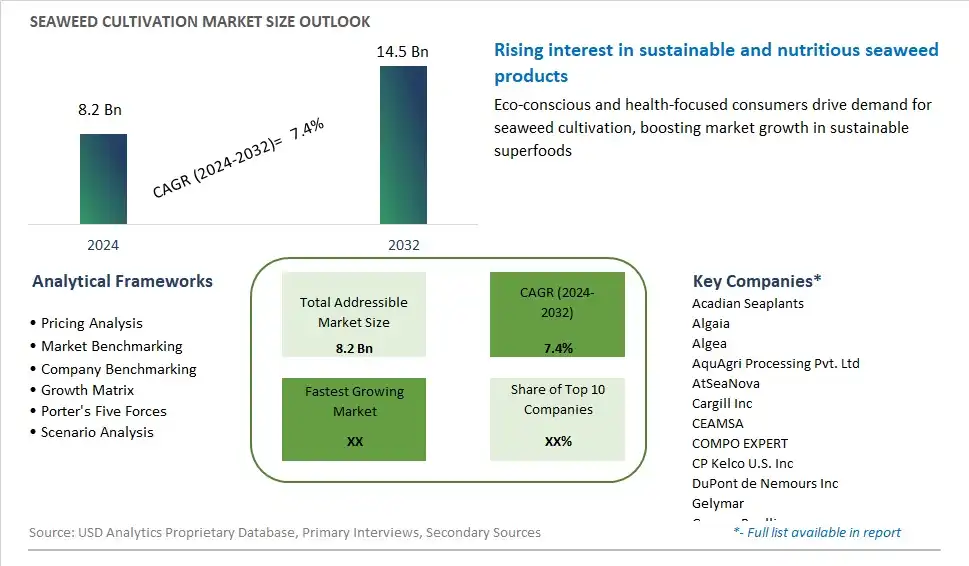
Global Seaweed Cultivation Market Size is valued at $8.2 Billion in 2024 and is forecast to register a growth rate (CAGR) of 7.4% to reach $14.5 Billion by 2032.
The global Seaweed Cultivation Market Comprehensive Study analyzes and forecasts the market size across 6 regions and 24 countries for diverse segments -By Process (Seeding, Open Sea Transplanting, Harvesting, Drying, Processing), By Type (Red Seaweeds, Brown Seaweeds, Green Seaweeds), By Method Of Harvesting (Aquaculture, Wild Harvesting), By Form (Liquid, Powder, Flakes, Sheets), By Application (Food, Feed, Agriculture, Pharmaceuticals, Others)
An Introduction to Seaweed Cultivation Market
Seaweed cultivation, also known as seaweed farming or mariculture, involves the cultivation of seaweed species for food, feed, phycocolloid production, and biofuel production in 2024. Seaweed cultivation typically takes place in coastal areas or offshore waters, where seaweed species such as kelp, nori, and wakame are grown on ropes, nets, or other substrates suspended in the water. Seaweed cultivation provides numerous environmental benefits, including carbon sequestration, nutrient uptake, and habitat creation, while also offering economic opportunities for coastal communities and seaweed farmers. Seaweed is a highly nutritious and sustainable food source, rich in vitamins, minerals, antioxidants, and omega-3 fatty acids, with applications in sushi, salads, soups, and snacks. With increasing consumer interest in plant-based diets, sustainable seafood alternatives, and functional ingredients, the market for seaweed cultivation is growing, driven by investments in cultivation technology, breeding programs, and product development that enable the sustainable and scalable production of high-quality seaweed products to meet market demands and consumer preferences.
Seaweed Cultivation Competitive Landscape
The market report analyses the leading companies in the industry including Acadian Seaplants, Algaia, Algea, AquAgri Processing Pvt. Ltd, AtSeaNova, Cargill Inc, CEAMSA, COMPO EXPERT, CP Kelco U.S. Inc, DuPont de Nemours Inc, Gelymar, Groupe Roullier, Irish Seaweeds, Leili, Mara Seaweed, Qingdao Gather Great Ocean Algae Industry Group, Qingdao Seawin Biotech Group Co. Ltd, Seasol, Seaweed Energy Solutions AS, The Seaweed Company, and Others.
Seaweed Cultivation Market Dynamics
Seaweed Cultivation Market Trend: Rising Demand for Sustainable and Nutrient-Rich Food Sources
One prominent market trend in seaweed cultivation is the rising demand for sustainable and nutrient-rich food sources. As concerns about environmental sustainability and food security continue to escalate, consumers are increasingly turning to seaweed as a viable solution. Seaweed offers a plethora of nutritional benefits, including being rich in vitamins, minerals, antioxidants, and essential fatty acids, making it an attractive option for health-conscious consumers. Moreover, seaweed cultivation is environmentally friendly, requiring minimal freshwater, land, and fertilizers compared to traditional crops, and it can play a significant role in mitigating ocean acidification and carbon sequestration. This trend reflects a growing awareness of the importance of sustainable food production practices and the potential of seaweed as a nutritious and eco-friendly dietary staple.
Market Driver: Expanding Applications in Food, Pharmaceuticals, and Cosmetics
A key driver propelling the market for seaweed cultivation is the expanding applications of seaweed-derived products across various industries, including food, pharmaceuticals, and cosmetics. Seaweed is a versatile ingredient that can be processed into a wide range of products, such as seaweed snacks, supplements, extracts, hydrocolloids, and skincare formulations. The growing demand for natural and functional ingredients in these industries drives the need for a sustainable and reliable supply of high-quality seaweed biomass. Furthermore, ongoing research and innovation in seaweed biotechnology, extraction methods, and product development are unlocking new opportunities for seaweed-derived ingredients with enhanced functionalities and bioactive properties, driving market growth and diversification.
Market Opportunity: Technology Advancements and Cultivation Innovation
An opportunity within the seaweed cultivation market lies in technology advancements and cultivation innovation to increase efficiency, scalability, and sustainability in seaweed farming practices. Traditional seaweed cultivation methods, such as wild harvesting and manual cultivation, are labor-intensive and often limited by environmental factors and seasonal fluctuations. However, advancements in seaweed farming technologies, such as integrated multi-trophic aquaculture (IMTA), offshore cultivation systems, and automated monitoring systems, offer opportunities to optimize productivity, minimize environmental impact, and scale up production to meet growing demand. Additionally, there's potential for innovation in seaweed breeding and genetic improvement programs to develop new cultivars with desirable traits, such as higher yield, faster growth rates, and enhanced nutritional profiles. By embracing technology and innovation, seaweed cultivators can capitalize on the expanding market opportunities and contribute to the sustainable growth of the seaweed cultivation industry.
Seaweed Cultivation Market Share Analysis: Harvesting held the dominant market share in 2024
The harvesting segment dominates the seaweed cultivation market due to its critical role in obtaining mature seaweed biomass for further processing and commercialization. Harvesting involves the manual or mechanical collection of mature seaweed from cultivation sites, such as ocean farms or coastal areas, once it reaches optimal growth and nutritional content. This process is crucial for maintaining the sustainability of seaweed cultivation operations and ensuring a continuous supply of raw materials for various end-uses, including food and beverage, pharmaceuticals, cosmetics, and agriculture. Additionally, efficient harvesting techniques minimize environmental impacts and labor costs, contributing to the profitability and scalability of seaweed cultivation operations. As the demand for seaweed-derived products continues to grow globally, particularly in the food and pharmaceutical industries, the harvesting segment is expected to maintain its dominance in the seaweed cultivation market, driving innovation and investment in sustainable harvesting practices and technologies.
Seaweed Cultivation Market Share Analysis: Green Seaweeds market is poised to register the fastest growth rae over the forecast period to 2032
The green seaweeds segment is experiencing rapid growth in the seaweed cultivation market due to increasing consumer demand for sustainable and nutritious plant-based ingredients. Green seaweeds, such as Ulva, Enteromorpha, and Caulerpa species, are rich in vitamins, minerals, antioxidants, and dietary fibers, making them attractive ingredients for various applications, including food, feed, pharmaceuticals, and bioplastics. Further, green seaweeds are known for their fast growth rates and adaptability to different environmental conditions, allowing for efficient cultivation and harvest cycles. Additionally, advancements in cultivation techniques, such as integrated multitrophic aquaculture (IMTA) and land-based seaweed farms, have facilitated the commercial-scale production of green seaweeds, further driving market growth. With growing awareness of the nutritional benefits and sustainability advantages of green seaweed-based products, the green seaweeds segment is poised to continue its rapid expansion, offering opportunities for innovation and investment in the seaweed cultivation market.
Seaweed Cultivation Market Share Analysis: Aquaculture held the dominant market share in 2024
The aquaculture segment dominates the seaweed cultivation market due to its controlled and sustainable approach to seaweed production, which ensures consistent quality, yield, and environmental stewardship. Aquaculture involves the cultivation of seaweeds in controlled marine environments, such as ocean farms, sea beds, or integrated multitrophic aquaculture (IMTA) systems. This method allows for optimized growth conditions, including nutrient supply, water quality, and temperature regulation, resulting in higher productivity and quality of harvested seaweeds compared to wild harvesting. Additionally, aquaculture practices minimize the impact on natural ecosystems and biodiversity while providing employment opportunities and income generation for coastal communities. With increasing demand for seaweed-derived products in various industries, including food, pharmaceuticals, cosmetics, and biotechnology, aquaculture is the preferred method of harvesting seaweeds due to its scalability, sustainability, and economic viability. As a result, the aquaculture segment maintains its dominance in the seaweed cultivation market, driving continued growth and innovation in the industry.
Seaweed Cultivation Market Segmentation
By Process
Seeding
Open Sea Transplanting
Harvesting
Drying
Processing
By Type
Red Seaweeds
Brown Seaweeds
Green Seaweeds
By Method Of Harvesting
Aquaculture
Wild Harvesting
By Form
Liquid
Powder
Flakes
Sheets
By Application
Food
Feed
Agriculture
Pharmaceuticals
Others
Countries Analyzed
North America (US, Canada, Mexico)
Europe (Germany, UK, France, Spain, Italy, Russia, Rest of Europe)
Asia Pacific (China, India, Japan, South Korea, Australia, South East Asia, Rest of Asia)
South America (Brazil, Argentina, Rest of South America)
Middle East and Africa (Saudi Arabia, UAE, Rest of Middle East, South Africa, Egypt, Rest of Africa)
Seaweed Cultivation Companies Profiled in the Study
Acadian Seaplants
Algaia
Algea
AquAgri Processing Pvt. Ltd
AtSeaNova
Cargill Inc
CEAMSA
COMPO EXPERT
CP Kelco U.S. Inc
DuPont de Nemours Inc
Gelymar
Groupe Roullier
Irish Seaweeds
Leili
Mara Seaweed
Qingdao Gather Great Ocean Algae Industry Group
Qingdao Seawin Biotech Group Co. Ltd
Seasol
Seaweed Energy Solutions AS
The Seaweed Company
*- List Not Exhaustive
Chapter 1. TABLE OF CONTENTS
Chapter 2. Introduction to Seaweed Cultivation Market
2.1. Market Overview
2.2. Key Statistics and Report Highlights
2.3. Scope of the Comprehensive Study
2.3.1. Market Definition
2.3.2 Countries and Regions Covered
2.3.3 Research Objective
2.3.4 Units, Currency, and Conversions
2.3.5 Industry Value Chain
2.4. Key Market Segments
2.5. Key Companies
2.6. Study Period
Chapter 3. Strategic Analysis Review
3.1. Seaweed Cultivation Pricing Analysis and Forecast
3.2. Porter’s Five Forces
3.3. Market Ecosystem
3.4. SWOT Analysis
3.5. Regulatory Scenario
3.3. Effects of Inflation, Russia-Ukraine War, moderating economic growth, and other macroeconomic factors
Chapter 4. Competitive Landscape
4.1. Market Share Analysis
4.1.1. Global Seaweed Cultivation Market Share by Company, 2023
4.1.2. Product Offerings of Leading Seaweed Cultivation Companies
4.2. Market Entropy
4.2.1. New Product Launches in the Industry
4.2.2. Mergers, Acquisitions, Joint ventures, and Partnerships
4.3. Key Strategies and Best Practices
Chapter 5. Global Market Projections: Best, Reference, and Low Case Scenarios
5.1. Growth Analysis- Case Scenario Definitions
5.2. Low Growth Case Scenario Forecasts
5.3. Reference Growth Case Scenario Forecasts
5.4. High Growth Case Scenario Forecasts
Chapter 6. Market Dynamics
6.1. Seaweed Cultivation Market Drivers
6.2. Seaweed Cultivation Market Challenges
6.6. Seaweed Cultivation Market Opportunities
6.4. Seaweed Cultivation Market Trends
Chapter 7. Global Seaweed Cultivation Market Outlook Trends
7.1. Global Seaweed Cultivation Revenue (USD Million) and CAGR (%) by Type (2021-2032)
7.2. Global Seaweed Cultivation Revenue (USD Million) and CAGR (%) by Application (2021-2032)
7.3. Global Seaweed Cultivation Revenue (USD Million) and CAGR (%) by Product (2021-2032)
By Process
Seeding
Open Sea Transplanting
Harvesting
Drying
Processing
By Type
Red Seaweeds
Brown Seaweeds
Green Seaweeds
By Method Of Harvesting
Aquaculture
Wild Harvesting
By Form
Liquid
Powder
Flakes
Sheets
By Application
Food
Feed
Agriculture
Pharmaceuticals
Others
Chapter 8. Global Seaweed Cultivation Regional Analysis and Outlook
8.1. Global Seaweed Cultivation Revenue (USD Million) By Regions (2021- 2032)
8.2. North America Seaweed Cultivation Revenue (USD Million) by Country (2021-2032)
8.2.1. United States Seaweed Cultivation Regional Analysis and Outlook
8.2.2. Canada Seaweed Cultivation Regional Analysis and Outlook
8.2.3. Mexico Seaweed Cultivation Regional Analysis and Outlook
8.3. Europe Seaweed Cultivation Revenue (USD Million), by Country (2021-2032)
8.3.1. Germany Seaweed Cultivation Regional Analysis and Outlook
8.3.2. France Seaweed Cultivation Regional Analysis and Outlook
8.3.3. United Kingdom Seaweed Cultivation Regional Analysis and Outlook
8.3.4. Spain Seaweed Cultivation Regional Analysis and Outlook
8.3.5. Italy Seaweed Cultivation Regional Analysis and Outlook
8.3.6. Russia Seaweed Cultivation Regional Analysis and Outlook
8.3.7. Rest of Europe Seaweed Cultivation Regional Analysis and Outlook
8.4. Asia Pacific Seaweed Cultivation Revenue (USD Million) by Country (2021-2032)
8.4.1. China Seaweed Cultivation Regional Analysis and Outlook
8.4.2. Japan Seaweed Cultivation Regional Analysis and Outlook
8.4.3. India Seaweed Cultivation Regional Analysis and Outlook
8.4.4. South Korea Seaweed Cultivation Regional Analysis and Outlook
8.4.5. Australia Seaweed Cultivation Regional Analysis and Outlook
8.4.6. South East Asia Seaweed Cultivation Regional Analysis and Outlook
8.4.7. Rest of Asia Pacific Seaweed Cultivation Regional Analysis and Outlook
8.5. South America Seaweed Cultivation Revenue (USD Million), by Country (2021-2032)
8.5.1. Brazil Seaweed Cultivation Regional Analysis and Outlook
8.5.2. Argentina Seaweed Cultivation Regional Analysis and Outlook
8.5.3. Rest of South America Seaweed Cultivation Regional Analysis and Outlook
8.6. Middle East and Africa Seaweed Cultivation Revenue (USD Million) by Country (2021-2032)
8.6.1. Middle East Seaweed Cultivation Regional Analysis and Outlook
8.6.2. Africa Seaweed Cultivation Regional Analysis and Outlook
Chapter 9. North America Seaweed Cultivation Analysis and Outlook
9.1. North America Seaweed Cultivation Revenue (USD Million) by Segments (2021-2032)
9.1.1. North America Seaweed Cultivation Revenue (USD Million) by Type (2021-2032)
9.1.2. North America Seaweed Cultivation Revenue (USD Million) by Application (2021-2032)
9.1.3. North America Seaweed Cultivation Revenue (USD Million) by Product (2021-2032)
By Process
Seeding
Open Sea Transplanting
Harvesting
Drying
Processing
By Type
Red Seaweeds
Brown Seaweeds
Green Seaweeds
By Method Of Harvesting
Aquaculture
Wild Harvesting
By Form
Liquid
Powder
Flakes
Sheets
By Application
Food
Feed
Agriculture
Pharmaceuticals
Others
Chapter 10. Europe Seaweed Cultivation Analysis and Outlook
10.1. Europe Seaweed Cultivation Revenue (USD Million), by Segments (USD Million) (2021-2032)
10.1.1. Europe Seaweed Cultivation Revenue (USD Million) by Type (2021-2032)
10.1.2. Europe Seaweed Cultivation Revenue (USD Million) by Application (2021-2032)
10.1.3. Europe Seaweed Cultivation Revenue (USD Million) by Product (2021-2032)
By Process
Seeding
Open Sea Transplanting
Harvesting
Drying
Processing
By Type
Red Seaweeds
Brown Seaweeds
Green Seaweeds
By Method Of Harvesting
Aquaculture
Wild Harvesting
By Form
Liquid
Powder
Flakes
Sheets
By Application
Food
Feed
Agriculture
Pharmaceuticals
Others
Chapter 11. Asia Pacific Seaweed Cultivation Analysis and Outlook
11.1. Asia Pacific Seaweed Cultivation Revenue (USD Million), and Revenue (USD Million) by Segments (2021-2032)
11.1.1. Asia Pacific Seaweed Cultivation Revenue (USD Million) by Type (2021-2032)
11.1.2. Asia Pacific Seaweed Cultivation Revenue (USD Million) by Application (2021-2032)
11.1.3. Asia Pacific Seaweed Cultivation Revenue (USD Million) by Product (2021-2032)
By Process
Seeding
Open Sea Transplanting
Harvesting
Drying
Processing
By Type
Red Seaweeds
Brown Seaweeds
Green Seaweeds
By Method Of Harvesting
Aquaculture
Wild Harvesting
By Form
Liquid
Powder
Flakes
Sheets
By Application
Food
Feed
Agriculture
Pharmaceuticals
Others
Chapter 12. South America Seaweed Cultivation Analysis and Outlook
12.1. South America Seaweed Cultivation Revenue (USD Million), by Segments (2021-2032)
12.1.1. South America Seaweed Cultivation Revenue (USD Million) by Type (2021-2032)
12.1.2. South America Seaweed Cultivation Revenue (USD Million) by Application (2021-2032)
12.1.3. South America Seaweed Cultivation Revenue (USD Million) by Product (2021-2032)
By Process
Seeding
Open Sea Transplanting
Harvesting
Drying
Processing
By Type
Red Seaweeds
Brown Seaweeds
Green Seaweeds
By Method Of Harvesting
Aquaculture
Wild Harvesting
By Form
Liquid
Powder
Flakes
Sheets
By Application
Food
Feed
Agriculture
Pharmaceuticals
Others
Chapter 13. Middle East and Africa Seaweed Cultivation Analysis and Outlook
13.1. Middle East and Africa Seaweed Cultivation Revenue (USD Million), by Segments (2021-2032)
13.1.1. Middle East and Africa Seaweed Cultivation Revenue (USD Million) by Type (2021-2032)
13.1.2. Middle East and Africa Seaweed Cultivation Revenue (USD Million) by Application (2021-2032)
13.1.3. Middle East and Africa Seaweed Cultivation Revenue (USD Million) by Product (2021-2032)
By Process
Seeding
Open Sea Transplanting
Harvesting
Drying
Processing
By Type
Red Seaweeds
Brown Seaweeds
Green Seaweeds
By Method Of Harvesting
Aquaculture
Wild Harvesting
By Form
Liquid
Powder
Flakes
Sheets
By Application
Food
Feed
Agriculture
Pharmaceuticals
Others
Chapter 14. Seaweed Cultivation Company Profiles
14.1 Business Overview
14.2 Product Profiles
14.3 SWOT Profiles
14.5 Recent Developments
14.6 Financial Profile
List of Companies
Acadian Seaplants
Algaia
Algea
AquAgri Processing Pvt. Ltd
AtSeaNova
Cargill Inc
CEAMSA
COMPO EXPERT
CP Kelco U.S. Inc
DuPont de Nemours Inc
Gelymar
Groupe Roullier
Irish Seaweeds
Leili
Mara Seaweed
Qingdao Gather Great Ocean Algae Industry Group
Qingdao Seawin Biotech Group Co. Ltd
Seasol
Seaweed Energy Solutions AS
The Seaweed Company
15. Methodology and Data Sources
15.1 Customization Offerings
15.2 Subscription Services
15.3 Related Reports
15.4 Publisher Expertise
LIST OF TABLES
Table 1 Market Segmentation Analysis
Table 2 Global Seaweed Cultivation Market Share of Leading Companies, 2023
Table 3 Product Offerings of Leading Companies
Table 4 Low Growth Scenario Forecasts
Table 5 Reference Case Growth Scenario
Table 6 High Growth Case Scenario
Table 7 Global Seaweed Cultivation Revenue (USD Million) And CAGR (%) By Type (2021-2032)
Table 8 Global Seaweed Cultivation Revenue (USD Million) And CAGR (%) By Application (2021-2032)
Table 9 Global Seaweed Cultivation Revenue (USD Million) And CAGR (%) By Product (2021-2032)
Table 10 Global Seaweed Cultivation Market Revenue (USD Million) By Regions (2021-2032)
Table 11 Global Seaweed Cultivation Market Share (%) By Regions (2021-2032)
Table 12 North America Seaweed Cultivation Revenue (USD Million) By Country (2021-2032)
Table 13 Europe Seaweed Cultivation Revenue (USD Million) By Country (2021-2032)
Table 14 Asia Pacific Seaweed Cultivation Revenue (USD Million) By Country (2021-2032)
Table 15 South America Seaweed Cultivation Revenue (USD Million) By Country (2021-2032)
Table 16 Middle East and Africa Seaweed Cultivation Revenue (USD Million) By Region (2021-2032)
Table 17 North America Seaweed Cultivation Revenue (USD Million) By Type (2021-2032)
Table 18 North America Seaweed Cultivation Revenue (USD Million) By Application (2021-2032)
Table 19 North America Seaweed Cultivation Revenue (USD Million) By Product (2021-2032)
Table 20 Europe Seaweed Cultivation Revenue (USD Million) By Type (2021-2032)
Table 21 Europe Seaweed Cultivation Revenue (USD Million) By Application (2021-2032)
Table 22 Europe Seaweed Cultivation Revenue (USD Million) By Product (2021-2032)
Table 23 Asia Pacific Seaweed Cultivation Revenue (USD Million) By Type (2021-2032)
Table 24 Asia Pacific Seaweed Cultivation Revenue (USD Million) By Application (2021-2032)
Table 25 Asia Pacific Seaweed Cultivation Revenue (USD Million) By Product (2021-2032)
Table 26 South America Seaweed Cultivation Revenue (USD Million) By Type (2021-2032)
Table 27 South America Seaweed Cultivation Revenue (USD Million) By Application (2021-2032)
Table 28 South America Seaweed Cultivation Revenue (USD Million) By Product (2021-2032)
Table 29 Middle East and Africa Seaweed Cultivation Revenue (USD Million) By Type (2021-2032)
Table 30 Middle East and Africa Seaweed Cultivation Revenue (USD Million) By Application (2021-2032)
Table 31 Middle East and Africa Seaweed Cultivation Revenue (USD Million) By Product (2021-2032)
LIST OF FIGURES
Figure 1. Market Scope
Figure 2. Pricing Forecasts Per Unit, 2023- 2032
Figure 3. Porter’s Five Forces
Figure 4. Global Seaweed Cultivation Market Revenue (USD Million) By Regions (2021-2032)
Figure 5. Global Seaweed Cultivation Market Share (%) By Regions (2023)
Figure 6. North America Seaweed Cultivation Revenue (USD Million) By Country (2021-2032)
Figure 7. United States Seaweed Cultivation Revenue (USD Million) By Country (2021-2032)
Figure 8. Canada Seaweed Cultivation Revenue (USD Million) By Country (2021-2032)
Figure 9. Mexico Seaweed Cultivation Revenue (USD Million) By Country (2021-2032)
Figure 10. Europe Seaweed Cultivation Revenue (USD Million) By Country (2021-2032)
Figure 11. Germany Seaweed Cultivation Revenue (USD Million) By Country (2021-2032)
Figure 12. France Seaweed Cultivation Revenue (USD Million) By Country (2021-2032)
Figure 13. United Kingdom Seaweed Cultivation Revenue (USD Million) By Country (2021-2032)
Figure 14. Spain Seaweed Cultivation Revenue (USD Million) By Country (2021-2032)
Figure 15. Italy Seaweed Cultivation Revenue (USD Million) By Country (2021-2032)
Figure 16. Russia Seaweed Cultivation Revenue (USD Million) By Country (2021-2032)
Figure 17. Rest of Europe Seaweed Cultivation Revenue (USD Million) By Country (2021-2032)
Figure 11. Asia Pacific Seaweed Cultivation Revenue (USD Million) By Country (2021-2032)
Figure 12. China Seaweed Cultivation Revenue (USD Million) By Country (2021-2032)
Figure 13. Japan Seaweed Cultivation Revenue (USD Million) By Country (2021-2032)
Figure 14. India Seaweed Cultivation Revenue (USD Million) By Country (2021-2032)
Figure 15. South Korea Seaweed Cultivation Revenue (USD Million) By Country (2021-2032)
Figure 16. Australia Seaweed Cultivation Revenue (USD Million) By Country (2021-2032)
Figure 17. South East Asia Seaweed Cultivation Revenue (USD Million) By Country (2021-2032)
Figure 18. South America Seaweed Cultivation Revenue (USD Million) By Country (2021-2032)
Figure 19. Brazil Seaweed Cultivation Revenue (USD Million) By Country (2021-2032)
Figure 20. Argentina Seaweed Cultivation Revenue (USD Million) By Country (2021-2032)
Figure 21. Rest of Asia Pacific Seaweed Cultivation Revenue (USD Million) By Country (2021-2032)
Figure 22. Middle East and Africa Seaweed Cultivation Revenue (USD Million) By Region (2021-2032)
Figure 23. Saudi Arabia Seaweed Cultivation Revenue (USD Million) By Region (2021-2032)
Figure 24. The UAE Seaweed Cultivation Revenue (USD Million) By Region (2021-2032)
Figure 25. Rest of Middle East Seaweed Cultivation Revenue (USD Million) By Region (2021-2032)
Figure 26. South Africa Seaweed Cultivation Revenue (USD Million) By Region (2021-2032)
Figure 27. Africa Seaweed Cultivation Revenue (USD Million) By Region (2021-2032)
Figure 28. North America Seaweed Cultivation Revenue (USD Million) By Type (2021-2032)
Figure 29. North America Seaweed Cultivation Revenue (USD Million) By Application (2021-2032)
Figure 30. North America Seaweed Cultivation Revenue (USD Million) By Product (2021-2032)
Figure 31. Europe Seaweed Cultivation Revenue (USD Million) By Type (2021-2032)
Figure 32. Europe Seaweed Cultivation Revenue (USD Million) By Application (2021-2032)
Figure 33. Europe Seaweed Cultivation Revenue (USD Million) By Product (2021-2032)
Figure 34. Asia Pacific Seaweed Cultivation Revenue (USD Million) By Type (2021-2032)
Figure 35. Asia Pacific Seaweed Cultivation Revenue (USD Million) By Application (2021-2032)
Figure 36. Asia Pacific Seaweed Cultivation Revenue (USD Million) By Product (2021-2032)
Figure 37. South America Seaweed Cultivation Revenue (USD Million) By Type (2021-2032)
Figure 38. South America Seaweed Cultivation Revenue (USD Million) By Application (2021-2032)
Figure 39. South America Seaweed Cultivation Revenue (USD Million) By Product (2021-2032)
Figure 40. Middle East and Africa Seaweed Cultivation Revenue (USD Million) By Type (2021-2032)
Figure 41. Middle East and Africa Seaweed Cultivation Revenue (USD Million) By Application (2021-2032)
Figure 42. Middle East and Africa Seaweed Cultivation Revenue (USD Million) By Product (2021-2032)
By Process
Seeding
Open Sea Transplanting
Harvesting
Drying
Processing
By Type
Red Seaweeds
Brown Seaweeds
Green Seaweeds
By Method Of Harvesting
Aquaculture
Wild Harvesting
By Form
Liquid
Powder
Flakes
Sheets
By Application
Food
Feed
Agriculture
Pharmaceuticals
Others
Countries Analyzed
North America (US, Canada, Mexico)
Europe (Germany, UK, France, Spain, Italy, Russia, Rest of Europe)
Asia Pacific (China, India, Japan, South Korea, Australia, South East Asia, Rest of Asia)
South America (Brazil, Argentina, Rest of South America)
Middle East and Africa (Saudi Arabia, UAE, Rest of Middle East, South Africa, Egypt, Rest of Africa)
