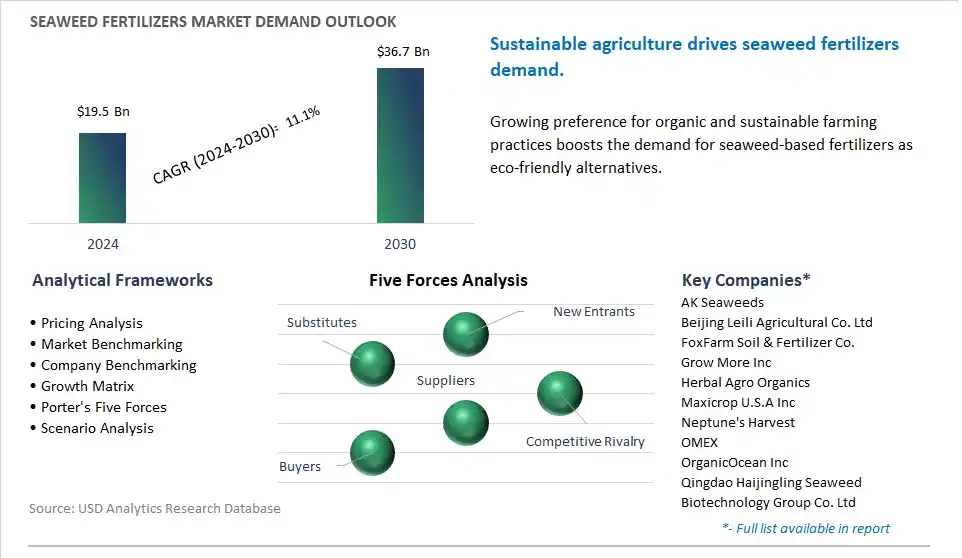
The global Seaweed Fertilizers Market is poised to register a 11.1% CAGR from $19.5 Billion in 2024 to $36.7 Billion in 2030.
The global Seaweed Fertilizers Market Study analyzes and forecasts the market size across 6 regions and 24 countries for diverse segments -By Form (Liquid Seaweed Fertilizer, Power Seaweed Fertilizer), By Application (Farm, Green House, Garden, Others).
An Introduction to Global Seaweed Fertilizers Market in 2024
The future of seaweed fertilizers is shaped by key trends such as sustainable agriculture, organic farming practices, and environmental awareness. Seaweed fertilizers, derived from various species of marine algae, are valued for their rich nutrient content, including nitrogen, phosphorus, potassium, and micronutrients, which promote plant growth, improve soil health, and enhance crop yields. With growing concerns about soil degradation, water pollution, and chemical runoff associated with conventional fertilizers, there is a rising demand for sustainable and environmentally friendly alternatives in agriculture. Seaweed fertilizers offer several advantages over synthetic fertilizers, including biodegradability, low environmental impact, and compatibility with organic farming standards. Moreover, seaweed extracts contain natural plant growth hormones such as auxins, cytokinins, and gibberellins, which stimulate root development, flowering, and fruiting in crops, leading to healthier plants and higher-quality harvests. Additionally, seaweed fertilizers enhance soil structure and microbial activity, increasing soil fertility and water retention capacity while reducing the need for chemical inputs and irrigation. Furthermore, as climate change poses challenges to global food security and agricultural productivity, seaweed fertilizers offer a sustainable solution to mitigate the impact of environmental stressors on crop production and resilience. As farmers and growers increasingly prioritize sustainability, soil health, and crop nutrition, the seaweed fertilizers market will continue to expand with new formulations, applications, and market-driven solutions to meet the evolving needs of modern agriculture and address environmental challenges.
Seaweed Fertilizers Market Competitive Landscape
The market report analyses the leading companies in the industry including AK Seaweeds, Beijing Leili Agricultural Co. Ltd, FoxFarm Soil & Fertilizer Co., Grow More Inc, Herbal Agro Organics, Maxicrop U.S.A Inc, Neptune's Harvest, OMEX, OrganicOcean Inc, Qingdao Haijingling Seaweed Biotechnology Group Co. Ltd, Qingdao Seawin Biotech Group Co. Ltd, SAOSIS, Technaflora, Zhejiang Dongyang Lianfeng Biological Technology Co. Ltd.
Seaweed Fertilizers Market Dynamics
Seaweed Fertilizers Market Trend: Rising Demand for Organic and Sustainable Agriculture Practices
A significant trend in the market for seaweed fertilizers is the rising demand for organic and sustainable agriculture practices. With increasing concerns about environmental sustainability and food safety, there is a growing preference among farmers and consumers for organic fertilizers that minimize the use of synthetic chemicals and reduce environmental impact. Seaweed fertilizers, derived from marine algae, offer natural sources of nutrients such as nitrogen, phosphorus, potassium, and micronutrients, making them a popular choice for organic farming and sustainable agriculture. The trend towards organic and sustainable agriculture practices is driving the demand for seaweed fertilizers as environmentally friendly alternatives to conventional chemical fertilizers.
Seaweed Fertilizers Market Driver: Growing Need for Nutrient-Rich Soil Amendments
A primary driver for the market of seaweed fertilizers is the growing need for nutrient-rich soil amendments to enhance crop yields and quality. Seaweed fertilizers are valued for their unique composition, which includes a wide range of essential nutrients, growth hormones, and bioactive compounds that promote plant growth, improve soil health, and enhance crop resilience to stressors such as drought, disease, and pests. As agricultural practices intensify and soils become depleted of nutrients, there is increasing recognition of the benefits of using seaweed fertilizers to replenish soil fertility, increase nutrient availability, and optimize plant nutrition for sustainable crop production.
Seaweed Fertilizers Market Opportunity: Expansion into High-Value Crop Segments and Specialty Markets
An opportunity in the market for seaweed fertilizers lies in the expansion into high-value crop segments and specialty markets. While seaweed fertilizers are commonly used in conventional agriculture for a wide range of crops such as grains, vegetables, and fruits, there is potential to explore opportunities in high-value crop segments such as organic produce, specialty crops, and hydroponic farming. Additionally, there is opportunity to develop specialized formulations of seaweed fertilizers tailored to meet the specific nutritional requirements and growth stages of different crops, optimizing yield, quality, and market value. By expanding into high-value crop segments and specialty markets, manufacturers can differentiate their products, capture premium pricing, and capitalize on the growing demand for specialized agricultural inputs in the dynamic farming industry.
Seaweed Fertilizers Market Share Analysis: Liquid Seaweed Fertilizer segment generated the highest revenue in 2024
liquid seaweed fertilizers are widely preferred by farmers and gardeners due to their ease of use and rapid absorption by plants. Liquid seaweed fertilizers are formulated from extracts of seaweed or kelp, which are rich in essential nutrients, growth hormones, amino acids, and trace elements beneficial for plant growth and development. Additionally, liquid seaweed fertilizers can be easily applied through foliar spraying, drip irrigation, or soil drenching, providing efficient nutrient uptake by plants and promoting healthy root growth, flowering, and fruiting. Further, liquid seaweed fertilizers offer flexibility in application rates and timing, allowing for precise nutrient management and optimization of crop yields. Furthermore, liquid seaweed fertilizers are environmentally friendly and sustainable alternatives to synthetic fertilizers, as they are derived from natural sources and promote soil health and fertility without causing harm to ecosystems or waterways. These factors collectively contribute to the dominance of the Liquid Seaweed Fertilizer segment in the Seaweed Fertilizers Market.
Seaweed Fertilizers Market Share Analysis: Greenhouse application segment is poised to register the fastest growth rate (CAGR) over the forecast period to 2030
greenhouse cultivation is becoming increasingly popular due to its ability to provide controlled growing conditions, protection from adverse weather, and higher yields compared to traditional open-field farming. Greenhouse growers are increasingly recognizing the benefits of using seaweed fertilizers to enhance plant growth, improve crop quality, and increase yields. Seaweed fertilizers are particularly well-suited for greenhouse cultivation due to their ability to deliver essential nutrients, growth hormones, and biostimulants directly to plants' roots or foliage, promoting healthy growth and development in the controlled environment of greenhouses. Additionally, seaweed fertilizers can help greenhouse growers manage plant stress, enhance disease resistance, and improve crop resilience to environmental factors such as temperature fluctuations and water stress. Further, seaweed fertilizers are compatible with various hydroponic and soilless growing systems commonly used in greenhouse production, making them versatile and easy to integrate into existing cultivation practices. Furthermore, the growing trend towards sustainable and organic agriculture drives the demand for seaweed fertilizers as environmentally friendly alternatives to synthetic fertilizers in greenhouse cultivation. These factors collectively contribute to the rapid expansion of the Greenhouse application segment in the Seaweed Fertilizers Market.
Seaweed Fertilizers Market Report Segmentation
By Form
Liquid Seaweed Fertilizer
Power Seaweed Fertilizer
By Application
Farm
Green House
Garden
Others
Regions Included
North America (US, Canada, Mexico)
Europe (Germany, UK, France, Spain, Italy, Russia, Rest of Europe)
Asia Pacific (China, India, Japan, South Korea, Australia, South East Asia, Rest of Asia)
South America (Brazil, Argentina, Rest of South America)
Middle East and Africa (Saudi Arabia, UAE, Rest of Middle East, South Africa, Egypt, Rest of Africa)
Seaweed Fertilizers Companies Profiled in the Market Study
AK Seaweeds
Beijing Leili Agricultural Co. Ltd
FoxFarm Soil & Fertilizer Co.
Grow More Inc
Herbal Agro Organics
Maxicrop U.S.A Inc
Neptune's Harvest
OMEX
OrganicOcean Inc
Qingdao Haijingling Seaweed Biotechnology Group Co. Ltd
Qingdao Seawin Biotech Group Co. Ltd
SAOSIS
Technaflora
Zhejiang Dongyang Lianfeng Biological Technology Co. Ltd
*- List Not Exhaustive
TABLE OF CONTENTS
1 Introduction to 2024 Seaweed Fertilizers Market
1.1 Market Overview
1.2 Quick Facts
1.3 Scope/Objective of the Study
1.4 Market Definition
1.5 Countries and Regions Covered
1.6 Units, Currency, and Conversions
1.7 Industry Value Chain
2 Research Methodology
2.1 Market Size Estimation
2.2 Sources and Research Methodology
2.3 Data Triangulation
2.4 Assumptions and Limitations
3 Executive Summary
3.1 Global Seaweed Fertilizers Market Size Outlook, $ Million, 2021 to 2030
3.2 Seaweed Fertilizers Market Outlook by Type, $ Million, 2021 to 2030
3.3 Seaweed Fertilizers Market Outlook by Product, $ Million, 2021 to 2030
3.4 Seaweed Fertilizers Market Outlook by Application, $ Million, 2021 to 2030
3.5 Seaweed Fertilizers Market Outlook by Key Countries, $ Million, 2021 to 2030
4 Market Dynamics
4.1 Key Driving Forces of Seaweed Fertilizers Industry
4.2 Key Market Trends in Seaweed Fertilizers Industry
4.3 Potential Opportunities in Seaweed Fertilizers Industry
4.4 Key Challenges in Seaweed Fertilizers Industry
5 Market Factor Analysis
5.1 Value Chain Analysis
5.2 Competitive Landscape
5.2.1 Global Seaweed Fertilizers Market Share by Company (%), 2023
5.2.2 Product Offerings by Company
5.3 Porter’s Five Forces Analysis
5.4 Pricing Analysis and Outlook
6 Growth Outlook Across Scenarios
6.1 Growth Analysis-Case Scenario Definitions
6.2 Low Growth Scenario Forecasts
6.3 Reference Growth Scenario Forecasts
6.4 High Growth Scenario Forecasts
7 Global Seaweed Fertilizers Market Outlook by Segments
7.1 Seaweed Fertilizers Market Outlook by Segments, $ Million, 2021- 2030
By Form
Liquid Seaweed Fertilizer
Power Seaweed Fertilizer
By Application
Farm
Green House
Garden
Others
8 North America Seaweed Fertilizers Market Analysis and Outlook To 2030
8.1 Introduction to North America Seaweed Fertilizers Markets in 2024
8.2 North America Seaweed Fertilizers Market Size Outlook by Country, 2021-2030
8.2.1 United States
8.2.2 Canada
8.2.3 Mexico
8.3 North America Seaweed Fertilizers Market size Outlook by Segments, 2021-2030
By Form
Liquid Seaweed Fertilizer
Power Seaweed Fertilizer
By Application
Farm
Green House
Garden
Others
9 Europe Seaweed Fertilizers Market Analysis and Outlook To 2030
9.1 Introduction to Europe Seaweed Fertilizers Markets in 2024
9.2 Europe Seaweed Fertilizers Market Size Outlook by Country, 2021-2030
9.2.1 Germany
9.2.2 France
9.2.3 Spain
9.2.4 United Kingdom
9.2.4 Italy
9.2.5 Russia
9.2.6 Norway
9.2.7 Rest of Europe
9.3 Europe Seaweed Fertilizers Market Size Outlook by Segments, 2021-2030
By Form
Liquid Seaweed Fertilizer
Power Seaweed Fertilizer
By Application
Farm
Green House
Garden
Others
10 Asia Pacific Seaweed Fertilizers Market Analysis and Outlook To 2030
10.1 Introduction to Asia Pacific Seaweed Fertilizers Markets in 2024
10.2 Asia Pacific Seaweed Fertilizers Market Size Outlook by Country, 2021-2030
10.2.1 China
10.2.2 India
10.2.3 Japan
10.2.4 South Korea
10.2.5 Indonesia
10.2.6 Malaysia
10.2.7 Australia
10.2.8 Rest of Asia Pacific
10.3 Asia Pacific Seaweed Fertilizers Market size Outlook by Segments, 2021-2030
By Form
Liquid Seaweed Fertilizer
Power Seaweed Fertilizer
By Application
Farm
Green House
Garden
Others
11 South America Seaweed Fertilizers Market Analysis and Outlook To 2030
11.1 Introduction to South America Seaweed Fertilizers Markets in 2024
11.2 South America Seaweed Fertilizers Market Size Outlook by Country, 2021-2030
11.2.1 Brazil
11.2.2 Argentina
11.2.3 Rest of South America
11.3 South America Seaweed Fertilizers Market size Outlook by Segments, 2021-2030
By Form
Liquid Seaweed Fertilizer
Power Seaweed Fertilizer
By Application
Farm
Green House
Garden
Others
12 Middle East and Africa Seaweed Fertilizers Market Analysis and Outlook To 2030
12.1 Introduction to Middle East and Africa Seaweed Fertilizers Markets in 2024
12.2 Middle East and Africa Seaweed Fertilizers Market Size Outlook by Country, 2021-2030
12.2.1 Saudi Arabia
12.2.2 UAE
12.2.3 Oman
12.2.4 Rest of Middle East
12.2.5 Egypt
12.2.6 Nigeria
12.2.7 South Africa
12.2.8 Rest of Africa
12.3 Middle East and Africa Seaweed Fertilizers Market size Outlook by Segments, 2021-2030
By Form
Liquid Seaweed Fertilizer
Power Seaweed Fertilizer
By Application
Farm
Green House
Garden
Others
13 Company Profiles
13.1 Company Snapshot
13.2 SWOT Profiles
13.3 Products and Services
13.4 Recent Developments
13.5 Financial Profile
AK Seaweeds
Beijing Leili Agricultural Co. Ltd
FoxFarm Soil & Fertilizer Co.
Grow More Inc
Herbal Agro Organics
Maxicrop U.S.A Inc
Neptune's Harvest
OMEX
OrganicOcean Inc
Qingdao Haijingling Seaweed Biotechnology Group Co. Ltd
Qingdao Seawin Biotech Group Co. Ltd
SAOSIS
Technaflora
Zhejiang Dongyang Lianfeng Biological Technology Co. Ltd
14 Appendix
14.1 Customization Offerings
14.2 Subscription Services
14.3 Related Reports
14.4 Publisher Expertise
By Form
Liquid Seaweed Fertilizer
Power Seaweed Fertilizer
By Application
Farm
Green House
Garden
Others
Countries Analyzed
North America (US, Canada, Mexico)
Europe (Germany, UK, France, Spain, Italy, Russia, Rest of Europe)
Asia Pacific (China, India, Japan, South Korea, Australia, South East Asia, Rest of Asia)
South America (Brazil, Argentina, Rest of South America)
Middle East and Africa (Saudi Arabia, UAE, Rest of Middle East, South Africa, Egypt, Rest of Africa)
