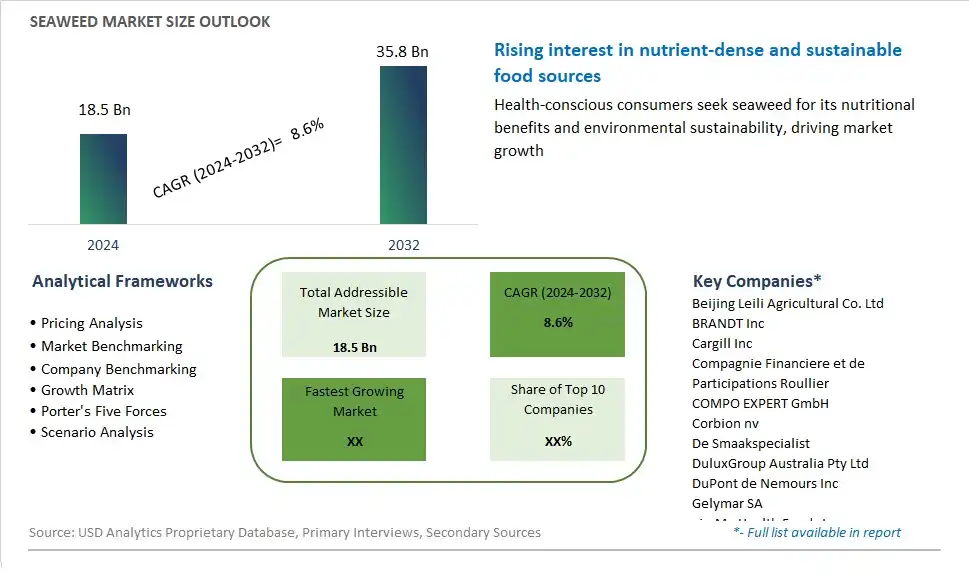
Global Seaweed Market Size is valued at $18.5 Billion in 2024 and is forecast to register a growth rate (CAGR) of 8.6% to reach $35.8 Billion by 2032.
The global Seaweed Market Comprehensive Study analyzes and forecasts the market size across 6 regions and 24 countries for diverse segments -By Product (Red, Brown, Green), By Application (Agriculture, Animal Feed, Human Food)
An Introduction to Seaweed Market
In 2024, the seaweed market is experiencing robust growth, driven by rising demand for nutritious, sustainable, and versatile food ingredients. Seaweed, rich in vitamins, minerals, and antioxidants, is used in a variety of products, including snacks, supplements, and beauty products. The market is influenced by the growing interest in plant-based and functional foods, with seaweed recognized for its health benefits and environmental sustainability. Innovations in harvesting and processing techniques are enhancing product quality and expanding applications. Key producers in Asia and other coastal regions are focusing on sustainable practices to meet the increasing global demand for seaweed and its derivatives.
Seaweed Competitive Landscape
The market report analyses the leading companies in the industry including Beijing Leili Agricultural Co. Ltd, BRANDT Inc, Cargill Inc, Compagnie Financiere et de Participations Roullier, COMPO EXPERT GmbH, Corbion nv, De Smaakspecialist, DuluxGroup Australia Pty Ltd, DuPont de Nemours Inc, Gelymar SA, gimMe Health Foods Inc, Indigrow Ltd, Irish Seaweeds, J M Huber Corp, Maine Coast Sea Vegetables Inc, Ocean Harvest Technology Ltd, West Coast Marine Bio Processing Corp, and Others.
Seaweed Market Dynamics
Seaweed Market Trend: Rising Popularity of Plant-Based and Sustainable Foods
A prominent market trend in the seaweed segment is the rising popularity of plant-based and sustainable foods. Seaweed, rich in nutrients, minerals, and antioxidants, is gaining recognition as a versatile and nutritious ingredient that aligns with plant-based and sustainable diets. As consumers become more health-conscious and environmentally aware, there is growing interest in incorporating seaweed-based products into their diets as a source of protein, fiber, and micronutrients. This trend is driven by the increasing demand for plant-based alternatives to animal products, the desire to reduce environmental impact, and the promotion of seaweed as a sustainable and eco-friendly food source that requires minimal resources to cultivate.
Market Driver: Growing Awareness of Health Benefits and Culinary Versatility
The market driver for seaweed is the growing awareness of its health benefits and culinary versatility. Seaweed is known for its nutritional value, including high levels of iodine, vitamins, and minerals, which contribute to overall health and well-being. Moreover, seaweed offers diverse culinary applications, ranging from traditional Asian cuisines to modern fusion dishes, making it appealing to chefs, home cooks, and food manufacturers seeking innovative ingredients. The increasing availability of seaweed-based products such as snacks, seasonings, sauces, and plant-based meat alternatives further drives market growth by expanding consumer accessibility and introducing seaweed to new audiences.
Market Opportunity: Diversification of Seaweed Products and Applications
One potential opportunity for the seaweed market lies in the diversification of products and applications. Beyond traditional seaweed products like nori sheets and sushi wraps, there is an opportunity to innovate and develop new seaweed-based foods and ingredients that cater to evolving consumer preferences and culinary trends. This includes products such as seaweed snacks, seaweed-infused beverages, seaweed-based condiments, and even seaweed-based cosmetics and skincare products. Additionally, exploring new cultivation techniques, product formulations, and value-added processing methods can unlock further opportunities to expand the seaweed market and address emerging consumer needs. By leveraging the versatility and nutritional benefits of seaweed across various product categories, stakeholders in the seaweed industry can capitalize on its growing popularity and contribute to the sustainable food movement.
Seaweed Market Share Analysis: Brown Seaweed Segment held the dominant market share in 2024
In the Seaweed Market, the brown seaweed segment is the largest, propelled by its wide-ranging applications in various industries such as food and beverage, pharmaceuticals, cosmetics, and agriculture. Brown seaweeds, including species like kelp and wakame, are prized for their rich nutritional profile, abundant polysaccharides, and bioactive compounds, making them versatile ingredients for food products, supplements, and functional additives. Additionally, brown seaweeds are utilized in animal feed and fertilizer production due to their high nutrient content and sustainable cultivation practices. Further, the growing consumer awareness of the health benefits associated with brown seaweed consumption, such as its antioxidant and anti-inflammatory properties, further drives demand for brown seaweed products. As the demand for natural, sustainable, and nutrient-rich ingredients continues to rise across various industries, the brown seaweed segment maintains its dominance in the seaweed market, poised for continued growth in the foreseeable future.
Seaweed Market Share Analysis: Human Food Segment market is poised to register the fastest growth rae over the forecast period to 2032
In the Seaweed Market, the human food segment is the fastest growing, driven by the increasing consumer demand for healthy, sustainable, and plant-based food alternatives. Seaweed, rich in vitamins, minerals, and antioxidants, has gained popularity as a nutritious superfood with various culinary applications. As consumers become more health-conscious and environmentally aware, there is a growing preference for seaweed-based snacks, condiments, and ingredients in cuisines worldwide. Additionally, seaweed's versatility allows for the creation of innovative products such as seaweed pasta, snacks, and beverages, catering to diverse dietary preferences and culinary trends. Further, the rising adoption of seaweed-based diets for their purported health benefits, including weight management and cardiovascular health, further propels the growth of the human food segment. As the demand for sustainable and nutrient-rich food options continues to rise, the human food segment of the seaweed market stands poised for rapid expansion in the coming years.
Seaweed Market Segmentation
By Product
Red
Brown
Green
By Application
Agriculture
Animal Feed
Human Food
Countries Analyzed
North America (US, Canada, Mexico)
Europe (Germany, UK, France, Spain, Italy, Russia, Rest of Europe)
Asia Pacific (China, India, Japan, South Korea, Australia, South East Asia, Rest of Asia)
South America (Brazil, Argentina, Rest of South America)
Middle East and Africa (Saudi Arabia, UAE, Rest of Middle East, South Africa, Egypt, Rest of Africa)
Seaweed Companies Profiled in the Study
Beijing Leili Agricultural Co. Ltd
BRANDT Inc
Cargill Inc
Compagnie Financiere et de Participations Roullier
COMPO EXPERT GmbH
Corbion nv
De Smaakspecialist
DuluxGroup Australia Pty Ltd
DuPont de Nemours Inc
Gelymar SA
gimMe Health Foods Inc
Indigrow Ltd
Irish Seaweeds
J M Huber Corp
Maine Coast Sea Vegetables Inc
Ocean Harvest Technology Ltd
West Coast Marine Bio Processing Corp
*- List Not Exhaustive
Chapter 1. TABLE OF CONTENTS
Chapter 2. Introduction to Seaweed Market
2.1. Market Overview
2.2. Key Statistics and Report Highlights
2.3. Scope of the Comprehensive Study
2.3.1. Market Definition
2.3.2 Countries and Regions Covered
2.3.3 Research Objective
2.3.4 Units, Currency, and Conversions
2.3.5 Industry Value Chain
2.4. Key Market Segments
2.5. Key Companies
2.6. Study Period
Chapter 3. Strategic Analysis Review
3.1. Seaweed Pricing Analysis and Forecast
3.2. Porter’s Five Forces
3.3. Market Ecosystem
3.4. SWOT Analysis
3.5. Regulatory Scenario
3.3. Effects of Inflation, Russia-Ukraine War, moderating economic growth, and other macroeconomic factors
Chapter 4. Competitive Landscape
4.1. Market Share Analysis
4.1.1. Global Seaweed Market Share by Company, 2023
4.1.2. Product Offerings of Leading Seaweed Companies
4.2. Market Entropy
4.2.1. New Product Launches in the Industry
4.2.2. Mergers, Acquisitions, Joint ventures, and Partnerships
4.3. Key Strategies and Best Practices
Chapter 5. Global Market Projections: Best, Reference, and Low Case Scenarios
5.1. Growth Analysis- Case Scenario Definitions
5.2. Low Growth Case Scenario Forecasts
5.3. Reference Growth Case Scenario Forecasts
5.4. High Growth Case Scenario Forecasts
Chapter 6. Market Dynamics
6.1. Seaweed Market Drivers
6.2. Seaweed Market Challenges
6.6. Seaweed Market Opportunities
6.4. Seaweed Market Trends
Chapter 7. Global Seaweed Market Outlook Trends
7.1. Global Seaweed Revenue (USD Million) and CAGR (%) by Type (2021-2032)
7.2. Global Seaweed Revenue (USD Million) and CAGR (%) by Application (2021-2032)
7.3. Global Seaweed Revenue (USD Million) and CAGR (%) by Product (2021-2032)
By Product
Red
Brown
Green
By Application
Agriculture
Animal Feed
Human Food
Chapter 8. Global Seaweed Regional Analysis and Outlook
8.1. Global Seaweed Revenue (USD Million) By Regions (2021- 2032)
8.2. North America Seaweed Revenue (USD Million) by Country (2021-2032)
8.2.1. United States Seaweed Regional Analysis and Outlook
8.2.2. Canada Seaweed Regional Analysis and Outlook
8.2.3. Mexico Seaweed Regional Analysis and Outlook
8.3. Europe Seaweed Revenue (USD Million), by Country (2021-2032)
8.3.1. Germany Seaweed Regional Analysis and Outlook
8.3.2. France Seaweed Regional Analysis and Outlook
8.3.3. United Kingdom Seaweed Regional Analysis and Outlook
8.3.4. Spain Seaweed Regional Analysis and Outlook
8.3.5. Italy Seaweed Regional Analysis and Outlook
8.3.6. Russia Seaweed Regional Analysis and Outlook
8.3.7. Rest of Europe Seaweed Regional Analysis and Outlook
8.4. Asia Pacific Seaweed Revenue (USD Million) by Country (2021-2032)
8.4.1. China Seaweed Regional Analysis and Outlook
8.4.2. Japan Seaweed Regional Analysis and Outlook
8.4.3. India Seaweed Regional Analysis and Outlook
8.4.4. South Korea Seaweed Regional Analysis and Outlook
8.4.5. Australia Seaweed Regional Analysis and Outlook
8.4.6. South East Asia Seaweed Regional Analysis and Outlook
8.4.7. Rest of Asia Pacific Seaweed Regional Analysis and Outlook
8.5. South America Seaweed Revenue (USD Million), by Country (2021-2032)
8.5.1. Brazil Seaweed Regional Analysis and Outlook
8.5.2. Argentina Seaweed Regional Analysis and Outlook
8.5.3. Rest of South America Seaweed Regional Analysis and Outlook
8.6. Middle East and Africa Seaweed Revenue (USD Million) by Country (2021-2032)
8.6.1. Middle East Seaweed Regional Analysis and Outlook
8.6.2. Africa Seaweed Regional Analysis and Outlook
Chapter 9. North America Seaweed Analysis and Outlook
9.1. North America Seaweed Revenue (USD Million) by Segments (2021-2032)
9.1.1. North America Seaweed Revenue (USD Million) by Type (2021-2032)
9.1.2. North America Seaweed Revenue (USD Million) by Application (2021-2032)
9.1.3. North America Seaweed Revenue (USD Million) by Product (2021-2032)
By Product
Red
Brown
Green
By Application
Agriculture
Animal Feed
Human Food
Chapter 10. Europe Seaweed Analysis and Outlook
10.1. Europe Seaweed Revenue (USD Million), by Segments (USD Million) (2021-2032)
10.1.1. Europe Seaweed Revenue (USD Million) by Type (2021-2032)
10.1.2. Europe Seaweed Revenue (USD Million) by Application (2021-2032)
10.1.3. Europe Seaweed Revenue (USD Million) by Product (2021-2032)
By Product
Red
Brown
Green
By Application
Agriculture
Animal Feed
Human Food
Chapter 11. Asia Pacific Seaweed Analysis and Outlook
11.1. Asia Pacific Seaweed Revenue (USD Million), and Revenue (USD Million) by Segments (2021-2032)
11.1.1. Asia Pacific Seaweed Revenue (USD Million) by Type (2021-2032)
11.1.2. Asia Pacific Seaweed Revenue (USD Million) by Application (2021-2032)
11.1.3. Asia Pacific Seaweed Revenue (USD Million) by Product (2021-2032)
By Product
Red
Brown
Green
By Application
Agriculture
Animal Feed
Human Food
Chapter 12. South America Seaweed Analysis and Outlook
12.1. South America Seaweed Revenue (USD Million), by Segments (2021-2032)
12.1.1. South America Seaweed Revenue (USD Million) by Type (2021-2032)
12.1.2. South America Seaweed Revenue (USD Million) by Application (2021-2032)
12.1.3. South America Seaweed Revenue (USD Million) by Product (2021-2032)
By Product
Red
Brown
Green
By Application
Agriculture
Animal Feed
Human Food
Chapter 13. Middle East and Africa Seaweed Analysis and Outlook
13.1. Middle East and Africa Seaweed Revenue (USD Million), by Segments (2021-2032)
13.1.1. Middle East and Africa Seaweed Revenue (USD Million) by Type (2021-2032)
13.1.2. Middle East and Africa Seaweed Revenue (USD Million) by Application (2021-2032)
13.1.3. Middle East and Africa Seaweed Revenue (USD Million) by Product (2021-2032)
By Product
Red
Brown
Green
By Application
Agriculture
Animal Feed
Human Food
Chapter 14. Seaweed Company Profiles
14.1 Business Overview
14.2 Product Profiles
14.3 SWOT Profiles
14.5 Recent Developments
14.6 Financial Profile
List of Companies
Beijing Leili Agricultural Co. Ltd
BRANDT Inc
Cargill Inc
Compagnie Financiere et de Participations Roullier
COMPO EXPERT GmbH
Corbion nv
De Smaakspecialist
DuluxGroup Australia Pty Ltd
DuPont de Nemours Inc
Gelymar SA
gimMe Health Foods Inc
Indigrow Ltd
Irish Seaweeds
J M Huber Corp
Maine Coast Sea Vegetables Inc
Ocean Harvest Technology Ltd
West Coast Marine Bio Processing Corp
15. Methodology and Data Sources
15.1 Customization Offerings
15.2 Subscription Services
15.3 Related Reports
15.4 Publisher Expertise
LIST OF TABLES
Table 1 Market Segmentation Analysis
Table 2 Global Seaweed Market Share of Leading Companies, 2023
Table 3 Product Offerings of Leading Companies
Table 4 Low Growth Scenario Forecasts
Table 5 Reference Case Growth Scenario
Table 6 High Growth Case Scenario
Table 7 Global Seaweed Revenue (USD Million) And CAGR (%) By Type (2021-2032)
Table 8 Global Seaweed Revenue (USD Million) And CAGR (%) By Application (2021-2032)
Table 9 Global Seaweed Revenue (USD Million) And CAGR (%) By Product (2021-2032)
Table 10 Global Seaweed Market Revenue (USD Million) By Regions (2021-2032)
Table 11 Global Seaweed Market Share (%) By Regions (2021-2032)
Table 12 North America Seaweed Revenue (USD Million) By Country (2021-2032)
Table 13 Europe Seaweed Revenue (USD Million) By Country (2021-2032)
Table 14 Asia Pacific Seaweed Revenue (USD Million) By Country (2021-2032)
Table 15 South America Seaweed Revenue (USD Million) By Country (2021-2032)
Table 16 Middle East and Africa Seaweed Revenue (USD Million) By Region (2021-2032)
Table 17 North America Seaweed Revenue (USD Million) By Type (2021-2032)
Table 18 North America Seaweed Revenue (USD Million) By Application (2021-2032)
Table 19 North America Seaweed Revenue (USD Million) By Product (2021-2032)
Table 20 Europe Seaweed Revenue (USD Million) By Type (2021-2032)
Table 21 Europe Seaweed Revenue (USD Million) By Application (2021-2032)
Table 22 Europe Seaweed Revenue (USD Million) By Product (2021-2032)
Table 23 Asia Pacific Seaweed Revenue (USD Million) By Type (2021-2032)
Table 24 Asia Pacific Seaweed Revenue (USD Million) By Application (2021-2032)
Table 25 Asia Pacific Seaweed Revenue (USD Million) By Product (2021-2032)
Table 26 South America Seaweed Revenue (USD Million) By Type (2021-2032)
Table 27 South America Seaweed Revenue (USD Million) By Application (2021-2032)
Table 28 South America Seaweed Revenue (USD Million) By Product (2021-2032)
Table 29 Middle East and Africa Seaweed Revenue (USD Million) By Type (2021-2032)
Table 30 Middle East and Africa Seaweed Revenue (USD Million) By Application (2021-2032)
Table 31 Middle East and Africa Seaweed Revenue (USD Million) By Product (2021-2032)
LIST OF FIGURES
Figure 1. Market Scope
Figure 2. Pricing Forecasts Per Unit, 2023- 2032
Figure 3. Porter’s Five Forces
Figure 4. Global Seaweed Market Revenue (USD Million) By Regions (2021-2032)
Figure 5. Global Seaweed Market Share (%) By Regions (2023)
Figure 6. North America Seaweed Revenue (USD Million) By Country (2021-2032)
Figure 7. United States Seaweed Revenue (USD Million) By Country (2021-2032)
Figure 8. Canada Seaweed Revenue (USD Million) By Country (2021-2032)
Figure 9. Mexico Seaweed Revenue (USD Million) By Country (2021-2032)
Figure 10. Europe Seaweed Revenue (USD Million) By Country (2021-2032)
Figure 11. Germany Seaweed Revenue (USD Million) By Country (2021-2032)
Figure 12. France Seaweed Revenue (USD Million) By Country (2021-2032)
Figure 13. United Kingdom Seaweed Revenue (USD Million) By Country (2021-2032)
Figure 14. Spain Seaweed Revenue (USD Million) By Country (2021-2032)
Figure 15. Italy Seaweed Revenue (USD Million) By Country (2021-2032)
Figure 16. Russia Seaweed Revenue (USD Million) By Country (2021-2032)
Figure 17. Rest of Europe Seaweed Revenue (USD Million) By Country (2021-2032)
Figure 11. Asia Pacific Seaweed Revenue (USD Million) By Country (2021-2032)
Figure 12. China Seaweed Revenue (USD Million) By Country (2021-2032)
Figure 13. Japan Seaweed Revenue (USD Million) By Country (2021-2032)
Figure 14. India Seaweed Revenue (USD Million) By Country (2021-2032)
Figure 15. South Korea Seaweed Revenue (USD Million) By Country (2021-2032)
Figure 16. Australia Seaweed Revenue (USD Million) By Country (2021-2032)
Figure 17. South East Asia Seaweed Revenue (USD Million) By Country (2021-2032)
Figure 18. South America Seaweed Revenue (USD Million) By Country (2021-2032)
Figure 19. Brazil Seaweed Revenue (USD Million) By Country (2021-2032)
Figure 20. Argentina Seaweed Revenue (USD Million) By Country (2021-2032)
Figure 21. Rest of Asia Pacific Seaweed Revenue (USD Million) By Country (2021-2032)
Figure 22. Middle East and Africa Seaweed Revenue (USD Million) By Region (2021-2032)
Figure 23. Saudi Arabia Seaweed Revenue (USD Million) By Region (2021-2032)
Figure 24. The UAE Seaweed Revenue (USD Million) By Region (2021-2032)
Figure 25. Rest of Middle East Seaweed Revenue (USD Million) By Region (2021-2032)
Figure 26. South Africa Seaweed Revenue (USD Million) By Region (2021-2032)
Figure 27. Africa Seaweed Revenue (USD Million) By Region (2021-2032)
Figure 28. North America Seaweed Revenue (USD Million) By Type (2021-2032)
Figure 29. North America Seaweed Revenue (USD Million) By Application (2021-2032)
Figure 30. North America Seaweed Revenue (USD Million) By Product (2021-2032)
Figure 31. Europe Seaweed Revenue (USD Million) By Type (2021-2032)
Figure 32. Europe Seaweed Revenue (USD Million) By Application (2021-2032)
Figure 33. Europe Seaweed Revenue (USD Million) By Product (2021-2032)
Figure 34. Asia Pacific Seaweed Revenue (USD Million) By Type (2021-2032)
Figure 35. Asia Pacific Seaweed Revenue (USD Million) By Application (2021-2032)
Figure 36. Asia Pacific Seaweed Revenue (USD Million) By Product (2021-2032)
Figure 37. South America Seaweed Revenue (USD Million) By Type (2021-2032)
Figure 38. South America Seaweed Revenue (USD Million) By Application (2021-2032)
Figure 39. South America Seaweed Revenue (USD Million) By Product (2021-2032)
Figure 40. Middle East and Africa Seaweed Revenue (USD Million) By Type (2021-2032)
Figure 41. Middle East and Africa Seaweed Revenue (USD Million) By Application (2021-2032)
Figure 42. Middle East and Africa Seaweed Revenue (USD Million) By Product (2021-2032)
By Product
Red
Brown
Green
By Application
Agriculture
Animal Feed
Human Food
Countries Analyzed
North America (US, Canada, Mexico)
Europe (Germany, UK, France, Spain, Italy, Russia, Rest of Europe)
Asia Pacific (China, India, Japan, South Korea, Australia, South East Asia, Rest of Asia)
South America (Brazil, Argentina, Rest of South America)
Middle East and Africa (Saudi Arabia, UAE, Rest of Middle East, South Africa, Egypt, Rest of Africa)
