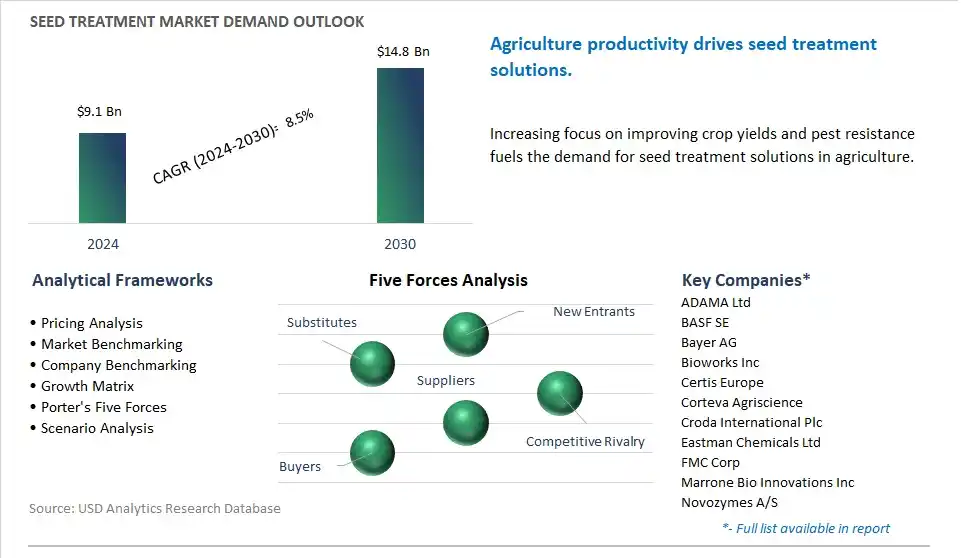
The global Seed Treatment Market is poised to register a 8.5% CAGR from $9.1 Billion in 2024 to $14.8 Billion in 2030.
The global Seed Treatment Market Study analyzes and forecasts the market size across 6 regions and 24 countries for diverse segments -By Type (Chemical, Non-chemical), By Product (Insecticides, Fungicides, Chemicals, Non-chemicals), By Crop (Corn, Soybean, Wheat, Canola, Others).
An Introduction to Global Seed Treatment Market in 2024
The future of seed treatment is influenced by key trends such as sustainable agriculture, crop protection, and technological innovations in seed coating formulations. Seed treatment involves the application of pesticides, fungicides, insecticides, and biological agents to seeds before planting to protect against pests, diseases, and environmental stressors, and enhance seed germination and plant vigor. With the growing global population and increasing demand for food production, there is a need for sustainable agricultural practices that optimize crop yields while minimizing environmental impact and resource use. Seed treatment plays a crucial role in integrated pest management (IPM) strategies by providing targeted and localized protection to seeds and seedlings, reducing the reliance on chemical sprays and enhancing crop health and productivity. Moreover, as farmers face challenges such as soil-borne diseases, pest infestations, and climate variability, there is a growing demand for seed treatment solutions that offer broad-spectrum protection, seedling vigor enhancement, and compatibility with modern farming practices. Additionally, technological advancements in seed coating technologies, such as polymer coatings, microencapsulation, and nanotechnology, improve the efficacy, adhesion, and release kinetics of active ingredients, ensuring optimal seed treatment performance and crop establishment. Furthermore, as regulatory agencies impose stricter regulations on pesticide use and promote sustainable agriculture practices, there is a shift towards environmentally friendly and biologically based seed treatment products that offer effective pest control while minimizing chemical residues and ecological impact. As agriculture embraces innovation and sustainability, the seed treatment industry will continue to evolve with new formulations, application methods, and integrated solutions to meet the evolving needs of farmers, agribusinesses, and food supply chains while addressing global challenges in crop protection and food security.
Seed Treatment Market Competitive Landscape
The market report analyses the leading companies in the industry including ADAMA Ltd, BASF SE, Bayer AG, Bioworks Inc, Certis Europe, Corteva Agriscience, Croda International Plc, Eastman Chemicals Ltd, FMC Corp, Marrone Bio Innovations Inc, Novozymes A/S, Rizobacter, Solvay, Sumitomo Chemical, Syngenta, UPL Ltd.
Seed Treatment Market Dynamics
Seed Treatment Market Trend: Growing Demand for Sustainable Agricultural Practices
A significant trend in the market for seed treatment is the growing demand for sustainable agricultural practices. With increasing awareness of environmental concerns and the need for efficient resource management, there is a rising preference among farmers for seed treatment solutions that promote sustainability while enhancing crop productivity. Seed treatment involves the application of protective chemicals, nutrients, and biological agents to seeds before planting, providing early-stage protection against pests, diseases, and environmental stressors. The trend towards sustainable agriculture drives the adoption of seed treatment technologies that minimize chemical usage, reduce environmental impact, and improve overall crop health and yield.
Seed Treatment Market Driver: Rising Need for Crop Protection and Yield Enhancement
A primary driver for the market of seed treatment is the rising need for crop protection and yield enhancement. As global population growth and changing dietary preferences drive the demand for food and agricultural products, there is increasing pressure on farmers to maximize crop yields and quality. Seed treatment plays a crucial role in modern agriculture by safeguarding seeds against pathogens, pests, and adverse environmental conditions, ensuring healthy crop establishment and early growth stages. The need for effective crop protection solutions, combined with the need to optimize yield potential and minimize input costs, acts as a key driver for the adoption of seed treatment technologies across various crop types and agricultural regions.
Seed Treatment Market Opportunity: Development of Innovative Formulations and Application Methods
An opportunity in the market for seed treatment lies in the development of innovative formulations and application methods to enhance efficacy and efficiency. Manufacturers can invest in research and development to engineer seed treatment products with improved active ingredients, adjuvants, and delivery systems that offer superior protection and performance against pests and diseases. Additionally, there is opportunity to explore novel application methods such as precision seed coating, biological seed inoculation, and seed priming techniques to optimize seed treatment effectiveness, reduce environmental impact, and minimize application costs. By innovating with advanced seed treatment solutions tailored to meet the specific needs of different crops, soil conditions, and farming practices, manufacturers can differentiate their products, capture market share, and drive growth in the dynamic agricultural inputs sector.
Seed Treatment Market Share Analysis: Chemical segment generated the highest revenue in 2024
chemical seed treatments have been widely adopted by farmers and growers for decades due to their effectiveness in protecting seeds and seedlings from pests, diseases, and environmental stressors. Chemical seed treatments involve the application of synthetic pesticides, fungicides, insecticides, and other agrochemicals to seeds or seed coatings to prevent seed and seedling damage during germination and early growth stages. Additionally, chemical seed treatments offer a broad spectrum of pest and disease control, targeting a wide range of pathogens, insects, and weeds that can affect crop establishment and yield. Further, chemical seed treatments are relatively easy to apply and integrate into existing seed treatment processes, making them convenient and cost-effective for large-scale agricultural operations. Furthermore, advancements in chemical seed treatment formulations, such as enhanced efficacy, safety, and environmental profiles, have contributed to the continued popularity and dominance of chemical seed treatments in the agricultural industry. These factors collectively contribute to the dominance of the Chemical segment in the Seed Treatment Market.
Seed Treatment Market Share Analysis: Non-chemical segment is poised to register the fastest growth rate (CAGR) over the forecast period to 2030
There are Diverse reasons for this trend. There is an increasing global focus on sustainable agriculture and environmentally friendly farming practices. Accordingly, there is growing demand for seed treatment products that minimize the use of synthetic chemicals and reduce the environmental impact of agricultural operations. Non-chemical seed treatments, such as biologicals, biopesticides, and microbial inoculants, offer effective alternatives to traditional chemical treatments while promoting soil health, biodiversity, and ecosystem resilience. Additionally, non-chemical seed treatments are often perceived as safer for human health, beneficial insects, and non-target organisms, making them attractive options for farmers, consumers, and regulatory agencies concerned about pesticide residues and ecological risks. Further, advancements in biotechnology and microbial science have led to the development of innovative non-chemical seed treatment products with improved efficacy, stability, and compatibility with modern agricultural practices. Furthermore, the increasing adoption of precision agriculture technologies, such as seed coating and seed priming techniques, enables the targeted delivery of non-chemical treatments to seeds, enhancing their performance and efficiency in crop protection and enhancement. These factors collectively contribute to the rapid growth of the Non-chemical segment in the Seed Treatment Market.
Seed Treatment Market Share Analysis: Canola segment is poised to register the fastest growth rate (CAGR) over the forecast period to 2030
Canola is a major oilseed crop grown worldwide for its high-quality oil, protein-rich meal, and versatility in food, feed, and industrial applications. The increasing global demand for vegetable oils and plant-based proteins, coupled with favorable market prices, has led to expanded canola cultivation in key producing regions. Additionally, canola faces significant challenges from pests, diseases, and environmental stressors, making seed treatment essential for ensuring optimal crop establishment, yield, and quality. Seed treatments tailored to the specific needs of canola, such as fungicides targeting soil-borne pathogens and insecticides controlling key pests like flea beetles and cutworms, play a critical role in protecting seedlings and promoting early growth. Further, advancements in seed treatment technologies, including novel active ingredients, formulations, and application methods, have enhanced the efficacy, safety, and sustainability of seed treatments for canola production. Furthermore, the adoption of integrated pest management (IPM) practices and sustainable agriculture initiatives further drive the demand for seed treatments that support crop health and productivity in canola farming systems. These factors collectively contribute to the rapid growth of the Canola segment in the Seed Treatment Market.
Seed Treatment Market Report Segmentation
By Type
Chemical
Non-chemical
By Product
Insecticides
Fungicides
Chemicals
Non-chemicals
By Crop
Corn
Soybean
Wheat
Canola
Others
Regions Included
North America (US, Canada, Mexico)
Europe (Germany, UK, France, Spain, Italy, Russia, Rest of Europe)
Asia Pacific (China, India, Japan, South Korea, Australia, South East Asia, Rest of Asia)
South America (Brazil, Argentina, Rest of South America)
Middle East and Africa (Saudi Arabia, UAE, Rest of Middle East, South Africa, Egypt, Rest of Africa)
Seed Treatment Companies Profiled in the Market Study
ADAMA Ltd
BASF SE
Bayer AG
Bioworks Inc
Certis Europe
Corteva Agriscience
Croda International Plc
Eastman Chemicals Ltd
FMC Corp
Marrone Bio Innovations Inc
Novozymes A/S
Rizobacter
Solvay
Sumitomo Chemical
Syngenta
UPL Ltd
*- List Not Exhaustive
TABLE OF CONTENTS
1 Introduction to 2024 Seed Treatment Market
1.1 Market Overview
1.2 Quick Facts
1.3 Scope/Objective of the Study
1.4 Market Definition
1.5 Countries and Regions Covered
1.6 Units, Currency, and Conversions
1.7 Industry Value Chain
2 Research Methodology
2.1 Market Size Estimation
2.2 Sources and Research Methodology
2.3 Data Triangulation
2.4 Assumptions and Limitations
3 Executive Summary
3.1 Global Seed Treatment Market Size Outlook, $ Million, 2021 to 2030
3.2 Seed Treatment Market Outlook by Type, $ Million, 2021 to 2030
3.3 Seed Treatment Market Outlook by Product, $ Million, 2021 to 2030
3.4 Seed Treatment Market Outlook by Application, $ Million, 2021 to 2030
3.5 Seed Treatment Market Outlook by Key Countries, $ Million, 2021 to 2030
4 Market Dynamics
4.1 Key Driving Forces of Seed Treatment Industry
4.2 Key Market Trends in Seed Treatment Industry
4.3 Potential Opportunities in Seed Treatment Industry
4.4 Key Challenges in Seed Treatment Industry
5 Market Factor Analysis
5.1 Value Chain Analysis
5.2 Competitive Landscape
5.2.1 Global Seed Treatment Market Share by Company (%), 2023
5.2.2 Product Offerings by Company
5.3 Porter’s Five Forces Analysis
5.4 Pricing Analysis and Outlook
6 Growth Outlook Across Scenarios
6.1 Growth Analysis-Case Scenario Definitions
6.2 Low Growth Scenario Forecasts
6.3 Reference Growth Scenario Forecasts
6.4 High Growth Scenario Forecasts
7 Global Seed Treatment Market Outlook by Segments
7.1 Seed Treatment Market Outlook by Segments, $ Million, 2021- 2030
By Type
Chemical
Non-chemical
By Product
Insecticides
Fungicides
Chemicals
Non-chemicals
By Crop
Corn
Soybean
Wheat
Canola
Others
8 North America Seed Treatment Market Analysis and Outlook To 2030
8.1 Introduction to North America Seed Treatment Markets in 2024
8.2 North America Seed Treatment Market Size Outlook by Country, 2021-2030
8.2.1 United States
8.2.2 Canada
8.2.3 Mexico
8.3 North America Seed Treatment Market size Outlook by Segments, 2021-2030
By Type
Chemical
Non-chemical
By Product
Insecticides
Fungicides
Chemicals
Non-chemicals
By Crop
Corn
Soybean
Wheat
Canola
Others
9 Europe Seed Treatment Market Analysis and Outlook To 2030
9.1 Introduction to Europe Seed Treatment Markets in 2024
9.2 Europe Seed Treatment Market Size Outlook by Country, 2021-2030
9.2.1 Germany
9.2.2 France
9.2.3 Spain
9.2.4 United Kingdom
9.2.4 Italy
9.2.5 Russia
9.2.6 Norway
9.2.7 Rest of Europe
9.3 Europe Seed Treatment Market Size Outlook by Segments, 2021-2030
By Type
Chemical
Non-chemical
By Product
Insecticides
Fungicides
Chemicals
Non-chemicals
By Crop
Corn
Soybean
Wheat
Canola
Others
10 Asia Pacific Seed Treatment Market Analysis and Outlook To 2030
10.1 Introduction to Asia Pacific Seed Treatment Markets in 2024
10.2 Asia Pacific Seed Treatment Market Size Outlook by Country, 2021-2030
10.2.1 China
10.2.2 India
10.2.3 Japan
10.2.4 South Korea
10.2.5 Indonesia
10.2.6 Malaysia
10.2.7 Australia
10.2.8 Rest of Asia Pacific
10.3 Asia Pacific Seed Treatment Market size Outlook by Segments, 2021-2030
By Type
Chemical
Non-chemical
By Product
Insecticides
Fungicides
Chemicals
Non-chemicals
By Crop
Corn
Soybean
Wheat
Canola
Others
11 South America Seed Treatment Market Analysis and Outlook To 2030
11.1 Introduction to South America Seed Treatment Markets in 2024
11.2 South America Seed Treatment Market Size Outlook by Country, 2021-2030
11.2.1 Brazil
11.2.2 Argentina
11.2.3 Rest of South America
11.3 South America Seed Treatment Market size Outlook by Segments, 2021-2030
By Type
Chemical
Non-chemical
By Product
Insecticides
Fungicides
Chemicals
Non-chemicals
By Crop
Corn
Soybean
Wheat
Canola
Others
12 Middle East and Africa Seed Treatment Market Analysis and Outlook To 2030
12.1 Introduction to Middle East and Africa Seed Treatment Markets in 2024
12.2 Middle East and Africa Seed Treatment Market Size Outlook by Country, 2021-2030
12.2.1 Saudi Arabia
12.2.2 UAE
12.2.3 Oman
12.2.4 Rest of Middle East
12.2.5 Egypt
12.2.6 Nigeria
12.2.7 South Africa
12.2.8 Rest of Africa
12.3 Middle East and Africa Seed Treatment Market size Outlook by Segments, 2021-2030
By Type
Chemical
Non-chemical
By Product
Insecticides
Fungicides
Chemicals
Non-chemicals
By Crop
Corn
Soybean
Wheat
Canola
Others
13 Company Profiles
13.1 Company Snapshot
13.2 SWOT Profiles
13.3 Products and Services
13.4 Recent Developments
13.5 Financial Profile
ADAMA Ltd
BASF SE
Bayer AG
Bioworks Inc
Certis Europe
Corteva Agriscience
Croda International Plc
Eastman Chemicals Ltd
FMC Corp
Marrone Bio Innovations Inc
Novozymes A/S
Rizobacter
Solvay
Sumitomo Chemical
Syngenta
UPL Ltd
14 Appendix
14.1 Customization Offerings
14.2 Subscription Services
14.3 Related Reports
14.4 Publisher Expertise
By Type
Chemical
Non-chemical
By Product
Insecticides
Fungicides
Chemicals
Non-chemicals
By Crop
Corn
Soybean
Wheat
Canola
Others
Countries Analyzed
North America (US, Canada, Mexico)
Europe (Germany, UK, France, Spain, Italy, Russia, Rest of Europe)
Asia Pacific (China, India, Japan, South Korea, Australia, South East Asia, Rest of Asia)
South America (Brazil, Argentina, Rest of South America)
Middle East and Africa (Saudi Arabia, UAE, Rest of Middle East, South Africa, Egypt, Rest of Africa)
