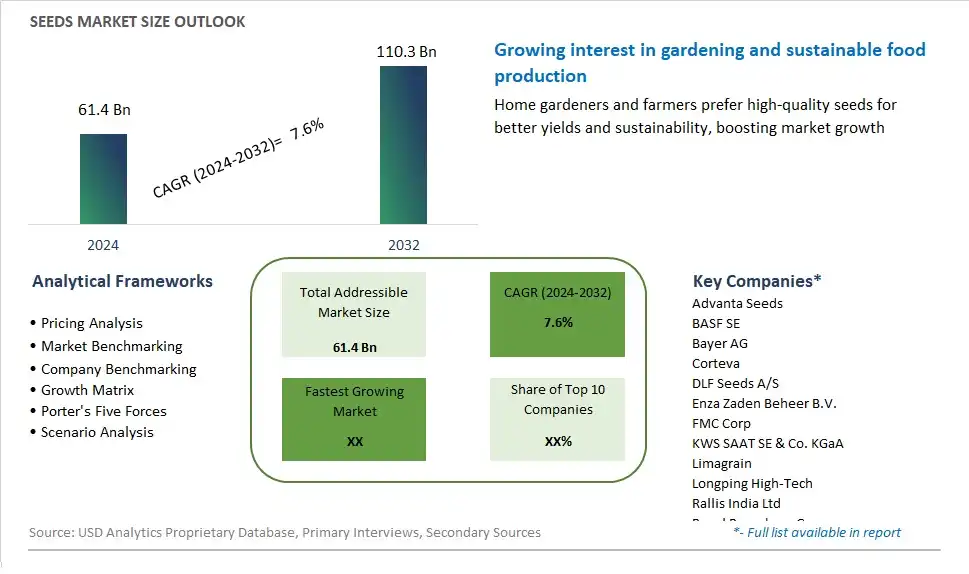
Global Seeds Market Size is valued at $61.4 Billion in 2024 and is forecast to register a growth rate (CAGR) of 7.6% to reach $110.3 Billion by 2032.
The global Seeds Market Comprehensive Study analyzes and forecasts the market size across 6 regions and 24 countries for diverse segments -By Type (Genetically Modified, Conventional), By Crop (Cereals & grains, Oilseeds & pulses, Fruits & vegetables, Others), By Trait (Herbicide Tolerance, Insect resistance, Others)
An Introduction to Seeds Market
In 2024, the seeds market is experiencing significant growth, driven by advancements in agricultural practices and the increasing demand for high-quality, high-yield crops. Seeds, including those for grains, vegetables, fruits, and flowers, are crucial for food production and biodiversity. The market is characterized by innovations in seed technology, such as genetic modification, hybridization, and organic cultivation, aimed at improving resistance to pests, diseases, and climate change. The rising interest in home gardening and sustainable farming practices is also boosting demand for seeds. Major players are focusing on research and development to create more resilient and productive seed varieties to meet global food security challenges.
Seeds Competitive Landscape
The market report analyses the leading companies in the industry including Advanta Seeds, BASF SE, Bayer AG, Corteva, DLF Seeds A/S, Enza Zaden Beheer B.V., FMC Corp, KWS SAAT SE & Co. KGaA, Limagrain, Longping High-Tech, Rallis India Ltd, Royal Barenbrug Group, Sakata Seed Corp, Syngenta Crop Protection AG, TAKII & Co. Ltd, and Others.
Seeds Market Dynamics
Seeds Market Trend: Increasing Demand for Plant-Based Foods and Sustainable Agriculture
A prominent market trend in the seeds segment is the increasing demand for plant-based foods and sustainable agriculture. As consumers become more health-conscious and environmentally aware, there is a growing preference for plant-based diets and sustainable farming practices. Seeds play a vital role in both aspects, serving as the foundation for plant growth and providing essential nutrients in plant-based food products. This trend is driven by concerns about health, animal welfare, and environmental sustainability, as well as the desire to support regenerative agriculture practices that promote soil health, biodiversity, and carbon sequestration. As a result, there is a rising demand for high-quality seeds that enable the cultivation of nutritious crops while minimizing environmental impact.
Market Driver: Expansion of the Health and Wellness Industry
The market driver for seeds is the expansion of the health and wellness industry. With growing awareness of the link between diet and health, consumers are increasingly seeking nutritious and functional foods that support their well-being. Seeds are recognized for their nutritional value, containing essential nutrients such as protein, fiber, vitamins, minerals, and healthy fats. This driver is reinforced by dietary trends emphasizing whole foods, plant-based nutrition, and superfoods known for their health-promoting properties. Additionally, the rise of specialty diets such as veganism, vegetarianism, and gluten-free diets has fueled demand for seeds as versatile ingredients that can be incorporated into a wide range of culinary applications, including snacks, beverages, baked goods, and plant-based protein alternatives.
Market Opportunity: Innovation in Seed Varieties and Genetic Technologies
One potential opportunity for the seeds market lies in innovation in seed varieties and genetic technologies. There is a growing need for seeds that are adapted to changing environmental conditions, resistant to pests and diseases, and capable of delivering higher yields and nutritional content. Advances in genetic engineering, breeding techniques, and biotechnology offer opportunities to develop improved seed varieties with desirable traits such as drought tolerance, disease resistance, nutrient fortification, and flavor enhancement. Moreover, there is potential for developing seeds tailored to specific agricultural systems, climate zones, and consumer preferences, catering to diverse farming practices and food markets worldwide. By investing in research and development and collaborating with agricultural scientists and breeders, seed companies can introduce innovative seed solutions that address evolving challenges and opportunities in global agriculture and food production.
Seeds Market Share Analysis: Conventional Seeds Segment Prevails held the dominant market share in 2024
Within the Seeds Market, the conventional seeds segment is the largest, driven by its widespread acceptance among farmers, regulatory concerns surrounding genetically modified organisms (GMOs), and consumer preferences for non-GMO products. Conventional seeds, bred through traditional breeding methods, offer farmers reliable and proven varieties with traits such as disease resistance, high yield potential, and adaptability to local growing conditions. Additionally, the perception of conventional seeds as natural and non-altered aligns with consumer demands for food transparency and sustainability. Conversely, the genetically modified seeds segment faces regulatory hurdles, public skepticism, and market restrictions in certain regions, limiting its growth potential. Despite advancements in biotechnology, conventional seeds remain the preferred choice for many farmers and consumers alike, driving the dominance of the conventional seeds segment in the seeds market.
Seeds Market Share Analysis: Oilseeds & Pulses Segment market is poised to register the fastest growth rae over the forecast period to 2032
In the Seeds Market, the oilseeds & pulses segment is the fastest growing, driven by increasing global demand for plant-based proteins, vegetable oils, and biofuels. With growing populations and changing dietary preferences towards healthier and sustainable food options, oilseeds such as soybean, canola, and cotton are witnessing heightened demand for their protein-rich seeds and oil extraction. Further, the expansion of biodiesel production and the use of oilseeds in animal feed further stimulate demand for oilseed crops. Additionally, pulses, including lentils, chickpeas, and beans, are gaining popularity as nutritious sources of protein and dietary fiber, particularly in vegetarian and vegan diets. The versatility of oilseeds & pulses in various applications, coupled with their agronomic benefits and market demand, positions this segment for rapid growth and significant contributions to the overall seeds market in the foreseeable future.
Seeds Market Share Analysis: Herbicide Tolerance Trait held the dominant market share in 2024
In the Seeds Market, the herbicide tolerance trait segment is the largest, driven by its widespread adoption among farmers seeking effective weed management solutions and increased crop yields. Seeds with herbicide tolerance traits are genetically engineered to withstand the application of specific herbicides, allowing farmers to control weeds without harming the crop. This trait offers farmers greater flexibility in weed control practices, reduces the need for manual labor, and enhances overall crop productivity. Further, the herbicide tolerance trait aligns with sustainable agricultural practices by promoting conservation tillage methods, which help reduce soil erosion and preserve soil health. As farmers continue to prioritize efficiency and sustainability in their farming practices, the herbicide tolerance trait remains a cornerstone of the seeds market, poised for continued dominance in the foreseeable future.
Seeds Market Segmentation
By Type
Genetically Modified
Conventional
By Crop
Cereals & grains
-Corn
-Wheat
-Rice
-Others
Oilseeds & pulses
-Soybean
-Canola
-Cotton
-Others
Fruits & vegetables
-Solanaceae
-Cucurbits
-Brassicas
-Leafy vegetables
-Roots & bulbs
-Others
Others
By Trait
Herbicide tolerance
Insect resistance
Others
Countries Analyzed
North America (US, Canada, Mexico)
Europe (Germany, UK, France, Spain, Italy, Russia, Rest of Europe)
Asia Pacific (China, India, Japan, South Korea, Australia, South East Asia, Rest of Asia)
South America (Brazil, Argentina, Rest of South America)
Middle East and Africa (Saudi Arabia, UAE, Rest of Middle East, South Africa, Egypt, Rest of Africa)
Seeds Companies Profiled in the Study
Advanta Seeds
BASF SE
Bayer AG
Corteva
DLF Seeds A/S
Enza Zaden Beheer B.V.
FMC Corp
KWS SAAT SE & Co. KGaA
Limagrain
Longping High-Tech
Rallis India Ltd
Royal Barenbrug Group
Sakata Seed Corp
Syngenta Crop Protection AG
TAKII & Co. Ltd
*- List Not Exhaustive
Chapter 1. TABLE OF CONTENTS
Chapter 2. Introduction to Seeds Market
2.1. Market Overview
2.2. Key Statistics and Report Highlights
2.3. Scope of the Comprehensive Study
2.3.1. Market Definition
2.3.2 Countries and Regions Covered
2.3.3 Research Objective
2.3.4 Units, Currency, and Conversions
2.3.5 Industry Value Chain
2.4. Key Market Segments
2.5. Key Companies
2.6. Study Period
Chapter 3. Strategic Analysis Review
3.1. Seeds Pricing Analysis and Forecast
3.2. Porter’s Five Forces
3.3. Market Ecosystem
3.4. SWOT Analysis
3.5. Regulatory Scenario
3.3. Effects of Inflation, Russia-Ukraine War, moderating economic growth, and other macroeconomic factors
Chapter 4. Competitive Landscape
4.1. Market Share Analysis
4.1.1. Global Seeds Market Share by Company, 2023
4.1.2. Product Offerings of Leading Seeds Companies
4.2. Market Entropy
4.2.1. New Product Launches in the Industry
4.2.2. Mergers, Acquisitions, Joint ventures, and Partnerships
4.3. Key Strategies and Best Practices
Chapter 5. Global Market Projections: Best, Reference, and Low Case Scenarios
5.1. Growth Analysis- Case Scenario Definitions
5.2. Low Growth Case Scenario Forecasts
5.3. Reference Growth Case Scenario Forecasts
5.4. High Growth Case Scenario Forecasts
Chapter 6. Market Dynamics
6.1. Seeds Market Drivers
6.2. Seeds Market Challenges
6.6. Seeds Market Opportunities
6.4. Seeds Market Trends
Chapter 7. Global Seeds Market Outlook Trends
7.1. Global Seeds Revenue (USD Million) and CAGR (%) by Type (2021-2032)
7.2. Global Seeds Revenue (USD Million) and CAGR (%) by Application (2021-2032)
7.3. Global Seeds Revenue (USD Million) and CAGR (%) by Product (2021-2032)
By Type
Genetically Modified
Conventional
By Crop
Cereals & grains
-Corn
-Wheat
-Rice
-Others
Oilseeds & pulses
-Soybean
-Canola
-Cotton
-Others
Fruits & vegetables
-Solanaceae
-Cucurbits
-Brassicas
-Leafy vegetables
-Roots & bulbs
-Others
Others
By Trait
Herbicide tolerance
Insect resistance
Others
Chapter 8. Global Seeds Regional Analysis and Outlook
8.1. Global Seeds Revenue (USD Million) By Regions (2021- 2032)
8.2. North America Seeds Revenue (USD Million) by Country (2021-2032)
8.2.1. United States Seeds Regional Analysis and Outlook
8.2.2. Canada Seeds Regional Analysis and Outlook
8.2.3. Mexico Seeds Regional Analysis and Outlook
8.3. Europe Seeds Revenue (USD Million), by Country (2021-2032)
8.3.1. Germany Seeds Regional Analysis and Outlook
8.3.2. France Seeds Regional Analysis and Outlook
8.3.3. United Kingdom Seeds Regional Analysis and Outlook
8.3.4. Spain Seeds Regional Analysis and Outlook
8.3.5. Italy Seeds Regional Analysis and Outlook
8.3.6. Russia Seeds Regional Analysis and Outlook
8.3.7. Rest of Europe Seeds Regional Analysis and Outlook
8.4. Asia Pacific Seeds Revenue (USD Million) by Country (2021-2032)
8.4.1. China Seeds Regional Analysis and Outlook
8.4.2. Japan Seeds Regional Analysis and Outlook
8.4.3. India Seeds Regional Analysis and Outlook
8.4.4. South Korea Seeds Regional Analysis and Outlook
8.4.5. Australia Seeds Regional Analysis and Outlook
8.4.6. South East Asia Seeds Regional Analysis and Outlook
8.4.7. Rest of Asia Pacific Seeds Regional Analysis and Outlook
8.5. South America Seeds Revenue (USD Million), by Country (2021-2032)
8.5.1. Brazil Seeds Regional Analysis and Outlook
8.5.2. Argentina Seeds Regional Analysis and Outlook
8.5.3. Rest of South America Seeds Regional Analysis and Outlook
8.6. Middle East and Africa Seeds Revenue (USD Million) by Country (2021-2032)
8.6.1. Middle East Seeds Regional Analysis and Outlook
8.6.2. Africa Seeds Regional Analysis and Outlook
Chapter 9. North America Seeds Analysis and Outlook
9.1. North America Seeds Revenue (USD Million) by Segments (2021-2032)
9.1.1. North America Seeds Revenue (USD Million) by Type (2021-2032)
9.1.2. North America Seeds Revenue (USD Million) by Application (2021-2032)
9.1.3. North America Seeds Revenue (USD Million) by Product (2021-2032)
By Type
Genetically Modified
Conventional
By Crop
Cereals & grains
-Corn
-Wheat
-Rice
-Others
Oilseeds & pulses
-Soybean
-Canola
-Cotton
-Others
Fruits & vegetables
-Solanaceae
-Cucurbits
-Brassicas
-Leafy vegetables
-Roots & bulbs
-Others
Others
By Trait
Herbicide tolerance
Insect resistance
Others
Chapter 10. Europe Seeds Analysis and Outlook
10.1. Europe Seeds Revenue (USD Million), by Segments (USD Million) (2021-2032)
10.1.1. Europe Seeds Revenue (USD Million) by Type (2021-2032)
10.1.2. Europe Seeds Revenue (USD Million) by Application (2021-2032)
10.1.3. Europe Seeds Revenue (USD Million) by Product (2021-2032)
By Type
Genetically Modified
Conventional
By Crop
Cereals & grains
-Corn
-Wheat
-Rice
-Others
Oilseeds & pulses
-Soybean
-Canola
-Cotton
-Others
Fruits & vegetables
-Solanaceae
-Cucurbits
-Brassicas
-Leafy vegetables
-Roots & bulbs
-Others
Others
By Trait
Herbicide tolerance
Insect resistance
Others
Chapter 11. Asia Pacific Seeds Analysis and Outlook
11.1. Asia Pacific Seeds Revenue (USD Million), and Revenue (USD Million) by Segments (2021-2032)
11.1.1. Asia Pacific Seeds Revenue (USD Million) by Type (2021-2032)
11.1.2. Asia Pacific Seeds Revenue (USD Million) by Application (2021-2032)
11.1.3. Asia Pacific Seeds Revenue (USD Million) by Product (2021-2032)
By Type
Genetically Modified
Conventional
By Crop
Cereals & grains
-Corn
-Wheat
-Rice
-Others
Oilseeds & pulses
-Soybean
-Canola
-Cotton
-Others
Fruits & vegetables
-Solanaceae
-Cucurbits
-Brassicas
-Leafy vegetables
-Roots & bulbs
-Others
Others
By Trait
Herbicide tolerance
Insect resistance
Others
Chapter 12. South America Seeds Analysis and Outlook
12.1. South America Seeds Revenue (USD Million), by Segments (2021-2032)
12.1.1. South America Seeds Revenue (USD Million) by Type (2021-2032)
12.1.2. South America Seeds Revenue (USD Million) by Application (2021-2032)
12.1.3. South America Seeds Revenue (USD Million) by Product (2021-2032)
By Type
Genetically Modified
Conventional
By Crop
Cereals & grains
-Corn
-Wheat
-Rice
-Others
Oilseeds & pulses
-Soybean
-Canola
-Cotton
-Others
Fruits & vegetables
-Solanaceae
-Cucurbits
-Brassicas
-Leafy vegetables
-Roots & bulbs
-Others
Others
By Trait
Herbicide tolerance
Insect resistance
Others
Chapter 13. Middle East and Africa Seeds Analysis and Outlook
13.1. Middle East and Africa Seeds Revenue (USD Million), by Segments (2021-2032)
13.1.1. Middle East and Africa Seeds Revenue (USD Million) by Type (2021-2032)
13.1.2. Middle East and Africa Seeds Revenue (USD Million) by Application (2021-2032)
13.1.3. Middle East and Africa Seeds Revenue (USD Million) by Product (2021-2032)
By Type
Genetically Modified
Conventional
By Crop
Cereals & grains
-Corn
-Wheat
-Rice
-Others
Oilseeds & pulses
-Soybean
-Canola
-Cotton
-Others
Fruits & vegetables
-Solanaceae
-Cucurbits
-Brassicas
-Leafy vegetables
-Roots & bulbs
-Others
Others
By Trait
Herbicide tolerance
Insect resistance
Others
Chapter 14. Seeds Company Profiles
14.1 Business Overview
14.2 Product Profiles
14.3 SWOT Profiles
14.5 Recent Developments
14.6 Financial Profile
List of Companies
Advanta Seeds
BASF SE
Bayer AG
Corteva
DLF Seeds A/S
Enza Zaden Beheer B.V.
FMC Corp
KWS SAAT SE & Co. KGaA
Limagrain
Longping High-Tech
Rallis India Ltd
Royal Barenbrug Group
Sakata Seed Corp
Syngenta Crop Protection AG
TAKII & Co. Ltd
15. Methodology and Data Sources
15.1 Customization Offerings
15.2 Subscription Services
15.3 Related Reports
15.4 Publisher Expertise
LIST OF TABLES
Table 1 Market Segmentation Analysis
Table 2 Global Seeds Market Share of Leading Companies, 2023
Table 3 Product Offerings of Leading Companies
Table 4 Low Growth Scenario Forecasts
Table 5 Reference Case Growth Scenario
Table 6 High Growth Case Scenario
Table 7 Global Seeds Revenue (USD Million) And CAGR (%) By Type (2021-2032)
Table 8 Global Seeds Revenue (USD Million) And CAGR (%) By Application (2021-2032)
Table 9 Global Seeds Revenue (USD Million) And CAGR (%) By Product (2021-2032)
Table 10 Global Seeds Market Revenue (USD Million) By Regions (2021-2032)
Table 11 Global Seeds Market Share (%) By Regions (2021-2032)
Table 12 North America Seeds Revenue (USD Million) By Country (2021-2032)
Table 13 Europe Seeds Revenue (USD Million) By Country (2021-2032)
Table 14 Asia Pacific Seeds Revenue (USD Million) By Country (2021-2032)
Table 15 South America Seeds Revenue (USD Million) By Country (2021-2032)
Table 16 Middle East and Africa Seeds Revenue (USD Million) By Region (2021-2032)
Table 17 North America Seeds Revenue (USD Million) By Type (2021-2032)
Table 18 North America Seeds Revenue (USD Million) By Application (2021-2032)
Table 19 North America Seeds Revenue (USD Million) By Product (2021-2032)
Table 20 Europe Seeds Revenue (USD Million) By Type (2021-2032)
Table 21 Europe Seeds Revenue (USD Million) By Application (2021-2032)
Table 22 Europe Seeds Revenue (USD Million) By Product (2021-2032)
Table 23 Asia Pacific Seeds Revenue (USD Million) By Type (2021-2032)
Table 24 Asia Pacific Seeds Revenue (USD Million) By Application (2021-2032)
Table 25 Asia Pacific Seeds Revenue (USD Million) By Product (2021-2032)
Table 26 South America Seeds Revenue (USD Million) By Type (2021-2032)
Table 27 South America Seeds Revenue (USD Million) By Application (2021-2032)
Table 28 South America Seeds Revenue (USD Million) By Product (2021-2032)
Table 29 Middle East and Africa Seeds Revenue (USD Million) By Type (2021-2032)
Table 30 Middle East and Africa Seeds Revenue (USD Million) By Application (2021-2032)
Table 31 Middle East and Africa Seeds Revenue (USD Million) By Product (2021-2032)
LIST OF FIGURES
Figure 1. Market Scope
Figure 2. Pricing Forecasts Per Unit, 2023- 2032
Figure 3. Porter’s Five Forces
Figure 4. Global Seeds Market Revenue (USD Million) By Regions (2021-2032)
Figure 5. Global Seeds Market Share (%) By Regions (2023)
Figure 6. North America Seeds Revenue (USD Million) By Country (2021-2032)
Figure 7. United States Seeds Revenue (USD Million) By Country (2021-2032)
Figure 8. Canada Seeds Revenue (USD Million) By Country (2021-2032)
Figure 9. Mexico Seeds Revenue (USD Million) By Country (2021-2032)
Figure 10. Europe Seeds Revenue (USD Million) By Country (2021-2032)
Figure 11. Germany Seeds Revenue (USD Million) By Country (2021-2032)
Figure 12. France Seeds Revenue (USD Million) By Country (2021-2032)
Figure 13. United Kingdom Seeds Revenue (USD Million) By Country (2021-2032)
Figure 14. Spain Seeds Revenue (USD Million) By Country (2021-2032)
Figure 15. Italy Seeds Revenue (USD Million) By Country (2021-2032)
Figure 16. Russia Seeds Revenue (USD Million) By Country (2021-2032)
Figure 17. Rest of Europe Seeds Revenue (USD Million) By Country (2021-2032)
Figure 11. Asia Pacific Seeds Revenue (USD Million) By Country (2021-2032)
Figure 12. China Seeds Revenue (USD Million) By Country (2021-2032)
Figure 13. Japan Seeds Revenue (USD Million) By Country (2021-2032)
Figure 14. India Seeds Revenue (USD Million) By Country (2021-2032)
Figure 15. South Korea Seeds Revenue (USD Million) By Country (2021-2032)
Figure 16. Australia Seeds Revenue (USD Million) By Country (2021-2032)
Figure 17. South East Asia Seeds Revenue (USD Million) By Country (2021-2032)
Figure 18. South America Seeds Revenue (USD Million) By Country (2021-2032)
Figure 19. Brazil Seeds Revenue (USD Million) By Country (2021-2032)
Figure 20. Argentina Seeds Revenue (USD Million) By Country (2021-2032)
Figure 21. Rest of Asia Pacific Seeds Revenue (USD Million) By Country (2021-2032)
Figure 22. Middle East and Africa Seeds Revenue (USD Million) By Region (2021-2032)
Figure 23. Saudi Arabia Seeds Revenue (USD Million) By Region (2021-2032)
Figure 24. The UAE Seeds Revenue (USD Million) By Region (2021-2032)
Figure 25. Rest of Middle East Seeds Revenue (USD Million) By Region (2021-2032)
Figure 26. South Africa Seeds Revenue (USD Million) By Region (2021-2032)
Figure 27. Africa Seeds Revenue (USD Million) By Region (2021-2032)
Figure 28. North America Seeds Revenue (USD Million) By Type (2021-2032)
Figure 29. North America Seeds Revenue (USD Million) By Application (2021-2032)
Figure 30. North America Seeds Revenue (USD Million) By Product (2021-2032)
Figure 31. Europe Seeds Revenue (USD Million) By Type (2021-2032)
Figure 32. Europe Seeds Revenue (USD Million) By Application (2021-2032)
Figure 33. Europe Seeds Revenue (USD Million) By Product (2021-2032)
Figure 34. Asia Pacific Seeds Revenue (USD Million) By Type (2021-2032)
Figure 35. Asia Pacific Seeds Revenue (USD Million) By Application (2021-2032)
Figure 36. Asia Pacific Seeds Revenue (USD Million) By Product (2021-2032)
Figure 37. South America Seeds Revenue (USD Million) By Type (2021-2032)
Figure 38. South America Seeds Revenue (USD Million) By Application (2021-2032)
Figure 39. South America Seeds Revenue (USD Million) By Product (2021-2032)
Figure 40. Middle East and Africa Seeds Revenue (USD Million) By Type (2021-2032)
Figure 41. Middle East and Africa Seeds Revenue (USD Million) By Application (2021-2032)
Figure 42. Middle East and Africa Seeds Revenue (USD Million) By Product (2021-2032)
By Type
Genetically Modified
Conventional
By Crop
Cereals & grains
-Corn
-Wheat
-Rice
-Others
Oilseeds & pulses
-Soybean
-Canola
-Cotton
-Others
Fruits & vegetables
-Solanaceae
-Cucurbits
-Brassicas
-Leafy vegetables
-Roots & bulbs
-Others
Others
By Trait
Herbicide tolerance
Insect resistance
Others
Countries Analyzed
North America (US, Canada, Mexico)
Europe (Germany, UK, France, Spain, Italy, Russia, Rest of Europe)
Asia Pacific (China, India, Japan, South Korea, Australia, South East Asia, Rest of Asia)
South America (Brazil, Argentina, Rest of South America)
Middle East and Africa (Saudi Arabia, UAE, Rest of Middle East, South Africa, Egypt, Rest of Africa)
