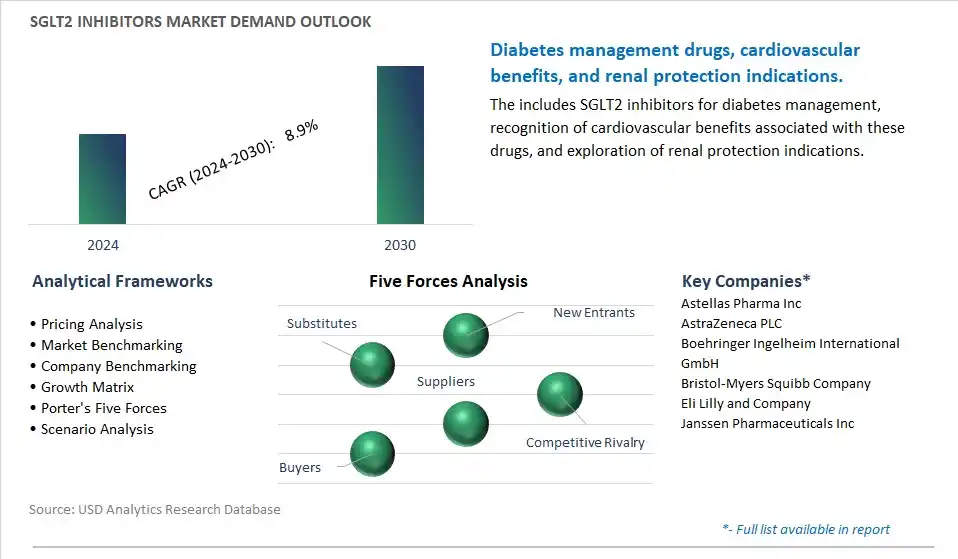
SGLT2 Inhibitors Market is estimated to increase at a Compounded Annual Growth Rate of 8.9% CAGR over the forecast period from 2024 to 2030
The SGLT2 Inhibitors Market study analyzes and forecasts the market size across 6 regions and 24 countries for diverse segments- By Drug (Sodium Glucose C-transport -2 (SGLT-2) Inhibitor, Invokana (Canagliflozin), Jardiance (Empagliflozin), Farxiga/Forxiga (Dapagliflozin), Suglat (Ipragliflozin)).
An Introduction to SGLT2 Inhibitors Market in 2024
In 2024, the market for sodium-glucose cotransporter-2 (SGLT2) inhibitors continues to grow, driven by their efficacy in the management of type 2 diabetes mellitus (T2DM) and cardiovascular conditions. SGLT2 inhibitors are a class of oral antidiabetic medications that lower blood glucose levels by inhibiting glucose reabsorption in the kidneys, leading to glycosuria and improved glycemic control. Additionally, SGLT2 inhibitors have demonstrated cardiovascular and renal benefits, including reductions in cardiovascular events, heart failure hospitalizations, and progression of chronic kidney disease (CKD) in patients with T2DM and established cardiovascular risk factors. With a favorable safety profile and potential for weight loss, SGLT2 inhibitors offer patients and healthcare providers an effective treatment option for managing T2DM and reducing the risk of cardiovascular and renal complications. Moreover, ongoing research explores the therapeutic potential of SGLT2 inhibitors in other metabolic and cardiovascular conditions, highlighting their versatility and impact on multiple disease pathways.
Market Trend: Expansion of Indications Beyond Type 2 Diabetes
A significant trend in the SGLT2 inhibitors market is the expansion of indications beyond type 2 diabetes. Originally developed as glucose-lowering agents for the treatment of type 2 diabetes mellitus, SGLT2 inhibitors have demonstrated efficacy and safety in managing a range of cardiometabolic conditions and renal diseases. Recent clinical trials have shown that SGLT2 inhibitors offer benefits beyond glycemic control, including reductions in cardiovascular events, heart failure hospitalizations, and progression of chronic kidney disease (CKD) in patients with or without diabetes. This trend towards the expanded use of SGLT2 inhibitors in cardiorenal indications reflects a growing recognition of their pleiotropic effects on cardiovascular and renal outcomes, driving market growth and investment in research and development initiatives focused on exploring new therapeutic applications and expanding label indications for SGLT2 inhibitors.
Market Driver: Focus on Cardiovascular and Renal Risk Reduction
A primary driver propelling the SGLT2 inhibitors market forward is the focus on cardiovascular and renal risk reduction. Cardiovascular disease and CKD are leading causes of morbidity and mortality worldwide, particularly among individuals with type 2 diabetes and other cardiometabolic risk factors. SGLT2 inhibitors have emerged as a promising class of medications that offer significant cardiovascular and renal protective effects, independent of their glucose-lowering properties. Mechanisms such as improved hemodynamic function, reduction in arterial stiffness, and modulation of renal sodium and glucose handling contribute to the cardiorenal benefits observed with SGLT2 inhibitors. With increasing recognition of the importance of comprehensive cardiometabolic care and the value of multi-targeted therapies in reducing cardiovascular and renal risk, there is a growing demand for SGLT2 inhibitors as integral components of cardiometabolic treatment regimens. This driver underscores the pivotal role of SGLT2 inhibitors in addressing unmet medical needs and improving outcomes for patients with cardiometabolic conditions and renal diseases, driving market growth and adoption of SGLT2 inhibitors in clinical practice.
Market Opportunity: Expansion into Heart Failure and Chronic Kidney Disease
An opportunity within the SGLT2 inhibitors market lies in the expansion into heart failure and chronic kidney disease (CKD) indications. While SGLT2 inhibitors were initially approved for the treatment of type 2 diabetes, recent clinical trials have demonstrated their efficacy and safety in reducing the risk of heart failure exacerbations and slowing the progression of CKD in patients with and without diabetes. Given the significant burden of heart failure and CKD worldwide and the limited treatment options available, there is a compelling opportunity to position SGLT2 inhibitors as first-line therapies for these high-risk patient populations. By leveraging their established cardiovascular and renal protective effects, SGLT2 inhibitors offer the potential to improve outcomes, reduce hospitalizations, and delay disease progression in patients with heart failure and CKD, irrespective of diabetes status. This expansion into heart failure and CKD indications represents an opportunity for manufacturers to capitalize on the growing demand for effective cardiorenal therapies, differentiate their products in the competitive landscape, and address the unmet medical needs of patients with these debilitating conditions.
SGLT2 Inhibitors Market Share Analysis: Jardiance (Empagliflozin)
The fast-growing segment in the SGLT2 Inhibitors Market is Jardiance (Empagliflozin). Jardiance, along with other SGLT2 inhibitors like Invokana (Canagliflozin) and Farxiga/Forxiga (Dapagliflozin), belongs to a class of drugs that help lower blood sugar levels in adults with type 2 diabetes by causing the kidneys to remove sugar from the body through urine. Among these SGLT2 inhibitors, Jardiance has witnessed significant growth due to its efficacy in reducing the risk of cardiovascular events and mortality in patients with type 2 diabetes and established cardiovascular disease. Clinical trials have demonstrated the cardiovascular benefits of Jardiance, making it a preferred choice for patients with type 2 diabetes who require additional cardiovascular protection. Additionally, Jardiance has shown favorable results in reducing the risk of hospitalization for heart failure in diabetic patients with or without cardiovascular disease, further driving its adoption and contributing to its fast growth in the SGLT2 inhibitors market.
SGLT2 Inhibitors Competitive Analysis
The market research study provides in-depth insights into leading companies including the SWOT analyses, product profile, financial details, and recent developments acrossAstellas Pharma Inc, AstraZeneca PLC, Boehringer Ingelheim International GmbH, Bristol-Myers Squibb Company, Eli Lilly and Company, Janssen Pharmaceuticals Inc
SGLT2 Inhibitors Market Segmentation
By Drug
Sodium - Glucose C-transport -2 (SGLT-2) Inhibitor
-Invokana (Canagliflozin)
-Jardiance (Empagliflozin)
-Farxiga/Forxiga (Dapagliflozin)
-Suglat (Ipragliflozin)
Geographical Analysis
North America (United States, Canada, Mexico)
Europe (Germany, France, United Kingdom, Spain, Italy, Rest of Europe)
Asia Pacific (China, India, Japan, South Korea, Rest of Asia Pacific)
South America (Brazil, Argentina, Rest of South America)
Middle East and Africa (Saudi Arabia, UAE, Rest of Middle East, South Africa, Egypt, Rest of Africa)
SGLT2 Inhibitors Market Companies
Astellas Pharma Inc
AstraZeneca PLC
Boehringer Ingelheim International GmbH
Bristol-Myers Squibb Company
Eli Lilly and Company
Janssen Pharmaceuticals Inc
Reasons to Buy the SGLT2 Inhibitors Market Study
• Deepen your industry insights and navigate uncertainties for strategy formulation, CAPEX, and Operational decisions
• Gain access to detailed insights on the SGLT2 Inhibitors Market, encompassing current market size, growth trends, and forecasts till 2030.
• Access detailed competitor analysis, enabling competitive advantage through a thorough understanding of market players, strategies, and potential differentiation opportunities
• Stay ahead of the curve with insights on technological advancements, innovations, and upcoming trends
• Identify lucrative investment avenues and expansion opportunities within the SGLT2 Inhibitors Market industry, guided by robust, data-backed analysis.
• Understand regional and global markets through country-wise analysis, regional market potential, regulatory nuances, and dynamics
• Execute strategies with confidence and speed through information, analytics, and insights on the industry value chain
• Corporate leaders, strategists, financial experts, shareholders, asset managers, and governmental representatives can make long-term planning scenarios and build an integrated and timely understanding of market dynamics
• Benefit from tailored solutions and expert consultation based on report insights, providing personalized strategies aligned with specific business needs.
TABLE OF CONTENTS
1 Introduction to 2024 SGLT2 Inhibitors Market
1.1 Market Overview
1.2 Quick Facts
1.3 Scope/Objective of the Study
1.4 Market Definition
1.5 Countries and Regions Covered
1.6 Units, Currency, and Conversions
1.7 Industry Value Chain
2 Research Methodology
2.1 Market Size Estimation
2.2 Sources and Research Methodology
2.3 Data Triangulation
2.4 Assumptions and Limitations
3 Executive Summary
3.1 Global SGLT2 Inhibitors Market Size Outlook, $ Million, 2021 to 2030
3.2 SGLT2 Inhibitors Market Outlook by Type, $ Million, 2021 to 2030
3.3 SGLT2 Inhibitors Market Outlook by Product, $ Million, 2021 to 2030
3.4 SGLT2 Inhibitors Market Outlook by Application, $ Million, 2021 to 2030
3.5 SGLT2 Inhibitors Market Outlook by Key Countries, $ Million, 2021 to 2030
4 Market Dynamics
4.1 Key Driving Forces of SGLT2 Inhibitors Industry
4.2 Key Market Trends in SGLT2 Inhibitors Industry
4.3 Potential Opportunities in SGLT2 Inhibitors Industry
4.4 Key Challenges in SGLT2 Inhibitors Industry
5 Market Factor Analysis
5.1 Value Chain Analysis
5.2 Competitive Landscape
5.2.1 Global SGLT2 Inhibitors Market Share by Company (%), 2023
5.2.2 Product Offerings by Company
5.3 Porter’s Five Forces Analysis
5.4 Pricing Analysis and Outlook
6 Growth Outlook Across Scenarios
6.1 Growth Analysis-Case Scenario Definitions
6.2 Low Growth Scenario Forecasts
6.3 Reference Growth Scenario Forecasts
6.4 High Growth Scenario Forecasts
7 Global SGLT2 Inhibitors Market Outlook by Segments
7.1 SGLT2 Inhibitors Market Outlook by Segments, $ Million, 2021- 2030
By Drug
Sodium - Glucose C-transport -2 (SGLT-2) Inhibitor
-Invokana (Canagliflozin)
-Jardiance (Empagliflozin)
-Farxiga/Forxiga (Dapagliflozin)
-Suglat (Ipragliflozin)
8 North America SGLT2 Inhibitors Market Analysis and Outlook To 2030
8.1 Introduction to North America SGLT2 Inhibitors Markets in 2024
8.2 North America SGLT2 Inhibitors Market Size Outlook by Country, 2021-2030
8.2.1 United States
8.2.2 Canada
8.2.3 Mexico
8.3 North America SGLT2 Inhibitors Market size Outlook by Segments, 2021-2030
By Drug
Sodium - Glucose C-transport -2 (SGLT-2) Inhibitor
-Invokana (Canagliflozin)
-Jardiance (Empagliflozin)
-Farxiga/Forxiga (Dapagliflozin)
-Suglat (Ipragliflozin)
9 Europe SGLT2 Inhibitors Market Analysis and Outlook To 2030
9.1 Introduction to Europe SGLT2 Inhibitors Markets in 2024
9.2 Europe SGLT2 Inhibitors Market Size Outlook by Country, 2021-2030
9.2.1 Germany
9.2.2 France
9.2.3 Spain
9.2.4 United Kingdom
9.2.4 Italy
9.2.5 Russia
9.2.6 Norway
9.2.7 Rest of Europe
9.3 Europe SGLT2 Inhibitors Market Size Outlook by Segments, 2021-2030
By Drug
Sodium - Glucose C-transport -2 (SGLT-2) Inhibitor
-Invokana (Canagliflozin)
-Jardiance (Empagliflozin)
-Farxiga/Forxiga (Dapagliflozin)
-Suglat (Ipragliflozin)
10 Asia Pacific SGLT2 Inhibitors Market Analysis and Outlook To 2030
10.1 Introduction to Asia Pacific SGLT2 Inhibitors Markets in 2024
10.2 Asia Pacific SGLT2 Inhibitors Market Size Outlook by Country, 2021-2030
10.2.1 China
10.2.2 India
10.2.3 Japan
10.2.4 South Korea
10.2.5 Indonesia
10.2.6 Malaysia
10.2.7 Australia
10.2.8 Rest of Asia Pacific
10.3 Asia Pacific SGLT2 Inhibitors Market size Outlook by Segments, 2021-2030
By Drug
Sodium - Glucose C-transport -2 (SGLT-2) Inhibitor
-Invokana (Canagliflozin)
-Jardiance (Empagliflozin)
-Farxiga/Forxiga (Dapagliflozin)
-Suglat (Ipragliflozin)
11 South America SGLT2 Inhibitors Market Analysis and Outlook To 2030
11.1 Introduction to South America SGLT2 Inhibitors Markets in 2024
11.2 South America SGLT2 Inhibitors Market Size Outlook by Country, 2021-2030
11.2.1 Brazil
11.2.2 Argentina
11.2.3 Rest of South America
11.3 South America SGLT2 Inhibitors Market size Outlook by Segments, 2021-2030
By Drug
Sodium - Glucose C-transport -2 (SGLT-2) Inhibitor
-Invokana (Canagliflozin)
-Jardiance (Empagliflozin)
-Farxiga/Forxiga (Dapagliflozin)
-Suglat (Ipragliflozin)
12 Middle East and Africa SGLT2 Inhibitors Market Analysis and Outlook To 2030
12.1 Introduction to Middle East and Africa SGLT2 Inhibitors Markets in 2024
12.2 Middle East and Africa SGLT2 Inhibitors Market Size Outlook by Country, 2021-2030
12.2.1 Saudi Arabia
12.2.2 UAE
12.2.3 Oman
12.2.4 Rest of Middle East
12.2.5 Egypt
12.2.6 Nigeria
12.2.7 South Africa
12.2.8 Rest of Africa
12.3 Middle East and Africa SGLT2 Inhibitors Market size Outlook by Segments, 2021-2030
By Drug
Sodium - Glucose C-transport -2 (SGLT-2) Inhibitor
-Invokana (Canagliflozin)
-Jardiance (Empagliflozin)
-Farxiga/Forxiga (Dapagliflozin)
-Suglat (Ipragliflozin)
13 Company Profiles
13.1 Company Snapshot
13.2 SWOT Profiles
13.3 Products and Services
13.4 Recent Developments
13.5 Financial Profile
List of Companies
Astellas Pharma Inc
AstraZeneca PLC
Boehringer Ingelheim International GmbH
Bristol-Myers Squibb Company
Eli Lilly and Company
Janssen Pharmaceuticals Inc
14 Appendix
14.1 Customization Offerings
14.2 Subscription Services
14.3 Related Reports
14.4 Publisher Expertise
By Drug
Sodium - Glucose C-transport -2 (SGLT-2) Inhibitor
-Invokana (Canagliflozin)
-Jardiance (Empagliflozin)
-Farxiga/Forxiga (Dapagliflozin)
-Suglat (Ipragliflozin)
Countries Analyzed
North America (United States, Canada, Mexico)
Europe (Germany, France, United Kingdom, Spain, Italy, Rest of Europe)
Asia Pacific (China, India, Japan, South Korea, Rest of Asia Pacific)
South America (Brazil, Argentina, Rest of South America)
Middle East and Africa (Saudi Arabia, UAE, Rest of Middle East, South Africa, Egypt, Rest of Africa)
