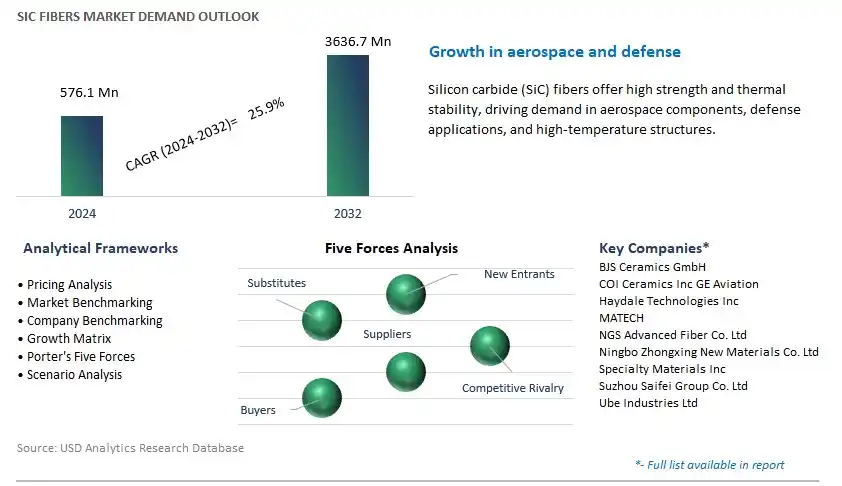
Global SiC Fibers Market Size is valued at $576.1 Million in 2024 and is forecast to register a growth rate (CAGR) of 25.9% to reach $3636.7 Million by 2032.
The global SiC Fibers Market Study analyzes and forecasts the market size across 6 regions and 24 countries for diverse segments -By Type (First Generation, Second Generation, Third Generation), By Form (Continuous, Woven, Others), By Phase (Amorphous, Crystalline), By Usage (Composites, Non-Composites), By End-User (Aerospace & Defense, Energy & Power, Industrial, Others).
An Introduction to SiC Fibers Market in 2024
In 2024, the SiC fibers market is experiencing significant growth driven by the increasing demand for lightweight, high-strength materials in aerospace, automotive, and energy industries. Silicon carbide (SiC) fibers offer exceptional mechanical properties such as high tensile strength, stiffness, and temperature resistance, making them ideal for applications requiring superior performance under extreme conditions. The aerospace sector is a major consumer of SiC fibers, utilizing them in aircraft components such as engine parts, thermal protection systems, and structural components, benefiting from their ability to reduce weight while maintaining structural integrity and heat resistance. Further, the automotive industry is adopting SiC fibers for lightweighting strategies in vehicle structures, brake systems, and exhaust components, contributing to fuel efficiency, performance, and emissions reduction in electric and hybrid vehicles. Additionally, the energy sector utilizes SiC fibers for applications such as nuclear reactor components, gas turbine blades, and renewable energy systems, ensuring reliability and efficiency in power generation and energy storage technologies. With advancements in fiber production techniques, fiber-matrix composites, and cost-effective manufacturing processes, the SiC fibers market is poised for d expansion, driven by innovations in material performance, scalability, and affordability for diverse industrial applications.
SiC Fibers Market Competitive Landscape
The market report analyses the leading companies in the industry including BJS Ceramics GmbH, COI Ceramics Inc GE Aviation, Haydale Technologies Inc, MATECH, NGS Advanced Fiber Co. Ltd, Ningbo Zhongxing New Materials Co. Ltd, Specialty Materials Inc, Suzhou Saifei Group Co. Ltd, Ube Industries Ltd, and others.
SiC Fibers Market Dynamics
Market Trend: Increasing Demand for Lightweight and High-Strength Materials in Aerospace and Automotive Industries
One prominent market trend in SiC fibers is the increasing demand for lightweight and high-strength materials in aerospace and automotive industries. SiC fibers, known for their exceptional mechanical properties including high tensile strength, stiffness, and corrosion resistance, are gaining traction as advanced composite materials for structural components in aircraft, spacecraft, and high-performance vehicles. The trend towards lightweighting in aerospace and automotive sectors, driven by fuel efficiency requirements and performance optimization, fuels the demand for SiC fibers as key reinforcements in composite materials, offering significant weight reduction benefits without compromising structural integrity or durability.
Market Driver: Advancements in Aerospace and Defense Technologies
A key market driver for SiC fibers is advancements in aerospace and defense technologies. With ongoing developments in aircraft design, propulsion systems, and defense applications, there is a growing need for materials that can withstand extreme operating conditions, including high temperatures, corrosive environments, and mechanical stresses. SiC fibers, renowned for their superior thermal stability, chemical inertness, and damage tolerance, are increasingly utilized in aerospace and defense applications such as engine components, thermal protection systems, and ballistic armor. The drive for performance enhancement, reliability, and mission success in aerospace and defense sectors propels the demand for SiC fibers as critical components of advanced composite materials.
Market Opportunity: Expansion into Renewable Energy and Industrial Applications
An emerging opportunity in the SiC fibers market lies in the expansion into renewable energy and industrial applications. As the global focus shifts towards renewable energy sources and sustainable manufacturing practices, there is a growing demand for materials that can withstand harsh operating conditions in renewable energy systems such as solar panels, wind turbines, and geothermal power plants. SiC fibers, with their excellent thermal and chemical stability, offer opportunities for integration into high-temperature insulation, heat exchangers, and structural components in renewable energy infrastructure. Additionally, SiC fibers find applications in industrial sectors such as semiconductor manufacturing, chemical processing, and metallurgy, where they provide superior performance in high-temperature and corrosive environments. By exploring new application areas and partnering with industry stakeholders, manufacturers of SiC fibers can capitalize on emerging market opportunities and expand their presence in diverse industrial sectors.
SiC Fibers Market Share Analysis: First Generation segment generated the highest revenue in 2024
The largest segment in the SiC Fibers Market is typically the "First Generation" type. This is because first-generation SiC fibers have been in commercial production for the longest period and have established a significant presence in various industries. First-generation SiC fibers are produced using traditional methods such as chemical vapor deposition (CVD) and are characterized by their high tensile strength, stiffness, and thermal stability. They find widespread applications in aerospace, defense, and high-performance industries due to their excellent mechanical properties and resistance to high temperatures. Additionally, first-generation SiC fibers are relatively mature in terms of production processes and manufacturing capabilities, making them more readily available and cost-effective compared to newer generations. As a result, the First-Generation segment dominates the SiC Fibers Market due to its established market presence, extensive applications, and technological maturity.
SiC Fibers Market Share Analysis: Continuous is poised to register the fastest CAGR over the forecast period
The Continuous segment is the fastest-growing segment in the SiC Fibers Market, fuelled by its increasing applications in advanced composite materials and high-performance components. Continuous SiC fibers are manufactured in a continuous process, resulting in fibers of uniform length and superior mechanical properties. These fibers exhibit exceptional strength-to-weight ratio, high modulus of elasticity, and excellent thermal and chemical resistance, making them ideal for reinforcing composite materials used in aerospace, automotive, and industrial applications. Continuous SiC fibers are particularly favored in industries where lightweight, high-strength materials are essential for improving performance and efficiency. Additionally, advancements in manufacturing technologies have enabled the production of continuous SiC fibers with enhanced properties and reduced production costs, further driving their adoption across various sectors. As industries continue to demand materials with superior mechanical properties and durability, the Continuous segment experiences rapid growth, positioning itself as the fastest-growing segment in the SiC Fibers Market.
SiC Fibers Market Share Analysis: Crystalline segment generated the highest revenue in 2024
The Crystalline segment stands out as the largest segment in the SiC Fibers Market, primarily due to its superior mechanical properties and widespread applications in high-performance industries. Crystalline SiC fibers are characterized by their ordered atomic structure, resulting in excellent strength, stiffness, and thermal stability. These fibers exhibit exceptional resistance to harsh environments, including high temperatures, corrosive chemicals, and radiation, making them indispensable in aerospace, defense, and energy sectors. Crystalline SiC fibers are extensively used in the production of advanced composite materials, reinforcing ceramics, and structural components where lightweight and high-strength materials are required. Additionally, advancements in manufacturing techniques have led to the development of high-purity crystalline SiC fibers with enhanced properties, further driving their demand in critical applications. As industries continue to prioritize performance, durability, and efficiency, the Crystalline segment maintains its dominance in the SiC Fibers Market due to its unmatched mechanical properties and versatile applications across various sectors.
SiC Fibers Market Share Analysis: Composites is poised to register the fastest CAGR over the forecast period
The Composites segment is the fastest-growing segment in the SiC Fibers Market, driven by the increasing demand for lightweight and high-strength materials in various industries. SiC fibers are widely utilized as reinforcements in composite materials due to their exceptional mechanical properties, including high tensile strength, stiffness, and thermal stability. Composites reinforced with SiC fibers offer superior performance characteristics, such as improved impact resistance, fatigue properties, and thermal conductivity, making them ideal for applications in aerospace, automotive, defense, and energy sectors. Additionally, advancements in composite manufacturing technologies have enabled the development of complex structures and tailored properties, further expanding the scope of SiC fiber composites in critical applications. As industries seek to enhance performance, efficiency, and sustainability, the demand for SiC fiber composites continues to surge, driving the rapid growth of the Composites segment in the SiC Fibers Market.
SiC Fibers Market
By Type
First Generation
Second Generation
Third Generation
By Form
Continuous
Woven
Others
By Phase
Amorphous
Crystalline
By Usage
Composites
Non-Composites
By End-User
Aerospace & Defense
Energy & Power
Industrial
Others
Countries Analyzed
North America (US, Canada, Mexico)
Europe (Germany, UK, France, Spain, Italy, Russia, Rest of Europe)
Asia Pacific (China, India, Japan, South Korea, Australia, South East Asia, Rest of Asia)
South America (Brazil, Argentina, Rest of South America)
Middle East and Africa (Saudi Arabia, UAE, Rest of Middle East, South Africa, Egypt, Rest of Africa)
SiC Fibers Companies Profiled in the Study
BJS Ceramics GmbH
COI Ceramics Inc GE Aviation
Haydale Technologies Inc
MATECH
NGS Advanced Fiber Co. Ltd
Ningbo Zhongxing New Materials Co. Ltd
Specialty Materials Inc
Suzhou Saifei Group Co. Ltd
Ube Industries Ltd
*- List Not Exhaustive
TABLE OF CONTENTS
1 Introduction to 2024 SiC Fibers Market
1.1 Market Overview
1.2 Quick Facts
1.3 Scope/Objective of the Study
1.4 Market Definition
1.5 Countries and Regions Covered
1.6 Units, Currency, and Conversions
1.7 Industry Value Chain
2 Research Methodology
2.1 Market Size Estimation
2.2 Sources and Research Methodology
2.3 Data Triangulation
2.4 Assumptions and Limitations
3 Executive Summary
3.1 Global SiC Fibers Market Size Outlook, $ Million, 2021 to 2032
3.2 SiC Fibers Market Outlook by Type, $ Million, 2021 to 2032
3.3 SiC Fibers Market Outlook by Product, $ Million, 2021 to 2032
3.4 SiC Fibers Market Outlook by Application, $ Million, 2021 to 2032
3.5 SiC Fibers Market Outlook by Key Countries, $ Million, 2021 to 2032
4 Market Dynamics
4.1 Key Driving Forces of SiC Fibers Industry
4.2 Key Market Trends in SiC Fibers Industry
4.3 Potential Opportunities in SiC Fibers Industry
4.4 Key Challenges in SiC Fibers Industry
5 Market Factor Analysis
5.1 Value Chain Analysis
5.2 Competitive Landscape
5.2.1 Global SiC Fibers Market Share by Company (%), 2023
5.2.2 Product Offerings by Company
5.3 Porter’s Five Forces Analysis
5.4 Pricing Analysis and Outlook
6 Growth Outlook Across Scenarios
6.1 Growth Analysis-Case Scenario Definitions
6.2 Low Growth Scenario Forecasts
6.3 Reference Growth Scenario Forecasts
6.4 High Growth Scenario Forecasts
7 Global SiC Fibers Market Outlook by Segments
7.1 SiC Fibers Market Outlook by Segments, $ Million, 2021- 2032
By Type
First Generation
Second Generation
Third Generation
By Form
Continuous
Woven
Others
By Phase
Amorphous
Crystalline
By Usage
Composites
Non-Composites
By End-User
Aerospace & Defense
Energy & Power
Industrial
Others
8 North America SiC Fibers Market Analysis and Outlook To 2032
8.1 Introduction to North America SiC Fibers Markets in 2024
8.2 North America SiC Fibers Market Size Outlook by Country, 2021-2032
8.2.1 United States
8.2.2 Canada
8.2.3 Mexico
8.3 North America SiC Fibers Market size Outlook by Segments, 2021-2032
By Type
First Generation
Second Generation
Third Generation
By Form
Continuous
Woven
Others
By Phase
Amorphous
Crystalline
By Usage
Composites
Non-Composites
By End-User
Aerospace & Defense
Energy & Power
Industrial
Others
9 Europe SiC Fibers Market Analysis and Outlook To 2032
9.1 Introduction to Europe SiC Fibers Markets in 2024
9.2 Europe SiC Fibers Market Size Outlook by Country, 2021-2032
9.2.1 Germany
9.2.2 France
9.2.3 Spain
9.2.4 United Kingdom
9.2.4 Italy
9.2.5 Russia
9.2.6 Norway
9.2.7 Rest of Europe
9.3 Europe SiC Fibers Market Size Outlook by Segments, 2021-2032
By Type
First Generation
Second Generation
Third Generation
By Form
Continuous
Woven
Others
By Phase
Amorphous
Crystalline
By Usage
Composites
Non-Composites
By End-User
Aerospace & Defense
Energy & Power
Industrial
Others
10 Asia Pacific SiC Fibers Market Analysis and Outlook To 2032
10.1 Introduction to Asia Pacific SiC Fibers Markets in 2024
10.2 Asia Pacific SiC Fibers Market Size Outlook by Country, 2021-2032
10.2.1 China
10.2.2 India
10.2.3 Japan
10.2.4 South Korea
10.2.5 Indonesia
10.2.6 Malaysia
10.2.7 Australia
10.2.8 Rest of Asia Pacific
10.3 Asia Pacific SiC Fibers Market size Outlook by Segments, 2021-2032
By Type
First Generation
Second Generation
Third Generation
By Form
Continuous
Woven
Others
By Phase
Amorphous
Crystalline
By Usage
Composites
Non-Composites
By End-User
Aerospace & Defense
Energy & Power
Industrial
Others
11 South America SiC Fibers Market Analysis and Outlook To 2032
11.1 Introduction to South America SiC Fibers Markets in 2024
11.2 South America SiC Fibers Market Size Outlook by Country, 2021-2032
11.2.1 Brazil
11.2.2 Argentina
11.2.3 Rest of South America
11.3 South America SiC Fibers Market size Outlook by Segments, 2021-2032
By Type
First Generation
Second Generation
Third Generation
By Form
Continuous
Woven
Others
By Phase
Amorphous
Crystalline
By Usage
Composites
Non-Composites
By End-User
Aerospace & Defense
Energy & Power
Industrial
Others
12 Middle East and Africa SiC Fibers Market Analysis and Outlook To 2032
12.1 Introduction to Middle East and Africa SiC Fibers Markets in 2024
12.2 Middle East and Africa SiC Fibers Market Size Outlook by Country, 2021-2032
12.2.1 Saudi Arabia
12.2.2 UAE
12.2.3 Oman
12.2.4 Rest of Middle East
12.2.5 Egypt
12.2.6 Nigeria
12.2.7 South Africa
12.2.8 Rest of Africa
12.3 Middle East and Africa SiC Fibers Market size Outlook by Segments, 2021-2032
By Type
First Generation
Second Generation
Third Generation
By Form
Continuous
Woven
Others
By Phase
Amorphous
Crystalline
By Usage
Composites
Non-Composites
By End-User
Aerospace & Defense
Energy & Power
Industrial
Others
13 Company Profiles
13.1 Company Snapshot
13.2 SWOT Profiles
13.3 Products and Services
13.4 Recent Developments
13.5 Financial Profile
BJS Ceramics GmbH
COI Ceramics Inc GE Aviation
Haydale Technologies Inc
MATECH
NGS Advanced Fiber Co. Ltd
Ningbo Zhongxing New Materials Co. Ltd
Specialty Materials Inc
Suzhou Saifei Group Co. Ltd
Ube Industries Ltd
14 Appendix
14.1 Customization Offerings
14.2 Subscription Services
14.3 Related Reports
14.4 Publisher Expertise
By Type
First Generation
Second Generation
Third Generation
By Form
Continuous
Woven
Others
By Phase
Amorphous
Crystalline
By Usage
Composites
Non-Composites
By End-User
Aerospace & Defense
Energy & Power
Industrial
Others
Countries Analyzed
North America (US, Canada, Mexico)
Europe (Germany, UK, France, Spain, Italy, Russia, Rest of Europe)
Asia Pacific (China, India, Japan, South Korea, Australia, South East Asia, Rest of Asia)
South America (Brazil, Argentina, Rest of South America)
Middle East and Africa (Saudi Arabia, UAE, Rest of Middle East, South Africa, Egypt, Rest of Africa)
