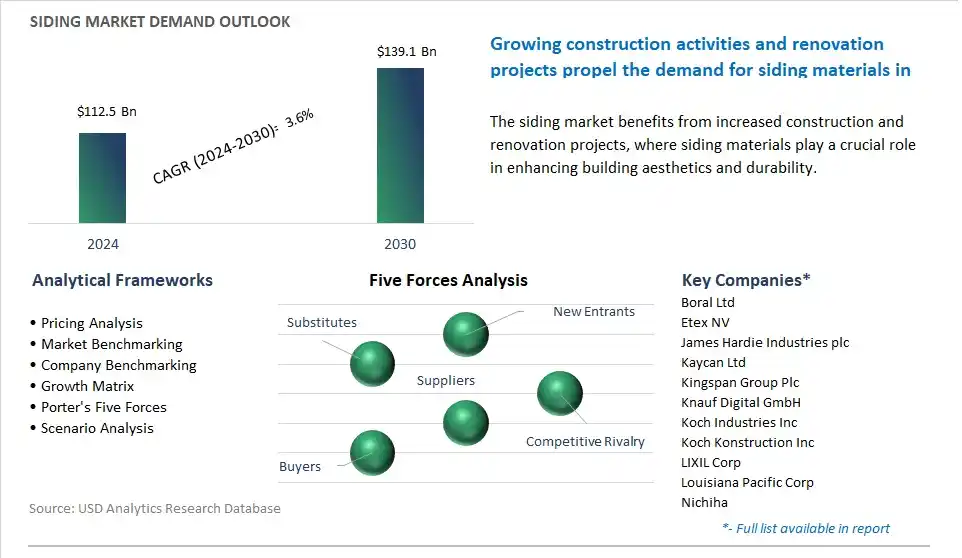
The global Siding Market is poised to register a 3.6% CAGR from $112.5 Billion in 2024 to $139.1 Billion in 2030.
The global Siding Market Study analyzes and forecasts the market size across 6 regions and 24 countries for diverse segments -By Material (Vinyl, Fiber, Wood, Stone, Others), By Type (Vertical board siding, Horizontal lap siding, Clapboard, Shingles, Others), By Application (Residential, Commercial, Others).
An Introduction to Global Siding Market in 2024
The siding market is experiencing steady growth driven by increasing construction activities, renovation projects, and demand for durable and low-maintenance building materials. Key trends shaping the future of the industry include the rising adoption of engineered siding materials such as vinyl, fiber cement, metal, and composite siding for their weather resistance, design versatility, and ease of installation compared to traditional wood siding. Moreover, there's a growing emphasis on energy efficiency and sustainability, with manufacturers offering insulated siding solutions and eco-friendly materials to meet energy codes and green building certifications. Additionally, advancements in siding manufacturing technologies, embossing techniques, and colorfast finishes are driving innovation in siding products, enabling homeowners and builders to achieve desired aesthetics, curb appeal, and long-term performance while minimizing maintenance requirements and lifecycle costs, thereby fueling market growth and competitiveness in the global siding market.
Siding Market Competitive Landscape
The market report analyses the leading companies in the industry including Boral Ltd, Etex NV, James Hardie Industries plc, Kaycan Ltd, Kingspan Group Plc, Knauf Digital GmbH, Koch Industries Inc, Koch Konstruction Inc, LIXIL Corp, Louisiana Pacific Corp, Nichiha, Ply Gem Residential Solutions, Revelstone, ROCKWOOL International AS, The Alumasc Group plc.
Siding Market Dynamics
Siding Market Trend: Increasing Demand for Sustainable and Energy-Efficient Building Materials
A prominent market trend in the siding industry is the increasing demand for sustainable and energy-efficient building materials, driven by growing environmental awareness and regulatory requirements for energy conservation in construction. Siding materials play a crucial role in enhancing the thermal performance and energy efficiency of buildings by providing insulation and weather protection. With the construction industry increasingly prioritizing sustainability and green building practices, there is a shift towards siding materials that offer improved energy efficiency, durability, and recyclability. Manufacturers are responding to this trend by developing eco-friendly siding options such as fiber cement, engineered wood, and vinyl siding with enhanced insulation properties, low environmental impact, and longer lifespan. This trend is reshaping the siding market, driving innovation in materials and construction techniques to meet the evolving needs of environmentally conscious consumers and builders.
Siding Market Driver: Renovation and Replacement Activities in Residential and Commercial Markets
The market for siding is being driven by renovation and replacement activities in both residential and commercial sectors, fueled by aging building stock, changing design preferences, and the need for maintenance and upgrades. As existing buildings reach the end of their service life or undergo aesthetic renovations, siding replacement becomes necessary to refresh the building's appearance, improve curb appeal, and enhance property value. Additionally, the increasing popularity of exterior remodeling projects, such as home renovations, facelifts, and exterior makeovers, contributes to the demand for siding materials that offer versatility, aesthetics, and durability. In the commercial sector, renovation and retrofit projects in retail, hospitality, and office buildings drive the demand for high-performance siding solutions that meet architectural and design requirements while providing long-term performance and maintenance benefits. As renovation activities continue to drive market demand, manufacturers and suppliers of siding materials stand to benefit from opportunities to provide innovative products and solutions tailored to renovation and replacement projects.
Siding Market Opportunity: Expansion into Architectural and Design-driven Applications
A potential opportunity for the siding market lies in the expansion into architectural and design-driven applications, catering to the growing demand for customized and aesthetically pleasing siding solutions in residential and commercial construction projects. Modern building designs emphasize architectural features, façade aesthetics, and exterior finishes as key elements of the building's identity and character. Siding materials with diverse textures, colors, profiles, and finishes allow architects, designers, and builders to create visually appealing and distinctive facades that reflect the desired architectural style and design intent. By offering a wide range of siding options, including premium materials such as natural wood, metal panels, and composite cladding, manufacturers can tap into the architectural and design-driven segment of the market, providing solutions that combine aesthetics with performance, durability, and sustainability. Moreover, there is an opportunity to collaborate with architects, designers, and developers to create custom siding solutions for high-profile projects, luxury homes, and commercial buildings, further expanding market reach and differentiation in the siding industry.
Siding Market Share Analysis: The Vinyl segment generated the highest revenue in 2024
The Vinyl segment is the largest in the Siding Market. vinyl siding offers a combination of affordability, durability, and low maintenance, making it a popular choice among homeowners and builders alike. Vinyl siding is available in a wide range of colors, styles, and textures, allowing for customization to suit various architectural designs and aesthetic preferences. Additionally, vinyl siding is resistant to moisture, rot, insects, and fading, ensuring long-term performance and reducing the need for frequent repairs or replacements. Further, advancements in manufacturing processes have improved the quality and appearance of vinyl siding, further driving its popularity in the market. Furthermore, the growing trend towards energy-efficient and eco-friendly construction practices has led to the development of insulated vinyl siding options, providing enhanced thermal performance and energy savings for homeowners. Over the forecast period, the affordability, durability, versatility, and aesthetic appeal of vinyl siding contribute to its dominance as the largest segment in the Siding Market.
Siding Market Share Analysis: The Vertical Board Siding segment is poised to register the fastest growth rate (CAGR) over the forecast period to 2030
The Vertical Board Siding segment is the fastest-growing segment in the Siding Market. vertical board siding offers a modern and visually appealing aesthetic that is increasingly sought after by homeowners and architects for contemporary and transitional-style homes. The clean lines and vertical orientation of this siding type can enhance the architectural character of a building and create a striking exterior appearance. Additionally, vertical board siding provides design versatility, allowing for various customization options such as board width, spacing, and finishes to achieve different looks and textures. Further, vertical board siding is often perceived as more durable and weather-resistant compared to traditional horizontal lap siding, particularly in regions prone to heavy rainfall or moisture exposure. Furthermore, advancements in manufacturing technologies and materials have expanded the range of vertical board siding options available in the market, including engineered wood, fiber cement, and composite materials, offering homeowners a wider selection to choose from. Over the forecast period, the combination of modern aesthetics, design versatility, and improved durability drives the rapid growth of the Vertical Board Siding segment in the Siding Market.
Siding Market Share Analysis: The Residential segment is poised to register the fastest growth rate (CAGR) over the forecast period to 2030
The Residential segment is the fastest-growing segment in the Siding Market. There is a continuous demand for residential construction and renovation projects, driven by population growth, urbanization, and changing housing preferences. As more individuals and families seek homeownership or upgrade their existing residences, the demand for siding materials increases accordingly. Additionally, advancements in building technologies and design trends have led to a greater emphasis on energy efficiency, durability, and curb appeal in residential construction, prompting homeowners and builders to invest in high-quality siding materials that offer these benefits. Further, the COVID-19 pandemic has accelerated the shift towards remote work and telecommuting, leading to increased demand for home improvement projects as homeowners prioritize comfort, functionality, and aesthetics in their living spaces. Furthermore, government incentives and regulations promoting sustainable construction practices and energy-efficient building materials further drive the adoption of siding solutions in residential applications. Over the forecast period, the combination of housing market dynamics, evolving consumer preferences, and regulatory factors contributes to the rapid growth of the Residential segment in the Siding Market.
Siding Market Report Segmentation
By Material
Vinyl
Fiber
Wood
Stone
Others
By Type
Vertical board siding
Horizontal lap siding
Clapboard
Shingles
Others
By Application
Residential
Commercial
Others
Regions Included
North America (US, Canada, Mexico)
Europe (Germany, UK, France, Spain, Italy, Russia, Rest of Europe)
Asia Pacific (China, India, Japan, South Korea, Australia, South East Asia, Rest of Asia)
South America (Brazil, Argentina, Rest of South America)
Middle East and Africa (Saudi Arabia, UAE, Rest of Middle East, South Africa, Egypt, Rest of Africa)
Siding Companies Profiled in the Market Study
Boral Ltd
Etex NV
James Hardie Industries plc
Kaycan Ltd
Kingspan Group Plc
Knauf Digital GmbH
Koch Industries Inc
Koch Konstruction Inc
LIXIL Corp
Louisiana Pacific Corp
Nichiha
Ply Gem Residential Solutions
Revelstone
ROCKWOOL International AS
The Alumasc Group plc
*- List Not Exhaustive
TABLE OF CONTENTS
1 Introduction to 2024 Siding Market
1.1 Market Overview
1.2 Quick Facts
1.3 Scope/Objective of the Study
1.4 Market Definition
1.5 Countries and Regions Covered
1.6 Units, Currency, and Conversions
1.7 Industry Value Chain
2 Research Methodology
2.1 Market Size Estimation
2.2 Sources and Research Methodology
2.3 Data Triangulation
2.4 Assumptions and Limitations
3 Executive Summary
3.1 Global Siding Market Size Outlook, $ Million, 2021 to 2030
3.2 Siding Market Outlook by Type, $ Million, 2021 to 2030
3.3 Siding Market Outlook by Product, $ Million, 2021 to 2030
3.4 Siding Market Outlook by Application, $ Million, 2021 to 2030
3.5 Siding Market Outlook by Key Countries, $ Million, 2021 to 2030
4 Market Dynamics
4.1 Key Driving Forces of Siding Industry
4.2 Key Market Trends in Siding Industry
4.3 Potential Opportunities in Siding Industry
4.4 Key Challenges in Siding Industry
5 Market Factor Analysis
5.1 Value Chain Analysis
5.2 Competitive Landscape
5.2.1 Global Siding Market Share by Company (%), 2023
5.2.2 Product Offerings by Company
5.3 Porter’s Five Forces Analysis
5.4 Pricing Analysis and Outlook
6 Growth Outlook Across Scenarios
6.1 Growth Analysis-Case Scenario Definitions
6.2 Low Growth Scenario Forecasts
6.3 Reference Growth Scenario Forecasts
6.4 High Growth Scenario Forecasts
7 Global Siding Market Outlook by Segments
7.1 Siding Market Outlook by Segments, $ Million, 2021- 2030
By Material
Vinyl
Fiber
Wood
Stone
Others
By Type
Vertical board siding
Horizontal lap siding
Clapboard
Shingles
Others
By Application
Residential
Commercial
Others
8 North America Siding Market Analysis and Outlook To 2030
8.1 Introduction to North America Siding Markets in 2024
8.2 North America Siding Market Size Outlook by Country, 2021-2030
8.2.1 United States
8.2.2 Canada
8.2.3 Mexico
8.3 North America Siding Market size Outlook by Segments, 2021-2030
By Material
Vinyl
Fiber
Wood
Stone
Others
By Type
Vertical board siding
Horizontal lap siding
Clapboard
Shingles
Others
By Application
Residential
Commercial
Others
9 Europe Siding Market Analysis and Outlook To 2030
9.1 Introduction to Europe Siding Markets in 2024
9.2 Europe Siding Market Size Outlook by Country, 2021-2030
9.2.1 Germany
9.2.2 France
9.2.3 Spain
9.2.4 United Kingdom
9.2.4 Italy
9.2.5 Russia
9.2.6 Norway
9.2.7 Rest of Europe
9.3 Europe Siding Market Size Outlook by Segments, 2021-2030
By Material
Vinyl
Fiber
Wood
Stone
Others
By Type
Vertical board siding
Horizontal lap siding
Clapboard
Shingles
Others
By Application
Residential
Commercial
Others
10 Asia Pacific Siding Market Analysis and Outlook To 2030
10.1 Introduction to Asia Pacific Siding Markets in 2024
10.2 Asia Pacific Siding Market Size Outlook by Country, 2021-2030
10.2.1 China
10.2.2 India
10.2.3 Japan
10.2.4 South Korea
10.2.5 Indonesia
10.2.6 Malaysia
10.2.7 Australia
10.2.8 Rest of Asia Pacific
10.3 Asia Pacific Siding Market size Outlook by Segments, 2021-2030
By Material
Vinyl
Fiber
Wood
Stone
Others
By Type
Vertical board siding
Horizontal lap siding
Clapboard
Shingles
Others
By Application
Residential
Commercial
Others
11 South America Siding Market Analysis and Outlook To 2030
11.1 Introduction to South America Siding Markets in 2024
11.2 South America Siding Market Size Outlook by Country, 2021-2030
11.2.1 Brazil
11.2.2 Argentina
11.2.3 Rest of South America
11.3 South America Siding Market size Outlook by Segments, 2021-2030
By Material
Vinyl
Fiber
Wood
Stone
Others
By Type
Vertical board siding
Horizontal lap siding
Clapboard
Shingles
Others
By Application
Residential
Commercial
Others
12 Middle East and Africa Siding Market Analysis and Outlook To 2030
12.1 Introduction to Middle East and Africa Siding Markets in 2024
12.2 Middle East and Africa Siding Market Size Outlook by Country, 2021-2030
12.2.1 Saudi Arabia
12.2.2 UAE
12.2.3 Oman
12.2.4 Rest of Middle East
12.2.5 Egypt
12.2.6 Nigeria
12.2.7 South Africa
12.2.8 Rest of Africa
12.3 Middle East and Africa Siding Market size Outlook by Segments, 2021-2030
By Material
Vinyl
Fiber
Wood
Stone
Others
By Type
Vertical board siding
Horizontal lap siding
Clapboard
Shingles
Others
By Application
Residential
Commercial
Others
13 Company Profiles
13.1 Company Snapshot
13.2 SWOT Profiles
13.3 Products and Services
13.4 Recent Developments
13.5 Financial Profile
Boral Ltd
Etex NV
James Hardie Industries plc
Kaycan Ltd
Kingspan Group Plc
Knauf Digital GmbH
Koch Industries Inc
Koch Konstruction Inc
LIXIL Corp
Louisiana Pacific Corp
Nichiha
Ply Gem Residential Solutions
Revelstone
ROCKWOOL International AS
The Alumasc Group plc
14 Appendix
14.1 Customization Offerings
14.2 Subscription Services
14.3 Related Reports
14.4 Publisher Expertise
By Material
Vinyl
Fiber
Wood
Stone
Others
By Type
Vertical board siding
Horizontal lap siding
Clapboard
Shingles
Others
By Application
Residential
Commercial
Others
Countries Analyzed
North America (US, Canada, Mexico)
Europe (Germany, UK, France, Spain, Italy, Russia, Rest of Europe)
Asia Pacific (China, India, Japan, South Korea, Australia, South East Asia, Rest of Asia)
South America (Brazil, Argentina, Rest of South America)
Middle East and Africa (Saudi Arabia, UAE, Rest of Middle East, South Africa, Egypt, Rest of Africa)
