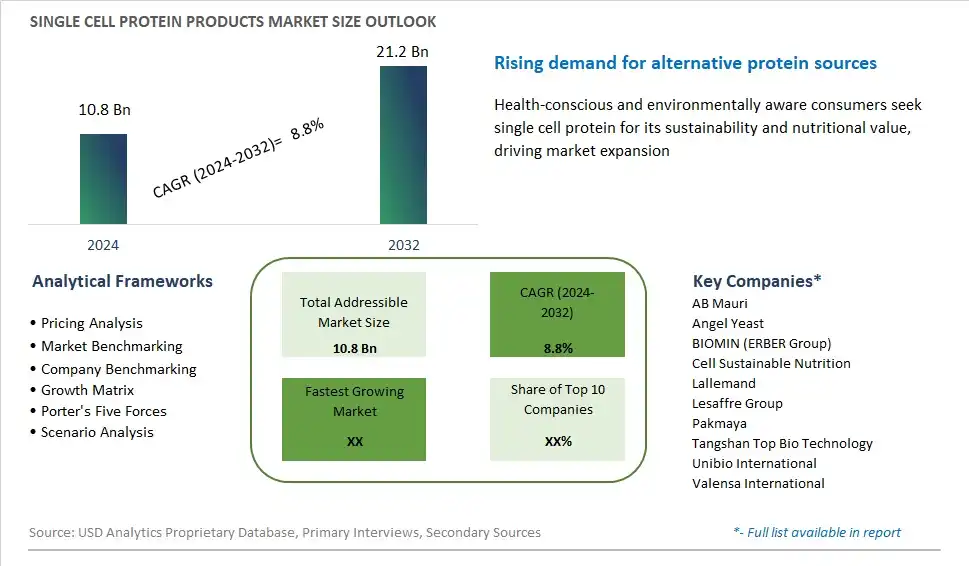
Global Single Cell Protein Products Market Size is valued at $10.8 Billion in 2024 and is forecast to register a growth rate (CAGR) of 8.8% to reach $21.2 Billion by 2032.
The global Single Cell Protein Products Market Comprehensive Study analyzes and forecasts the market size across 6 regions and 24 countries for diverse segments -By Product (Yeast, Algae, Bacteria, Others), By End-User (Animal Feed, Human Food)
An Introduction to Single Cell Protein Products Market
In 2024, the market for single-cell protein (SCP) products is experiencing exponential growth as global demand for sustainable protein sources intensifies amidst concerns over food security, environmental degradation, and animal welfare. SCP, produced through microbial fermentation of various organic substrates such as algae, yeast, fungi, and bacteria, offers a promising solution to the challenges associated with conventional protein sources like livestock and crops. SCP boasts several advantages, including high protein content, amino acid completeness, minimal land and water requirements, and reduced greenhouse gas emissions compared to traditional protein sources. As population growth and urbanization drive increased demand for protein-rich diets, SCP products are gaining traction as ingredients in animal feed, aquafeed, pet food, and plant-based meat alternatives. Moreover, ongoing research and technological advancements in bioprocess engineering, strain optimization, and downstream processing are driving down production costs and improving the scalability and sustainability of SCP production. As consumers increasingly prioritize health, sustainability, and ethical considerations in their food choices, the SCP market presents vast opportunities for innovation, investment, and market penetration in the global protein economy.
Single Cell Protein Products Competitive Landscape
The market report analyses the leading companies in the industry including AB Mauri, Angel Yeast, BIOMIN (ERBER Group), Cell Sustainable Nutrition, Lallemand, Lesaffre Group, Pakmaya, Tangshan Top Bio Technology, Unibio International, Valensa International, and Others.
Single Cell Protein Products Market Dynamics
Single Cell Protein Products Market Trend: Rising Interest in Sustainable Protein Sources
The market for Single Cell Protein Products is experiencing a significant trend driven by the rising interest in sustainable protein sources. With increasing concerns about environmental sustainability, land use, and animal welfare, there's a growing shift towards alternative protein sources that have a lower environmental footprint. Single cell proteins, derived from microorganisms such as algae, fungi, and bacteria, offer a promising solution as they can be cultivated using minimal land, water, and resources compared to traditional protein sources like livestock. This trend aligns with consumers' desire for more eco-friendly and ethical food options, driving the demand for single cell protein products across various food and feed applications.
Market Driver: Growing Population and Food Security Concerns
The market for Single Cell Protein Products is primarily driven by the growing global population and concerns about food security. With the world's population projected to reach nearly 10 billion by 2050, there's an urgent need to increase food production while minimizing the environmental impact of agriculture. Single cell protein production offers a scalable and efficient solution to address food security challenges by providing a sustainable source of high-quality protein that can supplement or replace traditional protein sources. This driver is reinforced by the growing demand for protein-rich foods and ingredients to support healthy diets and nutrition outcomes, especially in regions facing food shortages and malnutrition.
Market Opportunity: Expansion into Alternative Protein Markets
The market for Single Cell Protein Products presents a significant opportunity for expansion into alternative protein markets, including plant-based foods, meat substitutes, animal feed, and aquaculture feed. Single cell proteins can be incorporated into a wide range of food and feed products to enhance their nutritional value, functionality, and sustainability. Companies can leverage the versatility and adaptability of single cell proteins to develop innovative food formulations, fortified snacks, plant-based burgers, meat analogs, and protein supplements targeting health-conscious consumers, vegetarians, flexitarians, and athletes. By tapping into the growing market for alternative proteins, companies can diversify their product portfolios, capitalize on emerging consumer trends, and contribute to a more sustainable food system.
Single Cell Protein Products Market Share Analysis: Yeast held the dominant market share in 2024
In the Single Cell Protein Products market, the "Yeast" segment is the largest, commanding significant prominence for several compelling reasons. Yeast serves as a versatile and widely utilized source of single-cell protein, offering numerous nutritional benefits and functional properties. With its rich protein content, amino acids, vitamins, and minerals, yeast is a valuable ingredient in various food, feed, and industrial applications. In the food industry, yeast is commonly used as a nutritional supplement, flavor enhancer, and leavening agent in baked goods, beverages, and savory products. Additionally, yeast-based single-cell proteins are extensively utilized in animal feed formulations to enhance the nutritional profile and growth performance of livestock and aquaculture species. Further, yeast-derived proteins find application in the pharmaceutical and biotechnology industries for the production of vaccines, enzymes, and therapeutic proteins. With its widespread usage and multifaceted applications across different sectors, the Yeast segment maintains its dominance in the Single Cell Protein Products market, shaping the landscape of protein sourcing and production.
Single Cell Protein Products Market Share Analysis: Animal Feed market is poised to register the fastest growth rae over the forecast period to 2032
Among the segments delineated in the Single Cell Protein Products market, the "Animal Feed" segment is the fastest-growing, propelled by several key factors. Single-cell protein products offer a sustainable and high-quality protein source for livestock, poultry, and aquaculture species, addressing the increasing demand for protein-rich feed ingredients to support animal growth and health. As the global population continues to grow, the demand for animal protein also rises, driving the need for efficient and sustainable feed solutions. Single-cell protein products, derived from yeast, algae, and bacteria, offer nutritional benefits such as high protein content, essential amino acids, and vitamins, contributing to improved animal performance and productivity. Further, single-cell protein products exhibit superior digestibility and palatability, making them ideal supplements in animal feed formulations. Additionally, the growing emphasis on sustainable and environmentally friendly practices in animal agriculture further boosts the adoption of single-cell protein products as alternatives to conventional feed ingredients. With the increasing focus on animal welfare, nutrition, and sustainability, the Animal Feed segment is poised to sustain its rapid growth, reshaping the landscape of the Single Cell Protein Products market towards sustainable feed solutions for livestock and aquaculture production.
Single Cell Protein Products Market Segmentation
By Product
Yeast
Algae
Bacteria
Others
By End-User
Animal Feed
Human Food
Countries Analyzed
North America (US, Canada, Mexico)
Europe (Germany, UK, France, Spain, Italy, Russia, Rest of Europe)
Asia Pacific (China, India, Japan, South Korea, Australia, South East Asia, Rest of Asia)
South America (Brazil, Argentina, Rest of South America)
Middle East and Africa (Saudi Arabia, UAE, Rest of Middle East, South Africa, Egypt, Rest of Africa)
Single Cell Protein Products Companies Profiled in the Study
AB Mauri
Angel Yeast
BIOMIN (ERBER Group)
Cell Sustainable Nutrition
Lallemand
Lesaffre Group
Pakmaya
Tangshan Top Bio Technology
Unibio International
Valensa International
*- List Not Exhaustive
Chapter 1. TABLE OF CONTENTS
Chapter 2. Introduction to Single Cell Protein Products Market
2.1. Market Overview
2.2. Key Statistics and Report Highlights
2.3. Scope of the Comprehensive Study
2.3.1. Market Definition
2.3.2 Countries and Regions Covered
2.3.3 Research Objective
2.3.4 Units, Currency, and Conversions
2.3.5 Industry Value Chain
2.4. Key Market Segments
2.5. Key Companies
2.6. Study Period
Chapter 3. Strategic Analysis Review
3.1. Single Cell Protein Products Pricing Analysis and Forecast
3.2. Porter’s Five Forces
3.3. Market Ecosystem
3.4. SWOT Analysis
3.5. Regulatory Scenario
3.3. Effects of Inflation, Russia-Ukraine War, moderating economic growth, and other macroeconomic factors
Chapter 4. Competitive Landscape
4.1. Market Share Analysis
4.1.1. Global Single Cell Protein Products Market Share by Company, 2023
4.1.2. Product Offerings of Leading Single Cell Protein Products Companies
4.2. Market Entropy
4.2.1. New Product Launches in the Industry
4.2.2. Mergers, Acquisitions, Joint ventures, and Partnerships
4.3. Key Strategies and Best Practices
Chapter 5. Global Market Projections: Best, Reference, and Low Case Scenarios
5.1. Growth Analysis- Case Scenario Definitions
5.2. Low Growth Case Scenario Forecasts
5.3. Reference Growth Case Scenario Forecasts
5.4. High Growth Case Scenario Forecasts
Chapter 6. Market Dynamics
6.1. Single Cell Protein Products Market Drivers
6.2. Single Cell Protein Products Market Challenges
6.6. Single Cell Protein Products Market Opportunities
6.4. Single Cell Protein Products Market Trends
Chapter 7. Global Single Cell Protein Products Market Outlook Trends
7.1. Global Single Cell Protein Products Revenue (USD Million) and CAGR (%) by Type (2021-2032)
7.2. Global Single Cell Protein Products Revenue (USD Million) and CAGR (%) by Application (2021-2032)
7.3. Global Single Cell Protein Products Revenue (USD Million) and CAGR (%) by Product (2021-2032)
By Product
Yeast
Algae
Bacteria
Others
By End-User
Animal Feed
Human Food
Chapter 8. Global Single Cell Protein Products Regional Analysis and Outlook
8.1. Global Single Cell Protein Products Revenue (USD Million) By Regions (2021- 2032)
8.2. North America Single Cell Protein Products Revenue (USD Million) by Country (2021-2032)
8.2.1. United States Single Cell Protein Products Regional Analysis and Outlook
8.2.2. Canada Single Cell Protein Products Regional Analysis and Outlook
8.2.3. Mexico Single Cell Protein Products Regional Analysis and Outlook
8.3. Europe Single Cell Protein Products Revenue (USD Million), by Country (2021-2032)
8.3.1. Germany Single Cell Protein Products Regional Analysis and Outlook
8.3.2. France Single Cell Protein Products Regional Analysis and Outlook
8.3.3. United Kingdom Single Cell Protein Products Regional Analysis and Outlook
8.3.4. Spain Single Cell Protein Products Regional Analysis and Outlook
8.3.5. Italy Single Cell Protein Products Regional Analysis and Outlook
8.3.6. Russia Single Cell Protein Products Regional Analysis and Outlook
8.3.7. Rest of Europe Single Cell Protein Products Regional Analysis and Outlook
8.4. Asia Pacific Single Cell Protein Products Revenue (USD Million) by Country (2021-2032)
8.4.1. China Single Cell Protein Products Regional Analysis and Outlook
8.4.2. Japan Single Cell Protein Products Regional Analysis and Outlook
8.4.3. India Single Cell Protein Products Regional Analysis and Outlook
8.4.4. South Korea Single Cell Protein Products Regional Analysis and Outlook
8.4.5. Australia Single Cell Protein Products Regional Analysis and Outlook
8.4.6. South East Asia Single Cell Protein Products Regional Analysis and Outlook
8.4.7. Rest of Asia Pacific Single Cell Protein Products Regional Analysis and Outlook
8.5. South America Single Cell Protein Products Revenue (USD Million), by Country (2021-2032)
8.5.1. Brazil Single Cell Protein Products Regional Analysis and Outlook
8.5.2. Argentina Single Cell Protein Products Regional Analysis and Outlook
8.5.3. Rest of South America Single Cell Protein Products Regional Analysis and Outlook
8.6. Middle East and Africa Single Cell Protein Products Revenue (USD Million) by Country (2021-2032)
8.6.1. Middle East Single Cell Protein Products Regional Analysis and Outlook
8.6.2. Africa Single Cell Protein Products Regional Analysis and Outlook
Chapter 9. North America Single Cell Protein Products Analysis and Outlook
9.1. North America Single Cell Protein Products Revenue (USD Million) by Segments (2021-2032)
9.1.1. North America Single Cell Protein Products Revenue (USD Million) by Type (2021-2032)
9.1.2. North America Single Cell Protein Products Revenue (USD Million) by Application (2021-2032)
9.1.3. North America Single Cell Protein Products Revenue (USD Million) by Product (2021-2032)
By Product
Yeast
Algae
Bacteria
Others
By End-User
Animal Feed
Human Food
Chapter 10. Europe Single Cell Protein Products Analysis and Outlook
10.1. Europe Single Cell Protein Products Revenue (USD Million), by Segments (USD Million) (2021-2032)
10.1.1. Europe Single Cell Protein Products Revenue (USD Million) by Type (2021-2032)
10.1.2. Europe Single Cell Protein Products Revenue (USD Million) by Application (2021-2032)
10.1.3. Europe Single Cell Protein Products Revenue (USD Million) by Product (2021-2032)
By Product
Yeast
Algae
Bacteria
Others
By End-User
Animal Feed
Human Food
Chapter 11. Asia Pacific Single Cell Protein Products Analysis and Outlook
11.1. Asia Pacific Single Cell Protein Products Revenue (USD Million), and Revenue (USD Million) by Segments (2021-2032)
11.1.1. Asia Pacific Single Cell Protein Products Revenue (USD Million) by Type (2021-2032)
11.1.2. Asia Pacific Single Cell Protein Products Revenue (USD Million) by Application (2021-2032)
11.1.3. Asia Pacific Single Cell Protein Products Revenue (USD Million) by Product (2021-2032)
By Product
Yeast
Algae
Bacteria
Others
By End-User
Animal Feed
Human Food
Chapter 12. South America Single Cell Protein Products Analysis and Outlook
12.1. South America Single Cell Protein Products Revenue (USD Million), by Segments (2021-2032)
12.1.1. South America Single Cell Protein Products Revenue (USD Million) by Type (2021-2032)
12.1.2. South America Single Cell Protein Products Revenue (USD Million) by Application (2021-2032)
12.1.3. South America Single Cell Protein Products Revenue (USD Million) by Product (2021-2032)
By Product
Yeast
Algae
Bacteria
Others
By End-User
Animal Feed
Human Food
Chapter 13. Middle East and Africa Single Cell Protein Products Analysis and Outlook
13.1. Middle East and Africa Single Cell Protein Products Revenue (USD Million), by Segments (2021-2032)
13.1.1. Middle East and Africa Single Cell Protein Products Revenue (USD Million) by Type (2021-2032)
13.1.2. Middle East and Africa Single Cell Protein Products Revenue (USD Million) by Application (2021-2032)
13.1.3. Middle East and Africa Single Cell Protein Products Revenue (USD Million) by Product (2021-2032)
By Product
Yeast
Algae
Bacteria
Others
By End-User
Animal Feed
Human Food
Chapter 14. Single Cell Protein Products Company Profiles
14.1 Business Overview
14.2 Product Profiles
14.3 SWOT Profiles
14.5 Recent Developments
14.6 Financial Profile
List of Companies
AB Mauri
Angel Yeast
BIOMIN (ERBER Group)
Cell Sustainable Nutrition
Lallemand
Lesaffre Group
Pakmaya
Tangshan Top Bio Technology
Unibio International
Valensa International
15. Methodology and Data Sources
15.1 Customization Offerings
15.2 Subscription Services
15.3 Related Reports
15.4 Publisher Expertise
LIST OF TABLES
Table 1 Market Segmentation Analysis
Table 2 Global Single Cell Protein Products Market Share of Leading Companies, 2023
Table 3 Product Offerings of Leading Companies
Table 4 Low Growth Scenario Forecasts
Table 5 Reference Case Growth Scenario
Table 6 High Growth Case Scenario
Table 7 Global Single Cell Protein Products Revenue (USD Million) And CAGR (%) By Type (2021-2032)
Table 8 Global Single Cell Protein Products Revenue (USD Million) And CAGR (%) By Application (2021-2032)
Table 9 Global Single Cell Protein Products Revenue (USD Million) And CAGR (%) By Product (2021-2032)
Table 10 Global Single Cell Protein Products Market Revenue (USD Million) By Regions (2021-2032)
Table 11 Global Single Cell Protein Products Market Share (%) By Regions (2021-2032)
Table 12 North America Single Cell Protein Products Revenue (USD Million) By Country (2021-2032)
Table 13 Europe Single Cell Protein Products Revenue (USD Million) By Country (2021-2032)
Table 14 Asia Pacific Single Cell Protein Products Revenue (USD Million) By Country (2021-2032)
Table 15 South America Single Cell Protein Products Revenue (USD Million) By Country (2021-2032)
Table 16 Middle East and Africa Single Cell Protein Products Revenue (USD Million) By Region (2021-2032)
Table 17 North America Single Cell Protein Products Revenue (USD Million) By Type (2021-2032)
Table 18 North America Single Cell Protein Products Revenue (USD Million) By Application (2021-2032)
Table 19 North America Single Cell Protein Products Revenue (USD Million) By Product (2021-2032)
Table 20 Europe Single Cell Protein Products Revenue (USD Million) By Type (2021-2032)
Table 21 Europe Single Cell Protein Products Revenue (USD Million) By Application (2021-2032)
Table 22 Europe Single Cell Protein Products Revenue (USD Million) By Product (2021-2032)
Table 23 Asia Pacific Single Cell Protein Products Revenue (USD Million) By Type (2021-2032)
Table 24 Asia Pacific Single Cell Protein Products Revenue (USD Million) By Application (2021-2032)
Table 25 Asia Pacific Single Cell Protein Products Revenue (USD Million) By Product (2021-2032)
Table 26 South America Single Cell Protein Products Revenue (USD Million) By Type (2021-2032)
Table 27 South America Single Cell Protein Products Revenue (USD Million) By Application (2021-2032)
Table 28 South America Single Cell Protein Products Revenue (USD Million) By Product (2021-2032)
Table 29 Middle East and Africa Single Cell Protein Products Revenue (USD Million) By Type (2021-2032)
Table 30 Middle East and Africa Single Cell Protein Products Revenue (USD Million) By Application (2021-2032)
Table 31 Middle East and Africa Single Cell Protein Products Revenue (USD Million) By Product (2021-2032)
LIST OF FIGURES
Figure 1. Market Scope
Figure 2. Pricing Forecasts Per Unit, 2023- 2032
Figure 3. Porter’s Five Forces
Figure 4. Global Single Cell Protein Products Market Revenue (USD Million) By Regions (2021-2032)
Figure 5. Global Single Cell Protein Products Market Share (%) By Regions (2023)
Figure 6. North America Single Cell Protein Products Revenue (USD Million) By Country (2021-2032)
Figure 7. United States Single Cell Protein Products Revenue (USD Million) By Country (2021-2032)
Figure 8. Canada Single Cell Protein Products Revenue (USD Million) By Country (2021-2032)
Figure 9. Mexico Single Cell Protein Products Revenue (USD Million) By Country (2021-2032)
Figure 10. Europe Single Cell Protein Products Revenue (USD Million) By Country (2021-2032)
Figure 11. Germany Single Cell Protein Products Revenue (USD Million) By Country (2021-2032)
Figure 12. France Single Cell Protein Products Revenue (USD Million) By Country (2021-2032)
Figure 13. United Kingdom Single Cell Protein Products Revenue (USD Million) By Country (2021-2032)
Figure 14. Spain Single Cell Protein Products Revenue (USD Million) By Country (2021-2032)
Figure 15. Italy Single Cell Protein Products Revenue (USD Million) By Country (2021-2032)
Figure 16. Russia Single Cell Protein Products Revenue (USD Million) By Country (2021-2032)
Figure 17. Rest of Europe Single Cell Protein Products Revenue (USD Million) By Country (2021-2032)
Figure 11. Asia Pacific Single Cell Protein Products Revenue (USD Million) By Country (2021-2032)
Figure 12. China Single Cell Protein Products Revenue (USD Million) By Country (2021-2032)
Figure 13. Japan Single Cell Protein Products Revenue (USD Million) By Country (2021-2032)
Figure 14. India Single Cell Protein Products Revenue (USD Million) By Country (2021-2032)
Figure 15. South Korea Single Cell Protein Products Revenue (USD Million) By Country (2021-2032)
Figure 16. Australia Single Cell Protein Products Revenue (USD Million) By Country (2021-2032)
Figure 17. South East Asia Single Cell Protein Products Revenue (USD Million) By Country (2021-2032)
Figure 18. South America Single Cell Protein Products Revenue (USD Million) By Country (2021-2032)
Figure 19. Brazil Single Cell Protein Products Revenue (USD Million) By Country (2021-2032)
Figure 20. Argentina Single Cell Protein Products Revenue (USD Million) By Country (2021-2032)
Figure 21. Rest of Asia Pacific Single Cell Protein Products Revenue (USD Million) By Country (2021-2032)
Figure 22. Middle East and Africa Single Cell Protein Products Revenue (USD Million) By Region (2021-2032)
Figure 23. Saudi Arabia Single Cell Protein Products Revenue (USD Million) By Region (2021-2032)
Figure 24. The UAE Single Cell Protein Products Revenue (USD Million) By Region (2021-2032)
Figure 25. Rest of Middle East Single Cell Protein Products Revenue (USD Million) By Region (2021-2032)
Figure 26. South Africa Single Cell Protein Products Revenue (USD Million) By Region (2021-2032)
Figure 27. Africa Single Cell Protein Products Revenue (USD Million) By Region (2021-2032)
Figure 28. North America Single Cell Protein Products Revenue (USD Million) By Type (2021-2032)
Figure 29. North America Single Cell Protein Products Revenue (USD Million) By Application (2021-2032)
Figure 30. North America Single Cell Protein Products Revenue (USD Million) By Product (2021-2032)
Figure 31. Europe Single Cell Protein Products Revenue (USD Million) By Type (2021-2032)
Figure 32. Europe Single Cell Protein Products Revenue (USD Million) By Application (2021-2032)
Figure 33. Europe Single Cell Protein Products Revenue (USD Million) By Product (2021-2032)
Figure 34. Asia Pacific Single Cell Protein Products Revenue (USD Million) By Type (2021-2032)
Figure 35. Asia Pacific Single Cell Protein Products Revenue (USD Million) By Application (2021-2032)
Figure 36. Asia Pacific Single Cell Protein Products Revenue (USD Million) By Product (2021-2032)
Figure 37. South America Single Cell Protein Products Revenue (USD Million) By Type (2021-2032)
Figure 38. South America Single Cell Protein Products Revenue (USD Million) By Application (2021-2032)
Figure 39. South America Single Cell Protein Products Revenue (USD Million) By Product (2021-2032)
Figure 40. Middle East and Africa Single Cell Protein Products Revenue (USD Million) By Type (2021-2032)
Figure 41. Middle East and Africa Single Cell Protein Products Revenue (USD Million) By Application (2021-2032)
Figure 42. Middle East and Africa Single Cell Protein Products Revenue (USD Million) By Product (2021-2032)
By Product
Yeast
Algae
Bacteria
Others
By End-User
Animal Feed
Human Food
Countries Analyzed
North America (US, Canada, Mexico)
Europe (Germany, UK, France, Spain, Italy, Russia, Rest of Europe)
Asia Pacific (China, India, Japan, South Korea, Australia, South East Asia, Rest of Asia)
South America (Brazil, Argentina, Rest of South America)
Middle East and Africa (Saudi Arabia, UAE, Rest of Middle East, South Africa, Egypt, Rest of Africa)
