
The global Slow and Controlled Release Pesticides Market Study analyzes and forecasts the market size across 6 regions and 24 countries for diverse segments -By Type (Herbicides, Fungicides, Insecticides, Others), By Application (Agriculture, Others).
The future of slow and controlled release pesticides is shaped by trends in sustainable agriculture, environmental protection, and crop protection technology, driven by the need for effective pest management solutions with reduced environmental impact and improved efficacy. Slow and controlled release pesticides, also known as controlled-release formulations or microencapsulated pesticides, are designed to release active ingredients gradually over time, providing targeted and prolonged pest control while minimizing off-target effects and environmental contamination. These formulations offer several advantages over conventional pesticides, including reduced application frequency, lower pesticide residues, and enhanced safety for non-target organisms and ecosystems. With the increasing demand for sustainable farming practices, integrated pest management (IPM) strategies, and organic agriculture, slow and controlled release pesticides play a crucial role in promoting environmentally friendly pest control solutions while preserving soil health and biodiversity. Moreover, in regions facing regulatory restrictions on pesticide use, water scarcity, and environmental pollution, these formulations offer viable alternatives for sustainable crop protection and food production. Additionally, as pest resistance to conventional pesticides continues to pose challenges for growers, slow and controlled release pesticides provide innovative solutions for managing resistant pest populations and preserving the efficacy of chemical control measures. Furthermore, advancements in pesticide formulation technology, such as biodegradable polymers, nanoencapsulation, and matrix diffusion systems, enable the development of customized formulations with tailored release profiles and improved performance under different environmental conditions. As agriculture evolves to meet the challenges of feeding a growing global population while minimizing environmental impact, slow and controlled release pesticides will play a pivotal role in sustainable crop protection and pest management practices, driving innovation and market growth in the global agrochemicals industry.
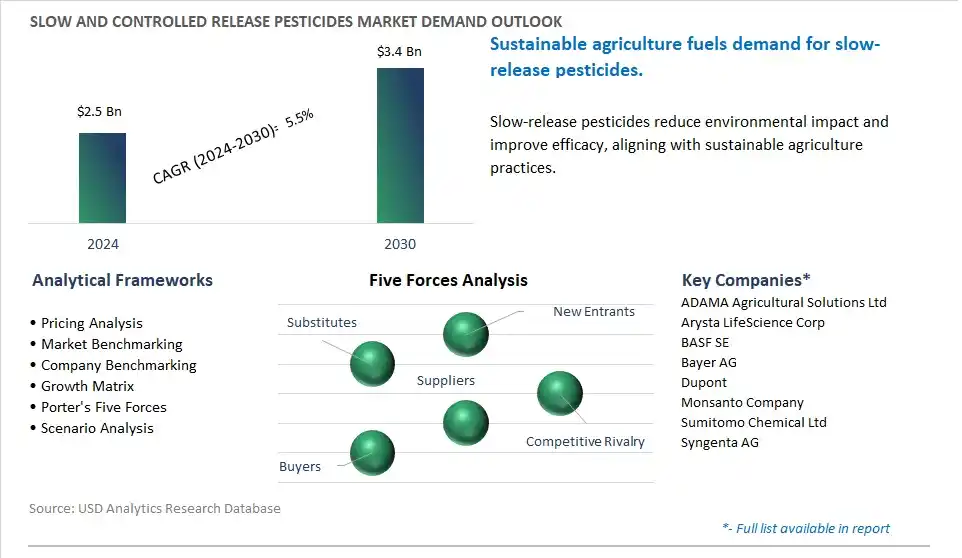
The market report analyses the leading companies in the industry including ADAMA Agricultural Solutions Ltd, Arysta LifeScience Corp, BASF SE, Bayer AG, Dupont, Monsanto Company, Sumitomo Chemical Ltd, Syngenta AG.
A significant trend in the market for slow and controlled release pesticides is the increasing focus on sustainable agriculture practices. With growing concerns about environmental sustainability and the impact of conventional pesticide use on ecosystems, there is a shift towards more environmentally friendly and sustainable pest management solutions in agriculture. Slow and controlled release pesticides offer a sustainable alternative by gradually releasing active ingredients over an extended period, reducing the need for frequent applications and minimizing environmental contamination. The trend towards sustainable agriculture practices drives the demand for slow and controlled release pesticides as farmers and growers seek effective pest control solutions that minimize environmental impact and promote long-term ecological balance.
A primary driver for the market of slow and controlled release pesticides is regulatory pressure and concerns about pesticide residue. With increasing regulatory scrutiny and stricter guidelines governing pesticide use, there is a growing need for pesticide formulations that meet stringent safety and environmental standards. Slow and controlled release pesticides, which offer targeted and controlled delivery of active ingredients to pest populations while minimizing off-target exposure and pesticide residues in the environment, align with regulatory requirements and consumer expectations for safer and more sustainable pest management practices. The drive for regulatory compliance and consumer safety fuels the demand for slow and controlled release pesticides as agricultural stakeholders seek to address concerns about pesticide residues and environmental sustainability.
An opportunity in the market for slow and controlled release pesticides lies in the development of precision agriculture solutions. While slow and controlled release pesticides are effective for long-term pest control, there is potential to integrate them with precision agriculture technologies to enhance their efficacy and optimize application efficiency. By leveraging technologies such as GPS-guided drones, automated spraying systems, and sensor-based monitoring devices, farmers can precisely target pest-infested areas and deliver slow-release pesticides with greater accuracy and efficiency. Additionally, there is an opportunity to develop customized pesticide formulations tailored to specific crop types, pest species, and environmental conditions, optimizing pest control outcomes while minimizing pesticide use and environmental impact. By embracing precision agriculture solutions, manufacturers of slow and controlled release pesticides can offer innovative and sustainable pest management solutions that meet the evolving needs of modern agriculture and contribute to the advancement of precision farming practices.
The largest segment in the Slow And Controlled Release Pesticides Market is Herbicides. Herbicides are widely used in agriculture to control unwanted weeds and vegetation that compete with crops for nutrients, water, and sunlight. With the increasing global demand for food production to feed a growing population, herbicides play a crucial role in maximizing crop yields and ensuring food security. Additionally, herbicides offer potential advantages, including ease of application, targeted weed control, and cost-effectiveness compared to manual or mechanical weed control methods. Further, advancements in herbicide formulations and delivery systems, including slow and controlled release technologies, have improved the efficacy, safety, and environmental sustainability of herbicide applications. These innovations enable the gradual release of active ingredients over time, providing long-lasting weed control while minimizing off-target effects and environmental impact. Accordingly, herbicides emerge as the largest segment in the Slow And Controlled Release Pesticides Market, reflecting their essential role in modern agriculture.
The fastest-growing segment in the Slow And Controlled Release Pesticides Market is the Agriculture application. agriculture is the largest and most significant end-user of pesticides, accounting for the majority of pesticide consumption globally. With the increasing pressure to enhance agricultural productivity, efficiency, and sustainability, there is a growing demand for innovative pesticide formulations that offer improved efficacy, reduced environmental impact, and prolonged activity. Slow and controlled release pesticides address these needs by providing targeted and sustained pest control while minimizing the risk of off-target effects, environmental contamination, and pesticide resistance. Additionally, slow-release formulations allow for fewer applications, reducing labor costs, pesticide usage, and environmental exposure, making them attractive to farmers and growers. Further, as regulatory agencies worldwide impose stricter regulations on pesticide use and promote integrated pest management (IPM) practices, there is a growing emphasis on adopting safer and more sustainable pest control strategies, driving the adoption of slow and controlled release pesticides in agriculture. Therefore, the Agriculture application is the fastest-growing segment in the Slow And Controlled Release Pesticides Market.
By Type
Herbicides
Fungicides
Insecticides
Others
By Application
Agriculture
Others
Regions Included
North America (US, Canada, Mexico)
Europe (Germany, UK, France, Spain, Italy, Russia, Rest of Europe)
Asia Pacific (China, India, Japan, South Korea, Australia, South East Asia, Rest of Asia)
South America (Brazil, Argentina, Rest of South America)
Middle East and Africa (Saudi Arabia, UAE, Rest of Middle East, South Africa, Egypt, Rest of Africa)
ADAMA Agricultural Solutions Ltd
Arysta LifeScience Corp
BASF SE
Bayer AG
Dupont
Monsanto Company
Sumitomo Chemical Ltd
Syngenta AG
*- List Not Exhaustive
TABLE OF CONTENTS
1 Introduction to 2024 Slow and Controlled Release Pesticides Market
1.1 Market Overview
1.2 Quick Facts
1.3 Scope/Objective of the Study
1.4 Market Definition
1.5 Countries and Regions Covered
1.6 Units, Currency, and Conversions
1.7 Industry Value Chain
2 Research Methodology
2.1 Market Size Estimation
2.2 Sources and Research Methodology
2.3 Data Triangulation
2.4 Assumptions and Limitations
3 Executive Summary
3.1 Global Slow and Controlled Release Pesticides Market Size Outlook, $ Million, 2021 to 2030
3.2 Slow and Controlled Release Pesticides Market Outlook by Type, $ Million, 2021 to 2030
3.3 Slow and Controlled Release Pesticides Market Outlook by Product, $ Million, 2021 to 2030
3.4 Slow and Controlled Release Pesticides Market Outlook by Application, $ Million, 2021 to 2030
3.5 Slow and Controlled Release Pesticides Market Outlook by Key Countries, $ Million, 2021 to 2030
4 Market Dynamics
4.1 Key Driving Forces of Slow and Controlled Release Pesticides Industry
4.2 Key Market Trends in Slow and Controlled Release Pesticides Industry
4.3 Potential Opportunities in Slow and Controlled Release Pesticides Industry
4.4 Key Challenges in Slow and Controlled Release Pesticides Industry
5 Market Factor Analysis
5.1 Value Chain Analysis
5.2 Competitive Landscape
5.2.1 Global Slow and Controlled Release Pesticides Market Share by Company (%), 2023
5.2.2 Product Offerings by Company
5.3 Porter’s Five Forces Analysis
5.4 Pricing Analysis and Outlook
6 Growth Outlook Across Scenarios
6.1 Growth Analysis-Case Scenario Definitions
6.2 Low Growth Scenario Forecasts
6.3 Reference Growth Scenario Forecasts
6.4 High Growth Scenario Forecasts
7 Global Slow and Controlled Release Pesticides Market Outlook by Segments
7.1 Slow and Controlled Release Pesticides Market Outlook by Segments, $ Million, 2021- 2030
By Type
Herbicides
Fungicides
Insecticides
Others
By Application
Agriculture
Others
8 North America Slow and Controlled Release Pesticides Market Analysis and Outlook To 2030
8.1 Introduction to North America Slow and Controlled Release Pesticides Markets in 2024
8.2 North America Slow and Controlled Release Pesticides Market Size Outlook by Country, 2021-2030
8.2.1 United States
8.2.2 Canada
8.2.3 Mexico
8.3 North America Slow and Controlled Release Pesticides Market size Outlook by Segments, 2021-2030
By Type
Herbicides
Fungicides
Insecticides
Others
By Application
Agriculture
Others
9 Europe Slow and Controlled Release Pesticides Market Analysis and Outlook To 2030
9.1 Introduction to Europe Slow and Controlled Release Pesticides Markets in 2024
9.2 Europe Slow and Controlled Release Pesticides Market Size Outlook by Country, 2021-2030
9.2.1 Germany
9.2.2 France
9.2.3 Spain
9.2.4 United Kingdom
9.2.4 Italy
9.2.5 Russia
9.2.6 Norway
9.2.7 Rest of Europe
9.3 Europe Slow and Controlled Release Pesticides Market Size Outlook by Segments, 2021-2030
By Type
Herbicides
Fungicides
Insecticides
Others
By Application
Agriculture
Others
10 Asia Pacific Slow and Controlled Release Pesticides Market Analysis and Outlook To 2030
10.1 Introduction to Asia Pacific Slow and Controlled Release Pesticides Markets in 2024
10.2 Asia Pacific Slow and Controlled Release Pesticides Market Size Outlook by Country, 2021-2030
10.2.1 China
10.2.2 India
10.2.3 Japan
10.2.4 South Korea
10.2.5 Indonesia
10.2.6 Malaysia
10.2.7 Australia
10.2.8 Rest of Asia Pacific
10.3 Asia Pacific Slow and Controlled Release Pesticides Market size Outlook by Segments, 2021-2030
By Type
Herbicides
Fungicides
Insecticides
Others
By Application
Agriculture
Others
11 South America Slow and Controlled Release Pesticides Market Analysis and Outlook To 2030
11.1 Introduction to South America Slow and Controlled Release Pesticides Markets in 2024
11.2 South America Slow and Controlled Release Pesticides Market Size Outlook by Country, 2021-2030
11.2.1 Brazil
11.2.2 Argentina
11.2.3 Rest of South America
11.3 South America Slow and Controlled Release Pesticides Market size Outlook by Segments, 2021-2030
By Type
Herbicides
Fungicides
Insecticides
Others
By Application
Agriculture
Others
12 Middle East and Africa Slow and Controlled Release Pesticides Market Analysis and Outlook To 2030
12.1 Introduction to Middle East and Africa Slow and Controlled Release Pesticides Markets in 2024
12.2 Middle East and Africa Slow and Controlled Release Pesticides Market Size Outlook by Country, 2021-2030
12.2.1 Saudi Arabia
12.2.2 UAE
12.2.3 Oman
12.2.4 Rest of Middle East
12.2.5 Egypt
12.2.6 Nigeria
12.2.7 South Africa
12.2.8 Rest of Africa
12.3 Middle East and Africa Slow and Controlled Release Pesticides Market size Outlook by Segments, 2021-2030
By Type
Herbicides
Fungicides
Insecticides
Others
By Application
Agriculture
Others
13 Company Profiles
13.1 Company Snapshot
13.2 SWOT Profiles
13.3 Products and Services
13.4 Recent Developments
13.5 Financial Profile
ADAMA Agricultural Solutions Ltd
Arysta LifeScience Corp
BASF SE
Bayer AG
Dupont
Monsanto Company
Sumitomo Chemical Ltd
Syngenta AG
14 Appendix
14.1 Customization Offerings
14.2 Subscription Services
14.3 Related Reports
14.4 Publisher Expertise
By Type
Herbicides
Fungicides
Insecticides
Others
By Application
Agriculture
Others
Countries Analyzed
North America (US, Canada, Mexico)
Europe (Germany, UK, France, Spain, Italy, Russia, Rest of Europe)
Asia Pacific (China, India, Japan, South Korea, Australia, South East Asia, Rest of Asia)
South America (Brazil, Argentina, Rest of South America)
Middle East and Africa (Saudi Arabia, UAE, Rest of Middle East, South Africa, Egypt, Rest of Africa)
Global Slow and Controlled Release Pesticides is forecast to reach $3.4 Billion in 2030 from $2.5 Billion in 2024, registering a CAGR of 5.5%
Emerging Markets across Asia Pacific, Europe, and Americas present robust growth prospects.
ADAMA Agricultural Solutions Ltd, Arysta LifeScience Corp, BASF SE, Bayer AG, Dupont, Monsanto Company, Sumitomo Chemical Ltd, Syngenta AG
Base Year- 2023; Estimated Year- 2024; Historic Period- 2018-2023; Forecast period- 2024 to 2030; Currency: Revenue (USD); Volume