Smart Fitness Mirror Market Accelerated Growth Driven by AI Integration and At-Home Fitness Demand
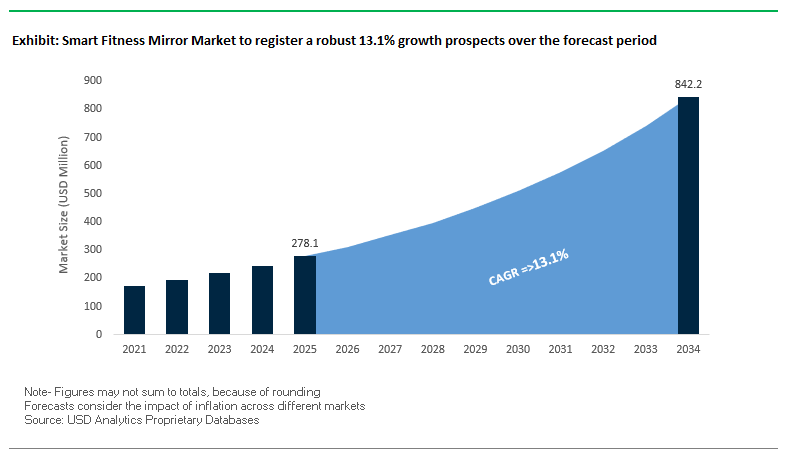
The global smart fitness mirror market will grow from $278.1 million in 2025 to $842.1 million in 2034, with a robust CAGR of 13.1%. The growth reflects the category's evolution from a luxury niche fitness device to a mass, tech-powered home fitness solution. For industry players, the path of the industry is characterized by the convergence of AI-based personalization, interactive fitness content, and space-efficient design, reflecting the evolving fitness behavior of metropolitan, technology-savvy consumers.
Smart fitness mirrors have revolutionized the idea of home work-outs by integrating full-length reflective display screens with built-in sensors, cameras, and artificial intelligence software. Not just do they provide live and on-demand work-outs, but also real-time feedback, posture correction, and personalized training plans mimicking the services of a personal trainer from the comfort of your home. On top of these, subscription-based content models are grounding recurring revenue streams for manufacturers with long-term commitment beyond sales of hardware.
Key Insights for Industry Professionals:
- AI-Powered Personalization: Motion tracking, AR integration, and rep counting elevate the training experience.
- Urban Space Optimization: Wall-mounted, slim designs meet the needs of compact living environments.
- Subscription-Driven Ecosystem: Ongoing revenue and user retention are fueled by diverse content libraries.
- Premium Partnerships: Collaborations like Lululemon-Peloton are redefining product positioning.
- Expansion into Wellness: Integration with nutrition advice, recovery tools, and wearables is broadening appeal.
Strategic Collaborations, Breakthrough Technologies, and Competitive Expansion in Smart Fitness Mirror Industry
Recent activity in the space of smart fitness mirrors has witnessed unprecedented disruption, with product launches, strategic partnerships, and funding rounds reshaping competitive markets. The July 2025 milestone of the Lululemon-Peloton partnership was a turning point, with Peloton becoming Lululemon's exclusive digital fitness content partner, uniting both brands under one strategy that unites premium apparel with premium training content.
Innovation is speeding up differentiation. FITURE's April 2025 introduction of its Motion-Tracking Mirror to the US used Motion Engine™ technology, fine-tuned with more than 130 million movement samples, to provide AI-powered feedback that raised the bar on precision training. Alter's February 2024 introduction of a DNA-based smart fitness mirror showed the promise of hyper-personalized fitness, employing genetic information to customize exercise suggestions.
Hardware innovation is accompanied by strategic distribution expansion and retail expansion. Tonal's January 2025 release of Tonal 2 introduced enhanced durability and new modes of workouts, and its November 2024 partnership with Best Buy introduced in-home delivery and installation, eliminating installation friction. Concurrently, Magic AI's $5 million funding in November 2024 reiterated investor confidence in AI-driven, holographic trainer technology, positioning it for US market entry.
Apart from hardware, retail experience spaces unveiled by leading sport brands in May 2025 showed the promise of in-store smart mirrors as interactive engagement tools, fusing product testing with immersive digital workouts that portend a hybrid future for connected fitness retail.
Trends and Opportunities Driving the Global Smart Fitness Mirror Market
FDA-Cleared Smart Mirrors Transforming Rehabilitation and Clinical Care
FDA-approved therapeutic smart mirrors are disrupting the market by expanding applications from home workout to clinical rehabilitation. Intended to help patients recover from stroke, neurologic disorders, or chronic pain, these mirrors integrate visual feedback, AI support, and motion tracking to enhance motor recovery. Expanding on the proven technology of mirror therapy, such systems leverage neuroplasticity by reflecting movement in impaired limbs. For example, companies like Syrebo are launching rehabilitation-oriented mirrors that integrate gamified exercise with real-time monitoring, enabling therapists to remotely monitor patients and modify programs. Such two-way in-clinic and at-home therapy enhances patient compliance while opening up the market to collaboration with hospitals, insurance providers, and telemedicine platforms. By being certified medical devices, manufacturers access new avenues of reimbursement and differentiate themselves from consumer-only facing competitors.
AI Form Coaching with 3D Skeletal Mapping for Precision Workouts
AI-driven form guidance through 3D pose estimation and computer vision is a core technology innovation in smart fitness mirrors. Using this capability, the mirror can analyze a user's skeleton in real time, detect posture flaws, and provide corrective feedback without the need for wearable sensors. Advanced algorithms can detect micro-misalignments such as knee valgus during squats and alert the user immediately to correct form, reducing the risk of injury. Beyond real-time feedback, these platforms track reps, measure technique quality, and adjust workout intensity based on historical performance. For consumers, this replaces an in-studio trainer; for gyms, corporate wellness initiatives, and sports academies, it offers scalable, high-quality instruction. The intersection of AI personalization and visual analytics is making smart fitness mirrors a high-end, data-driven fitness solution for individual and institutional buyers alike.
Senior Living Communities as a High-Value Institutional Market
Senior living is a strategic growth category for the smart fitness mirror market. With aging residents in need of active aging solutions and fall prevention programs, the mirrors can deliver low-impact, AI-based balance and strength training specifically designed for seniors. Fall prevention is an ancillary healthcare priority, and near-real-time corrected mirrors enable residents to move safely and efficiently. In-room convenience and privacy also drive adoption by seniors reluctant to attend group classes. Operators gain the value proposition of bulk purchase packages, allowing cost-effective upgrades to resident wellness programs while differentiating facility amenities. Beyond fitness, the mirrors' mobility metric capture offers healthcare staff valuable data for early intervention.
Hotel Fitness Room Upgrades to Attract Tech-Savvy Travelers
Hotels increasingly turn to integrate contactless, high-end fitness solutions to appeal to health-conscious guests. Smart fitness mirrors can replace space-consuming gym equipment, offering a flexible on-demand library of yoga to HIIT classes in a small percentage of space. In-room or private studio installations serve guests preferring individualized fitness experiences without the use of shared equipment, a demand boosted post-pandemic. By positioning smart mirrors as a high-end wellness amenity, hotels can enhance brand attractiveness, foster loyalty, and differentiate in a competitive hospitality space. Low maintenance requirements and vast fitness content appeal make the mirrors a high ROI solution for hotels seeking to balance convenience, technology, and wellness in their guest experience.
Smart Fitness Mirror Market Share and Segmentation Insights
Market Share by Product Type: Wall-Mounted Units Dominate, Free-Standing Models Expand Versatility
Smart wall-mounted mirrors lead the market with 65% share, driven by their thin, integrated design and space-saver appeal for apartment and home installation. Urban consumers and boutique gyms seeking a modern look are most attracted to these products. Free-standing mirrors attract an increasing customer base of renters, multi-room households, and commercial applications requiring portability and versatility. Hybrid models with detachable wall-mounting features are emerging as a premium niche, attracting residential consumers and institutional purchasers requiring dual installation flexibility. Segmentation is part of a broader trend toward modular, flexible fitness solutions to address various space and user requirements.
Market Share by Technology: AI & Machine Learning Lead in Personalization, Computer Vision Enables Wearable-Free Tracking
AI and machine learning-driven solutions dominate 50% market share, the gold standard for adaptive, personalized workout sessions. They leverage user data to recommend personalized workouts, track progress, and provide dynamic feedback to enhance performance. Computer vision, taking 30% market share, enables real-time motion analysis without wearables, accurate posture correction, and performance tracking. Augmented reality (AR) is being envisioned as a high-engagement feature in the interim, overlaying virtual trainers, gamified challenges, and interactive workout spaces on the user's reflection. With the technologies converging, the smart fitness mirror is becoming an end-to-end AI-driven wellness hub for the home and institutional market.
.png)
Competitive Landscape –Global Leaders in Smart Fitness Mirror Market
The smart fitness mirror industry is dominated by innovation-led brands and fitness-tech pioneers, each leveraging unique technology stacks, distribution networks, and content ecosystems to capture market share. Key players included are iFit Health & Fitness Inc., Tonal Systems, Inc., Echelon Fitness, Lululemon Athletica (Mirror), Tempo, Forme, Fiture (China), Nautilus, Inc., NordicTrack, Technogym S.p.A., ProForm, Vercon Smart Mirror (China), VAHA, Samsung Electronics Co., Ltd., Others.
Lululemon Athletica Inc. – Premium Lifestyle Integration
Lululemon's international brand value and high-end positioning allow it to connect high-performance clothing with engaged fitness technology. After its acquisition of MIRROR, the company provided a streamlined device with varied live and on-demand classes. After 2023, Lululemon shifted towards a content-focused strategy through its alliance with Peloton, with hardware support behind it and monetization through premium fitness content.
Tonal – AI-Driven Smart Strength Training
Renowned for its digital resistance technology, Tonal delivers dynamic, adaptive strength workouts tailored in real-time. Tonal 2, which was launched in January 2025, added durability and innovative coaching capabilities. Retail partnerships, such as with Best Buy, expand reach, but its AI-driven personalization pins it into the strength training category.
Echelon Fitness – Accessible, Multi-Device Ecosystem
Echelon's Reflect mirror is one of its larger portfolio of connected devices, offering competitive pricing and a complete content platform. Its strategy is centered on affordability without compromising on diversity, offering live and on-demand classes to both occasional users and dedicated fitness enthusiasts.
iFIT Health & Fitness Inc. – Immersive Content Leadership
Through its NordicTrack smart mirror, iFIT takes advantage of destination-based fitness programming, filming workouts in stunning worldwide destinations. Its AI-coach system is a behavior driver, and its multimedia library is an enticing hook for ongoing participation.
Tempo – Precision Strength with Computer Vision
Tempo's most groundbreaking feature is its real-time form correction through computer vision, which will appeal to strength-biased consumers who will pay a premium for injury prevention and technique enhancement. By providing an end-to-end hardware bundle with weights and bars, Tempo is a turnkey home gym solution with best-in-class coaching functionality.
United States: AI Personalization and Hybrid Fitness Ecosystem
The United States remains the most mature and innovation-driven market for smart fitness mirrors, characterized by rapid AI integration and personalized training features. Brands like iFit Health & Fitness Inc. and Tonal are pioneering systems that deliver customized workout recommendations based on biometric data, daily habits, and user preferences. AI-driven motion tracking and form correction features enable consumers to replicate a personal training experience at home, boosting adoption among tech-savvy fitness enthusiasts. The hardware segment is equally competitive, with brands investing in durability, high-resolution touchscreens, and sleek designs that complement modern interiors.
The U.S. market thrives on a hybrid fitness model, where consumers blend connected home workouts with gym memberships for flexibility and variety. Strategic acquisitions such as Lululemon’s acquisition of Mirror in 2020 highlight how apparel and wellness companies are merging technology and lifestyle branding. Smart fitness mirrors increasingly integrate with wearables like Apple Watch, Garmin, and Fitbit, enabling real-time health monitoring for a data-rich workout experience. The competitive edge lies in delivering premium content, celebrity-led classes, and gamified workouts that drive both engagement and brand loyalty.
China: Social Commerce and AI-Driven Price Competitiveness
China’s smart fitness mirror market is propelled by its vast, health-conscious millennial and Gen Z population and a dominant e-commerce infrastructure. Platforms like Tmall, JD.com, and Douyin (TikTok China) act as powerful sales channels, often integrating livestream workouts and influencer endorsements to drive impulse purchases. Social media community building is integral to product adoption, with consumers sharing progress, competing in virtual challenges, and syncing devices for socially engaging fitness experiences.
Domestic innovators like FITURE lead the market with aggressive pricing strategies and advanced technology that democratize access to high-end features. Chinese manufacturers are excelling in AI-powered motion tracking, real-time form correction, and automated rep counting, making the in-home experience comparable to personal training. Competitive manufacturing capabilities and localized content keep pricing attractive while ensuring broad appeal. The integration of wearable ecosystems, partnerships with online fitness influencers, and rapid product iteration cycles give China a unique competitive position globally.
Germany: Premium Engineering and Regulatory-Driven Trust
Germany’s smart fitness mirror market benefits from engineering excellence and high product durability expectations. Consumers are willing to invest in premium devices that deliver long-term performance and maintain accuracy over extended use. German-designed smart mirrors often feature high-quality materials, stable frames, and advanced optical sensors to withstand daily workouts without loss in calibration or visual clarity.
AI-powered personalization is a key selling point, with products like the KARA smart mirror offering bespoke workout plans and real-time feedback. Hybrid fitness habits mirror those in the U.S., with mirrors serving as a complementary tool to traditional gym training. The European regulatory environment particularly GDPR compliance adds a competitive layer, as brands must design privacy-first platforms that securely handle biometric and behavioral data. This emphasis on trust, privacy, and engineering precision has positioned Germany as a preferred market for high-end, data-secure smart fitness solutions.
Japan: Compact Wellness Technology and Preventive Healthcare Integration
Japan’s smart fitness mirror market is shaped by technological adoption, space efficiency, and preventive healthcare priorities. Urban housing constraints drive strong demand for sleek, wall-mounted, space-saving designs that can be seamlessly integrated into living rooms and bedrooms. Japanese consumers value discreet technology that blends into home aesthetics while offering high-performance functionality.
Preventive healthcare is a major growth driver, especially for an aging population seeking tools to monitor mobility, posture, and overall wellness. Smart mirrors are increasingly paired with health monitoring devices to provide holistic insights into cardiovascular health, body composition, and flexibility. This integration supports low-impact, customized exercise routines tailored for older users while also catering to younger, fitness-conscious consumers. Japanese brands emphasize ergonomic design, quiet operation, and intuitive interfaces, ensuring usability across age groups. The result is a market where premium design meets health-focused functionality, making Japan a global benchmark for compact wellness technology.
Smart Fitness Mirror Market Report Scope
Smart Fitness Mirror Market
|
Parameter
|
Details
|
|
Market Size (2025)
|
$278.1 Million
|
|
Market Size (2034)
|
$842.1 Million
|
|
Market Growth Rate
|
13.1%
|
|
Segments
|
By Product Type (Wall-Mounted, Free-Standing), By Application (Residential, Commercial (Gyms, Hotels, Corporate Wellness)), By Technology (AI & Machine Learning, Computer Vision, Augmented Reality (AR)), By Component (Hardware (Display, Camera, Sensors, Speakers), Software (Subscription Services, Content Library), Services), By End-User (Individuals, Fitness Professionals, Physical Therapists, Hotels & Resorts)
|
|
Study Period
|
2019- 2024 and 2025-2034
|
|
Units
|
Revenue (USD)
|
|
Qualitative Analysis
|
Porter’s Five Forces, SWOT Profile, Market Share, Scenario Forecasts, Market Ecosystem, Company Ranking, Market Dynamics, Industry Benchmarking
|
|
Companies
|
iFit Health & Fitness Inc., Tonal Systems, Inc., Echelon Fitness, Lululemon Athletica (Mirror), Tempo, Forme, Fiture (China), Nautilus, Inc., NordicTrack, Technogym S.p.A., ProForm, Vercon Smart Mirror (China), VAHA, Samsung Electronics Co., Ltd., Others.
|
|
Countries
|
US, Canada, Mexico, Germany, France, Spain, Italy, UK, Russia, China, India, Japan, South Korea, Australia, South East Asia, Brazil, Argentina, Middle East, Africa
|
Smart Fitness Mirror Market Segmentation
By Product
- Wall-Mounted
- Free-Standing
By Application
- Residential
- Commercial (Gyms, Hotels, Corporate Wellness)
By Technology
- AI & Machine Learning
- Computer Vision
- Augmented Reality (AR)
By Component
- Hardware
- Display
- Camera
- Sensors
- Speakers
- Software
- Subscription Services
- Content Library
- Services
By End-User
- Individuals
- Fitness Professionals
- Physical Therapists
- Hotels & Resorts
Countries Analyzed
- North America (US, Canada, Mexico)
- Europe (Germany, UK, France, Spain, Italy, Russia, Rest of Europe)
- Asia Pacific (China, India, Japan, South Korea, Australia, South East Asia, Rest of Asia)
- South America (Brazil, Argentina, Rest of South America)
- Middle East and Africa (Saudi Arabia, UAE, Rest of Middle East, South Africa, Egypt, Rest of Africa)
Top Companies in Smart Fitness Mirror Market
- iFit Health & Fitness Inc.
- Tonal Systems Inc.
- Echelon Fitness
- Lululemon Athletica
- Tempo
- Forme
- Fiture
- Nautilus Inc.
- NordicTrack
- Technogym S.p.A.
- ProForm
- Vercon Smart Mirror
- VAHA
- Samsung Electronics Co. Ltd.
* List Not Exhaustive
Research Coverage
This report investigates the global Smart Fitness Mirror Market, providing an in-depth exploration of market breakthroughs, strategic collaborations, and technology-led advancements that are shaping the industry’s future. It delivers analysis reviews on competitive positioning, regulatory influences, and emerging business models, highlighting how AI integration, immersive content ecosystems, and hardware innovation are accelerating market adoption. With comprehensive insights into institutional opportunities such as senior living and hospitality sectors, as well as the shift toward wearable-free tracking and personalized coaching, this report is an essential resource for industry professionals seeking to navigate a high-growth, innovation-driven market. Developed by USDAnalytics, the study offers an extensive assessment of segmentation, geographic reach, and competitive dynamics to equip decision-makers with actionable intelligence. Scope includes- :
- Segmentation:
- By Product: Wall-Mounted, Free-Standing
- By Application: Residential, Commercial (Gyms, Hotels, Corporate Wellness)
- By Technology: AI & Machine Learning, Computer Vision, Augmented Reality (AR)
- By Component: Hardware, Software, Services
- By End-User: Individuals, Fitness Professionals, Physical Therapists, Hotels & Resorts
- Geographic Scope: Analysis spans 25+ countries across North America, Europe, Asia Pacific, Latin America, and the Middle East & Africa.
- Historic Data: From 2021 to 2024, with forecast data from 2025 to 2034.
- Companies: Profiles and competitive analysis of 15+ leading players.
Methodology
The analysis in this report is based on a rigorous research methodology that combines primary and secondary data sources to ensure accuracy, depth, and relevance. Primary research involved direct interviews and surveys with key stakeholders, including manufacturers, distributors, technology providers, and institutional buyers, while secondary research leveraged trusted industry publications, trade journals, regulatory databases, and company reports. Quantitative data was validated through statistical modeling, while qualitative insights were derived from trend mapping, competitive benchmarking, and expert panel reviews. Forecasts from 2025 to 2034 were generated using a combination of time-series analysis, technology adoption curves, and macroeconomic indicators to provide a robust, forward-looking perspective.
Deliverables:
- Comprehensive Market Research Report (PDF and Excel) with detailed tables, charts, and interactive visualizations.
- Country-Specific Forecasts & Analysis.
- Segment-Wise Revenue Forecasts (2025–2034).
- Competitive Analysis, Benchmarking, and SWOT Profiles.
- Recent Developments & Innovation Tracker.
- Executive Summary & Analyst Commentary.
- Post-Purchase Analyst Support for Client-Specific Questions and Custom Data Requirements.
