The global Soil Fumigants Market is poised to register a 4.8% CAGR from $1.4 Billion in 2024 to $1.9 Billion in 2030.
The global Soil Fumigants Market Study analyzes and forecasts the market size across 6 regions and 24 countries for diverse segments -By Type (Methyl Bromide, Chloropicrin, Methyl Iodide, Dimethyl Disulfide, Others), By Form (Solid, Liquid, Gaseous).
An Introduction to Global Soil Fumigants Market in 2024
The soil fumigants market is witnessing steady growth driven by increasing demand in agriculture for pest and weed control, soil sterilization, and pre-planting treatments to improve crop yield and quality. Key trends shaping the future of the industry include the development of sustainable and environmentally friendly fumigation methods, such as bio-based fumigants, soil solarization, and integrated pest management practices, in response to regulatory restrictions and consumer preferences for safer agricultural practices. Moreover, there's a growing emphasis on precision fumigation techniques and application technologies to optimize efficacy, minimize off-target effects, and reduce environmental impact while ensuring worker safety and compliance with regulatory standards. Additionally, advancements in fumigant formulations, application equipment, and soil monitoring technologies are driving innovation in soil fumigation solutions, enabling manufacturers to meet diverse customer needs and market demands for effective pest management and soil health enhancement, thereby fueling market growth and competitiveness in the global soil fumigants market.
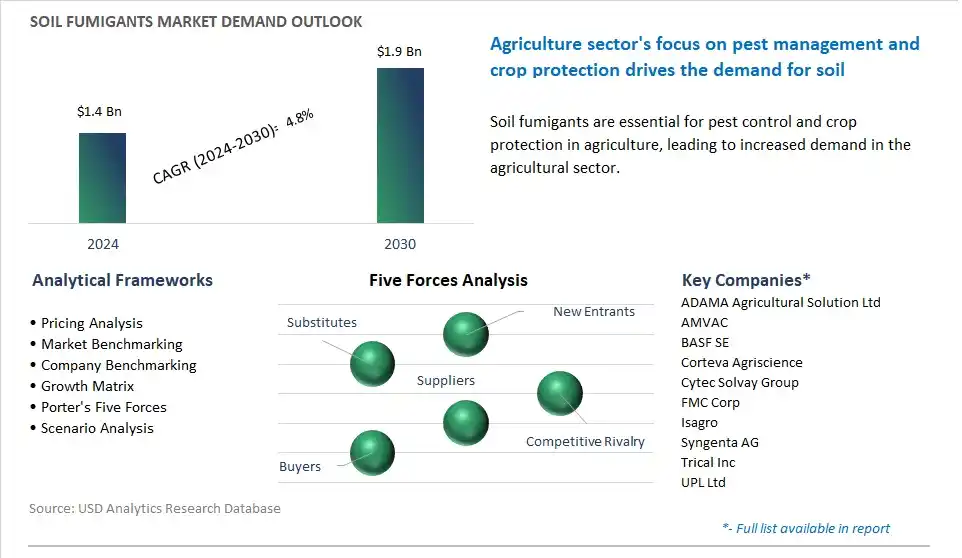
Soil Fumigants Market Competitive Landscape
The market report analyses the leading companies in the industry including ADAMA Agricultural Solution Ltd, AMVAC, BASF SE, Corteva Agriscience, Cytec Solvay Group, FMC Corp, Isagro, Syngenta AG, Trical Inc, UPL Ltd.
Soil Fumigants Market Dynamics
Soil Fumigants Market Trend: Increasing Adoption of Sustainable and Eco-Friendly Soil Fumigation Alternatives
A prominent market trend in soil fumigants is the increasing adoption of sustainable and eco-friendly alternatives to traditional chemical fumigants, driven by environmental regulations, consumer preferences, and concerns about soil and groundwater contamination. Soil fumigation plays a crucial role in agriculture by controlling soil-borne pests, pathogens, and weeds to improve crop yields and quality. However, the use of conventional chemical fumigants such as methyl bromide and chloropicrin has raised environmental and health concerns due to their ozone-depleting properties, toxicity, and potential for off-target effects. In response, there is a growing demand for safer, more sustainable soil fumigation methods that minimize environmental impact and human health risks. This trend has led to the development and adoption of alternative fumigation technologies, including bio-based fumigants, soil solarization, steam sterilization, and integrated pest management (IPM) practices, which offer effective pest control while reducing reliance on chemical inputs and preserving soil health and biodiversity.
Soil Fumigants Market Driver: Pressure to Increase Agricultural Productivity and Crop Quality
The market for soil fumigants is primarily driven by the pressure to increase agricultural productivity and crop quality to meet the growing demand for food, feed, and fiber worldwide. Soilborne pests, pathogens, and weeds pose significant challenges to agricultural production by causing yield losses, reducing crop quality, and limiting the success of farming operations. Soil fumigation is a critical tool for farmers to manage these challenges and maintain profitable crop production, particularly in high-value crops such as fruits, vegetables, and ornamentals. With the global population expected to exceed 9 billion by 2050, there is a growing need to intensify agricultural practices and optimize land use efficiency to sustainably feed the world's population. Soil fumigants play a vital role in this endeavor by enabling farmers to maximize crop yields, minimize post-harvest losses, and ensure food security for growing populations.
Soil Fumigants Market Opportunity: Development of Integrated Pest Management (IPM) Solutions
A potential opportunity for the soil fumigants market lies in the development and promotion of integrated pest management (IPM) solutions that combine multiple pest control strategies to achieve sustainable pest management outcomes while reducing reliance on chemical fumigants. IPM is a holistic approach to pest management that integrates various pest control tactics, including biological control, cultural practices, mechanical methods, and chemical interventions, in a coordinated and environmentally responsible manner. By implementing IPM strategies, farmers can reduce the need for soil fumigants and other chemical inputs while maintaining effective pest control and preserving natural resources. Manufacturers and suppliers of soil fumigants can capitalize on this opportunity by offering a diverse range of IPM-compatible products, including bio-based fumigants, pheromone traps, beneficial insects, cover crops, and crop rotation schemes. Additionally, there is an opportunity to provide educational resources, training programs, and technical support to farmers to facilitate the adoption of IPM practices and promote sustainable agriculture. By embracing IPM principles and offering integrated pest management solutions, companies can address environmental concerns, meet regulatory requirements, and enhance their market position in the soil fumigants industry.
Soil Fumigants Market Share Analysis: The Methyl Bromide segment generated the highest revenue in 2024
The Methyl Bromide segment stands as the largest in the Soil Fumigants Market. Methyl bromide has historically been one of the most widely used soil fumigants due to its broad-spectrum activity against a wide range of soil-borne pests, including nematodes, fungi, bacteria, and weeds. Its effectiveness in controlling pests, combined with its relatively low cost and ease of application, has made it a preferred choice for agricultural fumigation across various crops such as strawberries, tomatoes, peppers, and ornamentals. However, it's important to note that methyl bromide has been phased out or restricted in many countries due to its ozone-depleting properties and adverse environmental impacts. Accordingly, there has been a shift towards the development and adoption of alternative soil fumigants with lower environmental risks. Nonetheless, the Methyl Bromide segment continues to dominate the Soil Fumigants Market, albeit with declining usage in regions where regulations restrict its use.
Soil Fumigants Market Share Analysis: The Gaseous segment is poised to register the fastest growth rate (CAGR) over the forecast period to 2030
The Gaseous segment is the fastest-growing segment in the Soil Fumigants Market. Gaseous soil fumigants, such as methyl bromide and chloropicrin, offer potential advantages over solid and liquid forms in terms of efficacy, uniform distribution, and penetration into the soil profile. Gaseous fumigants can easily permeate soil pores and reach deep into the root zone, ensuring thorough pest control and minimizing the risk of reinfestation. Additionally, gaseous fumigants provide rapid action against a wide range of soil-borne pests, including nematodes, fungi, weeds, and pathogens, leading to improved crop yields and quality. Further, gaseous fumigants are applied using specialized equipment and application techniques, such as soil sealing and tarping, to maximize efficacy and minimize environmental exposure. Furthermore, the increasing adoption of precision agriculture practices and the need for sustainable pest management solutions drive the demand for gaseous soil fumigants, positioning the Gaseous segment for rapid growth in the Soil Fumigants Market.
Soil Fumigants Market Report Segmentation
By Type
Methyl Bromide
Chloropicrin
Methyl Iodide
Dimethyl Disulfide
Others
By Form
Solid
Liquid
Gaseous
Regions Included
North America (US, Canada, Mexico)
Europe (Germany, UK, France, Spain, Italy, Russia, Rest of Europe)
Asia Pacific (China, India, Japan, South Korea, Australia, South East Asia, Rest of Asia)
South America (Brazil, Argentina, Rest of South America)
Middle East and Africa (Saudi Arabia, UAE, Rest of Middle East, South Africa, Egypt, Rest of Africa)
Soil Fumigants Companies Profiled in the Market Study
ADAMA Agricultural Solution Ltd
AMVAC
BASF SE
Corteva Agriscience
Cytec Solvay Group
FMC Corp
Isagro
Syngenta AG
Trical Inc
UPL Ltd
*- List Not Exhaustive
TABLE OF CONTENTS
1 Introduction to 2024 Soil Fumigants Market
1.1 Market Overview
1.2 Quick Facts
1.3 Scope/Objective of the Study
1.4 Market Definition
1.5 Countries and Regions Covered
1.6 Units, Currency, and Conversions
1.7 Industry Value Chain
2 Research Methodology
2.1 Market Size Estimation
2.2 Sources and Research Methodology
2.3 Data Triangulation
2.4 Assumptions and Limitations
3 Executive Summary
3.1 Global Soil Fumigants Market Size Outlook, $ Million, 2021 to 2030
3.2 Soil Fumigants Market Outlook by Type, $ Million, 2021 to 2030
3.3 Soil Fumigants Market Outlook by Product, $ Million, 2021 to 2030
3.4 Soil Fumigants Market Outlook by Application, $ Million, 2021 to 2030
3.5 Soil Fumigants Market Outlook by Key Countries, $ Million, 2021 to 2030
4 Market Dynamics
4.1 Key Driving Forces of Soil Fumigants Industry
4.2 Key Market Trends in Soil Fumigants Industry
4.3 Potential Opportunities in Soil Fumigants Industry
4.4 Key Challenges in Soil Fumigants Industry
5 Market Factor Analysis
5.1 Value Chain Analysis
5.2 Competitive Landscape
5.2.1 Global Soil Fumigants Market Share by Company (%), 2023
5.2.2 Product Offerings by Company
5.3 Porter’s Five Forces Analysis
5.4 Pricing Analysis and Outlook
6 Growth Outlook Across Scenarios
6.1 Growth Analysis-Case Scenario Definitions
6.2 Low Growth Scenario Forecasts
6.3 Reference Growth Scenario Forecasts
6.4 High Growth Scenario Forecasts
7 Global Soil Fumigants Market Outlook by Segments
7.1 Soil Fumigants Market Outlook by Segments, $ Million, 2021- 2030
By Type
Methyl Bromide
Chloropicrin
Methyl Iodide
Dimethyl Disulfide
Others
By Form
Solid
Liquid
Gaseous
8 North America Soil Fumigants Market Analysis and Outlook To 2030
8.1 Introduction to North America Soil Fumigants Markets in 2024
8.2 North America Soil Fumigants Market Size Outlook by Country, 2021-2030
8.2.1 United States
8.2.2 Canada
8.2.3 Mexico
8.3 North America Soil Fumigants Market size Outlook by Segments, 2021-2030
By Type
Methyl Bromide
Chloropicrin
Methyl Iodide
Dimethyl Disulfide
Others
By Form
Solid
Liquid
Gaseous
9 Europe Soil Fumigants Market Analysis and Outlook To 2030
9.1 Introduction to Europe Soil Fumigants Markets in 2024
9.2 Europe Soil Fumigants Market Size Outlook by Country, 2021-2030
9.2.1 Germany
9.2.2 France
9.2.3 Spain
9.2.4 United Kingdom
9.2.4 Italy
9.2.5 Russia
9.2.6 Norway
9.2.7 Rest of Europe
9.3 Europe Soil Fumigants Market Size Outlook by Segments, 2021-2030
By Type
Methyl Bromide
Chloropicrin
Methyl Iodide
Dimethyl Disulfide
Others
By Form
Solid
Liquid
Gaseous
10 Asia Pacific Soil Fumigants Market Analysis and Outlook To 2030
10.1 Introduction to Asia Pacific Soil Fumigants Markets in 2024
10.2 Asia Pacific Soil Fumigants Market Size Outlook by Country, 2021-2030
10.2.1 China
10.2.2 India
10.2.3 Japan
10.2.4 South Korea
10.2.5 Indonesia
10.2.6 Malaysia
10.2.7 Australia
10.2.8 Rest of Asia Pacific
10.3 Asia Pacific Soil Fumigants Market size Outlook by Segments, 2021-2030
By Type
Methyl Bromide
Chloropicrin
Methyl Iodide
Dimethyl Disulfide
Others
By Form
Solid
Liquid
Gaseous
11 South America Soil Fumigants Market Analysis and Outlook To 2030
11.1 Introduction to South America Soil Fumigants Markets in 2024
11.2 South America Soil Fumigants Market Size Outlook by Country, 2021-2030
11.2.1 Brazil
11.2.2 Argentina
11.2.3 Rest of South America
11.3 South America Soil Fumigants Market size Outlook by Segments, 2021-2030
By Type
Methyl Bromide
Chloropicrin
Methyl Iodide
Dimethyl Disulfide
Others
By Form
Solid
Liquid
Gaseous
12 Middle East and Africa Soil Fumigants Market Analysis and Outlook To 2030
12.1 Introduction to Middle East and Africa Soil Fumigants Markets in 2024
12.2 Middle East and Africa Soil Fumigants Market Size Outlook by Country, 2021-2030
12.2.1 Saudi Arabia
12.2.2 UAE
12.2.3 Oman
12.2.4 Rest of Middle East
12.2.5 Egypt
12.2.6 Nigeria
12.2.7 South Africa
12.2.8 Rest of Africa
12.3 Middle East and Africa Soil Fumigants Market size Outlook by Segments, 2021-2030
By Type
Methyl Bromide
Chloropicrin
Methyl Iodide
Dimethyl Disulfide
Others
By Form
Solid
Liquid
Gaseous
13 Company Profiles
13.1 Company Snapshot
13.2 SWOT Profiles
13.3 Products and Services
13.4 Recent Developments
13.5 Financial Profile
ADAMA Agricultural Solution Ltd
AMVAC
BASF SE
Corteva Agriscience
Cytec Solvay Group
FMC Corp
Isagro
Syngenta AG
Trical Inc
UPL Ltd
14 Appendix
14.1 Customization Offerings
14.2 Subscription Services
14.3 Related Reports
14.4 Publisher Expertise
By Type
Methyl Bromide
Chloropicrin
Methyl Iodide
Dimethyl Disulfide
Others
By Form
Solid
Liquid
Gaseous
Countries Analyzed
North America (US, Canada, Mexico)
Europe (Germany, UK, France, Spain, Italy, Russia, Rest of Europe)
Asia Pacific (China, India, Japan, South Korea, Australia, South East Asia, Rest of Asia)
South America (Brazil, Argentina, Rest of South America)
Middle East and Africa (Saudi Arabia, UAE, Rest of Middle East, South Africa, Egypt, Rest of Africa)
